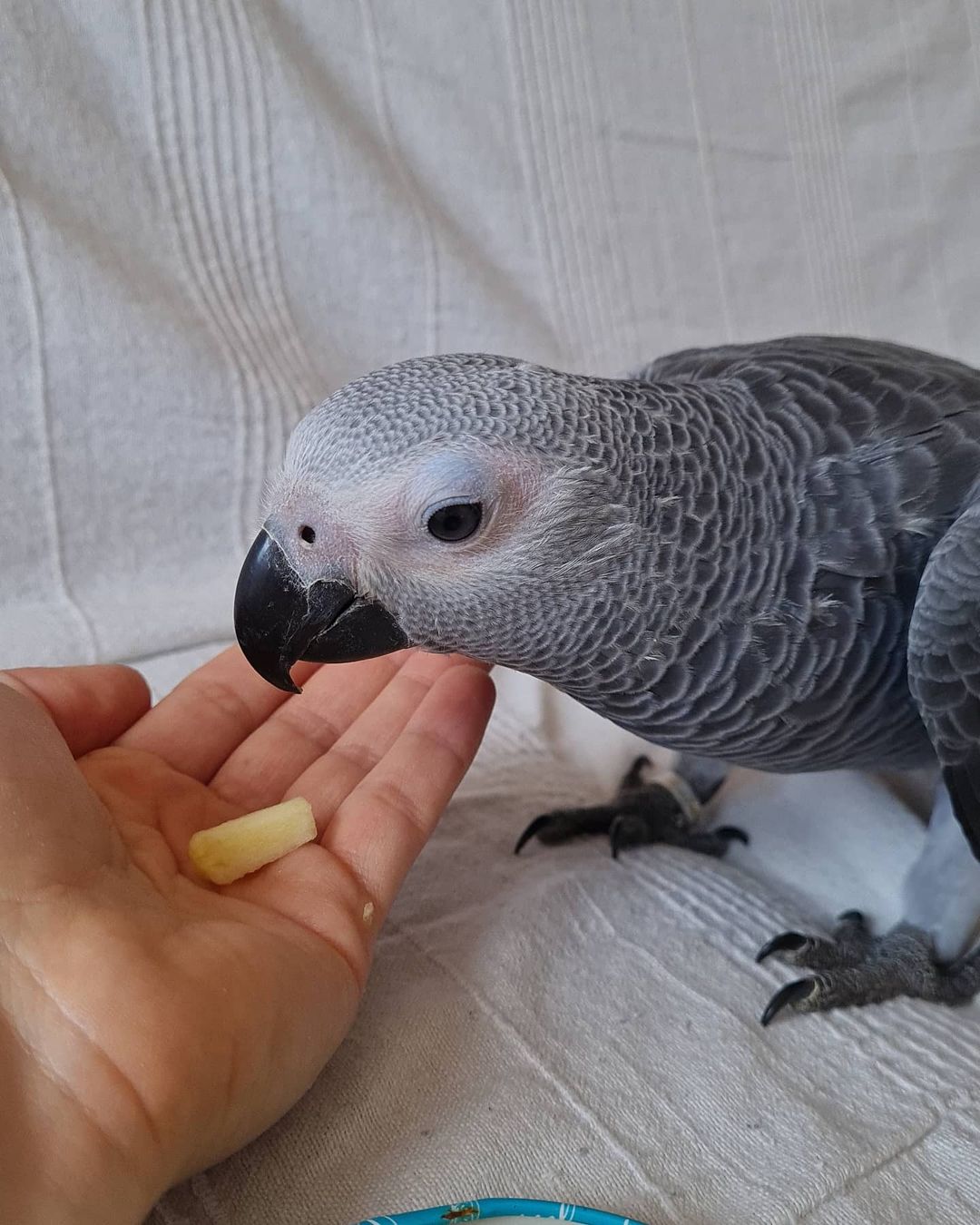
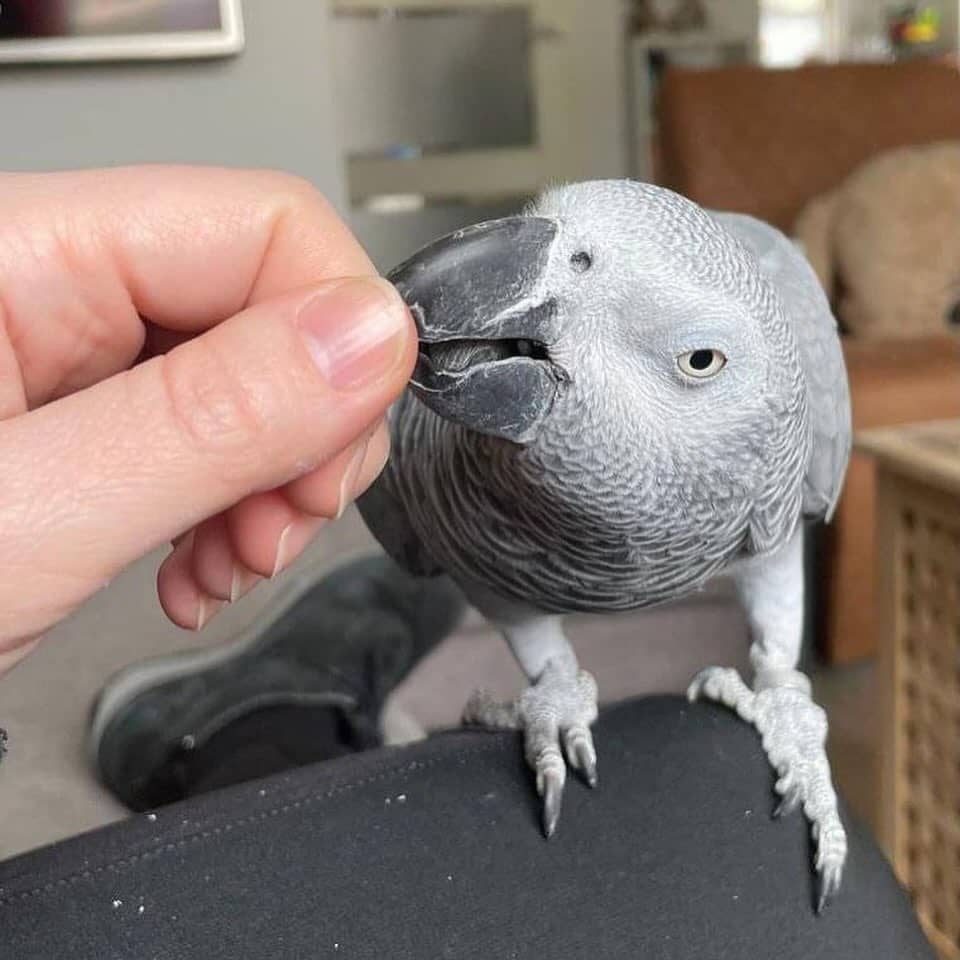
Written by Mark & Teri Benjamin · C.A.Gs African Grey breeders, Midland TX · USDA-licensed since 2014
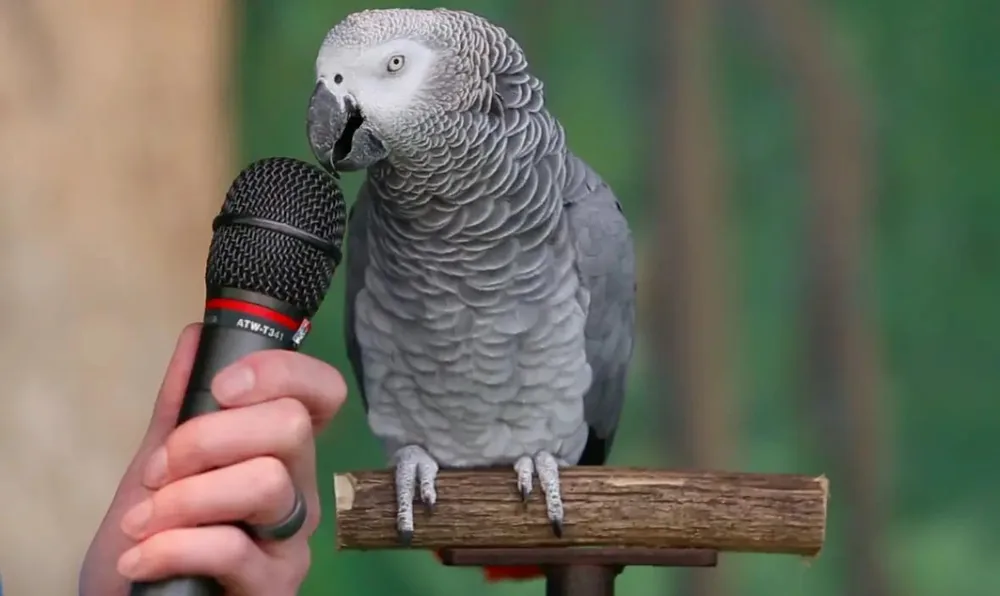
That's Maxy, one of our hand-raised Congos, talking.
#1
Ranked Talker
200–1000+
Word Vocabulary
12–18mo
First Words
30 yrs
Alex Science
Want a Grey with the best shot at talking?
Tell us about your home and routine — we'll match you with a chick we've been talking to daily since weaning.
✓ USDA AWA Licensed✓ CITES Appendix I✓ DNA Sexed✓ Avian Vet Certified✓ Ships Nationwide
On This Page
The short answer
How Well Do African Greys Really Talk?
African Greys are the best-talking parrots in the world. A well-socialised Grey can learn anywhere from a few dozen to 200–1,000+ words, usually says its first word around 12–18 months, and — uniquely — uses words in context rather than just mimicking. No breeder can guarantee a talker, but a Grey raised with daily conversation has the best odds of any companion bird.
Best talkerof any parrot species
Vocabulary200–1,000+ words possible
First wordsusually 12–18 months
Understandingcontextual, not just mimicry
How Do African Greys Actually Talk — Mimicry or Real Understanding?
Here's the question every buyer is really asking: when an African Grey "talks," is anyone home? The honest answer is that Greys do something no other parrot reliably does — they tie words to situations. Most talking birds repeat sounds; a Grey says "hello" when you walk in, asks "want up?" to be lifted, and names the treat it's hoping for. That's the difference between a recording and a conversation.
African Greys don't just copy sounds — they tie words to the moment in front of them.
Is It Contextual Speech or Just Copying Sounds?
What Contextual Speech Looks Like Day to Day
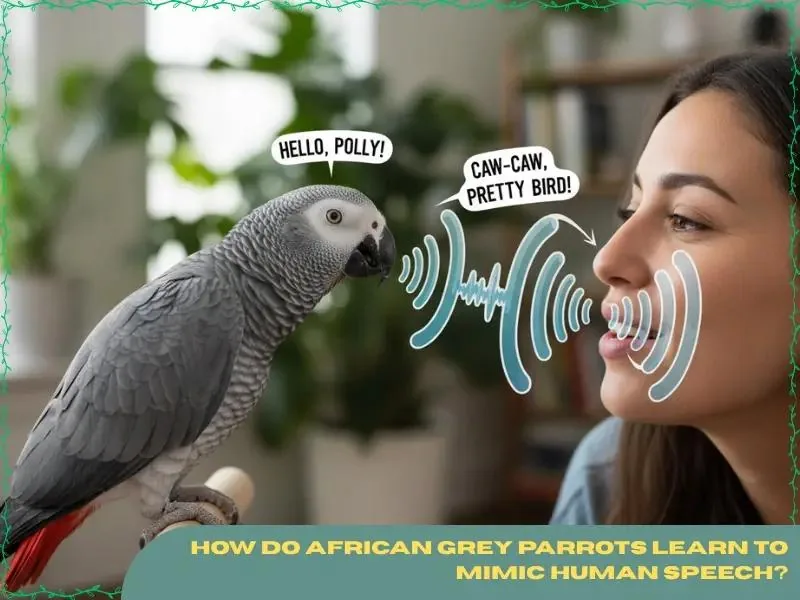
Contextual speech is the whole point of an African Grey. The bird isn't running a tape — as a LafeberVet feature on how grey parrots produce human speech ↗ details, it shapes each sound with a remarkably flexible vocal tract and matches a learned phrase to the moment in front of it. Once you live with one you stop noticing the vocabulary count and start noticing the timing: the goodbye as you pick up your keys, the "night night" when the lights dim, the wolf-whistle aimed squarely at the dog.
Phrases our birds tie to a moment
In our home aviary the chicks pick up our routine before they pick up rare words — a morning greeting, "step up," the call we use at feeding. Those context phrases come first precisely because they're anchored to something that happens the same way every day, which is exactly how a Grey learns best.
Breeder note: why we don't call it "a parrot trick"
We're careful never to sell talking as a circus act, because framing it that way sets owners up to "drill" their bird and get nowhere. Treat it as communication — talk to the bird, narrate your day, respond when it speaks — and the vocabulary takes care of itself.
What Did the Alex Studies Actually Prove?
What Dr. Pepperberg Documented Over 30 Years
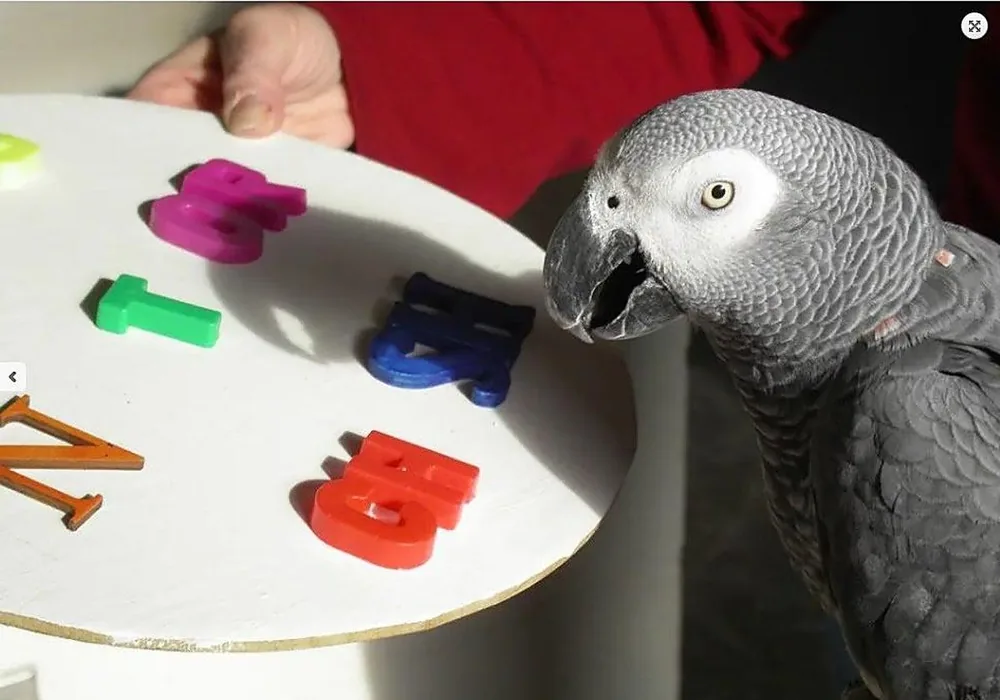
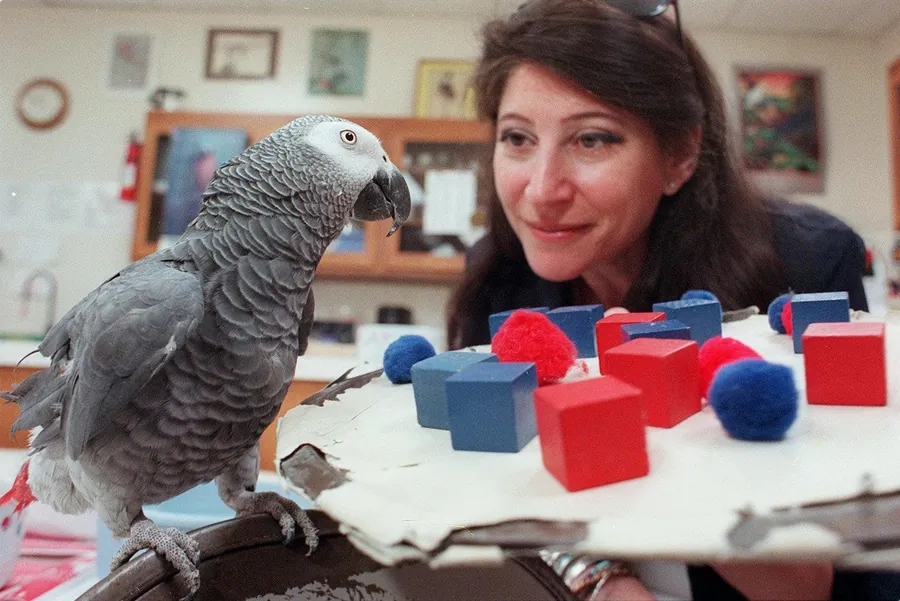
The reason "African Grey understanding" is taken seriously at all traces to one bird. From 1977 to 2007, Dr. Irene Pepperberg studied a Congo African Grey named Alex for three decades, and the findings reshaped how scientists think about animal cognition.
Objects, colours, shapes and the concept of "none"
Alex could identify around 50 objects, seven colours and five shapes, answer "how many?" up to six, grasp "same" and "different," and — remarkably — use the concept of "none." He requested items by name rather than just responding to cues. Whether every Grey shares that capacity or Alex was exceptional is still open, but it — together with newer work in which University of Georgia scientists showed a home-reared Grey varies its speech deliberately ↗ — moved the conversation from "can parrots mimic?" to "what can a Grey actually understand?"
Greys don't just copy — Alex's work showed real cognition: grasping concepts, not running a tape.
Citation: The Alex Foundation
The full body of work lives at the Alex Foundation, and the species background at the World Parrot Trust's grey parrot profile ↗. We point new owners to both, because the more you understand the mind you're bringing home, the better a talker you'll raise.
How Does an African Grey Compare to Other Talking Parrots?
Set against a typical companion parrot, the gap isn't subtle. Research from Duke University ↗ places parrots among the rare "vocal learners" that can imitate sound at all — and even inside that club, most parrots mimic a handful of sounds while an African Grey builds a real vocabulary and, uniquely, uses it in context. Here's how the Grey stacks up against the average talking parrot.
Talking trait
African GreyAfrican GreyThe #1 talking parrot
Average ParrotAverage ParrotTypical companion species
Vocabulary
100–1,000+ words
20–100 words
Mimicry clarity
Exceptional — near-human
Good
Contextual use
Very high — words tied to meaning
Low–medium
Trainability
Very high
Medium
Cognition
~4–6-year-old child (Alex studies)
Basic mimicry
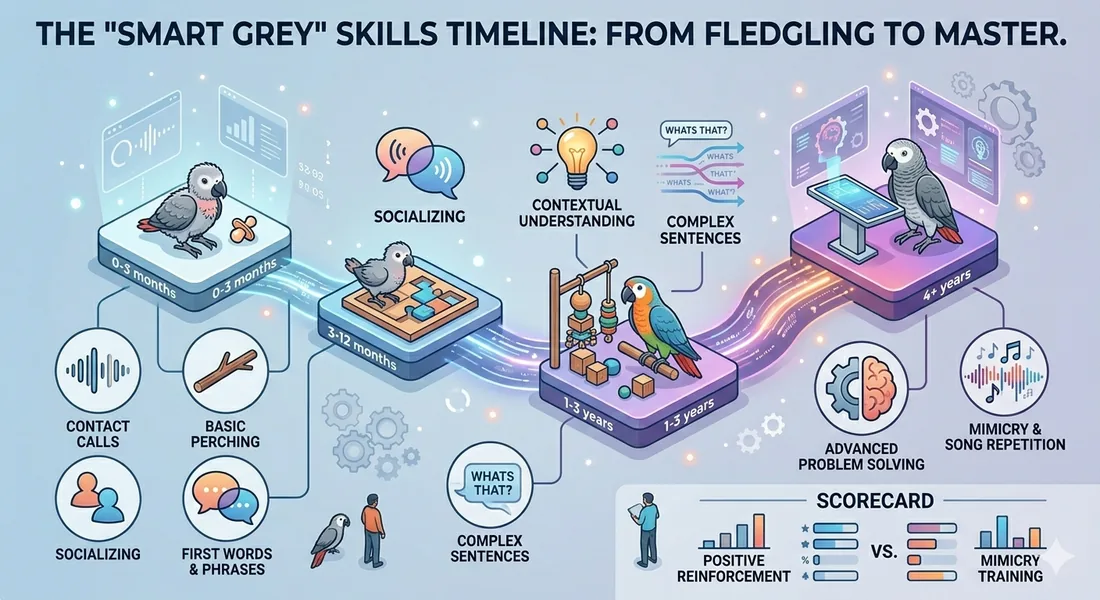
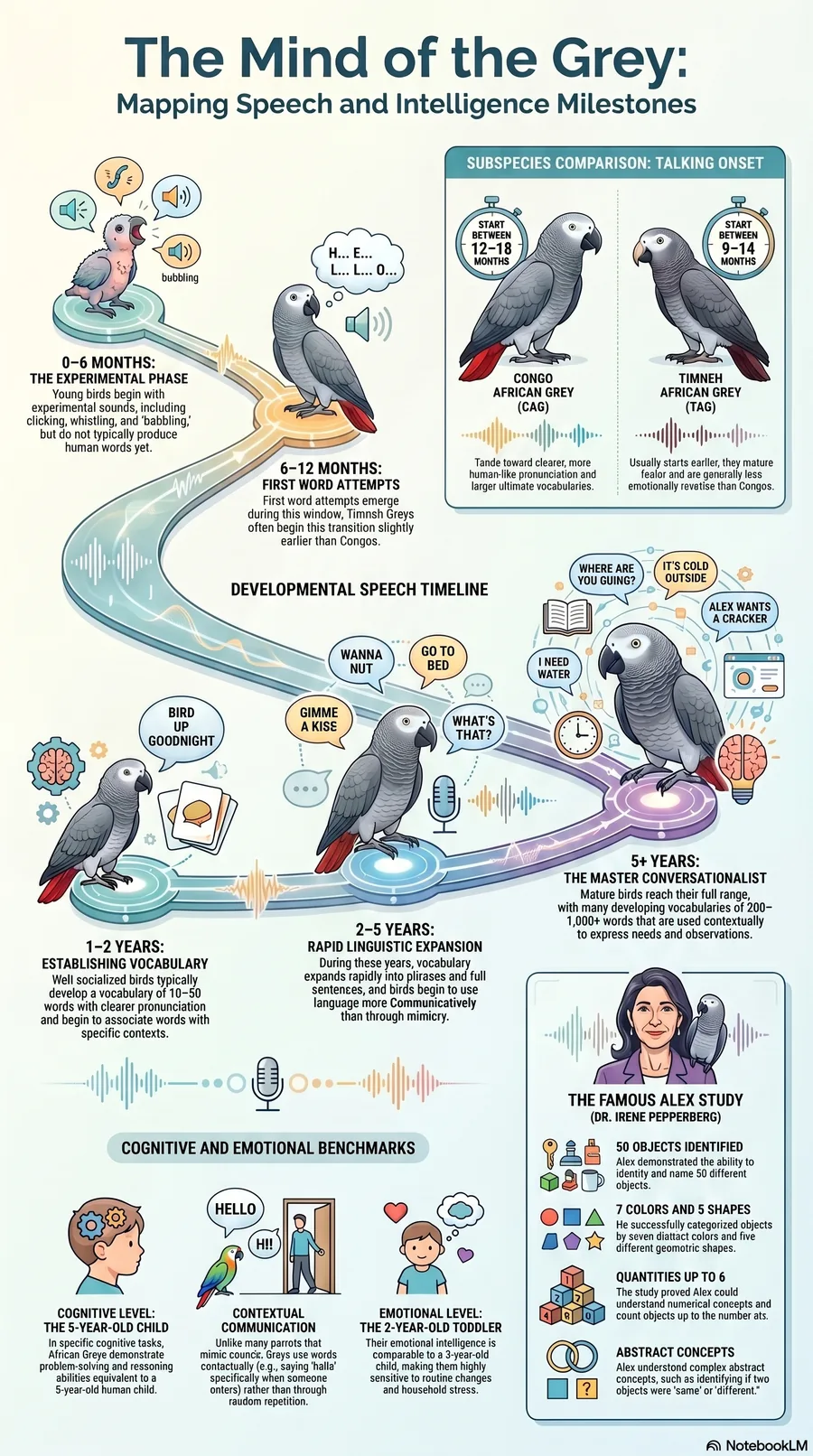
When Do African Greys Start Talking? The Month-by-Month Timeline
The single most common disappointment we hear is "my Grey isn't talking yet" — almost always from an owner whose bird is doing exactly what it should for its age. Talking is a multi-year arc, not a switch. Here's the realistic timeline, the same one we walk every family through before a chick goes home.
African Grey speech milestones at a glance — read the month-by-month version below.
10–6 months
Experimental sounds
Clicks, whistles, beeps and soft babble — the bird is tuning its syrinx. No real words yet, and none expected. A quiet chick now is not a quiet adult later.
26–12 months
First word attempts
The first recognisable word usually appears here — almost always a phrase tied to a moment ('hello' at the door, its own name, a morning greeting). Timnehs often beat Congos to this milestone.
31–2 years
10–50 words
In a well-socialised bird the vocabulary builds quickly and pronunciation sharpens. Phrases start linking to context — 'want up?', 'night night', the microwave beep it stole from your kitchen.
42–5 years
Phrases & sentences
The big expansion. Words become phrases, phrases become little sentences, and genuine contextual use settles in. This is when owners stop saying 'it mimics' and start saying 'it talks'.
55+ years
200–1,000+ words
Full range. Some birds plateau at a few dozen favourites; the keenest reach several hundred and a documented few pass a thousand. Development never fully stops — Greys add words for life.
What Should You Expect in the First Year?
From Babble to First Words (0–12 Months)
The first year is groundwork, not performance. Expect clicks, whistles and babble that slowly sharpen into a first recognisable word somewhere around the end of it. Pushing a six-month-old to "say hello" does nothing; talking to it constantly does everything.
Why the first "word" is usually a context phrase
That first word is rarely a random one you drilled — it's the phrase your bird hears in the same situation every day. Greys learn language the way toddlers do, by attaching sound to meaning, so the goodbye you say a thousand times beats the flashcard word you said ten times.
How Does Vocabulary Grow From Year One to Five?
The 1–5 Year Expansion Curve
Years one through five are where a Grey earns its reputation. Vocabulary climbs from a handful of words to dozens, pronunciation clears up, and single words knit into phrases and short sentences. Most birds find their personality as talkers in this window — the jokers, the mimics, the quiet ones with three perfect words.
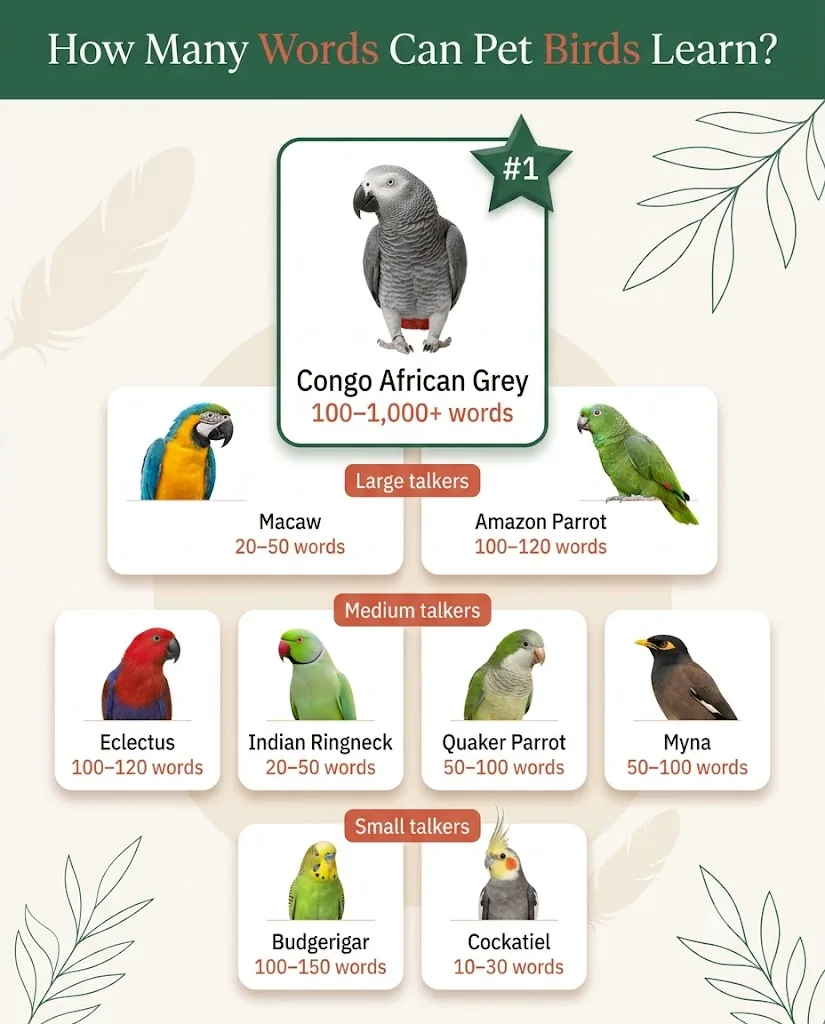
How Many Words Can an African Grey Learn?
This is the number everyone wants, so here it is straight: a typical well-socialised African Grey settles into a working vocabulary of a few dozen to a couple of hundred words and phrases. The keenest reach several hundred, and a documented few have passed a thousand. But the count is the least interesting thing about it — a 40-word Grey that uses every word in context feels far more like a companion than a 200-word bird rattling off sounds.
Where the African Grey sits among talking birds — vocabulary can climb into the hundreds, but a Grey using 40 words in context beats one parroting 200.
Can African Greys Say Multiple-Syllable Words and Whole Phrases?
Single Words vs Phrases vs Sentences
Yes — and the progression is part of the fun. Greys move from single words to multi-syllable words, then to phrases, then to short sentences, usually across years two to five. Plenty of birds will string several words into a context-correct line ("night night, see you tomorrow") and reproduce household sounds with unnerving accuracy: the microwave, the phone, the smoke-alarm chirp you wish you'd never let them hear.
Realistic vocabulary ranges (200–1,000+)
Treat 200–1,000+ words as the ceiling of what's possible, not a target you're failing to hit. Most companion Greys land comfortably below it and are wonderful talkers anyway. Vocabulary tracks the conversation in the home far more than the genes — a Grey only ever learns the words it actually hears, said with meaning.
Citation: documented record-holders
The famous high counts — Alex's working set, and pet Greys credited with vocabularies in the hundreds — come from birds in language-rich homes with owners who narrated everything. They show the ceiling. Your bird's real number will be set at your kitchen table, not by its hatch certificate.
Do All African Greys Talk — and Can a Timid One?
No, not every African Grey becomes a talker — and any breeder who tells you otherwise is selling, not breeding. Greys have the highest talking potential of any parrot, but potential isn't a promise. The good news for nervous buyers: most birds that "don't talk" are birds that haven't been given the right conditions, not birds that can't.
Most "quiet" Greys are simply unsettled — once they trust the room, the hellos arrive.
Why Don't Some African Greys Talk?
Genetics, Socialisation and Personality
Three things decide it: a little genetics, a lot of early socialisation, and the bird's own personality. A Grey that spent its first year with minimal human contact almost always ends up with a smaller vocabulary, no matter how chatty its family becomes later. Some birds are simply quieter characters — brilliant, bonded, and content to whistle rather than recite.
The first-year socialisation window
The first twelve months matter more than any other period. Birds raised with constant, gentle human interaction in that window have consistently better talking outcomes — which is the entire reason we hand-raise every chick in the house rather than in a barn, talking to them from weaning. You can't easily buy that back later.
Can a Shy or Timid African Grey Still Become a Talker?
How a Quiet Bird Finds Its Voice
Almost always, yes. A timid young Grey is usually a bird that hasn't settled yet — new home, new people, everything unfamiliar — not a bird that will stay silent for life. Greys are neophobic; they distrust the new until it becomes routine. Give a shy bird a calm room, a predictable rhythm, and no pressure, and the talking tends to arrive once the trust does.
What changes when a timid bird settles
The tell is usually private practice first: you'll catch a quiet Grey muttering its words to itself, alone, weeks before it ever performs for the room. That's the breakthrough. Staring at it, demanding "say hello," or a chaotic household all push it back into its shell; patience and a normal, talkative home draw it out.
Breeder note: our shy chicks still talk
We raise the occasional reserved chick, and we tell those families the truth — go slower, expect a longer runway — but in our experience the quiet ones get there. A timid bird isn't a non-talker. It's a talker on a longer timeline.
Congo vs Timneh: Which African Grey Talks Better?
Both subspecies talk beautifully, and the rivalry is more fun than it is decisive — in the wild, as Cornell's Birds of the World account of grey parrot vocal behaviour ↗ records, both are prolific vocalists. If you forced us to generalise: Congos tend toward clearer, more human-sounding pronunciation and a slightly larger ultimate vocabulary, while Timnehs usually start earlier and settle into a new home faster. The gap is real but modest.
Congos lean clearer, Timnehs start earlier — but socialisation outweighs subspecies every time.
Trait
Congo African Grey
Timneh African Grey
Starts talking
12–18 months
9–14 months (earlier)
Voice quality
Clearer, more human
Slightly raspier / softer
Ultimate vocabulary
Often larger
Strong, modestly smaller
Settling in a new home
Steadier, slower
Adapts & vocalises faster
Breeder verdict: Pick the bird, not the subspecies — a well-socialised Grey of either kind out-talks a neglected one of the other, every time.
How Do the Two Subspecies Differ as Talkers?
Timing, Clarity and Voice Quality
Timnehs often say their first words a few months ahead of Congos and tend to roll with change more easily, so a Timneh may chatter sooner in a brand-new home. Congos catch up and frequently overtake on clarity — that uncanny, almost human delivery Greys are famous for is usually a Congo. Timneh voices are often described as a touch raspier or softer, which many owners adore.
Why socialisation beats subspecies every time
Whichever you choose, the variable that actually moves the needle is how the bird was raised and how much you talk to it. The difference between a well-socialised Congo and a well-socialised Timneh is small; the difference between either of those and an under-socialised bird is enormous. Choose the individual chick and the breeder, not the label.
Breeder note: our Congos vs our Timnehs
Across our own clutches the pattern mostly holds — our Timnehs like Elad and Evie tend to find their voices a little earlier, our Congos a little clearer — but we've raised exceptions to every rule. We match families to a bird's temperament first and its subspecies second.
What Actually Develops an African Grey's Talking Ability?
If talking were just genetics, every Grey from talkative parents would be a chatterbox and they aren't. What reliably builds a talker is exposure — daily, contextual human speech from a bird that feels safe enough to join in. Almost everything that helps is free, and almost everything that's sold as a shortcut doesn't work.
The single biggest driver of a talking Grey: someone who talks to it, daily, like it's listening.
What Do We Do at the Aviary to Build It?
Daily Speech From Weaning
Our chicks grow up inside the conversation, not beside it. From weaning they hear us greet them the same way each morning, name their food, and chat through hand-feeding and cleaning — so by the time a bird goes home it already associates human speech with safety and routine. That head start is the whole point of buying a properly hand-raised Grey instead of a parent-reared or imported one.
What helps versus what wastes your time
Helps: talking to the bird directly, consistent context phrases, a busy room, responding when it vocalises, and patience. Wastes your time: recordings on a loop (Greys tune them out), word-drilling flashcards, leaving a talk-radio station on as a babysitter, and — worst of all — any kind of punishment for not talking, which only teaches the bird to stay quiet around you.
When Do African Greys Talk Most During the Day?
Dawn Greetings and the Before-Bed Chatter
Like wild flocks calling at first and last light, companion Greys often have two chatty peaks: a morning burst as the house wakes, and an early-evening wind-down before sleep. That "talks before bedtime" habit owners notice is completely normal — the bird is running through its favourite words as the day closes, and it's a sign of a settled, content Grey.
Greys run through their favourite words at dawn and dusk — and mimic the sounds of the house with eerie accuracy.
Why evenings get chatty
Evenings are when the household finally slows down and the bird has your attention, so it's prime talking time. It's also why a consistent bedtime and a cage cover matter — let the chatter run a while, then cover the cage for the 10–12 hours of dark, quiet sleep a Grey needs to stay even-tempered the next day.
Breeder note: Maxy's evening wind-down
Maxy, the Congo in the video at the top of this page, is at his most talkative in the evening — which is exactly when we filmed him. If your Grey saves its best material for dusk, that's not a quirk; that's a Grey being a Grey.
Myth
African Greys are guaranteed to talk, and playing recordings on a loop teaches them faster.
Fact
No bird is guaranteed to talk, and looped audio actually slows them down — Greys tune out recordings. They learn from live, contextual conversation with people they trust. There is no shortcut that replaces you.
Will MY African Grey Talk? A Quick Decision Guide
Talking is a relationship, not a spec sheet — so the honest answer to "will mine talk?" depends mostly on your home and your routine. Find your situation below for a realistic read on the odds.
Match Your Home to a Realistic Expectation
You're home and talk to the bird daily
Excellent odds. Daily, contextual speech from a bonded human is the single biggest driver of a strong talker.
You're out most of the day
Still likely, but plan for it — leave the radio off and the bird in a busy room, and make your hellos and goodbyes consistent verbal rituals.
Your bird is young and still shy
Give it time. Most timid chicks talk once they settle and trust the room; pressure and staring slow it down, patience speeds it up.
You want a guaranteed talker on a deadline
No honest breeder can promise that. We raise for the best odds, but talking is a relationship, not a spec — manage that expectation before you buy.
What Do You Really Get From a Breeder Who Raises Talkers?
You can't buy a guaranteed talker, but you can buy the best possible odds — and that starts with how the bird was raised. Here at C.A.Gs, every African Grey leaves fully weaned and socialised, talked to daily since weaning, with PCR DNA sexing, an avian-vet health certificate, and CITES Appendix I paperwork — all captive-bred in the USA and fully documented.
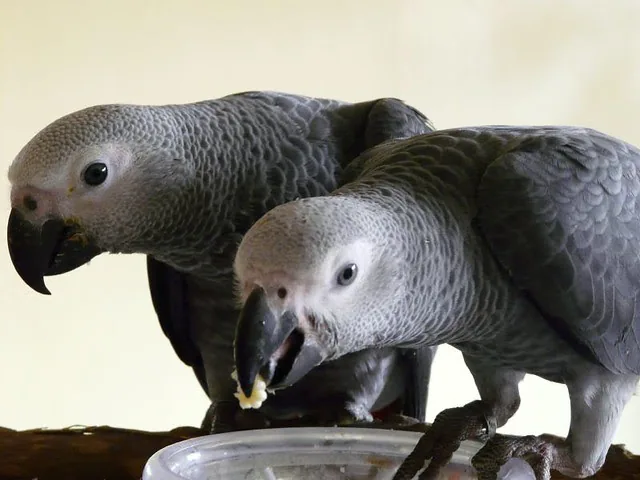
Jins & Jeni — raised inside the conversation, like every C.A.Gs chick.
Which of Our Greys Are Ready to Talk Their Way Home?
Every bird below is hand-raised here in Midland and has grown up hearing daily human speech — fully weaned, PCR DNA-sexed, vet-checked and CITES-documented. Here's who we have available right now:
New Arrival Midland, TX
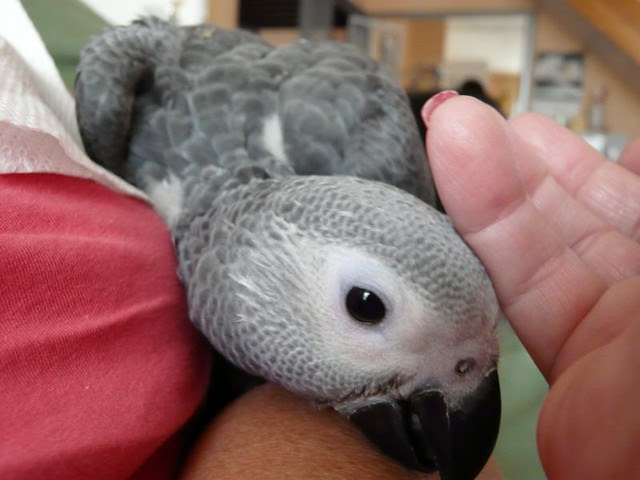
Amie
Female · 3 mo · Congo African Grey
"She mimics your laugh before you finish it."
Premium hand-raised female, 3 months old. Full social training. Responds to her name already.
Most well-socialised African Greys settle into a working vocabulary of a few dozen to a couple of hundred words and phrases, and the keenest reach several hundred — a documented few pass 1,000. More telling than the count is that Greys use words contextually, not as random mimicry, so even a 40-word bird can feel like it's holding a conversation.
Do African Greys really talk, or just mimic sounds?
They genuinely talk in the sense that matters: they attach words to situations. An African Grey says 'hello' when someone arrives, asks 'want up?' to be picked up, and names objects it wants. Whether that is 'understanding' in the human sense is still debated, but Greys use speech as communication far more than any other parrot — which is why they're ranked the #1 talking species.
When do African Grey parrots start talking?
Usually between 12 and 18 months, though some start as early as 9–10 months and others not until two years. Timneh African Greys often begin a few months earlier than Congos. The first 'word' is almost always a phrase tied to a repeated moment — a morning greeting, the bird's name, or 'hello' at the door.
Can a timid or shy African Grey still talk?
Yes. A timid young Grey is usually a bird that hasn't settled yet, not a bird that will never talk. Once it trusts the room and the people in it, the talking almost always comes. Staring, pressure and a chaotic environment slow it down; calm routine, consistent phrases and patience speed it up.
Can African Greys say multiple-syllable words and whole phrases?
They can. Greys move from single words to multi-syllable words, then to phrases and short sentences, typically across years two to five. Many string several words into a contextual phrase ('night night, see you tomorrow') and reproduce household sounds with eerie accuracy — the microwave beep, the phone, even another pet's name.
Do African Greys talk more at certain times of day?
Often, yes. Like wild flocks calling at first and last light, many companion Greys have their chattiest spells at dawn and again in the early evening — a 'before-bed' wind-down where the bird runs through its favourite words. It's normal, it's a good sign of a content bird, and covering the cage settles it for the night.
Congo vs Timneh — which African Grey talks better?
Both talk beautifully. Congos tend toward clearer, more human-sounding pronunciation and a slightly larger ultimate vocabulary; Timnehs usually start earlier and adapt faster to a new home. The gap is real but modest — a well-socialised bird of either subspecies out-talks a neglected one of the other every time. Socialisation matters far more than subspecies.
Are male or female African Greys better talkers?
Neither — talking ability is not reliably tied to sex in African Greys. Both males and females can become outstanding talkers, and the famous research bird Alex was male only by coincidence. What actually predicts a strong talker is early socialisation and daily human conversation, not whether the bird is a hen or a cock. That's also why we DNA-sex every chick for the buyer's information, never as a talking promise — choose a Grey on temperament and how it was raised, not its sex.
Will my African Grey definitely talk?
We never guarantee it, and you should be wary of any breeder who does. Talking depends on genetics, socialisation and — most of all — daily human interaction in the bird's home. We raise every chick with constant speech to give it the best possible odds, but talking is a relationship you build, not a feature you buy.
New talking African Grey clutches before they're listed — socialised families first.



 New Arrival Midland, TX