- Home
- African Greys for Sale
- Congo African Grey for Sale
Est. 2014 · Midland, TX · USDA-licensed aviary
Congo African Grey Parrots for Sale — Hand-Raised, DNA-Tested & CITES-Documented
Here at C.A.Gs we hand-raise Congo African Grey parrots (Psittacus erithacus) and place them nationwide from $1,700 — DNA-sexed, health-screened, and traced to named breeding pairs. No anonymous listing, no wild-caught birds: a USDA-licensed Texas breeder you can verify in about a minute and video-call before you pay a cent.
4.9 · 52 verified C.A.Gs buyers
- USDA Class A
- CITES Appendix I
- PCR DNA-sexed
- Ships nationwide
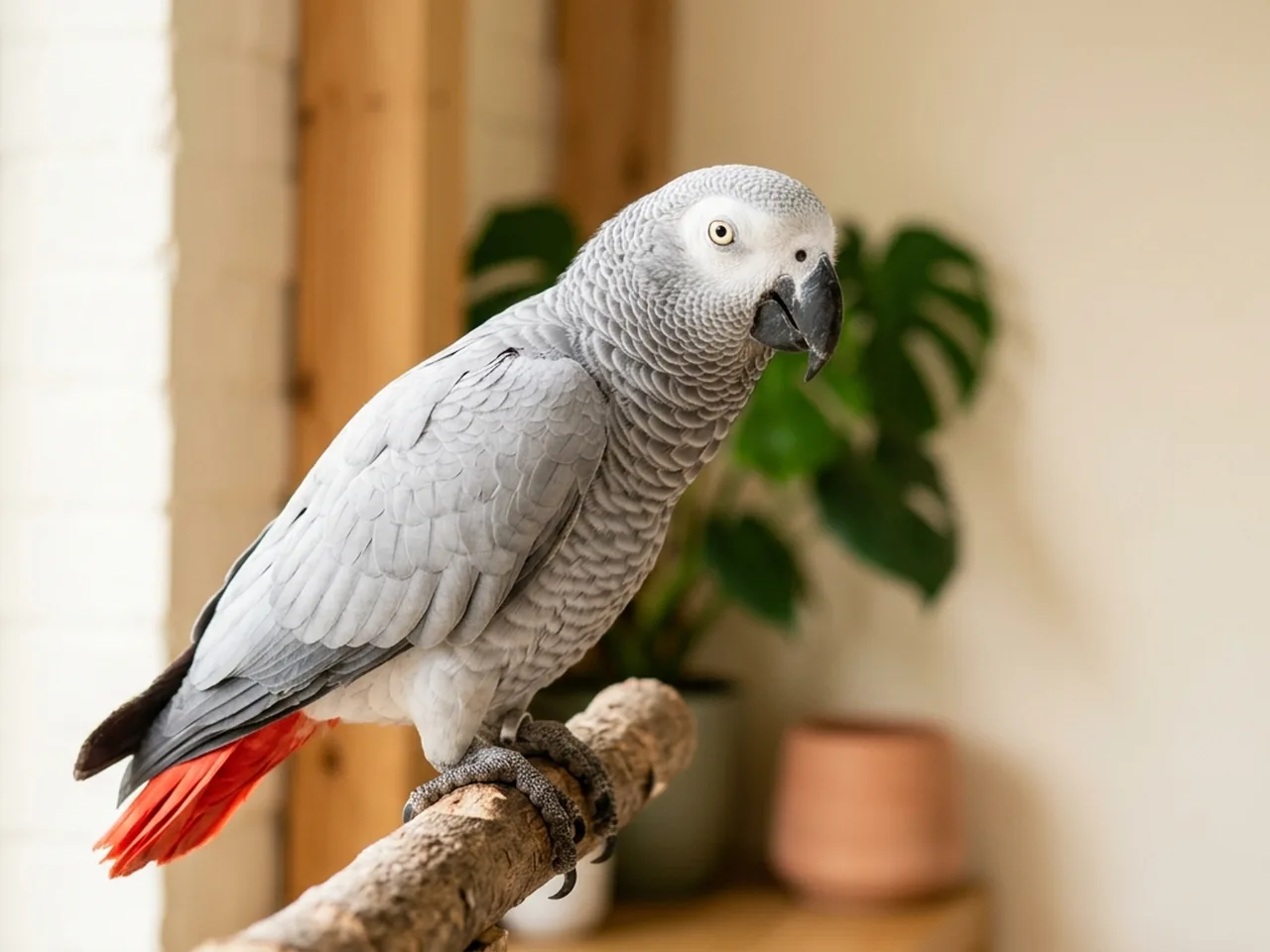 Hand-raised in Midland, TX
 Which Congo African Grey Parrots Do We Have for Sale Right Now?
Three hand-raised Congo African Greys are reservable at C.A.Gs today — Roys, a young male, and two hens, Amie and Bery — plus our bonded companion pair, Jins & Jeni. Every one is a real bird in our Midland, Texas home, DNA-sexed and health-screened, and each card below opens that Congo's own page with its photos, parentage and full paperwork.
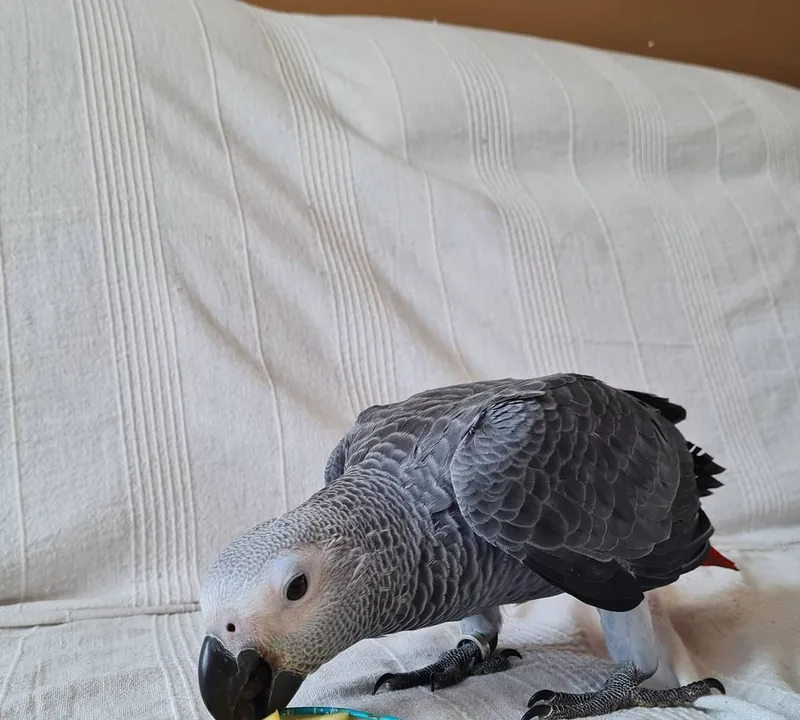 Male Roys $2,300 Confident, energetic young male who thrives in busy, active family homes.
 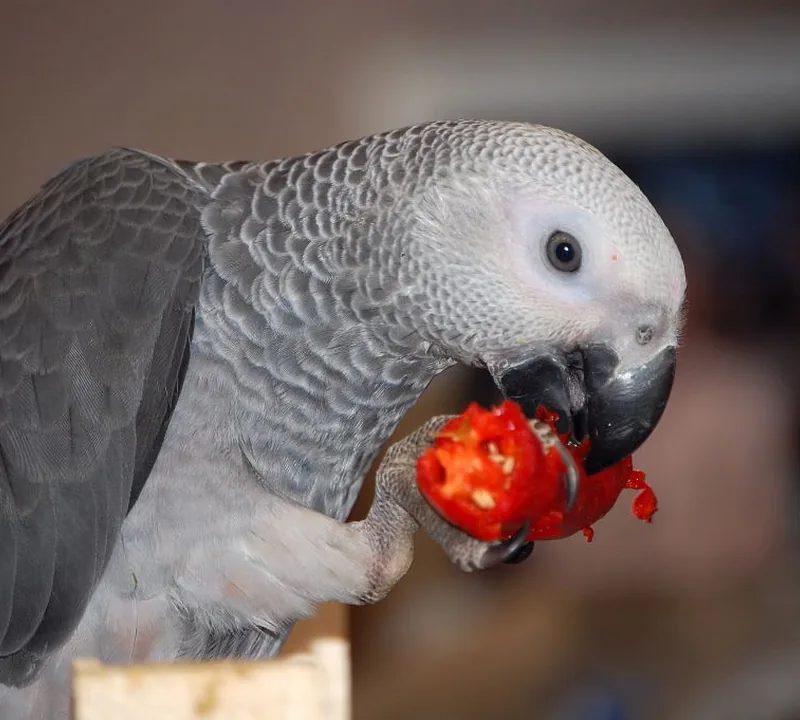 Female Amie $2,500 Hand-fed baby hen in full social training — gentle and people-focused from hatch.
 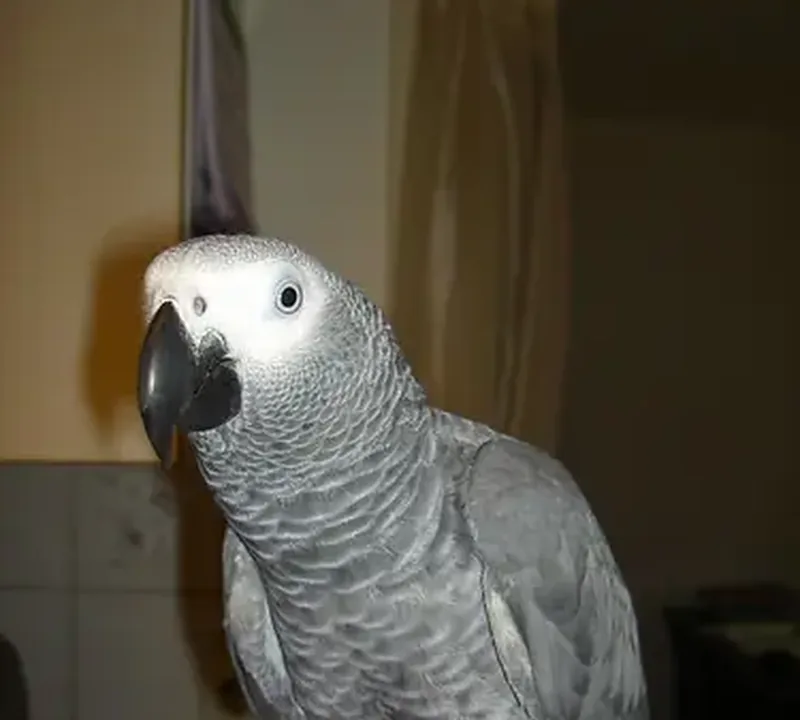 Female Bery $1,700 Cuddly, gentle one-year hen who settles fast and loves a calm lap.
 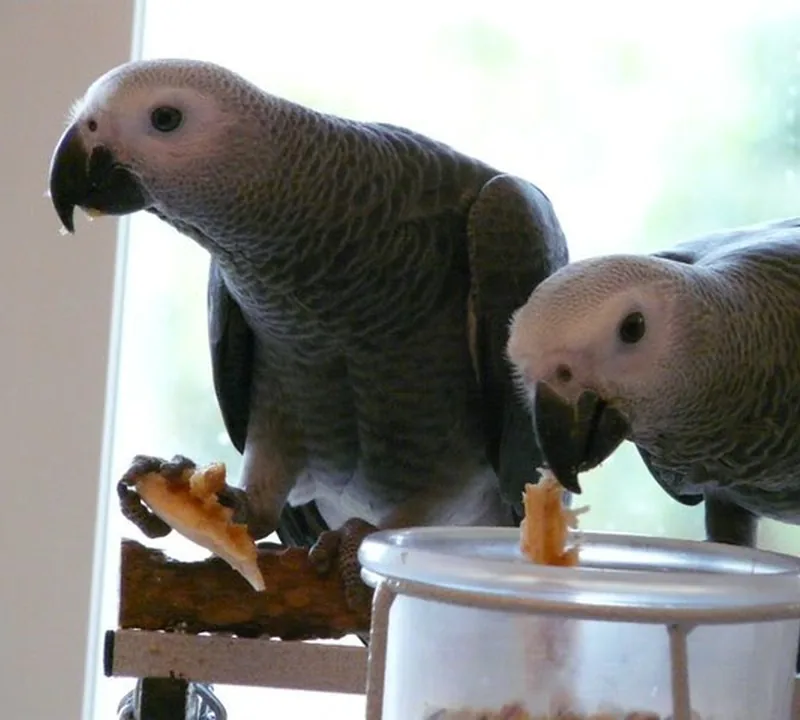 Companion Pair Jins & Jeni (Pair) $3,500 Unrelated companion pair raised side by side — they rehome as a bonded two.
 Every Congo above is a real, reservable bird in our home · Ships nationwide · $185 airport · $350 home · Local pickup in Midland, TX (within 2–3 hours)
Meet Roys, Amie & Bery, Our Available Congo Greys
Each of these Congos is a bird we've raised by hand since the nursery, so we can tell you their temperament rather than guess it: Roys is our bold, busy-household male, Amie is a gentle, people-focused baby hen still in daily socialization, and Bery is a cuddly one-year hen who settles onto a lap in minutes. Because they're individuals, we match each to the right home rather than sell a "type."
What Does Each Congo's Card Tell You?
Every card carries the four things a serious buyer checks first — sex, age, price and status — with the shipping line built in so nothing about cost is hidden. We keep availability honest, so a card marked available is a bird we truly have, and a reserved or sold Congo never sits here pretending to be in stock.
Every Available Congo Ships With a DNA-Sexing Certificate and Health Record
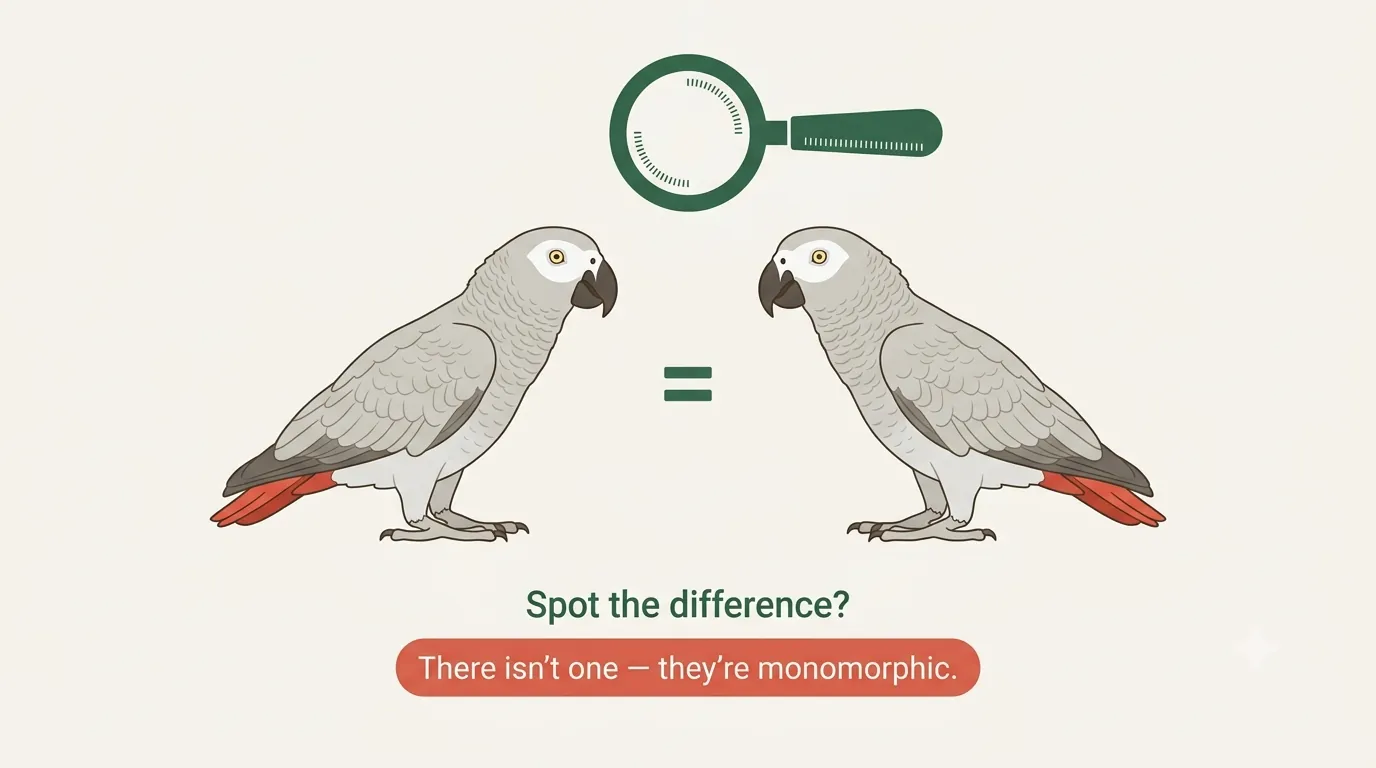
Sex on a Congo African Grey isn't a guess — it's confirmed by a DNA lab, and that certificate travels with the bird alongside an avian-vet health record. Because Congos are visually monomorphic (males and females look alike), that lab-confirmed paperwork is exactly what separates an honest listing from a hopeful one.
Roys (Male, $2,300) · Amie (Female, $2,500) · Bery (Female, $1,700) — Current, Real Birds
These are the live prices from our inventory, not placeholder numbers: Roys is $2,300, Amie is $2,500, and Bery is $1,700, each a specific bird with its own page. If a figure ever differs between pages, our African Grey pricing guide governs and we correct the card.
Prefer a Bonded Pair Over a Single Congo African Grey?
Some buyers want two birds who already love each other, and that's what our companion pair offers: Jins & Jeni are two Congos raised side by side who rehome together. A bonded pair keeps each other company when you're out, though it does not replace your own daily interaction — Greys still need you.
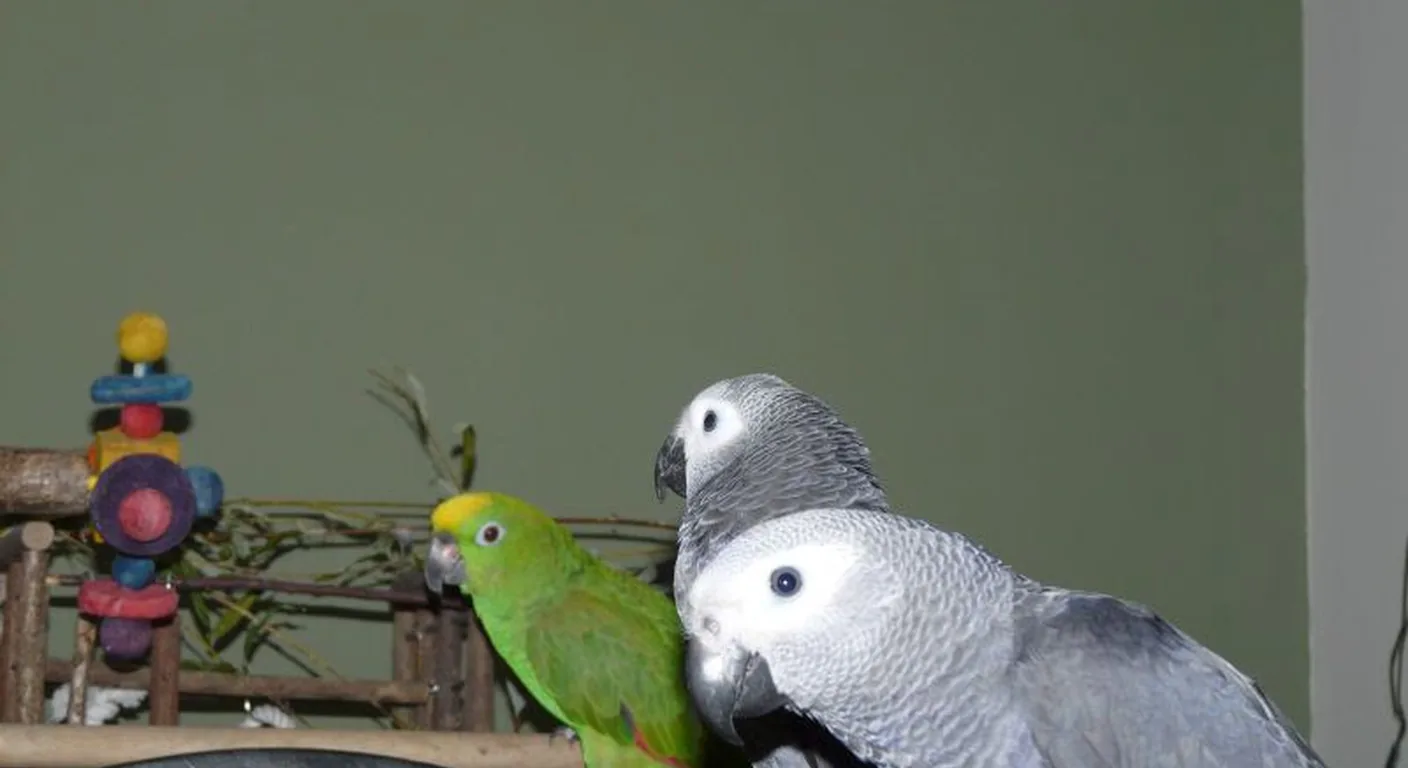
How Is the Jins & Jeni Companion Pair Different From a Single Bird?
A companion pair is priced and placed as one unit because splitting bonded birds is unkind, so Jins & Jeni go home as a two at $3,500. They're unrelated — raised together, not siblings — which is the healthiest way to form a companion bond without inbreeding risk.
Companion Pairs Are Sold Together — See Our Dedicated Pair Page
Because pairs deserve their own full write-up, we keep the deep detail on our Congo African Grey pair page rather than crowd this single-bird listing. Reserve either bird on their own and you'd break the bond — so the pair page is where that conversation belongs.
Jins & Jeni (Congo Companion Pair, $3,500) — Unrelated, Raised Together
For the record, Jins & Jeni are a Congo African Grey companion pair at $3,500, unrelated birds hand-raised together with full social training. If you want breeding rather than companionship, our proven breeding pair is the listing to look at instead.

What's the Short Version Before You Buy a Congo African Grey?
If you read nothing else, here's the honest summary: a real, hand-raised Congo African Grey from us starts at $1,700, arrives DNA-sexed and health-screened with CITES captive-bred paperwork, ships nationwide for $185–$350, and can be verified in about a minute before you pay. Everything below simply proves each of those lines.
Congo African Grey — Quick Facts
The Numbers That Actually Matter
Four numbers decide whether a Congo listing is trustworthy — the floor price, the testing, the paperwork, and the shipping cost — and a real breeder can state all four without flinching. We put ours on the card and in the summary above so you never have to dig for them.
Price Floor, Testing, Paperwork and Shipping at a Glance
Our floor is $1,700 for a single Congo, every bird is DNA-sexed and PCR-screened for PBFD and Avian Polyomavirus, the paperwork is CITES Appendix I captive-bred plus a USDA license, and shipping is a flat $185 airport or $350 home. Nothing there is a surprise fee, because surprise fees are a scam pattern we warn buyers about.
We Never List a Congo Below $1,500 — Anything Cheaper Is the Scam Tell
No honest breeder can raise, test, document and support a Congo African Grey for under $1,500, so a "$800 Congo, shipping included" isn't a bargain — it's the bait. When the price is too good to be true on a 40–60 year bird, the bird almost always doesn't exist.
What Makes the Congo African Grey Such a Sought-After Companion Parrot?
The Congo African Grey is prized because it pairs a genius-level mind with a gentle, deeply bonding temperament — this is the parrot behind the famous talking-bird studies, not a novelty mimic. Ours are hand-raised for that potential, so you're buying a socialized companion built to talk, problem-solve and bond, not a nervous bird you'll spend a year rehabilitating.
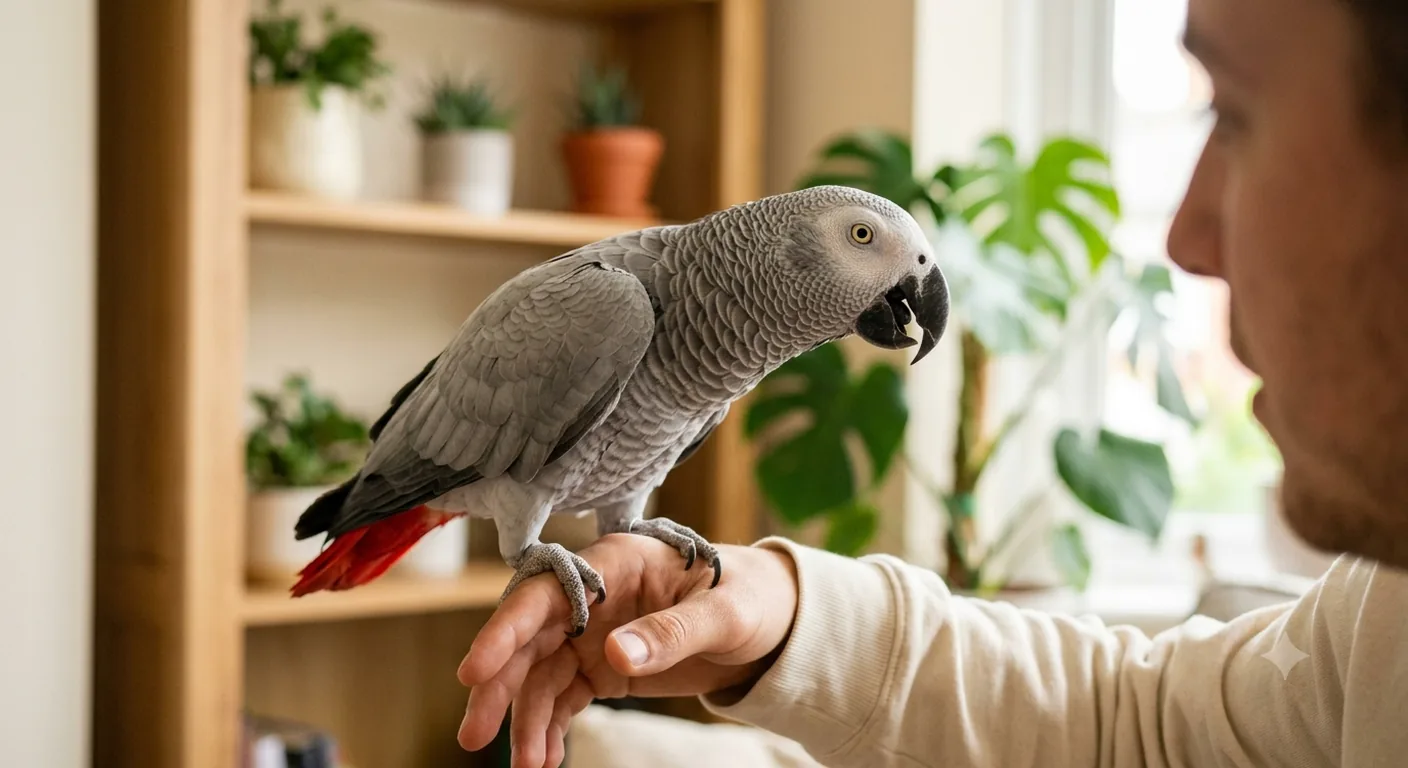
How Well Do Congo African Greys Actually Talk?
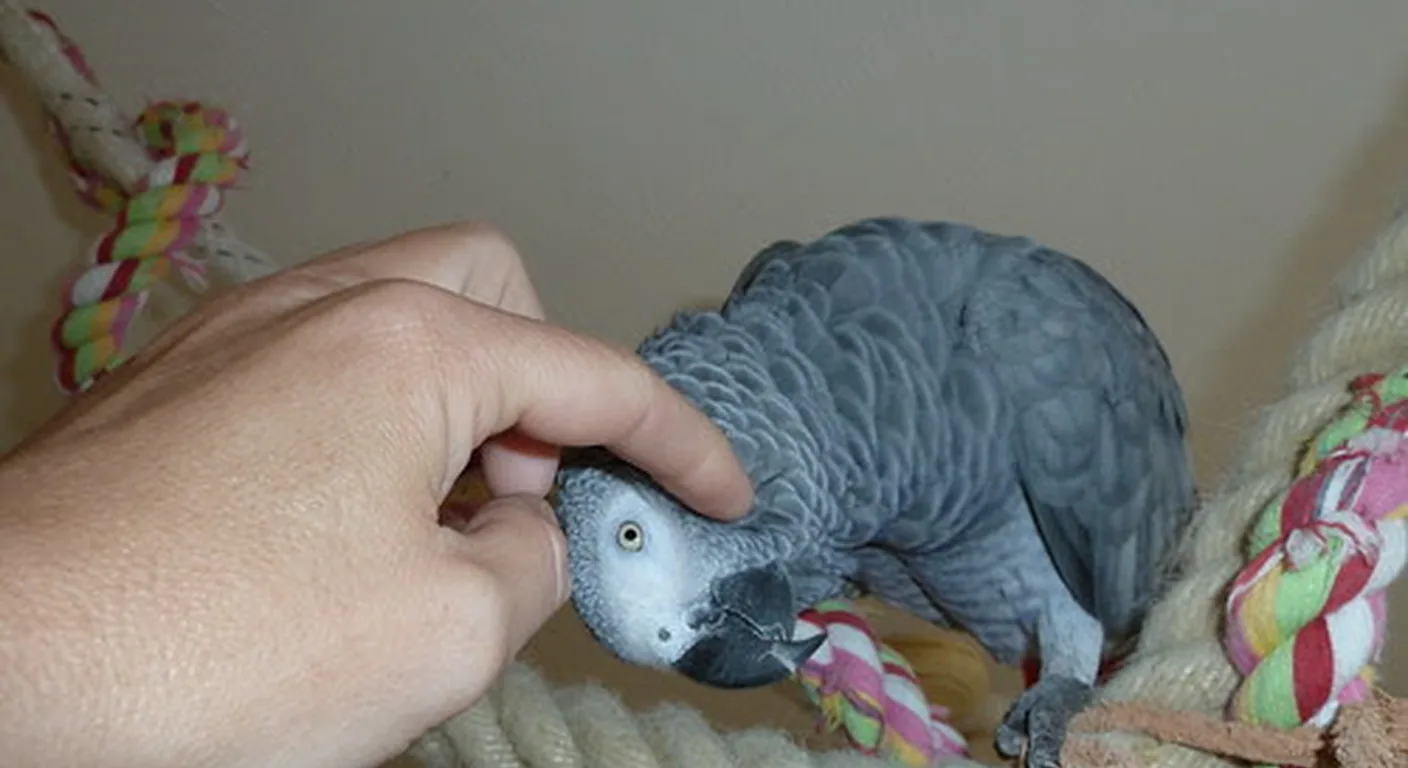
Congo African Greys are widely considered the best talking parrots on earth, routinely learning 100+ words and using them in context rather than parroting at random. That contextual ability — asking for a food by name, greeting a specific person — is what sets a Congo apart from birds that merely repeat sounds.
At What Age Does a Congo Start Talking?
Most Congo African Greys begin mimicking sounds and first words around 6–12 months and hit their stride between one and two years, though every bird runs its own timeline. Because talking grows from trust, an early-socialized, hand-raised chick tends to find its voice sooner than a stressed or under-handled bird.
Our Hand-Raising and Daily Socialization Build Early Vocabulary
We talk to, handle and name-train our chicks every single day, which front-loads the word-to-meaning associations a Congo needs. That daily groundwork is why our buyers so often report first words within weeks of homecoming — the foundation was laid here before the bird ever left.
How Do You Identify a True Congo — Red Tail, Grey Body, White Mask?
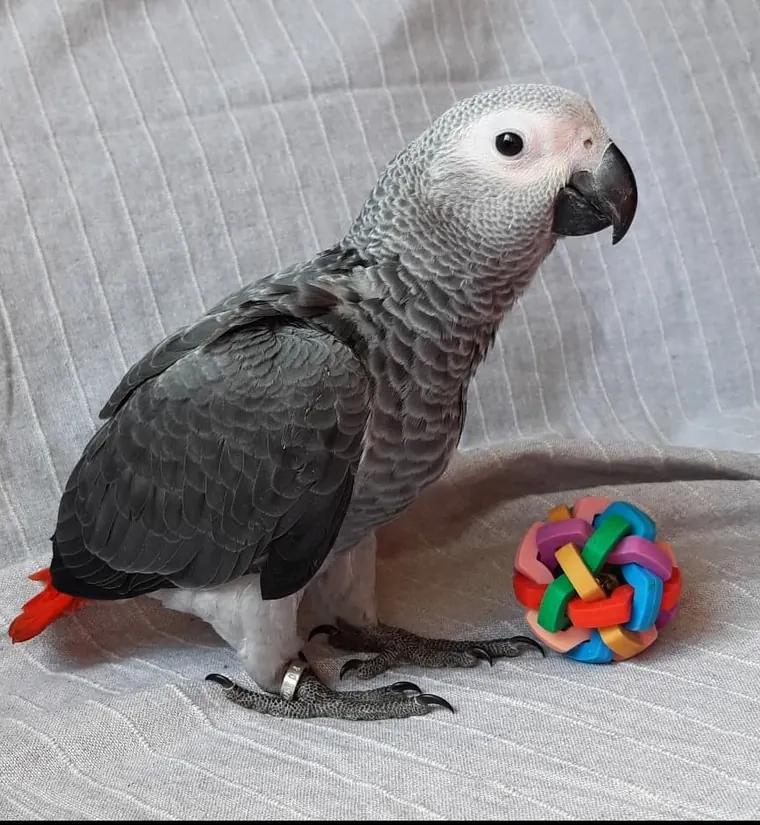
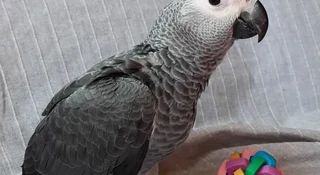
A true Congo African Grey is unmistakable once you know the marks: a light silver-grey scalloped body, a solid bright-red tail, a bare white face mask, a black beak, and pale yellow adult eyes. Those exact features are what our species photos show, and they're the first thing to check against any listing's pictures.
Should You Choose a Congo or a Timneh?
Congos are larger with a brighter red tail and the headline vocabulary, while Timnehs are smaller, maroon-tailed, and often calmer and earlier to talk — both are wonderful, and the right pick is about your home, not prestige. Our full Congo vs Timneh African Grey comparison weighs size, temperament, talking and price so you can choose with your eyes open, and our Timneh African Greys for sale are listed separately.
How Do You Know This African Grey Breeder Is Legit, Not a Scam?
You verify us — and we make it easy, because a real breeder welcomes the checks a scammer can't survive. C.A.Gs is a USDA Animal Welfare Act–licensed family aviary run by Mark & Teri Benjamin in Midland, Texas, with a lookup-able license, named breeding pairs, and a standing offer to video-call you with your chosen Congo before any money changes hands.
What Do African Grey Scam Sellers Look Like?
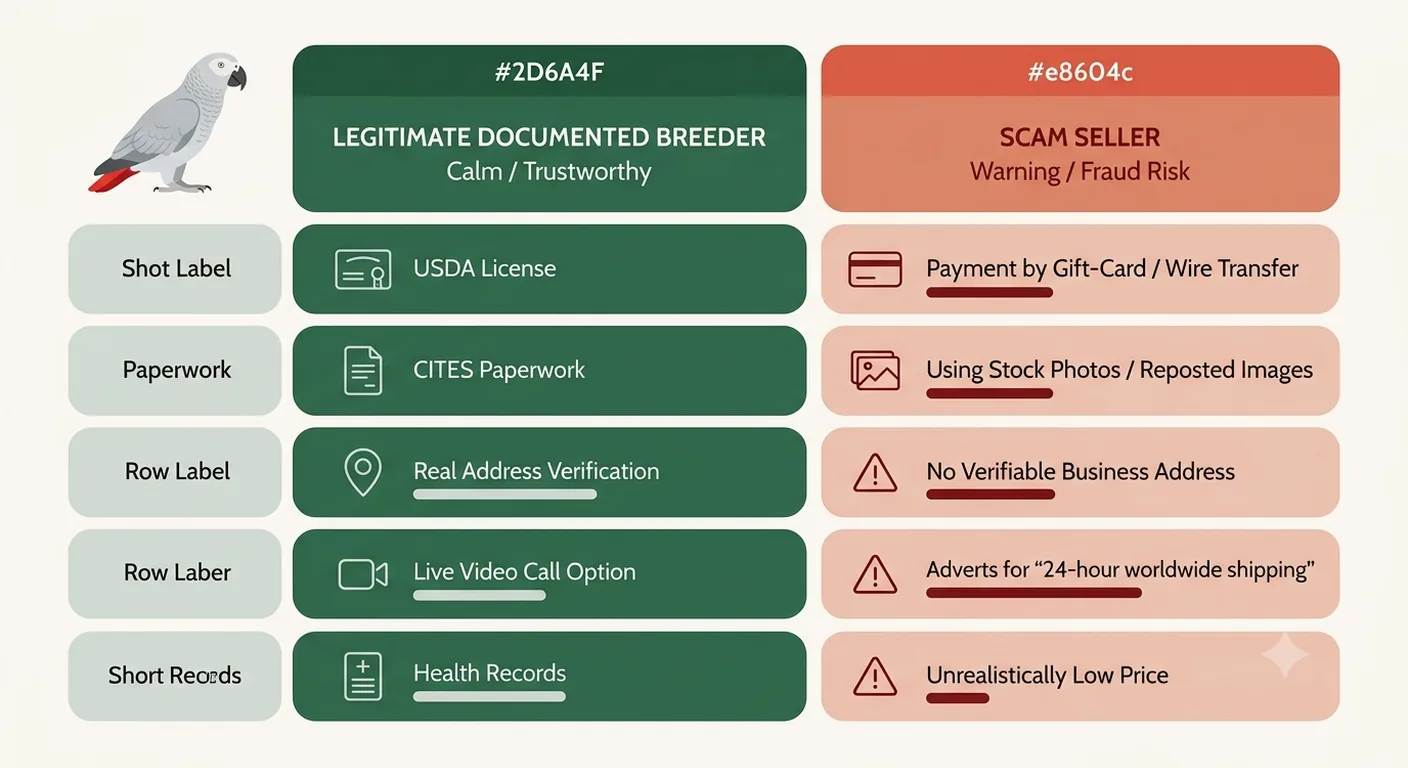
A Congo scam seller is a keyword-named website with stolen photos, no verifiable address, and a price that's too low for a real bird — and once you see the shape, it's obvious. Our own African Grey scam-prevention guide documents the full pattern, and the single most-reported scam in this exact search is a fake bird that never ships.
Which Payment and Shipping Red Flags Should Make You Walk Away?
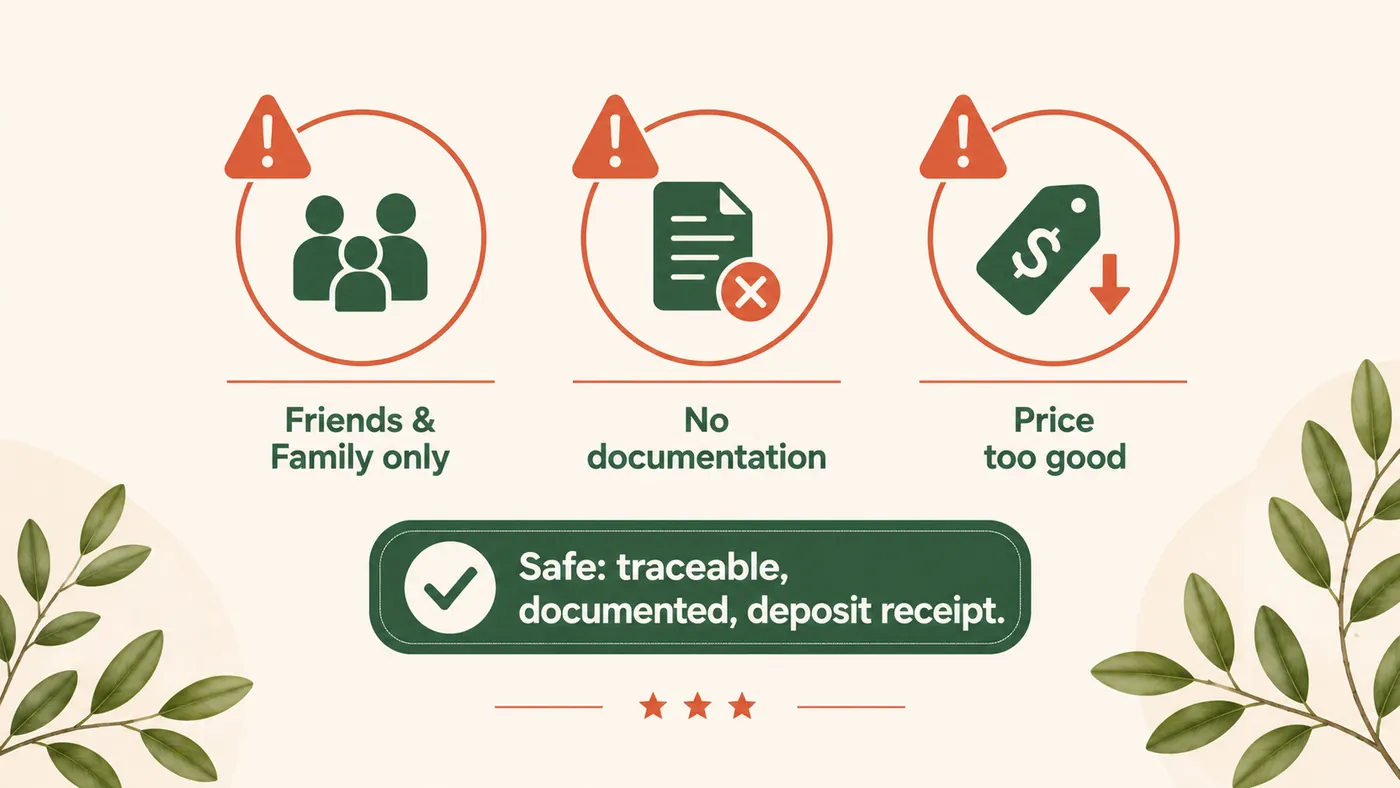
Two categories give a scammer away every time — how they want to be paid, and how they claim to ship — so treat both as tripwires. If the payment can't be reversed or the shipping promise defies biology, no photo or sob story should keep you in the conversation.
Gift Cards, Western Union, PayPal Friends & Family and "24-Hour Worldwide Air" Are Scam Signals
Any seller demanding gift cards, Western Union, or PayPal Friends & Family is choosing methods you can't dispute — that alone ends the deal. And "24-hour worldwide air shipping" of an Appendix-I parrot is a legal impossibility, which makes it a bright-red tell rather than a convenience.
The #2 Google Result for This Search Shows Exactly These Red Flags
We don't say this to score points: one of the top-ranking results for "congo african grey for sale" is itself a textbook scam, hitting the cheap-price, no-license, untraceable-payment trifecta. We built this section precisely because that fake is sitting next to us in the results.
How Do You Verify C.A.Gs Is Real in Under a Minute?
Cutting through scam anxiety comes down to one thing you can do yourself in about a minute — confirm we actually exist. Look up our USDA license, check our named breeding pairs, and ask for a live video call; because we're a licensed aviary at a real Texas address, every one of those checks lands, which is exactly what a fake farm cannot survive.
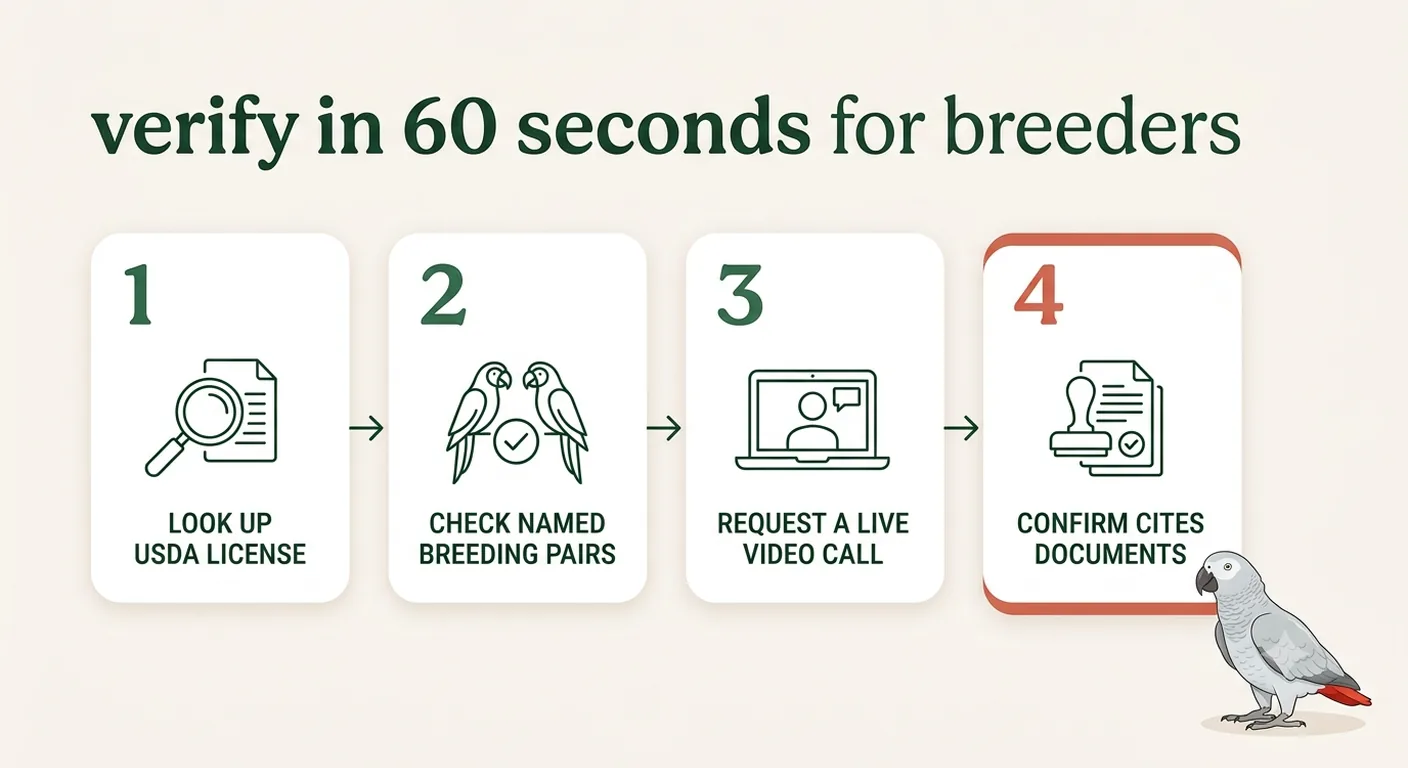
Before you send a deposit
Verify-the-Breeder Checklist — Run It on Us First
- Look up the USDA licenseSearch the breeder on the APHIS Animal Welfare Act public record
- Ask for named breeding pairsReal programs name their producers; farms can't
- Demand a live video callSee your actual Congo, on demand, before paying
- Confirm CITES paperworkAppendix I captive-bred documentation, in writing
- Use reversible paymentNever gift cards, Western Union or PayPal F&F
- Match the addressThe NAP must match the license and this site
What Proof Do We Put in Your Hands Before You Pay?
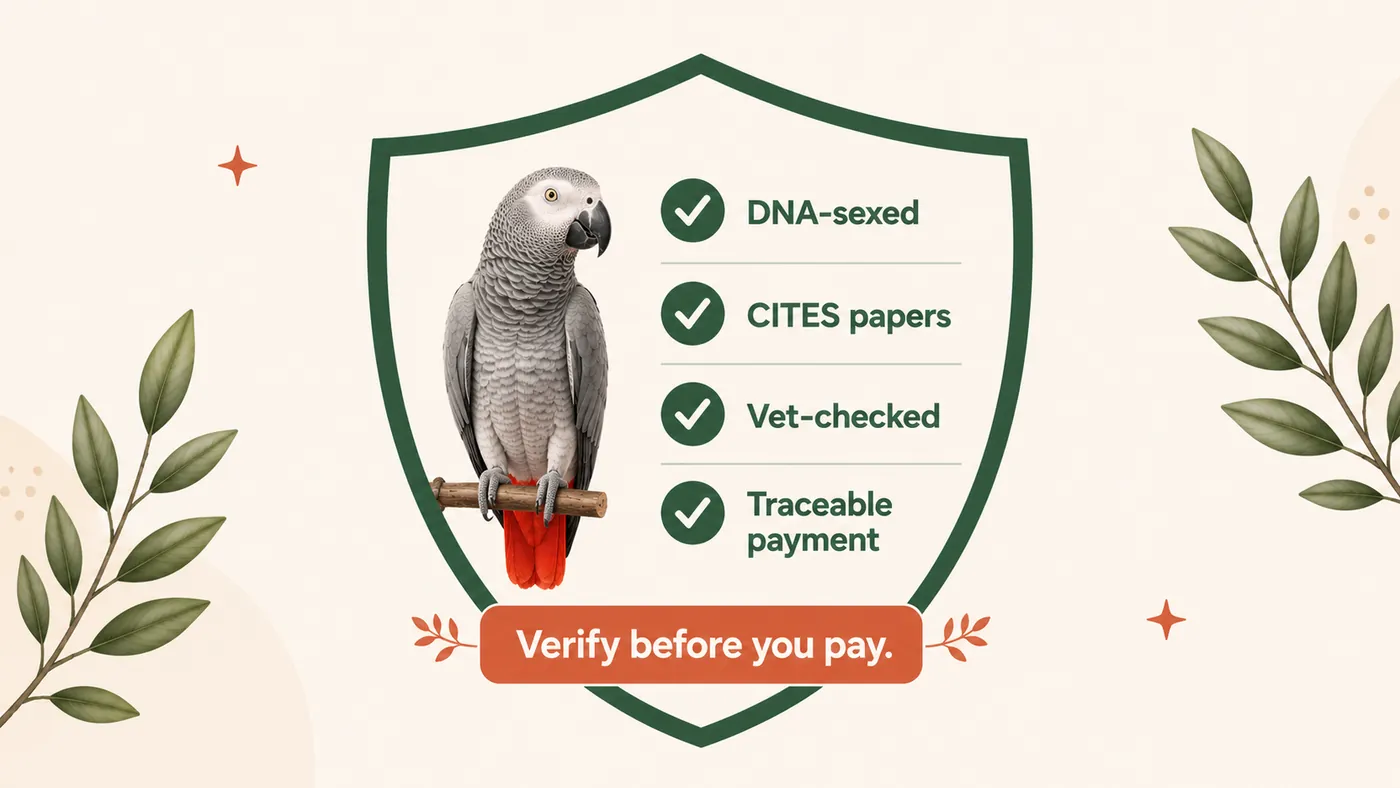
Before a deposit, we give you the things a scammer never can: our license details, a live video of your bird, and a written summary of the paperwork it will travel with. That upfront proof is the whole point — trust should be earned before payment, not promised after it.
USDA License Number, CITES Paperwork, a Real Midland-TX Address and a Live Video Call
Our proof stack is concrete: a USDA license you can verify on the USDA APHIS public search, CITES Appendix I captive-bred documentation, a genuine Midland, TX address on our contact page, and a live video call with the exact Congo you're considering. Match those four and you've separated us from every listing beside us.
We Will Video-Call You With Your Chosen Bird Before Any Deposit
To be perfectly clear, we'll get on a live video call and show you your chosen Congo — moving, vocalizing, banded — before you send a cent. A seller who won't do that on a bird this expensive is telling you something, and we'd rather over-prove than have you wonder.
Why Do Congo African Grey Prices Range From $1,500 to $8,500?
Congo African Grey prices swing that widely because you're not pricing a bird, you're pricing everything behind it — age, hand-raising, testing, temperament and documentation. A weaned, documented chick sits in the credible middle near $1,700–$3,500, while a fully tame, talking adult can climb toward the top; anything far below the floor is where the scams live.
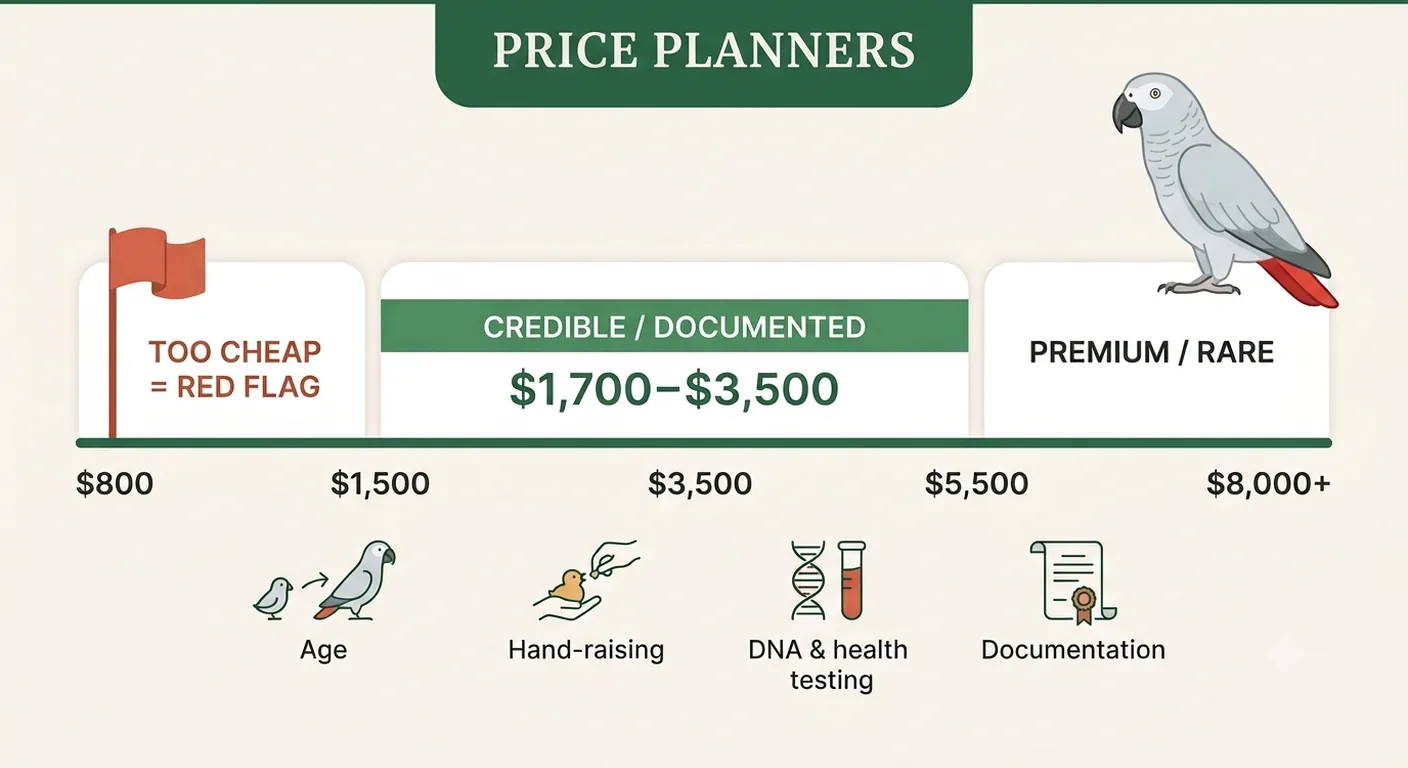
What Determines a Congo African Grey's Price?
Five factors move the number — how old and how tame the bird is, whether it's DNA-sexed and disease-tested, and how complete its paperwork is. A silent, untested, undocumented "Congo" is cheap for a reason; a socialized, tested, papered one costs what real work costs.
| Congo type | Typical price | What you're paying for | Best for |
|---|---|---|---|
| Weaned chickOur Bery | $1,700–$2,000 | Hand-raised, tested, documented | Bond-from-day-one buyers |
| Young, social birdOur Roys & Amie | $2,300–$2,500 | Extra socialization + training | Families wanting a head start |
| Companion pairJins & Jeni | $3,500 | Two bonded, tested Congos | Buyers away during the day |
| Tame talking adultRare | $4,000–$8,500 | Established vocabulary + calm | No-kids, quiet homes |
Why Is a Suspiciously Cheap $800 Congo a Warning Sign?
An $800 Congo African Grey is almost never a real, healthy, captive-bred bird — the honest cost of raising, testing and documenting one starts well above that. When the price undercuts the floor by that much, you're not looking at a deal, you're looking at the hook of a classic parrot scam.
Age, Hand-Raising, DNA and Health Testing and Documentation Drive the Real Price
The real price is the sum of real work: months of hand-feeding and socialization, a DNA-sexing lab fee, PBFD and Polyomavirus PCR panels, an avian-vet exam, and CITES plus USDA paperwork. Strip those out and the number drops — but so does everything that makes the bird safe to buy.
Our $1,700–$2,500 Singles Sit in the Credible Middle of the Market
Placed against that spread, our $1,700–$2,500 single Congos sit right in the credible middle — above the scam floor, below the rare-adult ceiling. That's deliberate: we price for a documented, hand-raised bird, not for a story.
What's Included When You Reserve a Congo African Grey From Us?
Reserving a Congo from C.A.Gs buys far more than a bird — it buys the whole documented package that makes ownership safe and legal. Every Congo comes home with its certificates, a closed leg band, an avian-vet health record, a care guide, a welcome kit, and our lifetime breeder support, because those are the things that turn a purchase into a lifelong relationship.
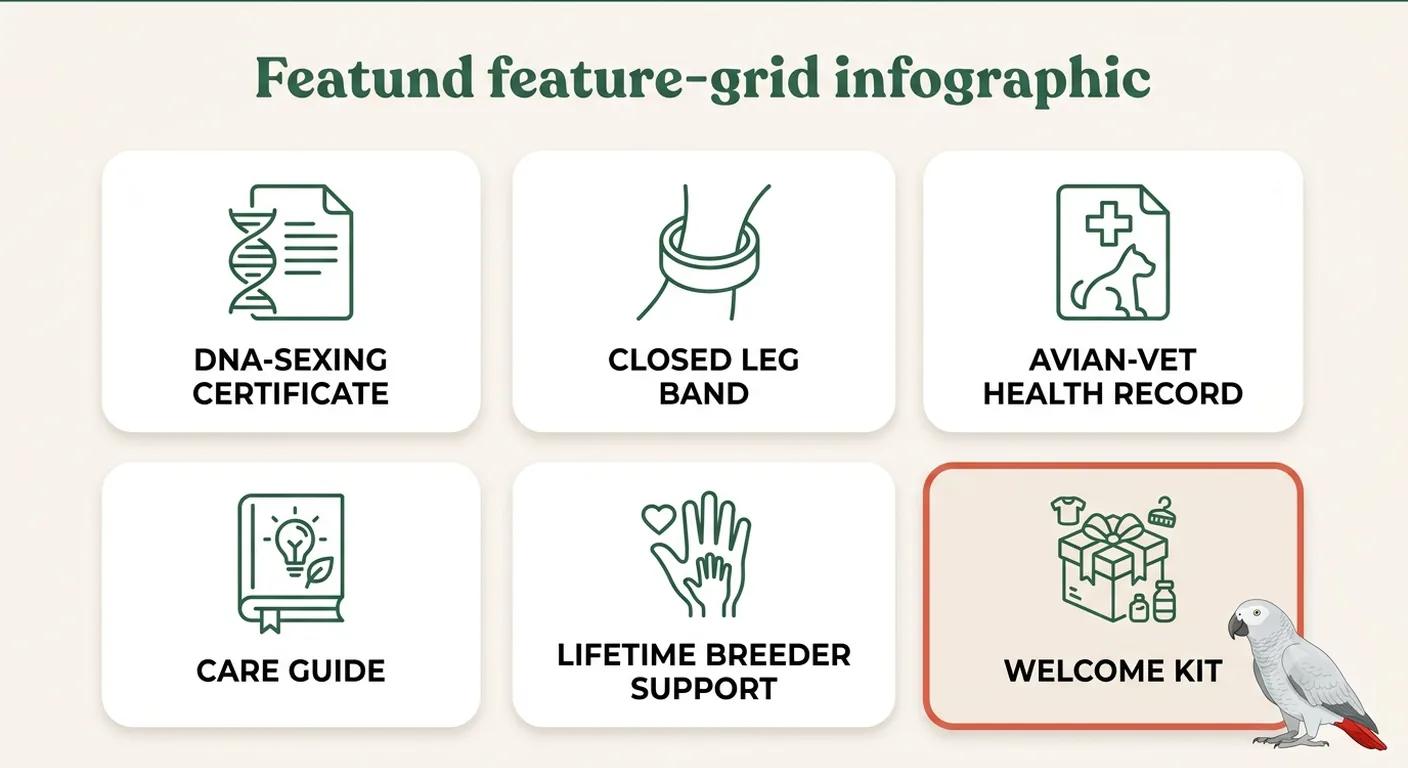
What Comes Home With Your Bird?
The document folder is identical for every Congo we place, and it's the one thing a keyword-named scam page can never put together. This is what rides along with your bird:
Every Congo Leaves With
- DNA-sexing certificateLab-confirmed male or female, in writing
- PBFD & Avian Polyomavirus PCRCore psittacine disease screening, negative required
- Avian-vet health recordIssued just before travel day
- Closed leg band + hatch recordTraceable to our aviary and clutch
- Care guide + welcome kit + lifetime supportDiet, setup, and us on the phone through year one
Certificates, Care Guide, Welcome Kit and Lifetime Support
Beyond the legal paperwork, we send you home ready: a written care guide covering diet and cage setup, a welcome kit to ease the first days, and our number for the questions that always come up in year one. Buying from us is the start of a relationship, not the end of a transaction.
DNA Certificate, Closed Leg Band, Avian-Vet Health Record and Care Guide Travel With Every Congo
To put it plainly, four documents and a band ride along with every Congo — the DNA certificate, the vet health record, the hatch record, and the care guide, under a traceable closed band. That bundle is your proof of a legal, tested, captive-bred bird, and it's non-negotiable on our end.
How Do You Buy a Congo African Grey From Us, Step by Step?
Buying a Congo from C.A.Gs is a simple, four-step path built around proof before payment: you inquire, we video-call so you can meet the bird, you reserve with a deposit, and we ship or you pick up in Midland. Nothing is rushed, and "not right now" is a real answer we'll give you if it's the honest one.
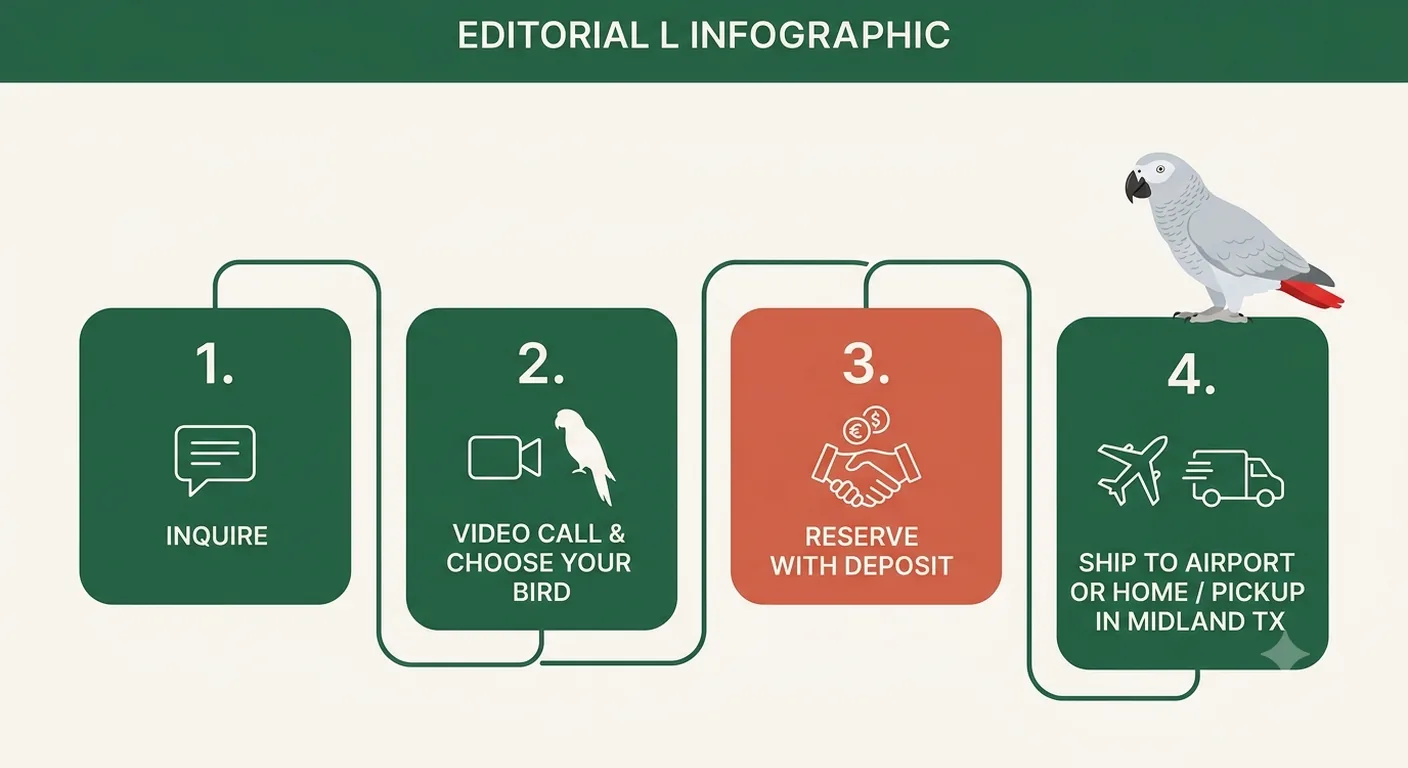
The Four Steps From Inquiry to Homecoming
Step one is a no-pressure inquiry through the form below; step two is a live video call to meet your Congo and ask anything; step three is a $200 refundable deposit once you're sure; and step four is delivery — airport, home, or pickup in Midland. Each step exists to make you more certain, not less.
How Do We Health-Test Every Congo, and What's Guaranteed?
Health is where an ethical breeder earns trust, so before any Congo travels it has cleared PCR disease screening and a hands-on avian-vet exam, and it goes home with a written health guarantee. We test for the illnesses that quietly wreck a collection, because a bird you can't confirm as healthy isn't a bird we're willing to sell you.
What Every C.A.Gs Congo Is Screened For
Which Diseases Do You Screen Our Congos For?
We screen for the two core psittacine threats — Psittacine Beak and Feather Disease and Avian Polyomavirus — plus a full avian-vet exam before travel. Those are the diseases that spread silently and end birds, which is exactly why we test rather than hope.
Are Our Congo African Greys PBFD and Polyomavirus Tested?
Yes — every Congo is PCR-screened for both PBFD and Avian Polyomavirus, with negatives required before placement. The Association of Avian Veterinarians treats both as core screening for psittacines, and we hold our birds to that standard rather than a marketing one.
Each Bird Is PCR-Screened for PBFD and Avian Polyomavirus by an Avian Vet
To be specific, an avian vet runs the PCR panels and the pre-travel exam, and the written health guarantee — full terms on our African Grey health guarantee page — backs the bird you bring home. That's the difference between a documented Congo and a hopeful one.
Can You Legally Own a Congo African Grey in the USA?
Yes — our Congos are captive-bred, which makes them fully legal to keep and rehome across state lines once the paperwork is in order. The species sits on CITES Appendix I, and rather than tiptoe around that, we put it front and centre: Appendix I is the very line that divides documented breeders like us from the wild-caught trade we will never touch.
What Does CITES Appendix I Mean for a Buyer?
CITES Appendix I is the strictest protection tier, and for a buyer it simply means captive-bred documentation is essential — which is why it rides on every bird we place. Set it alongside our USDA Animal Welfare Act license and you're holding a documentation trail no fake listing can reproduce. Our captive-bred African Grey program explains how that paperwork is generated.
Is It Legal to Ship a Captive-Bred African Grey Between States?
Domestic, state-to-state transfer of a captive-bred, documented African Grey is legal with the proper paperwork, which is exactly how our birds travel. What's not legal is international shipment of an Appendix-I parrot on a casual basis — and that distinction matters when you're reading listings.
Captive-Bred Appendix-I Birds Are Legal to Own and Transfer Domestically With Paperwork
The World Parrot Trust explains how ethical captive breeding takes poaching pressure off wild African Grey flocks — a principle we hold without exception: every Congo we sell was hatched in the USA to captive parents and moves legally inside the country with its CITES and USDA records. Our CITES documentation guide walks through each one.
We Do Not Ship Internationally — Anyone Offering to Is Breaking CITES Law
For the record, we do not ship African Greys internationally, full stop. Because the African Grey was uplisted to CITES Appendix I at CoP17, with the tighter rules taking hold in January 2017, any seller casually offering "worldwide shipping" of a Congo is advertising something the Convention forbids — a scam tell dressed up as a service.
How Do We Ship a Congo African Grey Nationwide, and What Does It Cost?
We ship Congos nationwide on two honest tiers — $185 to your nearest airport or $350 to your door — and if you're within 2–3 hours of Midland, we'll steer you to a gentle local pickup instead. Every bird travels on IATA live-animal cargo with its full document folder, and we confirm the carrier and window with you before it ever leaves.
What Are the Delivery Options and Prices?
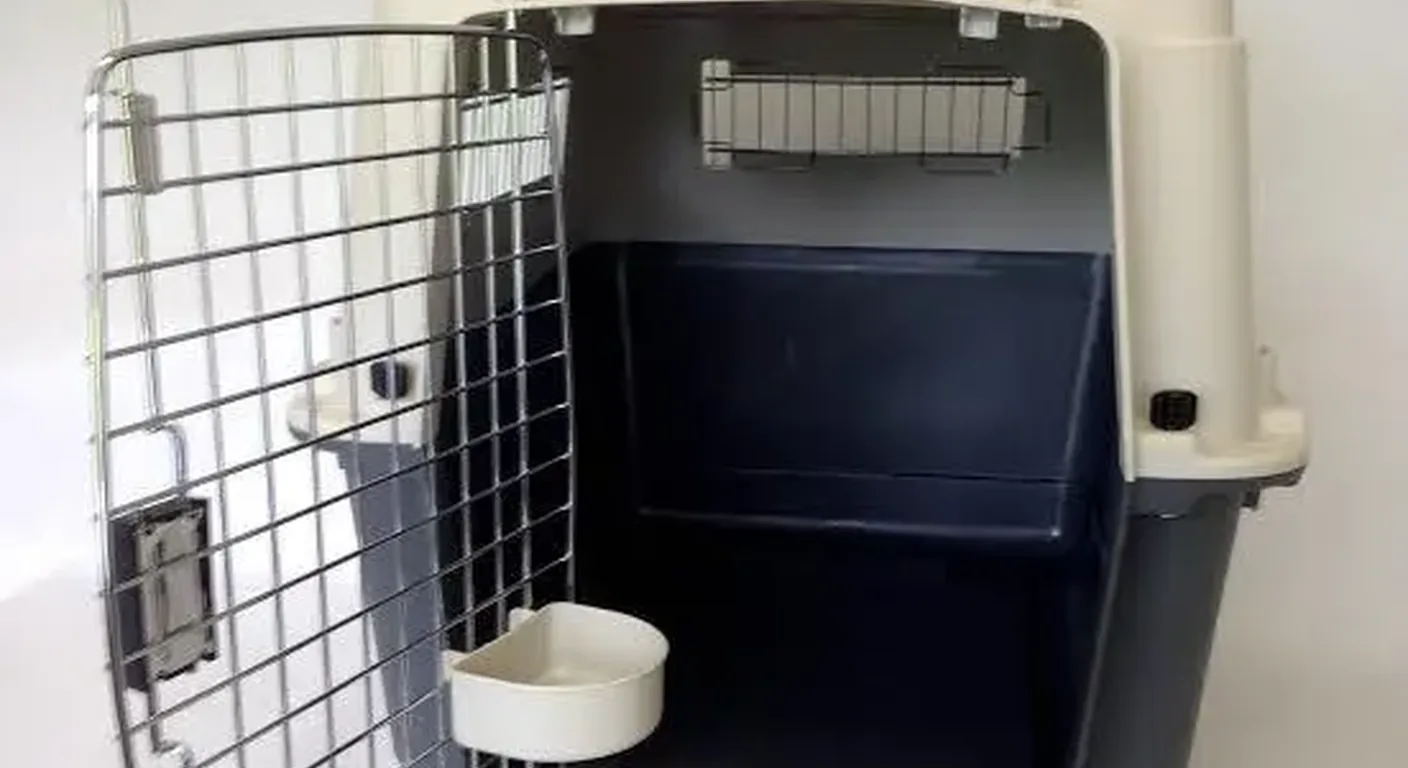
You choose the tier that fits: airport pickup on Delta, United or American is $185, and climate-controlled home delivery is $350. Both leave with the health certificate and paperwork in hand, so arrival day is about settling your bird in, not chasing documents.
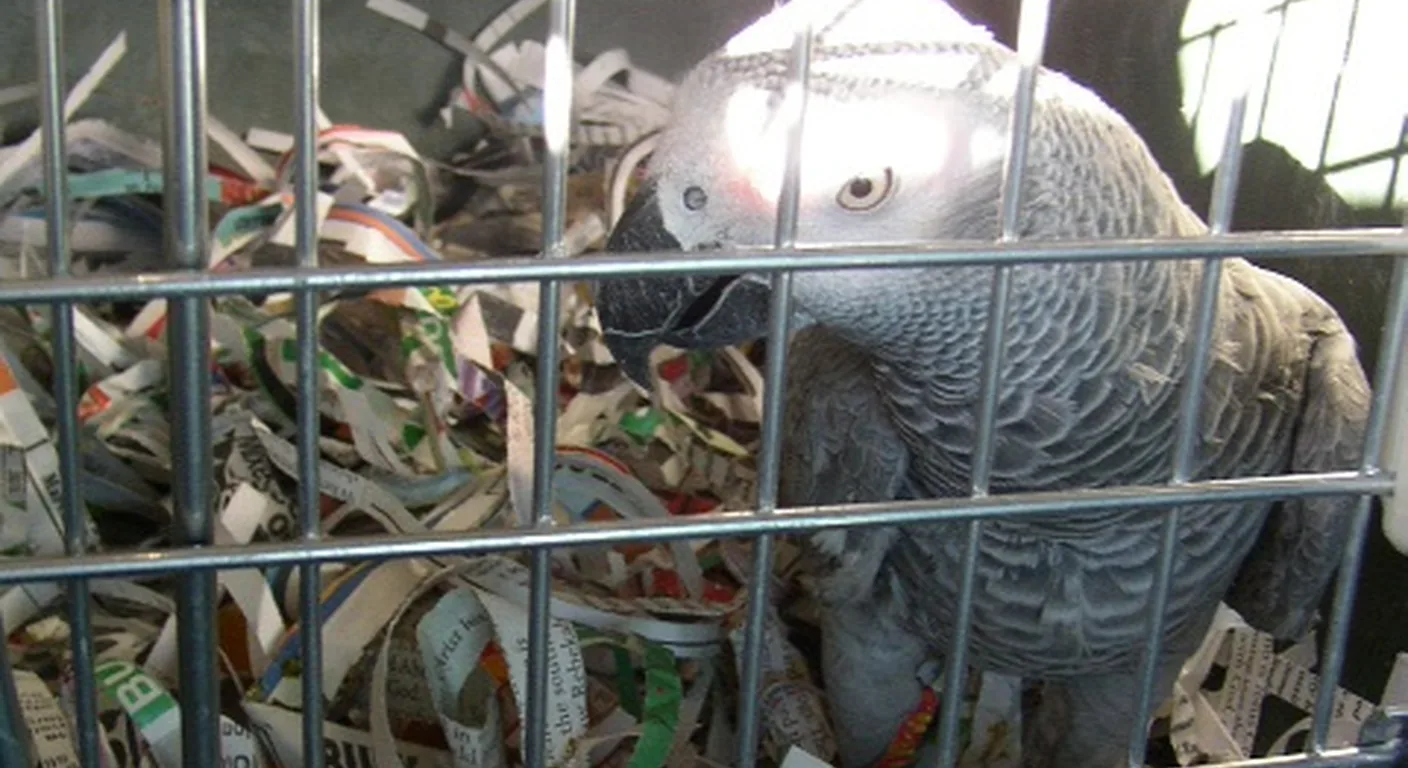
Your Congo flies IATA live-animal cargo — Delta, United or American — into the closest major airport to you

A temperature-controlled pet courier drives your Congo, plus the full document folder, right to your front door
Can You Pick Up a Congo in Person Instead of Shipping?
Yes — local pickup at our Midland, TX aviary is the gentlest handoff a bird can get, and it's open to anyone within a 2–3 hour drive. Meeting your Congo in person also lets you do the final in-real-life verification this whole page is built around.
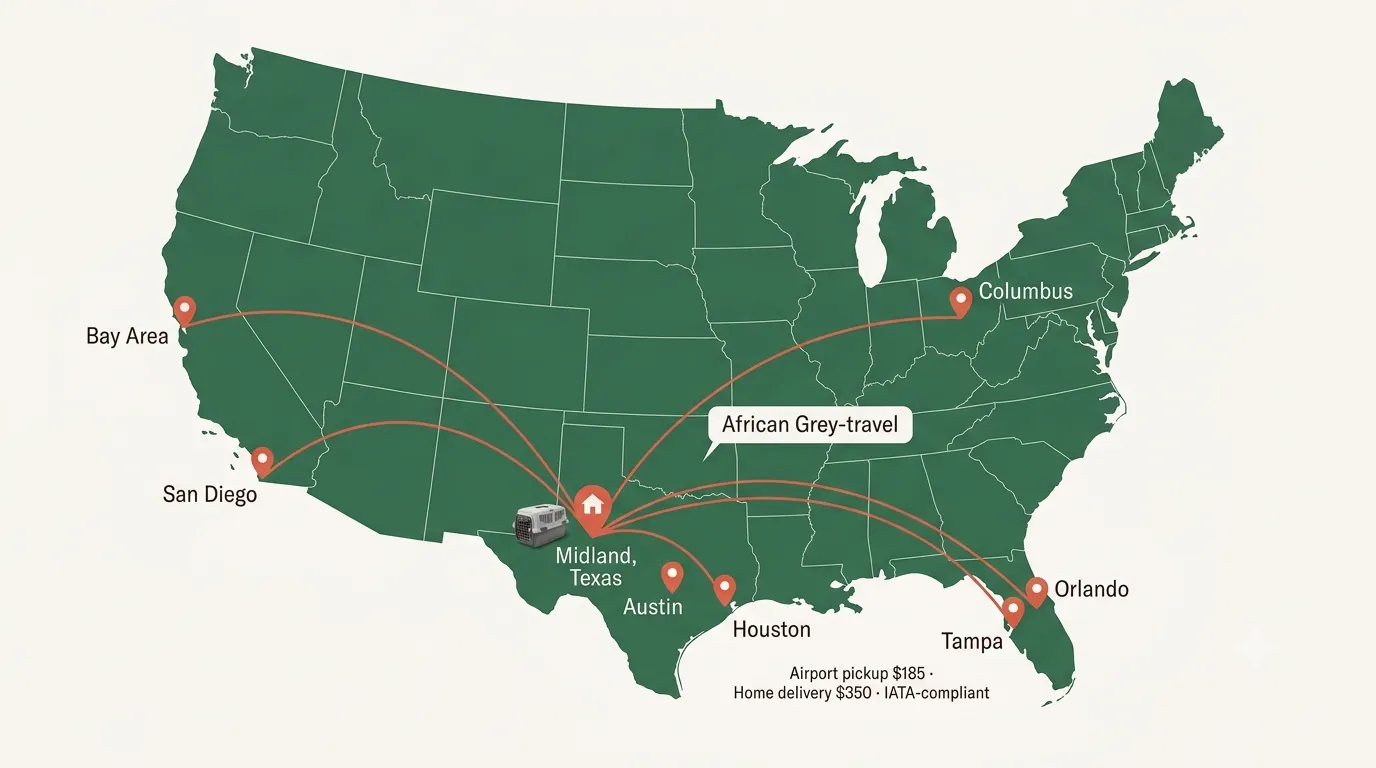
Airport Pickup Is $185 and Home Delivery Is $350 via IATA Carriers (Delta / United / American)
To restate it plainly: airport pickup is $185 and home delivery is $350, both flown on IATA-approved carriers — Delta, United, or American. These routes cover most of where our Congos go in a season, and each card opens that area's availability page:
Ships nationwide · $185 airport · $350 home
What Is It Like to Live With a Congo African Grey Every Day?
Living with a Congo African Grey is like sharing your home with a clever, opinionated toddler who never grows up — richly rewarding, and genuinely demanding. Ours are raised to slot into family life, but a Congo needs daily interaction, mental work, and a fresh, varied diet to stay happy over its 40–60 year lifetime.
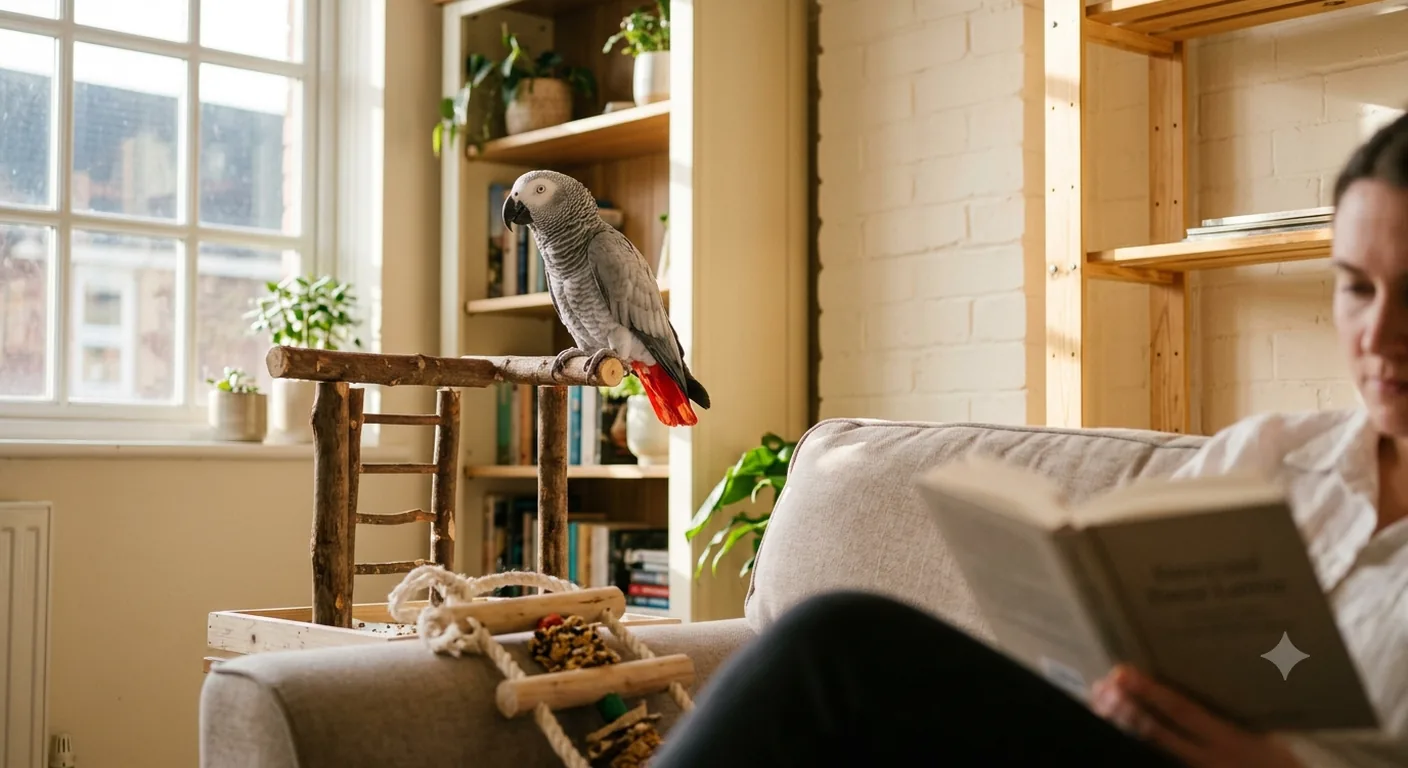
How Much Time and Enrichment Does a Congo Need?
Plan on several hours of out-of-cage time and active engagement a day, plus rotating foraging toys and puzzles to keep that big brain busy. A well-fed, well-stimulated Congo is a sweet companion; a bored or poorly-fed one develops the screaming and feather-plucking that lands birds in rescues.
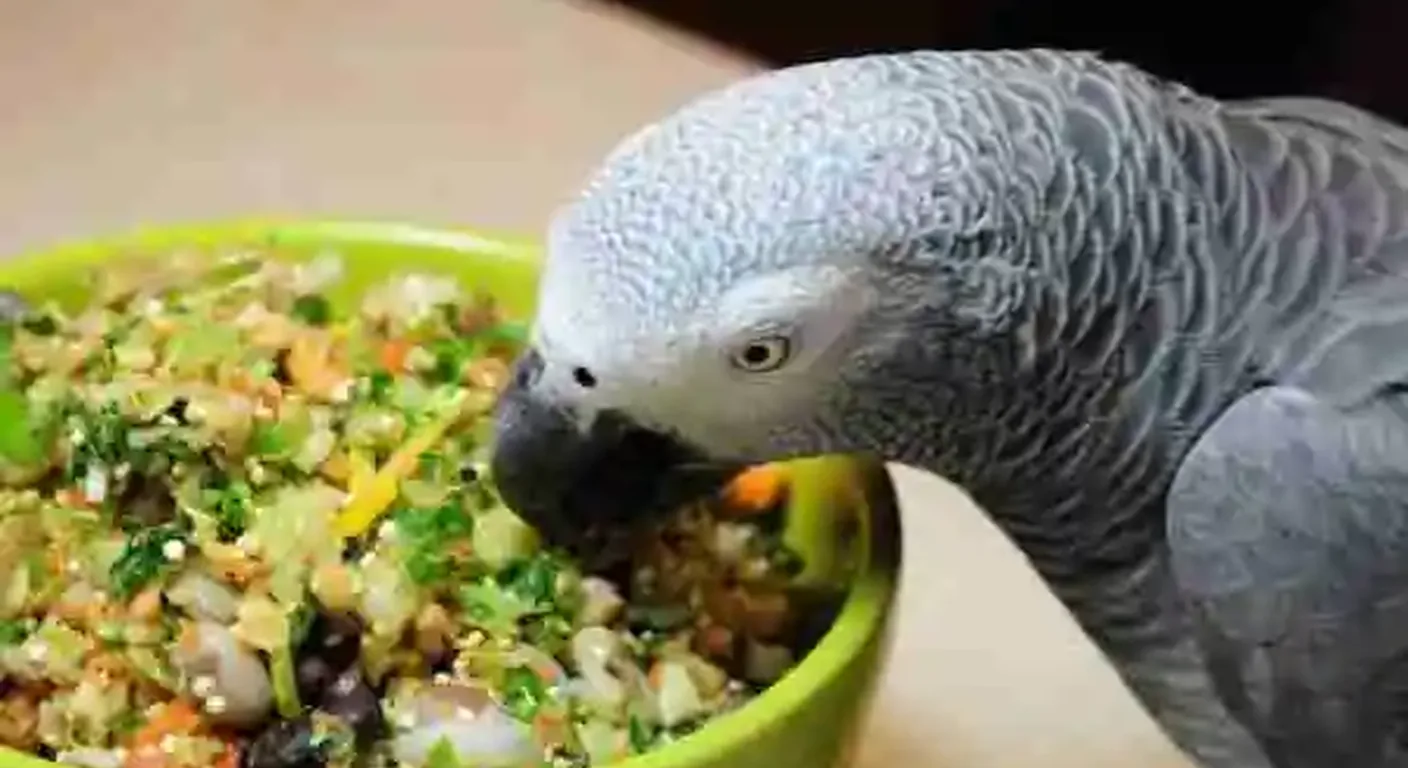
Diet, Calcium and a Congo's Long-Term Health
A healthy Congo eats a base of quality pellets plus daily fresh chop, with calcium sources like cuttlebone to support bone and feather health over the decades. Getting nutrition right early is the cheapest health insurance there is for a bird that will outlive most family pets many times over.
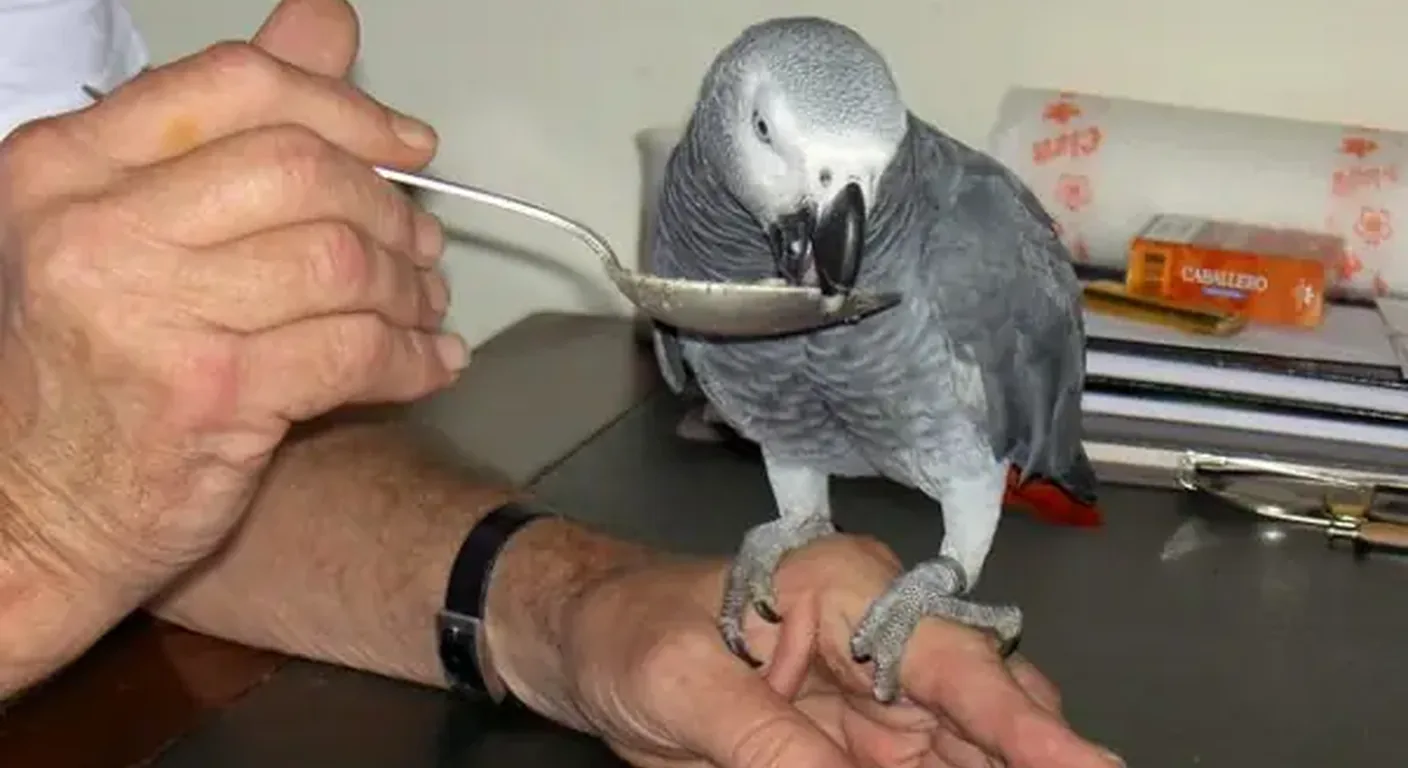
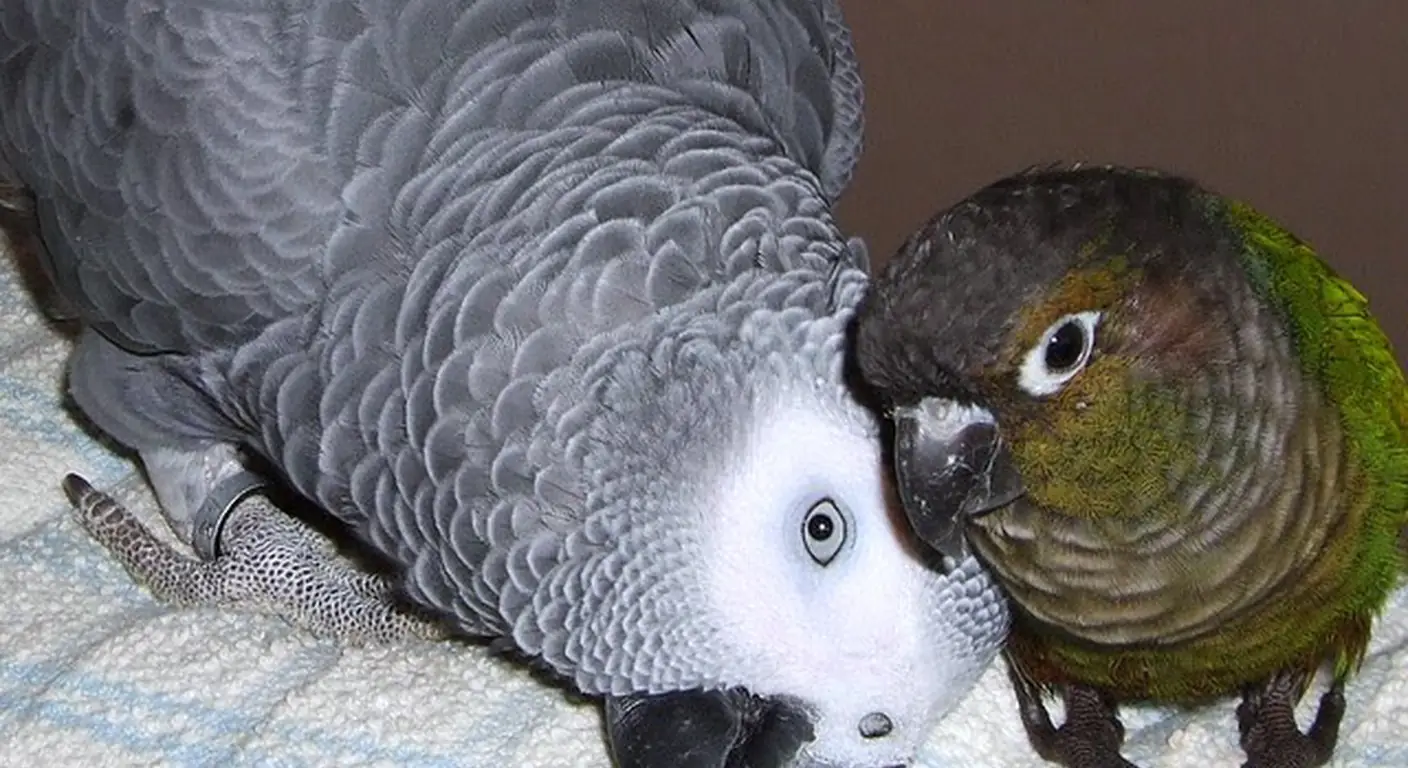
Watch Our Congo African Greys Talk and Play
Because photos can be stolen but honest video is hard to fake, here's one of our own Congos at home — no narration, no stock footage. Short of driving to Midland yourself, it's the most direct proof we can hand you that these birds are real.
Which Families Have Taken Home Our Congo Greys?
Real families across the country now share their homes with a documented C.A.Gs Congo, and two of them say it better than we could — both bought sight-unseen, and both had the shipping and paperwork go exactly as this page promises. Dozens more accounts, with photos, live on our African Grey reviews page.
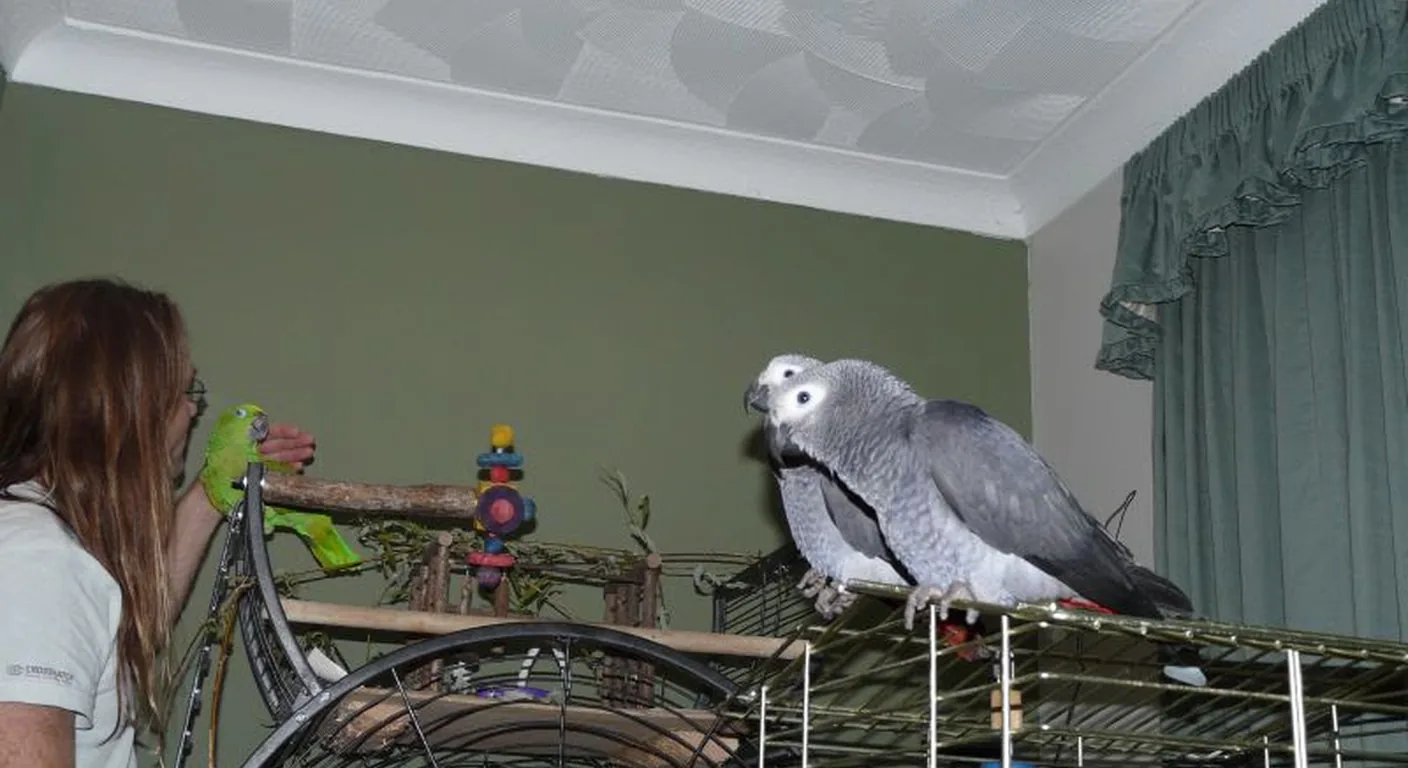
 Richard WoodardWinter Haven, FL · Congo African Grey★★★★★
"At first I was hesitant about buying a bird online, but C.A.Gs made the process stress-free. They provided detailed care instructions and my parrot arrived in perfect condition. My Congo African Grey is now the star of our family, talking and entertaining us daily."
 Archie O'BrienFarmingdale, NY · Congo African Grey★★★★★
"Finding a healthy and well-socialized female Congo African Grey was important to me, and I'm so glad I chose C.A.Gs. The entire experience was professional, transparent, and reassuring from start to finish. My Congo Grey is beautiful, affectionate, and already showing an amazing personality. I highly recommend C.A.Gs to anyone looking for a quality Congo Grey parrot."
Real Families, Real Documented Birds
What ties every one of these stories together is the same paper trail you'll get — a DNA certificate, health records, and CITES documentation — because a real outcome starts with a real, documented bird. We never fabricate a review, so the count you see is the count that's real.
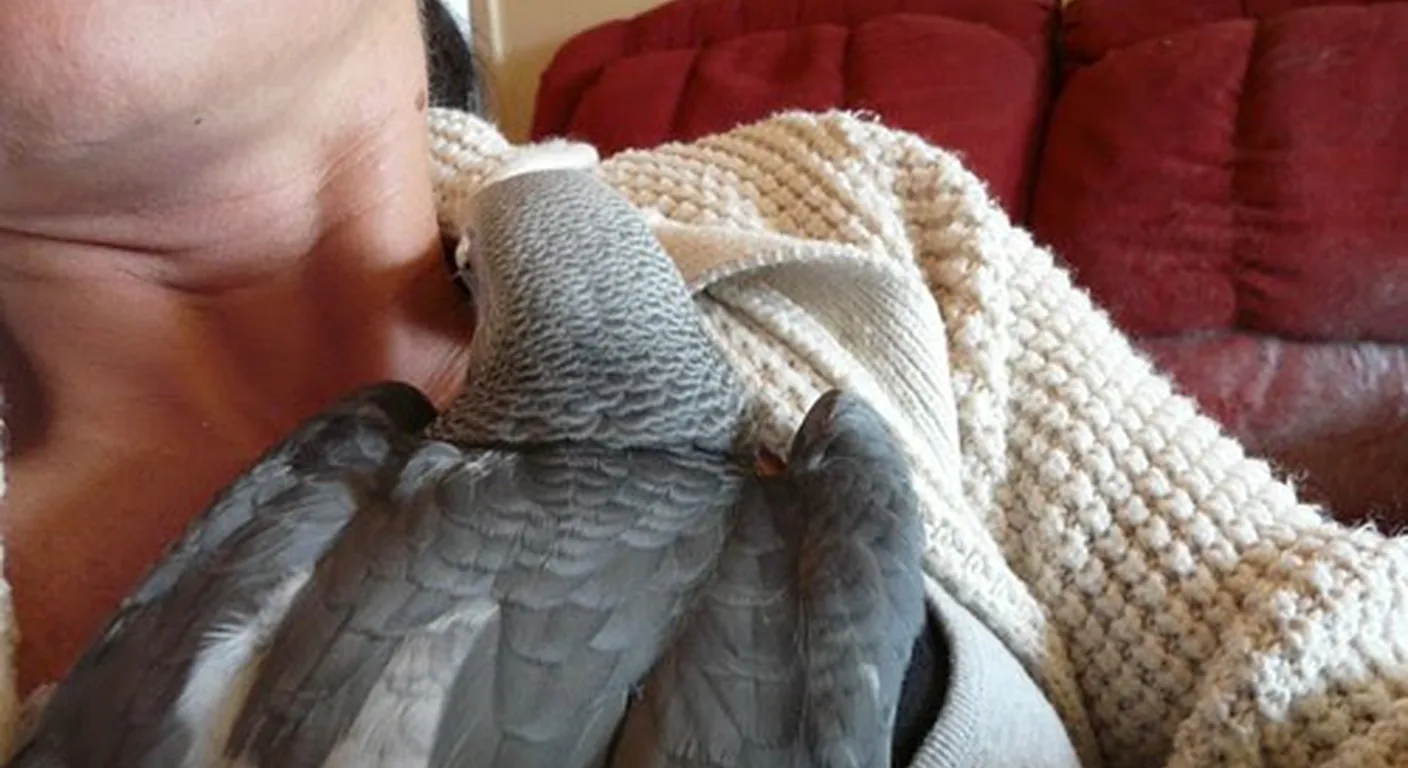
Keep Reading Before You Buy — Our Congo Buyer Guides
Before you send a deposit, these guides go deeper on the questions this page raises — spotting scams, choosing Congo vs Timneh, what the price really buys, and the paperwork behind a legal bird. Every one is something we wrote ourselves, from our own aviary, rather than spun up by a content mill.
 Scam guide How to avoid African Grey parrot scams The red flags every fake Congo listing shares — and how to walk past them. Read the guide →
  Which grey Congo vs Timneh African Grey Size, talking, temperament and price, compared side by side. Read the guide →
  Pricing African Grey price — what you actually pay for Why a real Congo starts near $1,700 and a $800 bird is a warning. Read the guide →
  Legality CITES documentation, explained The exact Appendix I records that follow a legal, captive-bred Congo home. Read the guide →
 Also from our aviary
Congo eggs in an incubator are a wholly different undertaking from a weaned chick, and we set out what it actually costs rather than what it is listed at.
The breeding pair we currently hold is priced and documented on its own page, for keepers moving from owning one grey to producing them.
Your Top Questions About Buying a Congo African Grey
Our full African Grey parrot FAQ covers care and ownership well beyond buying; below are the real questions buyers send us about a Congo African Grey for sale — cost, legality, talking, lifespan, scams and shipping — answered the same honest way we'd answer them on the phone.
How much does a Congo African Grey cost?
Our hand-raised Congo African Grey singles run $1,700–$2,500, and a bonded companion pair is $3,500. We never list a Congo below $1,500 — a healthy, DNA-sexed, captive-bred Congo African Grey costs real money to raise and document, so a suspiciously cheap $800 bird is one of the clearest scam tells there is.
Is it legal to buy a Congo African Grey in the USA?
Yes. African Greys are listed on CITES Appendix I, yet captive-bred birds can be legally owned and rehomed inside the United States when the paperwork is in order. Every Congo African Grey we sell was hatched in Texas to captive parents — never wild-caught — and comes with CITES captive-bred documentation plus a USDA-licensed breeder's paper trail.
Do Congo African Greys really talk?
Congo African Greys are among the best talking parrots in the world, often building vocabularies of well over 100 words and mimicking household sounds with uncanny clarity. Because we hand-raise and socialize every chick daily, our Congos start associating words with people and objects early, which is the foundation of a strong talking bird.
How long do Congo African Greys live?
A Congo African Grey typically lives 40–60 years in good care, so buying one is a multi-decade commitment closer to adopting a child than getting a pet. We raise ours to be healthy, well-socialized companions precisely because they'll be part of your family for that long.
How do I avoid a Congo African Grey scam?
Verify the seller before you send a cent: look up their USDA license on APHIS, ask for a live video call with the actual bird, and refuse any seller who wants gift cards, Western Union, or PayPal Friends & Family. Our full scam guide walks through every red flag, and we invite the same checks on ourselves.
Can a Congo African Grey be shipped safely?
Yes — a reserved Congo ships on IATA live-animal cargo with Delta, United or American for $185 to your nearest airport, or $350 by climate-controlled home delivery. If you live within 2–3 hours of Midland, Texas, local pickup is the gentlest option, and every bird travels with its full document folder and health certificate.
What's included when I reserve a Congo African Grey?
Every Congo comes home with a DNA-sexing certificate, a closed leg band, an avian-vet health record, PBFD and Avian Polyomavirus PCR screening, a care guide, a welcome kit, and our lifetime breeder support — the same documentation stack a fake listing can never assemble.
Are Congo African Grey eggs a cheaper way to get one?
On paper, and the paper leaves out most of the bill. Before a fertile egg turns into a Congo you have bought an incubator that holds temperature to a fraction of a degree, a brooder for afterwards, formula, a gram scale, and the months of feeds that follow — none of which comes back to you if the egg was never fertile. That is the larger risk. An egg is the easiest thing online to misrepresent, because by the time it fails to hatch there is nothing left to examine and usually nobody left to ask. A weaned bird you watched on a video call before paying cannot go wrong the same way.
Is a Congo pair a better buy than a single grey?
Only if you want something different out of it. A pair is bought to breed or to stock a flight, and the two birds will mostly be occupied with each other rather than with you. A single weaned Congo attaches to the household instead, which is what nearly everyone imagining a talking grey on a stand actually has in mind. The economics run the wrong way for most buyers too: a pair costs more at the outset, needs considerably more space, and returns less of the companionship this species is known for.
Why do Congo African Grey prices range from $1,500 to $8,500?
Price tracks age, hand-raising, DNA and disease testing, temperament, and documentation. A weaned, well-socialized chick from a documented pair sits in the credible middle of the market, while an already-tame, talking adult can reach the top of the range. Our $1,700–$2,500 singles sit squarely in that honest middle.
Reserve · 24-hour reply
Reserve Your Congo African Grey Today
Tell us which Congo caught your eye and how you'd like it delivered, and you'll hear back from us inside 24 hours with straight talk on availability — a plain "not yet" included, if that's the honest answer. Reserve with a $200 refundable deposit, or book a video call first so you can meet your bird before you decide.