 Ready now
 Bery
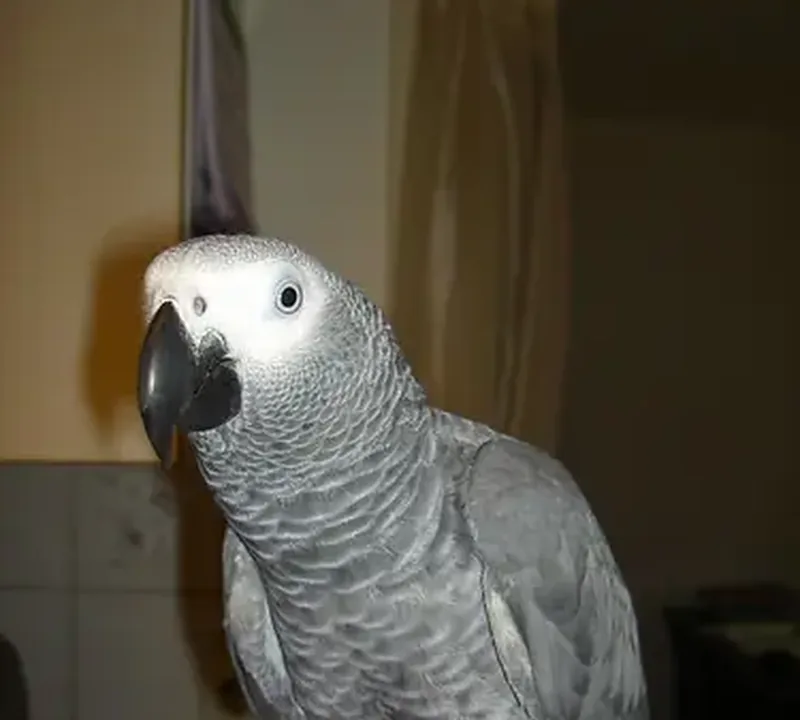
$1,700Settled Congo hen, already past every milestone the window is designed to catch.
Congo 1 year 72-hr terms
Ships nationwide · $185 airport · $350 home
Inquire about Bery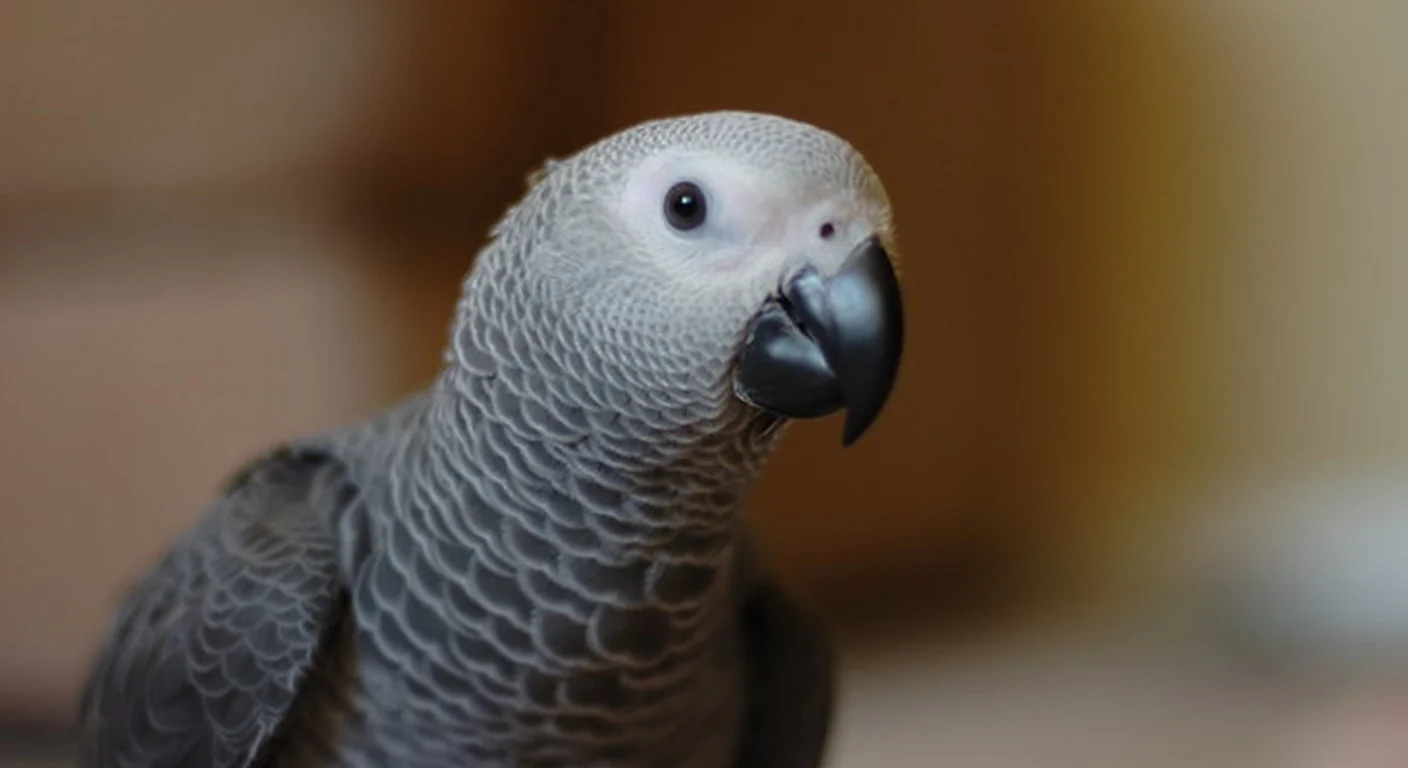
Written 72-hour guarantee · Midland, TX · USDA-licensed family aviary since 2014
Nearly every seller on this search result says "health guarantee." Almost none of them say what it covers, how long you have, or what they will actually do about it. Ours runs 72 hours from arrival, rests on an examination by your own avian vet, and is settled as replacement or refund. The terms sit further down this page in full — before you have given us a dollar.

A written health guarantee is a contract about risk, and here at C.A.Gs ours names the risks it accepts instead of gesturing at them. It stands behind two categories of illness for 72 hours after your grey lands, so that a fault carried out of our aviary stays our responsibility rather than becoming your veterinary bill.
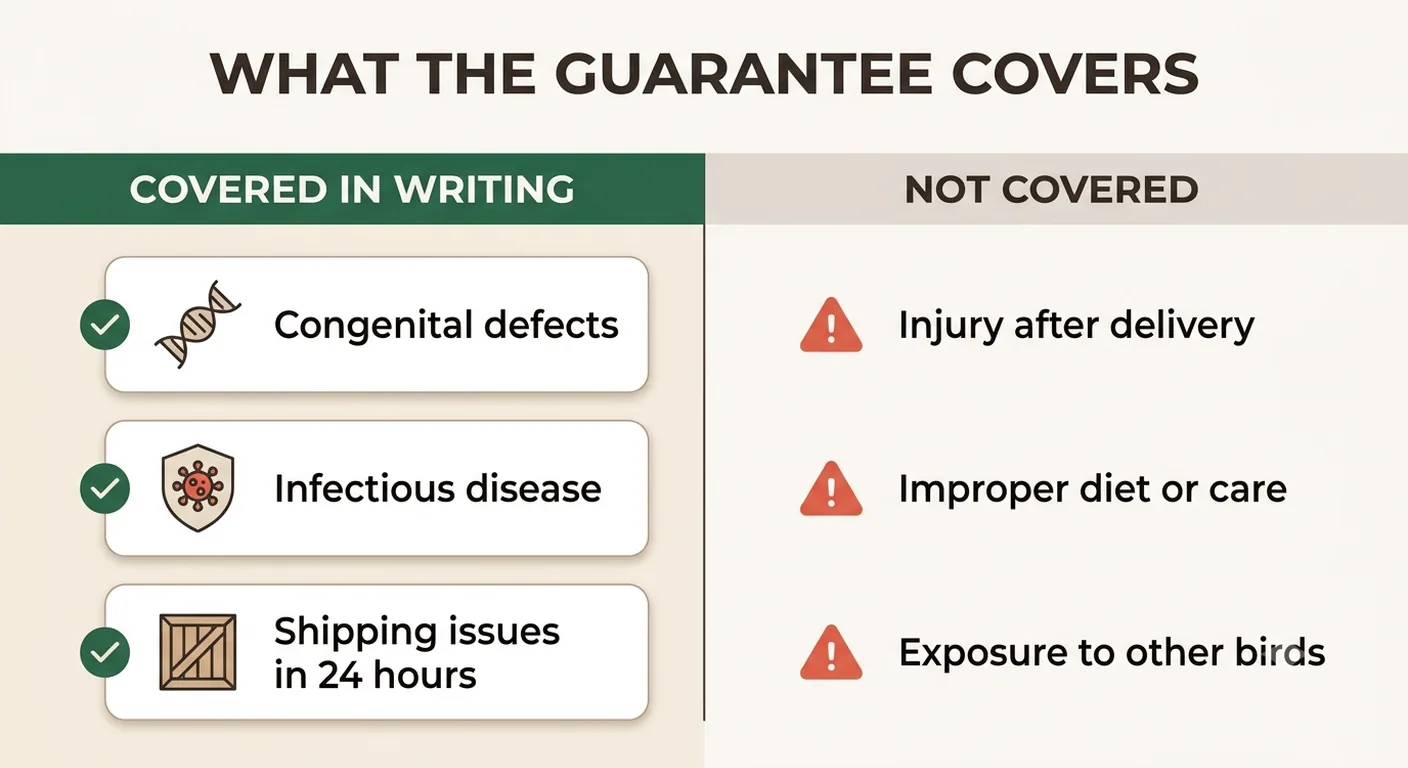
Two categories carry the weight. A congenital defect is something a grey hatched with — a heart or airway fault, a skeletal problem — that a pre-sale examination had no way of surfacing. Infectious disease covers an organism already at work in your bird when the crate closed but not yet visible to a vet. Both share one quality: they existed before you did anything, which is precisely why they belong to us.
Anything a veterinarian can trace to a point before delivery falls inside. In practice that means a positive PCR result on a disease we screen for, or a structural fault identified on examination. The 24-hour transit clause sits alongside it and answers a different question — injury or distress caused by the journey itself, which is neither congenital nor infectious but is still ours to put right.
We separate the two deliberately because they fail differently. A congenital fault is usually found at the first examination and is unambiguous. An infection may take a few days to declare itself, which is why the window runs to 72 hours rather than 24 — long enough for an incubating organism to become detectable, short enough that a new household has not yet become a competing explanation.
The document you receive names congenital defects and infectious disease explicitly, states the 72-hour health window and the 24-hour shipping window as separate clauses, and records your grey's closed band number so the terms attach to one specific bird. Our full health-guarantee policy carries the complete wording, including the fine print this summary compresses.
Four exclusions, and we would rather you read them now than discover them during a claim. The band must stay on. The diet must be the one we send you home with, not a seed bowl. No other birds for the first thirty days. And the avian-vet examination has to happen inside the window — without it, the sale is as-is.
Each exclusion marks a boundary where evidence runs out. Once a band is removed, no paperwork can be tied to that parrot. Once another bird shares the airspace, an infection has a second possible origin. Once a grey has been fed badly for a fortnight, its bloodwork tells a story about your kitchen rather than our aviary. These are not escape hatches; they are the honest edge of what anyone can promise about an animal in someone else's home.
Guarantee length has turned into an advertising arms race among African Grey sellers, and here at C.A.Gs we have watched it run in the wrong direction. The listings offering a full year are, with striking consistency, the ones least able to honour anything — so the number on the badge tells you less than how the promise is anchored.
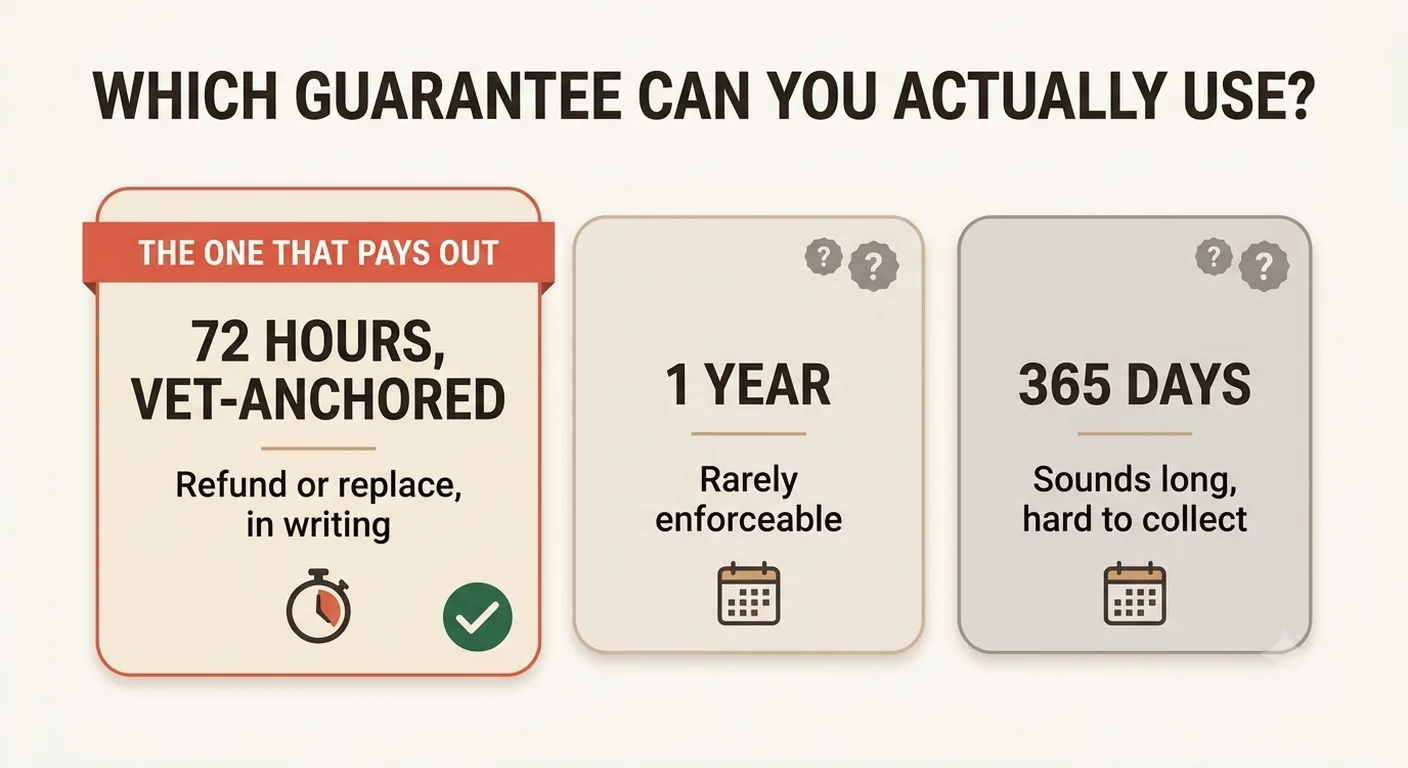
Length costs a seller nothing to advertise and everything to honour, so the incentive runs toward inflation. Independent parrot guides reach the same conclusion from the other side, advising buyers to treat an unusually long guarantee as a prompt to be reasonable rather than reassured. A promise stretched across twelve months has to survive a year of someone else's husbandry — which is another way of saying it will almost never be paid out.
Read the ones we found and the pattern repeats: a long window, no list of covered conditions, no named remedy, and no requirement that anyone examine the bird. The length is doing the persuading while the substance stays blank. One page-one seller pairs a one-year badge with a Congo discounted to roughly $750 — a figure that cannot cover the testing the badge implies.
A guarantee only functions if a third party can establish what was wrong and when. Strip out the vet requirement and there is nothing to establish anything with, which leaves the seller as sole judge of their own liability. That is why we would rather hand you a short window with an independent examiner in it than a long one where we decide.
Avian veterinarians make the clinical case better than the marketing does: a parrot that has just flown needs eyes on it quickly regardless of paperwork, because birds mask illness until it is advanced. The Association of Avian Veterinarians' find-a-vet directory is where to book that appointment ↗, ideally before your grey travels rather than after.
Set the models side by side on the axes that decide a claim, not the one printed on the badge.
| Term that decides a claim | Ours, in writing | What we found elsewhere on page one |
|---|---|---|
| Stated window | 72 hours from arrival, plus a 24-hour shipping window | Anything from 72 hours to 365 days, with the longest offered by the least verifiable sellers |
| Covered conditions named | Congenital defects and infectious disease, listed in writing | Usually unstated — “health guarantee” appears as a two-word badge |
| Remedy | Replacement or refund, at our discretion | Store credit toward a future purchase, or nothing stated at all |
| What voids it | Band removal, improper diet or care, exposure to other birds, no vet exam inside the window | Rarely published, so a buyer meets the exclusions only when claiming |
| Who confirms the illness | Your own avian vet, independent of us | The seller, or left unspecified |
| Anchored to documentation | Vet certificate, DNA certificate, CITES papers, closed band | One badge among many, with no document shown anywhere |
The one that sends you to them. Every veterinary recommendation on buying a bird converges on the same instruction — have an independent avian vet examine your new parrot promptly — and a guarantee built around that instruction is the only kind a vet can actually help you enforce.
A guarantee is only as good as the path through it, so here at C.A.Gs we keep that path to three steps and no intermediaries. You see a vet, you send us what the vet found, and we settle it — with Mark or Teri answering, not a form.
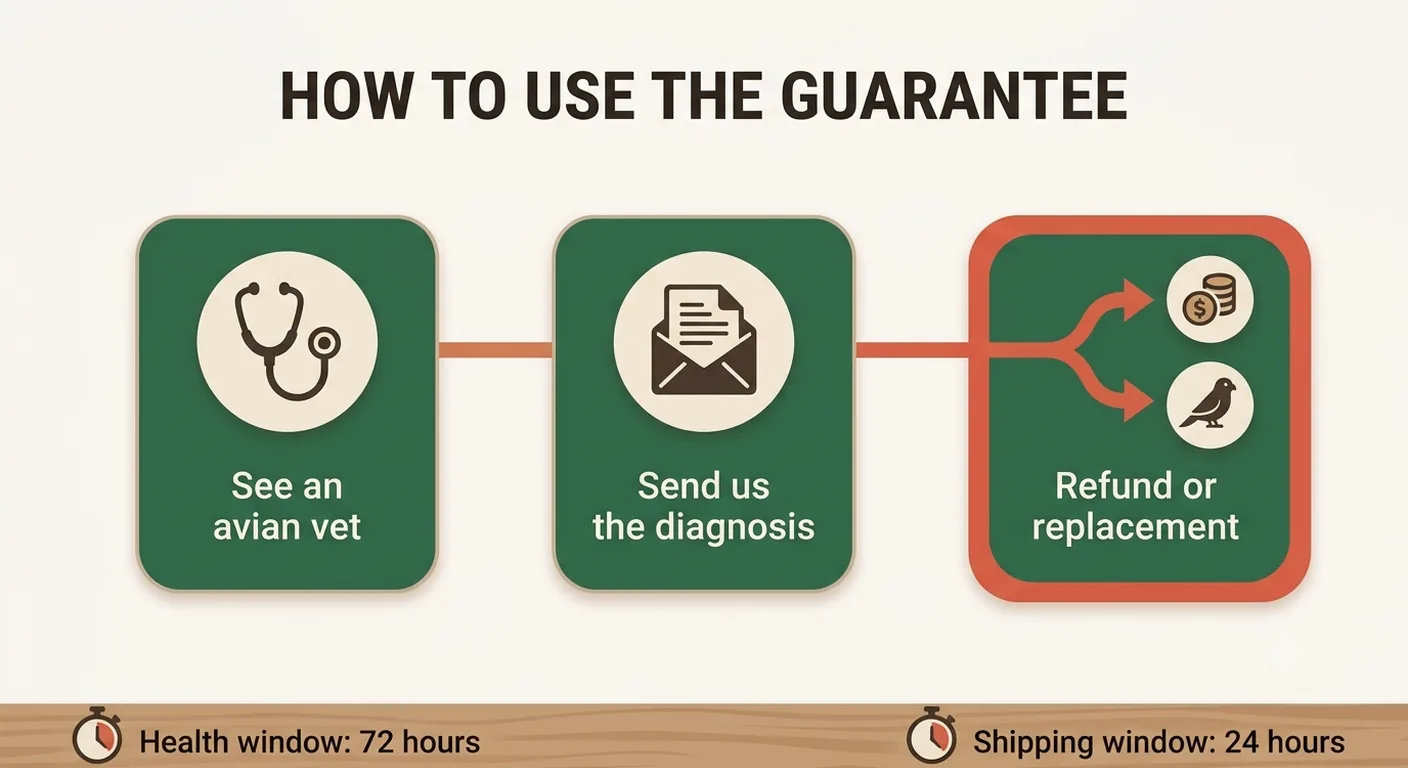
Book the avian-vet appointment first — it is the step everything else depends on. Ask for the diagnosis in writing, including any test results, and forward it to us the same day. We then settle the claim as replacement or refund. Nothing about that sequence requires you to argue with us; the veterinary record does the arguing.
Inside 72 hours of your grey arriving, which is why we ask buyers to line up a practice before travel day. Avian vets are thinner on the ground than general practices and often booked a week out. If the only appointment you can get falls outside the window, tell us before it lapses rather than after — we can work with a booked appointment, but not with a lapsed window and no examination.
Two clocks, both starting when you take possession. The shorter one covers anything the journey caused and closes quickly because transit effects show immediately. The longer one covers the congenital and infectious categories and runs three times as long because an incubating organism needs time to become detectable.
The document states replacement or refund at our discretion. In practice the choice usually makes itself — a family who has waited months for a specific chick generally wants another bird, while someone whose circumstances have changed wants their money. We ask which you would prefer before we decide.
Partly because it is what makes the guarantee enforceable, and partly because it is simply good practice. That first examination gives your grey a baseline weight, a baseline bloodwork picture and a relationship with a practice that may look after him for forty years. Buyers who skip it are usually the ones who later cannot tell whether something is new.
Every grey below carries the identical written terms — the same 72-hour window, the same remedy, the same four exclusions. What differs is only how soon each one can leave here at C.A.Gs, which is why we sort them by that rather than by price.
Ready now Settled Congo hen, already past every milestone the window is designed to catch.
Ships nationwide · $185 airport · $350 home
Inquire about Bery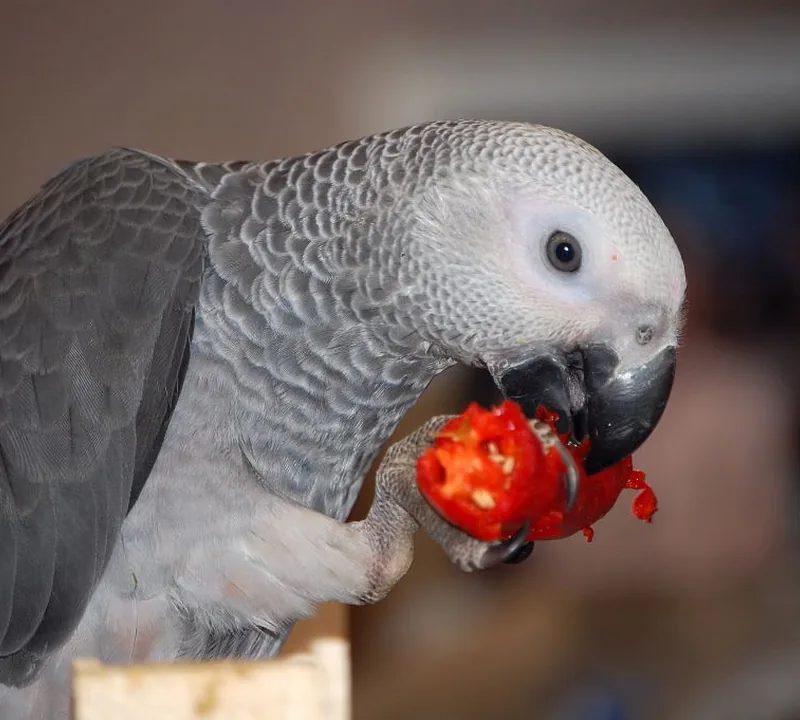 Reserve & wean
 Congo hen still weaning; her window opens the day she reaches you, not today.
Ships nationwide · $185 airport · $350 home
Inquire about Amie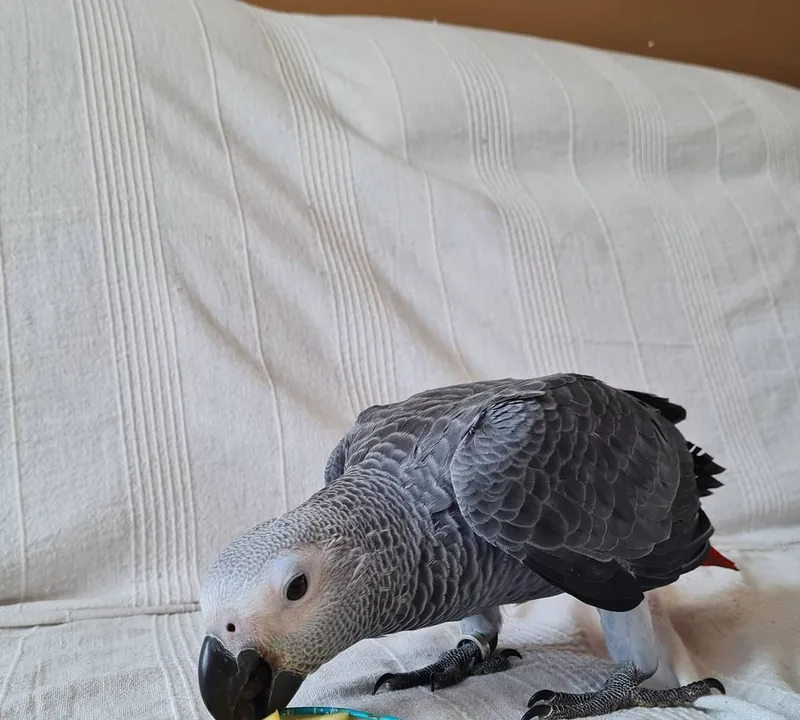 Reserve & wean
 Congo cock, screened and cleared, waiting out the last few weeks of weaning.
Ships nationwide · $185 airport · $350 home
Inquire about Roys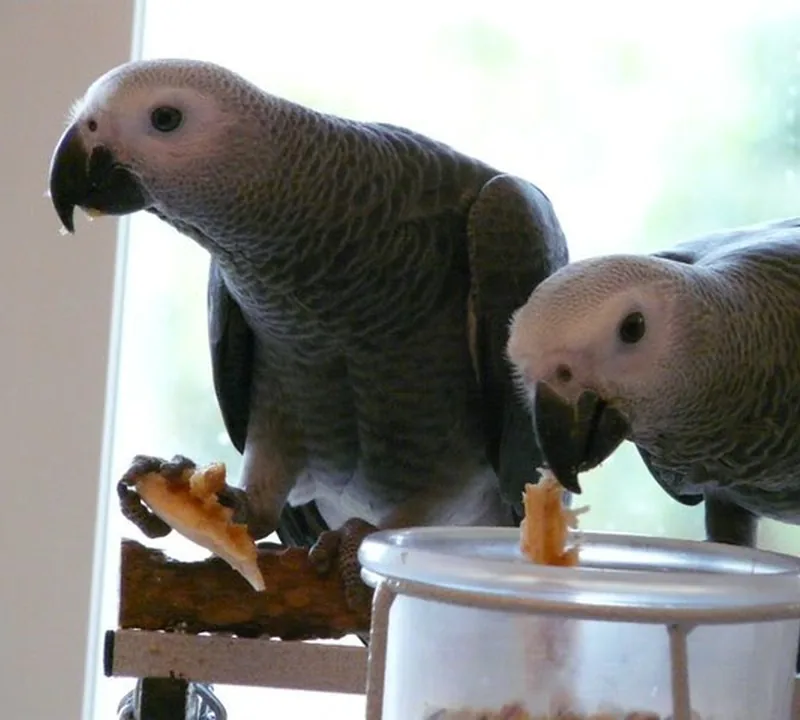 Pair · ships together
 Two greys, two sets of terms, one crate — they do not separate.
Ships nationwide · $185 airport · $350 home
Inquire about Jins & Jeni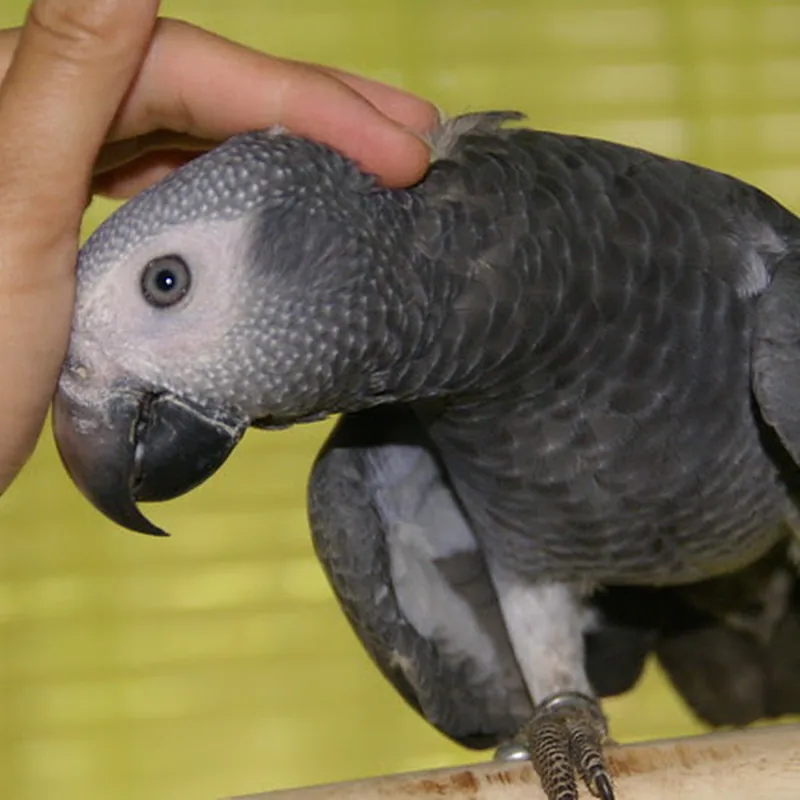 Reserve & wean
 Timneh cock out of Levi and Rily, examined and papered before he was listed.
Ships nationwide · $185 airport · $350 home
Inquire about Elad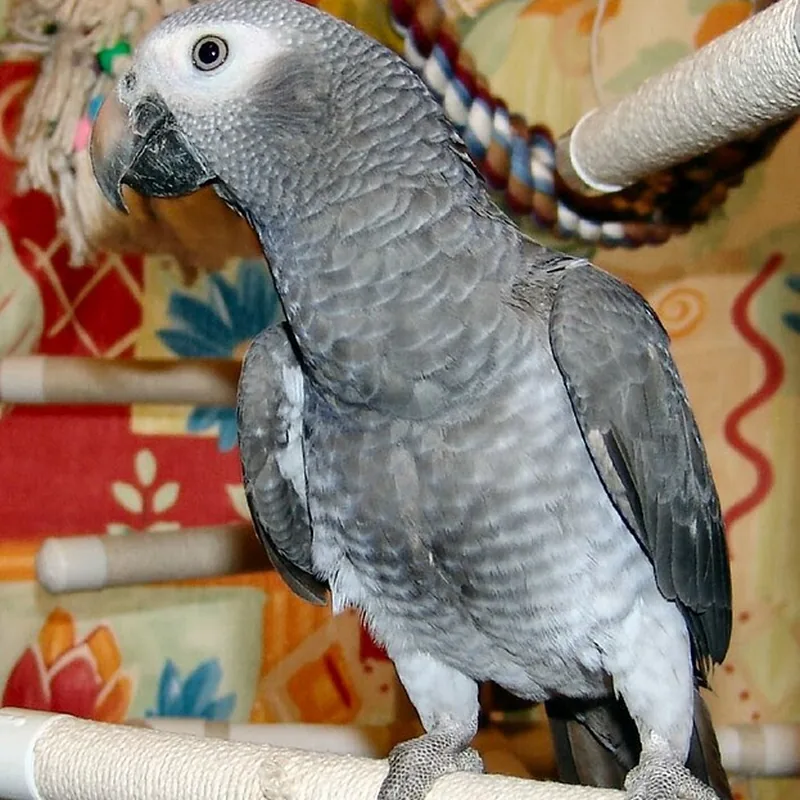 Reserve & wean
 Timneh hen, unhurried and deliberate, cleared at her pre-sale examination.
Ships nationwide · $185 airport · $350 home
Inquire about EvieFour Congos and two Timnehs are with us as this page stands, plus Jins and Jeni, who are an unrelated companion pair and leave together or not at all. Bery is the one grey already past the age where the window's typical findings appear; the younger birds finish weaning here first, because a chick that leaves early is the single most common cause of a claim anywhere in this trade.
Each card states the subspecies, the age, the real price and the same guarantee terms — no listing here says "DNA pending" or "vet check to follow." If a grey is not yet cleared and papered, it does not appear on this page at all, which is why the grid is short rather than padded.
The examination, the PCR panel and the sexing assay are all complete before a bird is listed, and the certificates are issued against the closed band number rather than the name. That ordering matters: a certificate written against a name proves a bird was tested, while one written against a band proves this bird was.
Health guarantee, avian-vet certificate, DNA sexing certificate, CITES Appendix I paperwork and the band record sit in a folder under each grey's name here before they sit in yours. Ask for any of them by bird and we will send it across the same day.
A guarantee with nothing behind it is a sentence on a website. Here at C.A.Gs it sits on top of a five-document stack, and each of those documents is independently checkable by somebody who is not us — which is the only property that makes any of them worth having.
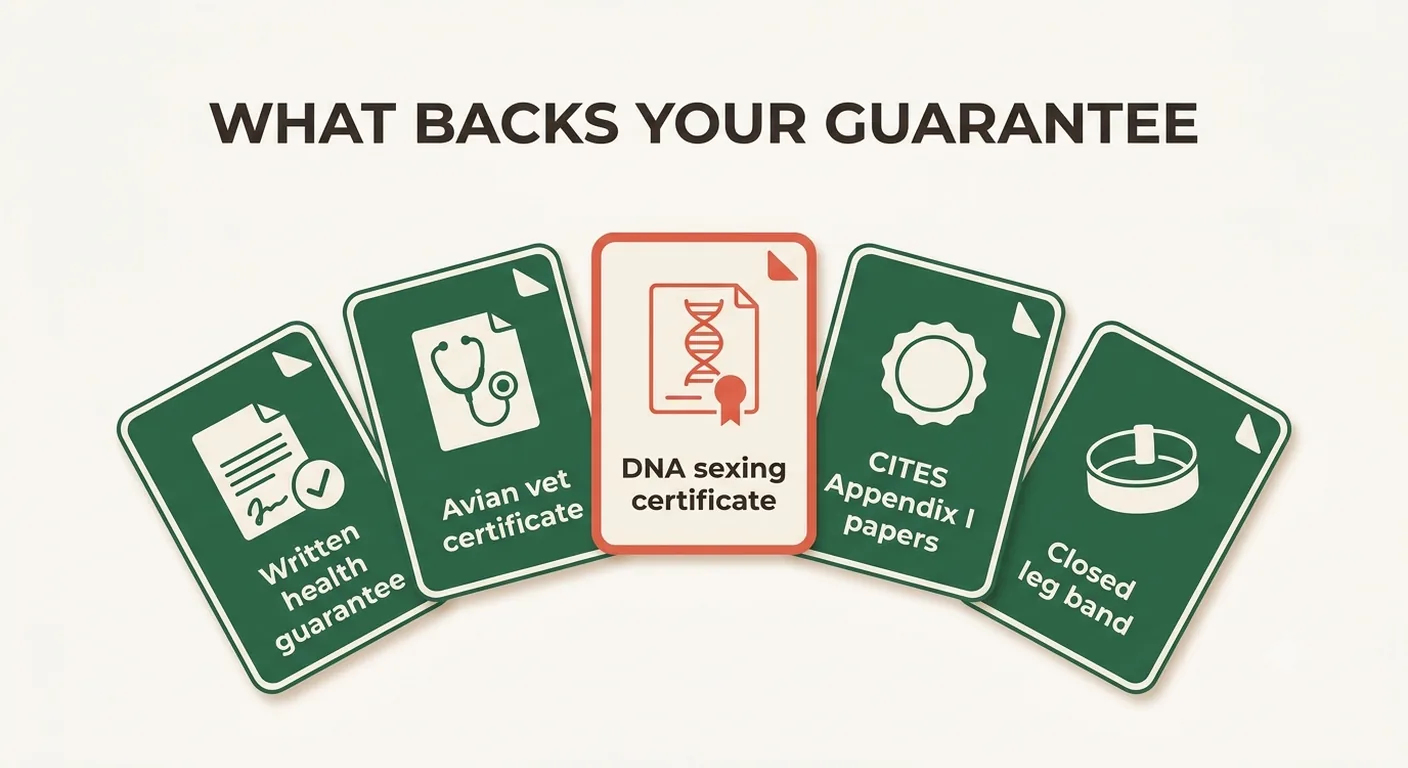
The written guarantee names the terms. The avian-vet health certificate records the pre-sale examination and is dated within ten days of travel. The DNA sexing certificate names the hen or cock. The CITES Appendix I documentation establishes captive-bred origin. The closed leg band ties all four to one parrot. Remove any one of them and the remaining four lose some of their force.
Differently, and that is the point of having five rather than one. The vet certificate protects you at the moment of sale; the guarantee protects you for three days afterwards; the DNA certificate settles a question that visual inspection cannot; the CITES paperwork protects you at a state line or a vet's reception desk years from now; the band makes every other document provably about your bird.
Read as a set, they answer the four questions a buyer actually has — is this bird healthy, what sex is it, is owning it lawful, and is this paperwork really about this parrot. No single document answers more than one. Sellers who publish one badge and call it documentation are answering a quarter of the question.
The guarantee comes from us; the health certificate from a board-certified avian veterinarian; the sexing certificate from the testing laboratory; the CITES documentation from the captive-breeding record; the band from the closed ring fitted at a few weeks old. Four of the five originate outside this aviary, which is precisely why they carry weight.
The pre-sale examination is where our guarantee stops being a promise and starts being a measurement. One visit, one sample, and three PCR panels come back — which is how we can afford to stand behind infectious disease at all.
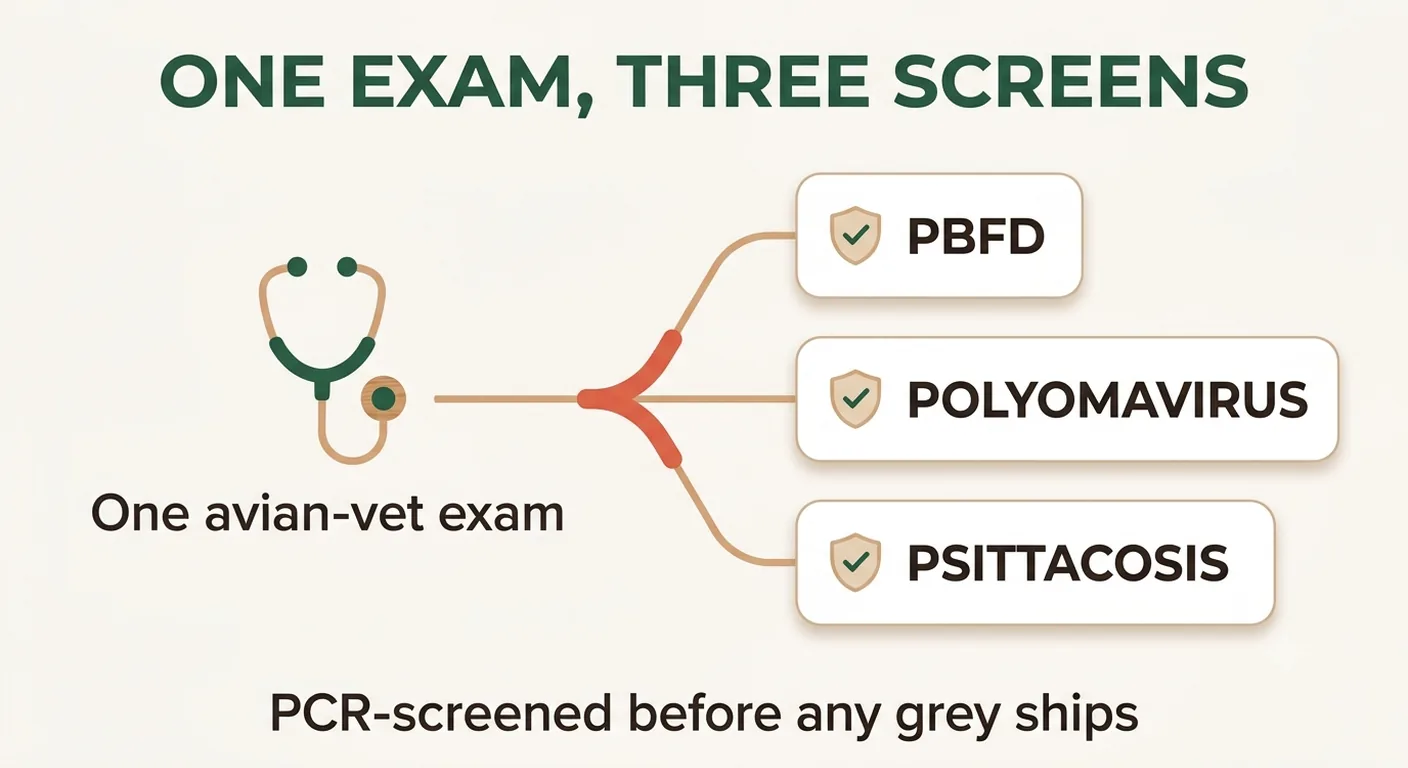
Psittacine beak and feather disease, avian polyomavirus, and psittacosis. All three run by polymerase chain reaction off the same sample type the sexing assay uses, so one clean pull answers several questions at once. A grey that returns anything other than a clear result does not go on this page.
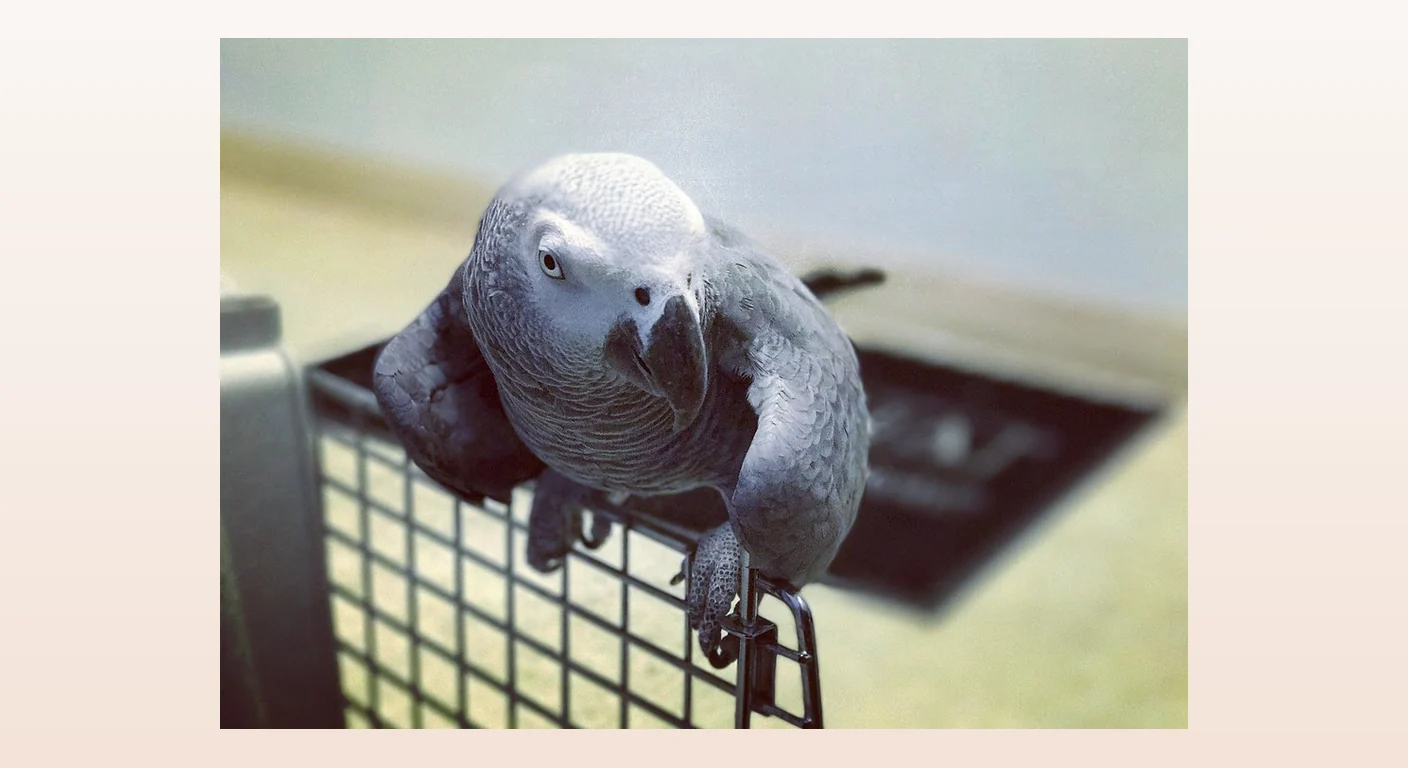
One of ours at the practice — beak and nails tidied, wings trimmed, and the pre-sale panel drawn in the same visit.
Because each is transmissible, each can be silent in a young bird, and each changes what a household should do next. Veterinary overviews of psittacine beak and feather disease describe a virus that can sit undeclared for months ↗. Psittacosis matters for a further reason — it passes to people, and public-health guidance on Chlamydia psittaci treats it as a reportable illness ↗. Screening for it before a bird ships is as much about your family as your parrot.
Most people reading a guarantee page are really asking a blunter question, and here at C.A.Gs we would rather answer it directly than pretend it was not asked. The African Grey market carries an unusual volume of fraud, and a guarantee badge is one of the cheapest things for a fraudulent listing to display.
Owner forums are full of the same post written by different people: a price well under market, a seller who will not video-call, pressure toward a wire transfer or a peer-to-peer payment app, photographs that reverse-search to somebody else's bird, and an offer to ship internationally. Any one of these is a reason to slow down. Two together is an answer. Our full scam-avoidance guide works through each tell in detail.
Because the input costs are fixed and public. Months of hand-feeding, an avian-vet examination, three PCR panels, a sexing assay and CITES paperwork do not compress to fit an $800 sticker. When a listing pairs that price with a one-year guarantee, the two claims are contradicting each other in the same sentence.
It requires no expertise to check, which is what makes it useful. You do not need to evaluate a photograph or interpret a certificate — you only need to know roughly what the species costs. That is why we publish our floor rather than quoting privately: a published floor is a number you can measure other sellers against.
Where such a bird exists at all, the saving has come from somewhere — an unweaned chick sold early, a skipped disease panel, a wild-sourced or undocumented bird, or a parrot rehomed for a behavioural reason nobody disclosed. Each of those becomes a veterinary bill or a heartbreak later, which is the arithmetic the sticker price hides.
Ask us for a live video call with a specific bird and we will schedule one. Ask which laboratory ran the panels and we will name it. Ask for the licence, the address, or a photograph of a band and none of it is a problem. The test is not whether a seller has good answers ready — it is whether questions are welcome at all. Our breeder credentials page sets out who we are in more detail.
Buyers arrive at this question from marketplaces, forums and videos that all raise it and none of them answer it from the breeder's side. Here at C.A.Gs we would rather hand you the questions ourselves, including the ones that are awkward for us.
Ask what the health guarantee covers and what voids it. Ask which diseases the bird was screened for and by what method. Ask whether the grey is fully weaned and how old it is. Ask what documentation travels with it. Ask to see the bird live on video today. Five questions, none of them hostile, and together they eliminate almost every fraudulent listing without any expertise on your part.
Congenital defects and infectious disease, voided by four published exclusions. PBFD, polyomavirus and psittacosis, by PCR. Fully weaned before travel, never earlier, at twelve to sixteen weeks. Five documents in one folder. And yes — name a time and one of us will hold the phone. Those answers do not change depending on who is asking, which is the only real test of whether they are true.
A floor price is a promise about what we will not do, and here at C.A.Gs ours sits at $1,500 because that is where the costs behind a properly raised, screened and papered grey actually land. Below it, something has to be left out.
Months of hand-feeding and socialising. A board-certified avian-vet examination. Three PCR disease panels. A DNA sexing assay and its certificate. CITES Appendix I documentation and a closed band. And the written guarantee itself, which is only affordable to offer because everything preceding it has already reduced the risk. Our itemised African Grey pricing page breaks each line out.
Set against the life of the bird, the figure looks different again. An African Grey lives 40 to 60 years in good care, so the purchase price is a rounding error beside four or five decades of food, veterinary care and enrichment. The 72-hour window exists to protect the start of that span — but the reason we screen and document so heavily is the other fifty years, which no guarantee of any length can cover.
Work backwards from $800 and the answer is unavoidable. The disease panels go first because they are invisible to a buyer. Then the vet examination. Then weaning time, since every extra week is feed and labour. What survives is a young, untested bird with a badge on its listing — which is exactly the animal that generates the veterinary bill a guarantee was supposed to protect you from.
Yes — a captive-bred African Grey with proper documentation is lawful to own and transfer domestically, and here at C.A.Gs every bird we place is captive-bred in the USA with that paperwork in hand.
The CITES listing for Psittacus erithacus placed the species on Appendix I in 2017 ↗, the strictest tier, in response to pressure on wild populations. That listing governs international trade; it does not prohibit domestic ownership of a captive-bred bird. What it does mean is that documentation stops being a nicety — your CITES paperwork and closed band are what establish your grey's captive-bred origin, and they are worth keeping for the bird's whole life. We have never sold a wild-caught bird and never will.
Travel is the part buyers worry about most, so here at C.A.Gs the guarantee carries its own transit clause — 24 hours from the moment you take possession, running alongside the 72-hour health window rather than replacing it.

Ships nationwide · $185 airport pickup · $350 home delivery · collection in Midland, TX is free if you are within two to three hours of us.
Airport pickup at $185 is what most buyers choose — your grey flies as live-animal cargo and you meet the flight at your nearest major airport. Home delivery at $350 puts the crate at your door. Collection here costs nothing and is the gentlest option for the bird, which is why buyers from Texas and the neighbouring states often drive. Meredith made the trip work from South Carolina; Jeffrey took the Denver route into Centennial.
Delta, United and American, in crates meeting IATA Live Animals Regulations — ventilated on multiple sides, with a secured water cup and absorbent bedding. We book direct flights wherever a route allows one, because connections are where temperature and handling risk accumulate. The health certificate travels taped to the crate, dated within ten days of the flight, because the airline will ask for it.
We went through the page-one results for this exact search and recorded what each one actually publishes about its guarantee. The table below reports only what we could read on their pages — where a seller says nothing, we say so rather than guessing.
| What we checked | C.A.Gs | Page-one sellers |
|---|---|---|
| Publishes the covered conditions | Yes — congenital defects and infectious disease, named | No page-one seller we checked lists covered conditions |
| States the remedy plainly | Replacement or refund | One registry breeder offers credit toward a future purchase only |
| Publishes what voids the guarantee | Four exclusions, stated on this page | Silent, or buried where the listing never links |
| Species-correct guarantee copy | Written for African Greys, by the people who raised them | Boilerplate naming the wrong farm and the wrong species |
| Lowest advertised price | A $1,500 floor, guarantee included | $750–$850 Congos advertised beneath a one-year guarantee badge |
| Guarantee attached to a named bird | Every grey below, by name and by band | Marketplace stock cards, or photographs shared by several sellers |
The pattern across all of it is the same: the badge is universal and the substance is rare. We are not claiming to be the only honest aviary on the internet — only that if a guarantee matters to you, the terms should be readable before you pay, and on most of these pages they are not.
Two buyers who took different routes to the same place — one searching for a healthy grey near her, one weighing rehoming against a breeder. Both are verified C.A.Gs buyers, and both wrote these words themselves.
I searched everywhere for a healthy African Grey bird for sale near me, and C.A.G.s was by far the best choice. From the first conversation, they were knowledgeable, responsive, and genuinely cared about matching me with the right bird. My African Grey arrived in excellent health, fully weaned, and incredibly friendly. The entire experience was smooth from start to finish, and I would absolutely recommend C.A.G.s to anyone looking for a quality African Grey.
 Meredith PlaisanceHartsville, SC · Verified C.A.Gs buyer
 Finding a trustworthy place for rehoming African Grey parrot options wasn't easy until I discovered C.A.G.s. They answered every question, provided regular updates, and made me feel confident throughout the entire adoption process. My Grey is healthy, intelligent, and has settled into our home beautifully. The professionalism and genuine care shown by C.A.G.s exceeded every expectation.
 Jeffrey HendershotCentennial, CO · Verified C.A.Gs buyer
 Both greys were placed under the same written terms set out at the top of this page. Our aggregate across every placement stands at 4.9 from 52 reviews.
Photographs are the easiest thing in this trade to steal, so we would rather show you a bird moving. Roys is one of the Congos in the grid above, filmed here at the aviary in Midland.
This page covers the terms and the birds that carry them. These four go deeper on the policy itself, on the fraud around it, on who we are, and on the testing underneath it.
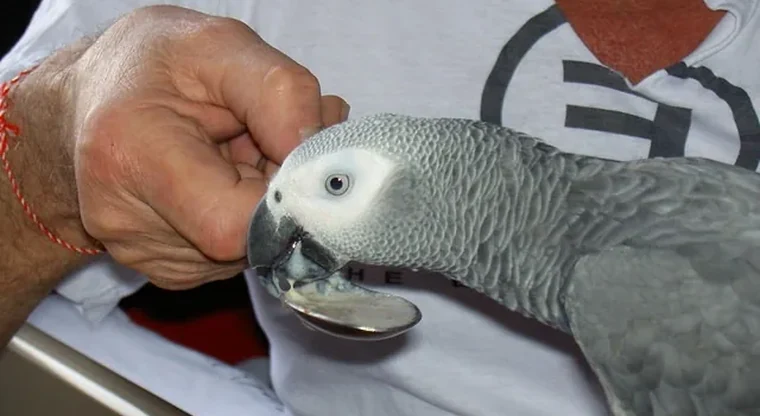 The policy Our African Grey health guarantee in full The complete written policy this page summarises, including fine print we did not have room for here.
  Scam guide How to avoid African Grey parrot scams Where a guarantee badge sits among the other signals a fraudulent listing gives off.
 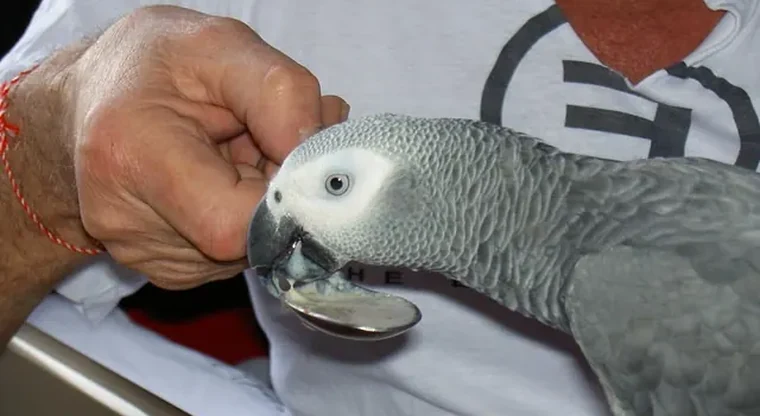 Who we are Trusted African Grey parrot breeders Mark and Teri, the licence, the aviary, and why any of that should matter to you.
 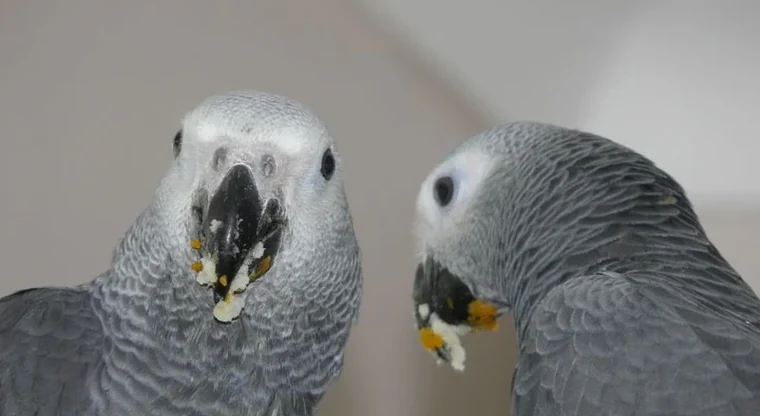 Testing DNA-tested African Greys for sale The sexing assay that runs off the same sample as the disease panel, priced openly.
 Also from our aviary
Fertile African Grey eggs are the one thing we will not attach a warranty to, and that page sets out the incubation arithmetic behind the decision.
Adult breeding pairs sell on their own written terms rather than these, with whichever proven birds are currently available listed there.
Our Congo pair listing covers the two birds we keep bonded as a unit and price together, which is a different purchase from a single weaned baby.
Ten questions we are asked most often about the window, the remedy and the paperwork — answered here at C.A.Gs in the same words we would use on the phone.
It covers two things, and we name them rather than leaving you to guess. The first is a congenital defect — something your grey was hatched with that no examination could have surfaced beforehand. The second is infectious disease already incubating when he left us and not yet showing itself. Separately, anything that goes wrong in transit is covered for 24 hours from arrival. What it does not stretch to is an illness acquired after delivery, because at that point we would be guaranteeing a household we have never seen.
It is long enough to do the one job a guarantee can honestly do, which is get an independent avian vet to look at your bird while the question of who was responsible is still answerable. Seventy-two hours is not a limit on our interest in your grey; we answer messages years later. It is the boundary of what we can fairly stand behind, because after three days in a new home the diet, the air and the stress are yours rather than ours. A twelve-month promise sounds generous precisely because nobody expects to honour it.
Ring an avian vet first and us second, in that order, because the examination is what makes everything afterwards possible. Book inside the 72-hour window, mention that your bird has just travelled, and ask for the findings in writing. Send us that diagnosis and we settle it as replacement or refund, at our discretion. There is no claims department here; it is Mark or Teri reading your email. What we cannot act on is a description of symptoms alone, however worrying, because the vet's record is the only thing either of us can rely on.
Four things, all published rather than buried. Removing the closed leg band voids it, because that band is the only physical link between the paperwork and the parrot. Improper diet or husbandry voids it, and a seed-only bowl is the usual culprit. Exposing your grey to other birds during the first thirty days voids it, since a new bird can carry something yours did not arrive with. Skipping the avian-vet exam inside the window voids it too, at which point the bird is sold as-is. None of these are traps; each marks the point where we can no longer tell what happened.
Yes, and we would push you to do it even if no guarantee existed. An avian vet is not the same as a general small-animal practice; birds hide illness so well that a trained eye catches things days or weeks before an owner would. Book the appointment before your grey arrives rather than after, because good avian practices run a waiting list and the window does not pause while you find one. Bring the paperwork folder — the vet will want the band number and the screening results, and it starts your grey's own medical record properly.
Ask for something only a real breeder can produce, then watch what happens. A live video call with the specific bird, taken now, on request, is the hardest thing for a fraudulent listing to fake. Beyond that: a real breeder has a physical address you can look up, a licence you can verify, a price that sits in the actual market, and no objection to your questions. Payment method is the loudest tell — anyone steering you toward a wire, a gift card or a peer-to-peer app is choosing the one route with no recourse, and that choice is the whole scam.
Because the costs underneath a grey do not move. A hand-raised chick eats formula every few hours for months, and somebody is awake to feed it. The pre-sale avian-vet exam, the PCR disease panel, the DNA sexing and the CITES paperwork each carry a real invoice. At $800 the arithmetic fails before the bird is even weaned, which means something in the description is untrue — the bird, the testing, or the seller. That is why the price is the first thing to check and the last thing to negotiate on.
Five, and they arrive together in one folder rather than trickling in afterwards. The written health guarantee itself, with the window and the remedy on it. The avian-vet health certificate from the pre-sale examination, dated within ten days of travel. The DNA sexing certificate naming the hen or cock. Your CITES Appendix I captive-bred documentation. And the closed leg band already on your grey's leg, whose number appears on the paperwork so you can match them yourself. Check the band against the certificate on day one; it takes a minute and it is the whole point.
Both, before a bird is ever listed rather than after somebody asks. Sexing runs by PCR on a feather or blood sample and comes back as a certificate tied to the band number. The disease screening runs off that same sample type and covers psittacine beak and feather disease, avian polyomavirus and psittacosis. We would rather find something at that stage and deal with it here than have you discover it in your living room, which is the practical reason the guarantee is affordable for us to offer at all.
They cannot, and no seller who understands the document would claim otherwise. Everything on this page rests on a bird we raised, examined and can describe to a vet — an egg gives us none of that, because whatever is inside it has not yet declared itself. Incubation outcomes also depend on equipment we will never see and a temperature curve we cannot audit, so a promise attached to an egg would be a promise about your incubator rather than our aviary. That is the honest reason we weaned the birds on this page before pricing them.
No, and the difference is worth understanding before you ask. Our window is built around a weaned baby whose whole history happened here, which is what lets us separate a fault we caused from one that arrived later. An established adult has years behind it, some of that time in an aviary rather than a nursery, so the clean line between our responsibility and yours blurs. Pairs are therefore sold on their own written terms, set case by case, and we would rather say that plainly than stretch a document until it stops meaning anything.
Yes, and shipping is exactly where the extra 24-hour window earns its place. Your grey travels as IATA-compliant live-animal cargo on Delta, United or American in a ventilated crate, on a direct flight wherever the route allows. From the moment you collect him, anything transit-related is covered for a day, and the 72-hour health window runs alongside it. If Midland is within two or three hours of you, collecting in person is free and skips the question entirely — several buyers make the drive for that reason alone.
Tell us which grey you are looking at and where you are, and one of us will reply within a day — usually much sooner. A $200 deposit holds a bird; the written guarantee is issued in your name at that point, not after delivery.
Every grey below ships under the identical 72-hour written terms.
Ships nationwide · $185 airport · $350 home · free collection in Midland, TX.