Congo African Grey Parrot Pair for Sale — Two Documented Birds, and the Honest Answer About Bonding
Most places selling you a pair will not tell you that two greys often end up preferring each other. We will, before you spend anything, because the answer changes which birds you should actually take home. Every bird here is captive-bred in the USA at our USDA AWA licensed aviary and leaves with its own CITES Appendix I documentation.
Will Two African Greys Bond to Each Other and Ignore You?
Often, yes — if you house them together all day and treat them as a unit. Two greys close in age will make each other the primary relationship and reduce you to staff. It is not inevitable. Separate cages, fifteen to thirty minutes alone with each bird daily, and training them one at a time keeps both birds people-focused. If you cannot give that time, one grey will love you more than two ever will.
The Short Answer Before You Scroll
That paragraph is the whole page in miniature, and we would rather you read it before you look at a single price. Buying a companion pair of African Greys is not the same decision as buying two African Greys, and the difference is entirely in what you do after they arrive.
What This Page Covers, and Where to Jump
Below you will find every pair and single we currently have, the three genuine routes to owning two birds, what a documented pair costs elsewhere, and the protocol we hand every pair buyer. Our honest case for buying one bird instead sits in the middle of the page rather than buried at the bottom, because for a fair number of households it is the right answer.
Which Congo African Grey Pairs and Singles Can You Reserve From Our Aviary?
Everything below is a real bird in our aviary right now, priced from our live inventory rather than from a template. The filter sorts by how you would take them home, because that is the decision most pair buyers are actually making.
Browse by route
Ships nationwide · $185 airport · $350 home
Ready-Made Pair
Jins & Jeni
$3,500
Two birds, one reservation
DNA sexed · CITES papered
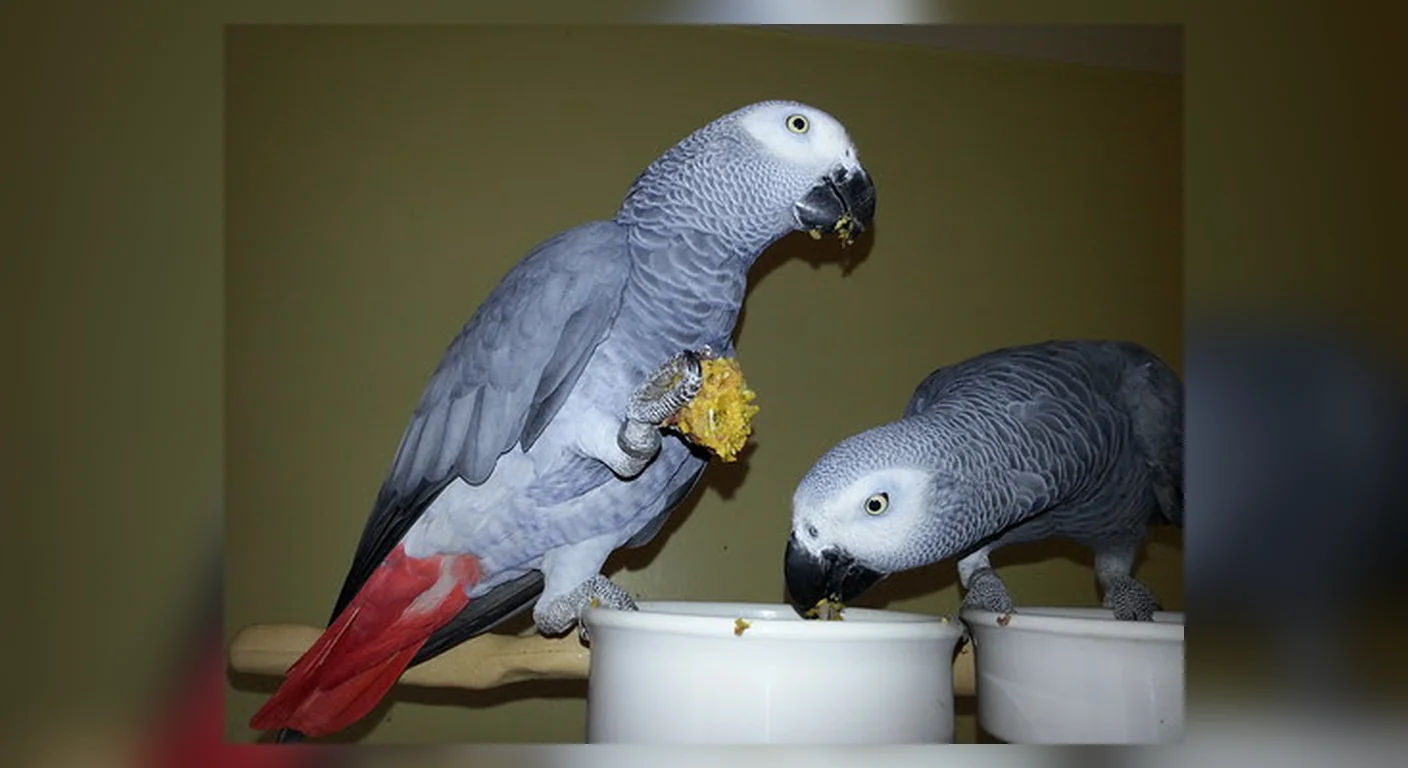
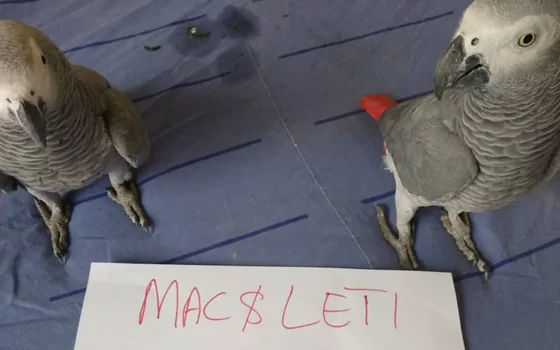
Jins (male, about six months) and Jeni (female, about four) were raised alongside each other here. Unrelated, both hand-raised, both papered.
Roys is a confident male, Amie a steadier female. Bought together they arrive as two individuals, not a unit, which is the configuration that keeps both birds people-focused.
How Does the Deposit Work on a Two-Bird Reservation?
One deposit of $200 holds a pair, not two deposits. It comes off the balance and it stops us showing those birds to anyone else while you arrange the rest.
Every Price on This Page Comes From Our Live Inventory
If a bird sells, it comes off this page rather than sitting here as bait. We would rather show you four birds that exist than twelve that do not.
From the Aviary: Jins Is the Elder of the Two by Roughly Eight Weeks
That gap matters more than it sounds. Jins reached each developmental stage first, and Jeni copied him through most of it, which is part of why they settle so easily together.
What Should You Know Before Committing to a Second Grey?
If you read nothing else on this page, read these five lines. They are the ones buyers tell us they wish someone had said before they bought.
The Five Facts That Decide This Purchase
The receipt
A pair bonds to itself
unless you actively work against it, every day
Two birds double the work
they do not halve it, and they do not entertain each other on your behalf
Two cages, not one
shared housing is the fastest route to two birds that ignore you
Both birds are papered separately
two CITES sets, two DNA certificates, two health certificates
One bird is a complete answer
and for a first-time owner it is usually the better one
From$1,800
A single documented Congo. A ready-made pair is $3,500, and our proven breeding pairs run $3,000 to $5,500.
Why Does a Pair of African Greys Sometimes Stop Needing You?
This is the question buyers ask us privately after they have already paid someone else, and it deserves a straight answer rather than a reassuring one. A grey is built to live in a flock and to pair-bond within it, and when you supply a second grey you have supplied the flock.
What a Pair Bond Actually Is in Psittacus erithacus
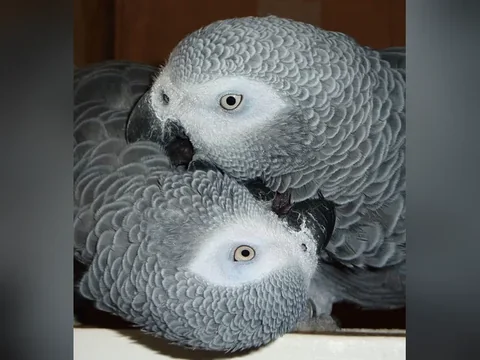
A pair bond is a preferred social partner, not a marriage and not necessarily a mating. Two greys who preen each other, call to each other across a room and choose the same perch have formed one. World Parrot Trust field material on grey social structure describes flocks that break into stable pairs well outside any breeding season, which is exactly what we see in our own aviary among birds far too young to breed. ↗
The Three Conditions That Make Human Bonding Fade
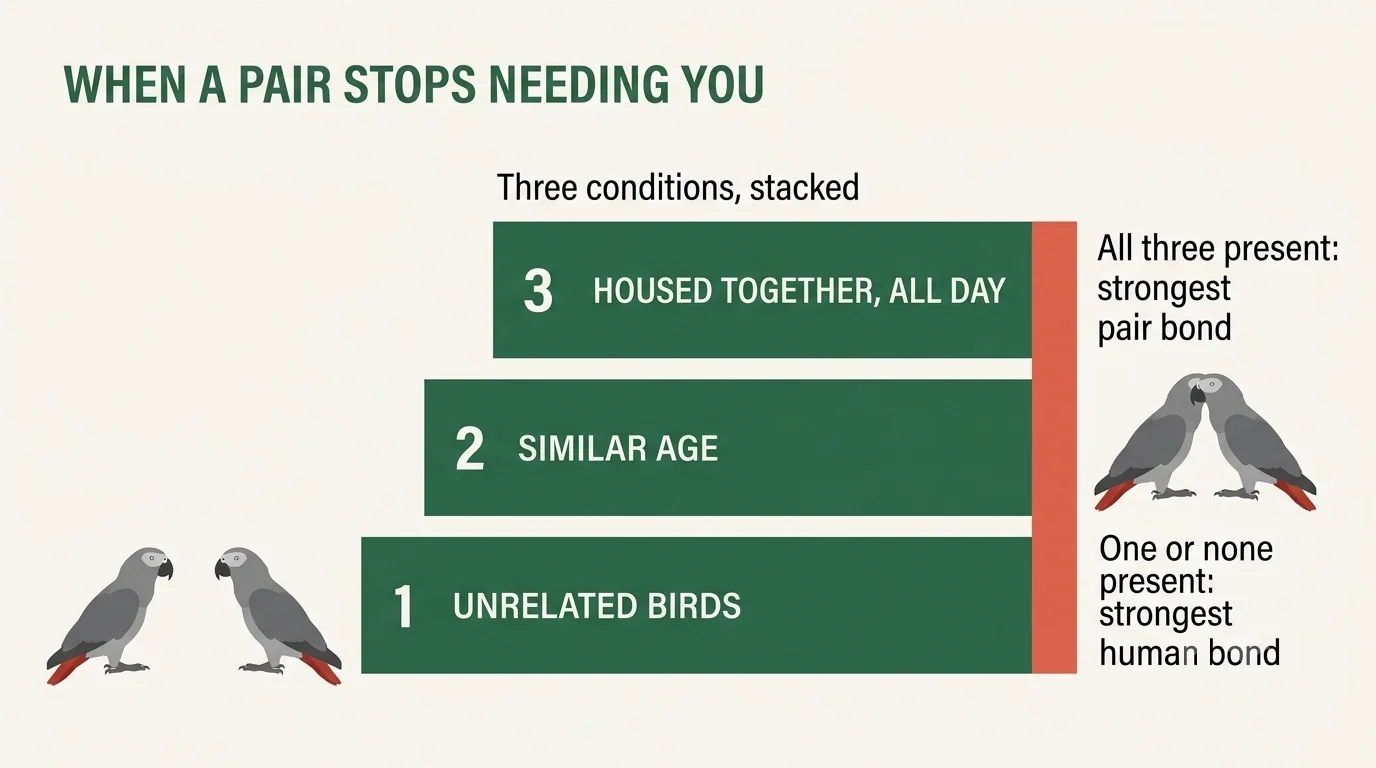
In our experience it takes all three together, and removing any one of them changes the outcome. The birds are unrelated, they are close in age, and they are housed together with constant access to each other and little separate handling.
All three present is the strongest pair bond. Remove any one of them and the human bond holds.
Does Buying Two Birds at Once Cause This?
Buying two at once raises the odds, because neither bird has an established relationship with you to fall back on. A grey that has lived with you for two years before a second arrives usually keeps its human bond intact.
Does It Matter If the Two Birds Are Unrelated?
It does, and not in the direction most people assume. Unrelated birds of similar age are more likely to pair-bond than siblings raised together, which is one reason the pairs sold as ready-made are the ones most likely to end up self-sufficient.
Owners Report Both Outcomes, and Husbandry Decides Which
Read enough owner threads and you will find people whose two greys adore them and people whose two greys barely acknowledge them. The difference is almost never the birds.
Before You Commit: Our Own Jins and Jeni Meet All Three Risk Conditions
They are unrelated, they are eight weeks apart, and they have been housed together since they weaned. We are telling you that about our own flagship pair because it is true and because the protocol below is the answer to it.
Constant shared access is the single strongest predictor of a pair that stops needing people.
What Does a Bonded Pair Protect Your Grey From?
Everything above is one half of the trade, and reporting only that half would be as misleading as the sales pages that report neither. There are real things a pair gives a grey that a single bird never gets.
The One-Person-Bird Problem a Single Grey Often Develops
Greys are notorious for choosing one human and defending that choice against everyone else in the house. It is the most common behavioural complaint we field, and it lands hardest on families. A second bird spreads the social load and takes the edge off it.
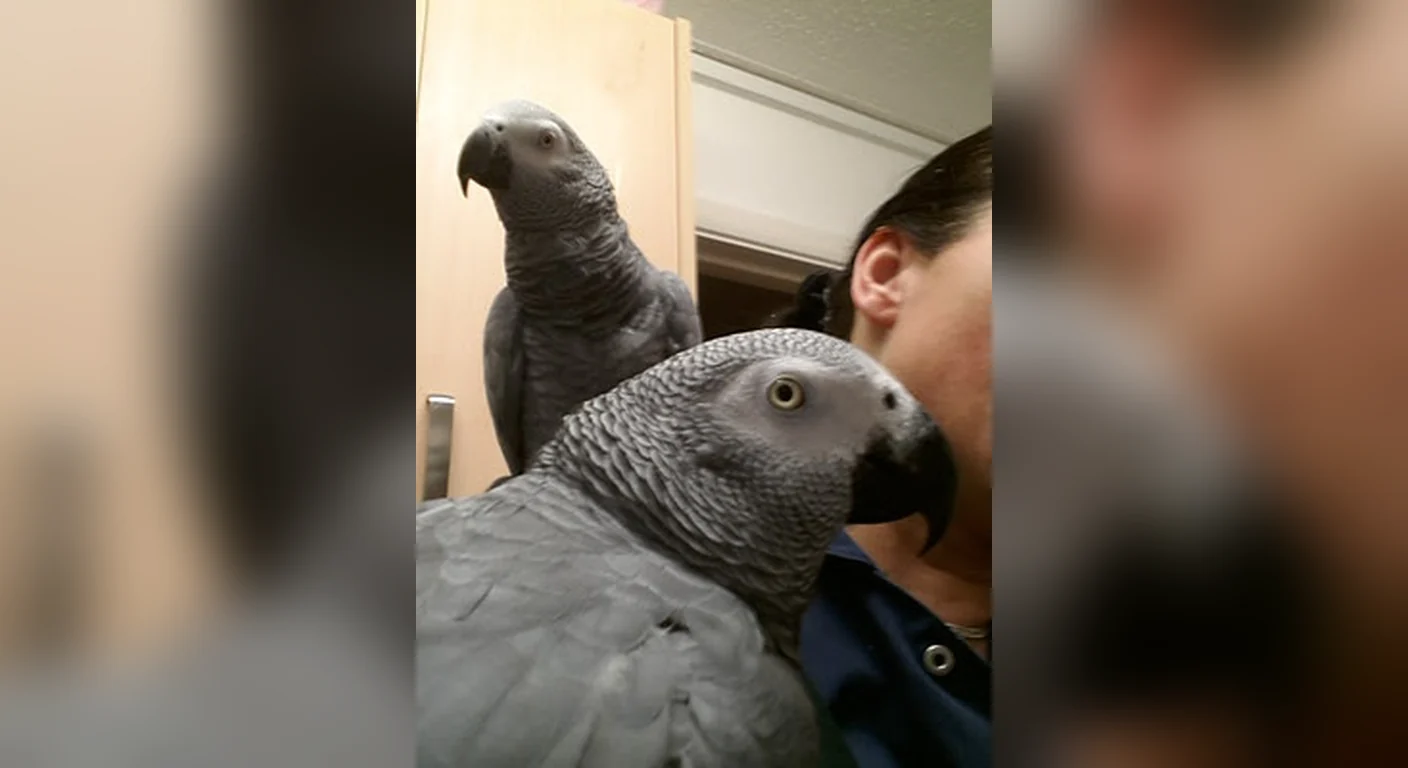
Two birds comfortable with the same person at the same time. That is the outcome the protocol below is aiming at.
Boredom, Plucking, and the Cost of an Under-Occupied Grey
A grey alone in a quiet house for nine hours is an intelligent animal with nothing to do. Lafeber's companion-bird behaviour library treats enrichment and social contact as core husbandry rather than enrichment extras, and company is one form of that contact. ↗
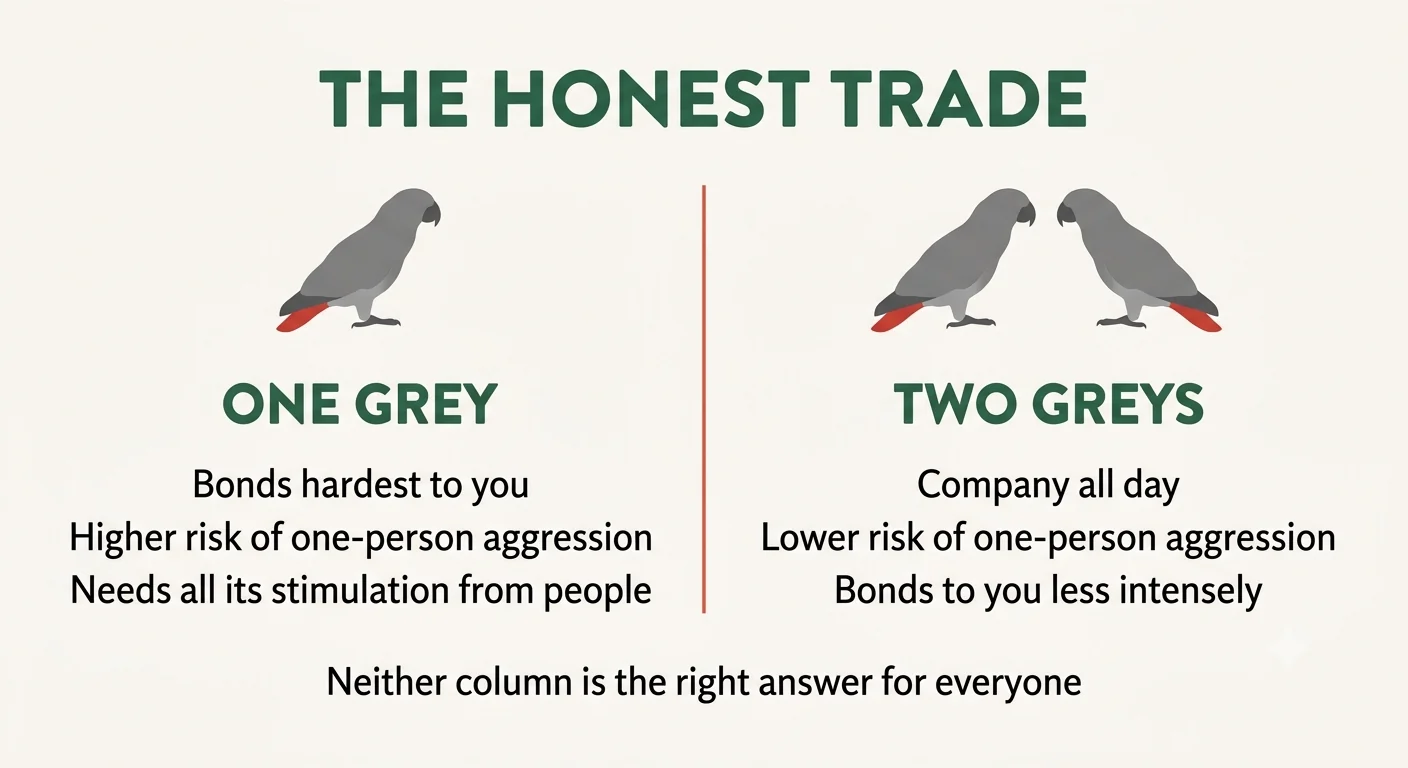
Both columns are true at once. Which one you want decides the purchase.
Are Two Greys Really Less Neurotic Than One?
Often, in households where the birds would otherwise be alone all day. Not reliably, in households where one bird would have had constant company anyway.
Feather-Destructive Behaviour Is Multi-Causal, Never Just Loneliness
Plucking has dietary, medical, hormonal and environmental drivers, and an avian vet works through all of them. The Association of Avian Veterinarians directory is where to start if you are seeing it. ↗
Two-Bird Note: Company Is Not a Treatment for Plucking, and We Never Sell It as One
If a seller offers you a second bird as a fix for a plucking grey, they are guessing with your money.
How Do You Keep a Pair Tame and Still Bonded to You?
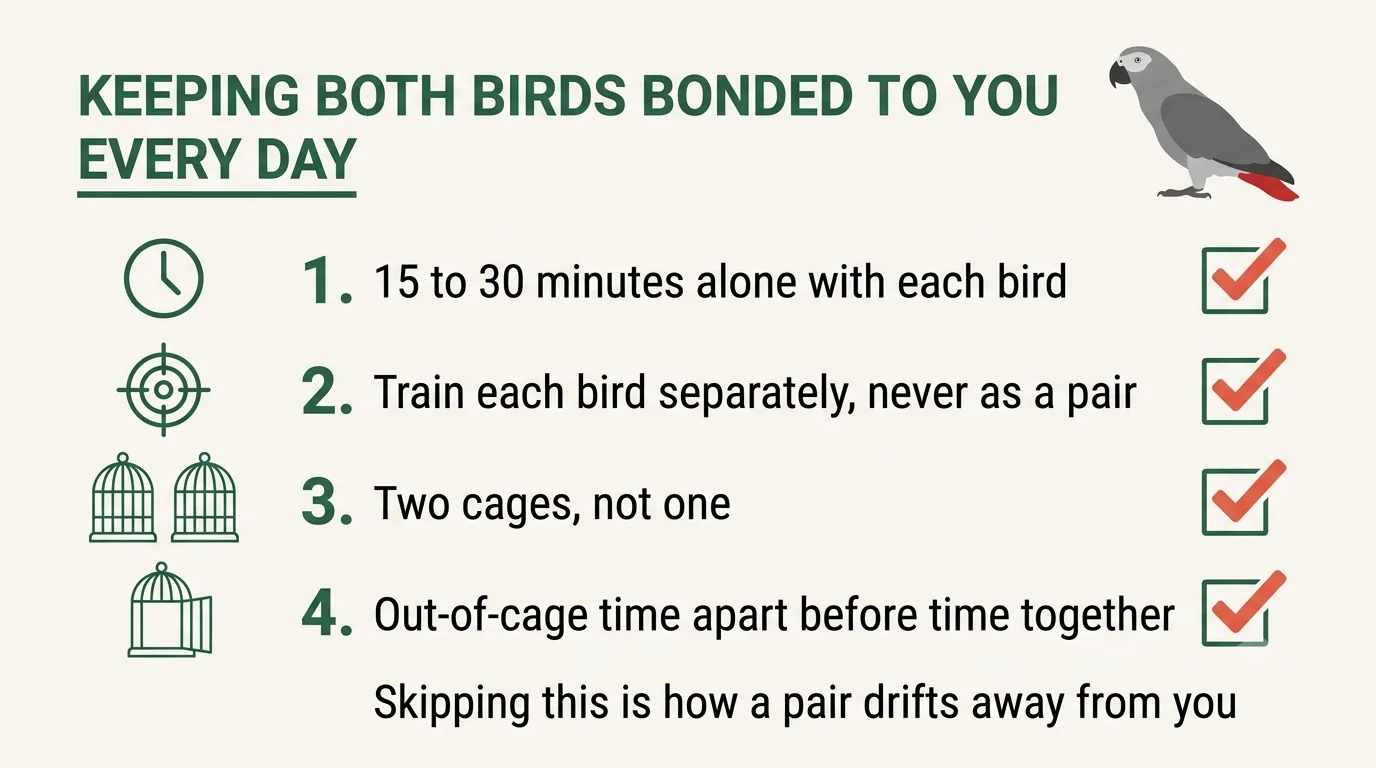
This is the part nobody hands you at the point of sale, and it is the whole difference between two birds that love your household and two birds that live in it. None of it is difficult. All of it is daily.
Separate One-to-One Time, Every Day, Per Bird
Fifteen to thirty minutes with each bird, alone, out of sight of the other. Not shared time in the same room. The point is that each bird experiences you as its own relationship rather than as a feature of the environment they share.
Training Each Bird Alone Rather Than as a Unit
Target training, step-up, recall, simple foraging puzzles — done individually. A bird that has learned something with you has a reason to seek you out. Two birds trained together learn to watch each other instead.
Our aviary · Midland, TX A one-to-one socialisation session, filmed here. This is what each bird in a pair needs on its own, away from the other.
Why We Recommend Two Cages, Not One
Two cages is the structural version of everything above. It gives you a way to separate without a confrontation, it lets each bird have its own territory, and it means an illness in one bird is not automatically an illness in both.
Four habits, done daily. Skipping them is how a pair drifts away from its owners.
30 Minutes a Day per Bird Is the Number That Keeps a Pair Tame
Fifteen minutes is the floor and thirty is comfortable. Two birds therefore need roughly an hour of your undivided attention a day before you count any shared time at all.
Can You Undo a Pair Bond That Has Already Formed?
Partially, and slowly, and it is far harder than preventing it. This is why the first thirty days matter more than the first year.
Separating a Settled Pair Causes Measurable Distress
Splitting two birds who have lived together for years is not a neutral act, and we would not recommend buying a pair on the assumption you can undo it later.
Two-Bird Note: The Midland Socialization Method Applied to Two Birds
Our house method puts every chick through family handling and out-of-cage routine with several people. With a pair we run it twice, in parallel, deliberately keeping the two birds' sessions apart so neither learns to rely on the other's confidence.
We sell more birds by answering this honestly than we would by avoiding it, and it is the reason Jins and Jeni can be split. A pair is a configuration, not an upgrade.
Two Birds Is Two Lifetimes, Not One Purchase
A Congo African Grey lives roughly 40 to 60 years in good care. Buying a pair is not one long commitment, it is two overlapping ones, and the second bird will very likely outlive the arrangement you are imagining today. Households that think that through and still want two are the ones a pair suits.
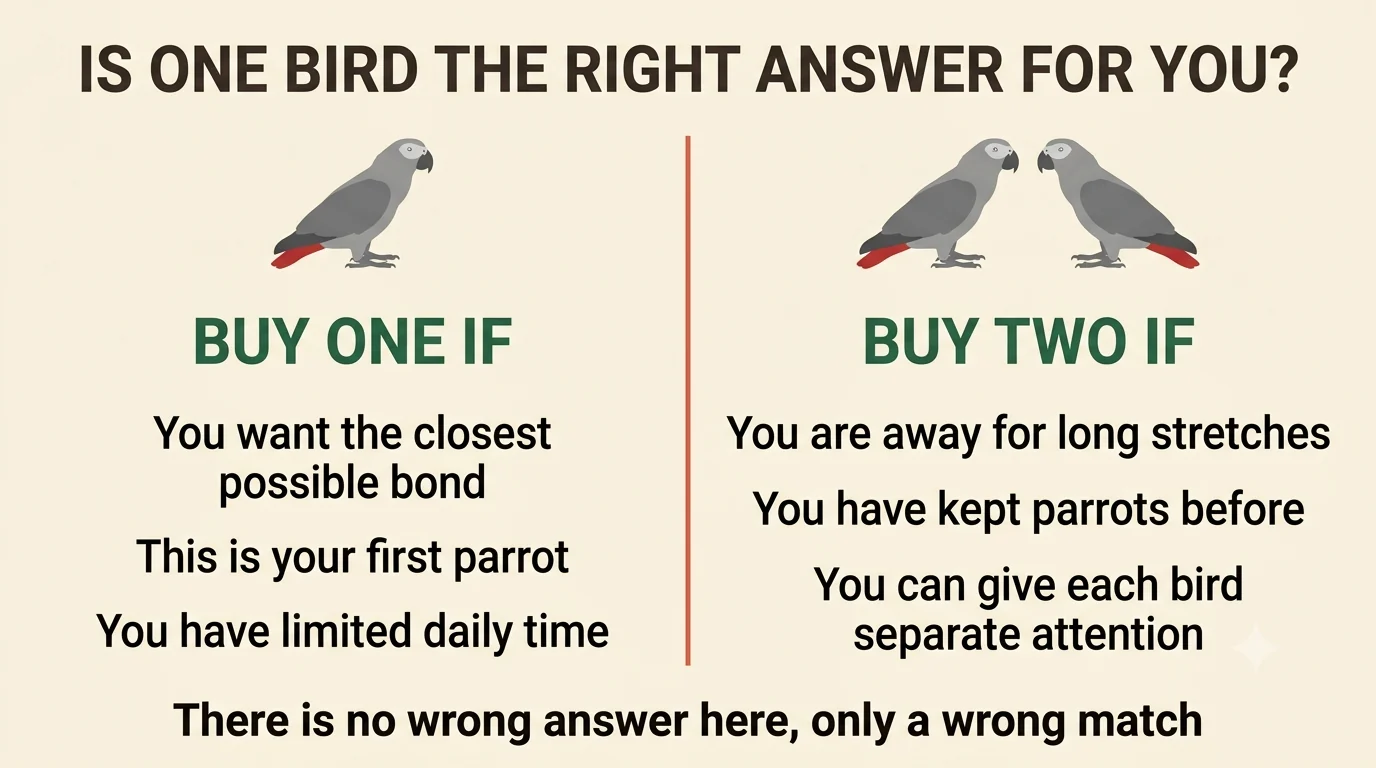
Buyer Profiles That Do Better With a Single Grey
If you want the closest possible relationship with a parrot, buy one. If this is your first parrot, buy one — a single grey is a large enough project on its own. If your daily free time is genuinely limited, buy one, because two birds without individual attention is the configuration that produces the outcome at the top of this page.
Buying One Now and a Second Later
This is the route we quietly recommend most often. Take one bird, build the relationship, and add a second in a year or two if the household still wants it. The established bird keeps its human bond, and the new arrival learns from a grey who already trusts people.
There is no wrong answer on this chart, only a wrong match to a household.
Will a Single Grey Be Lonely While You Work?
A single grey in an empty house needs foraging work, radio or background noise, a window view, and a real reunion when you get home. That is a manageable list, and it is a smaller commitment than a second bird.
How Do the Three Routes to a Pair Compare?
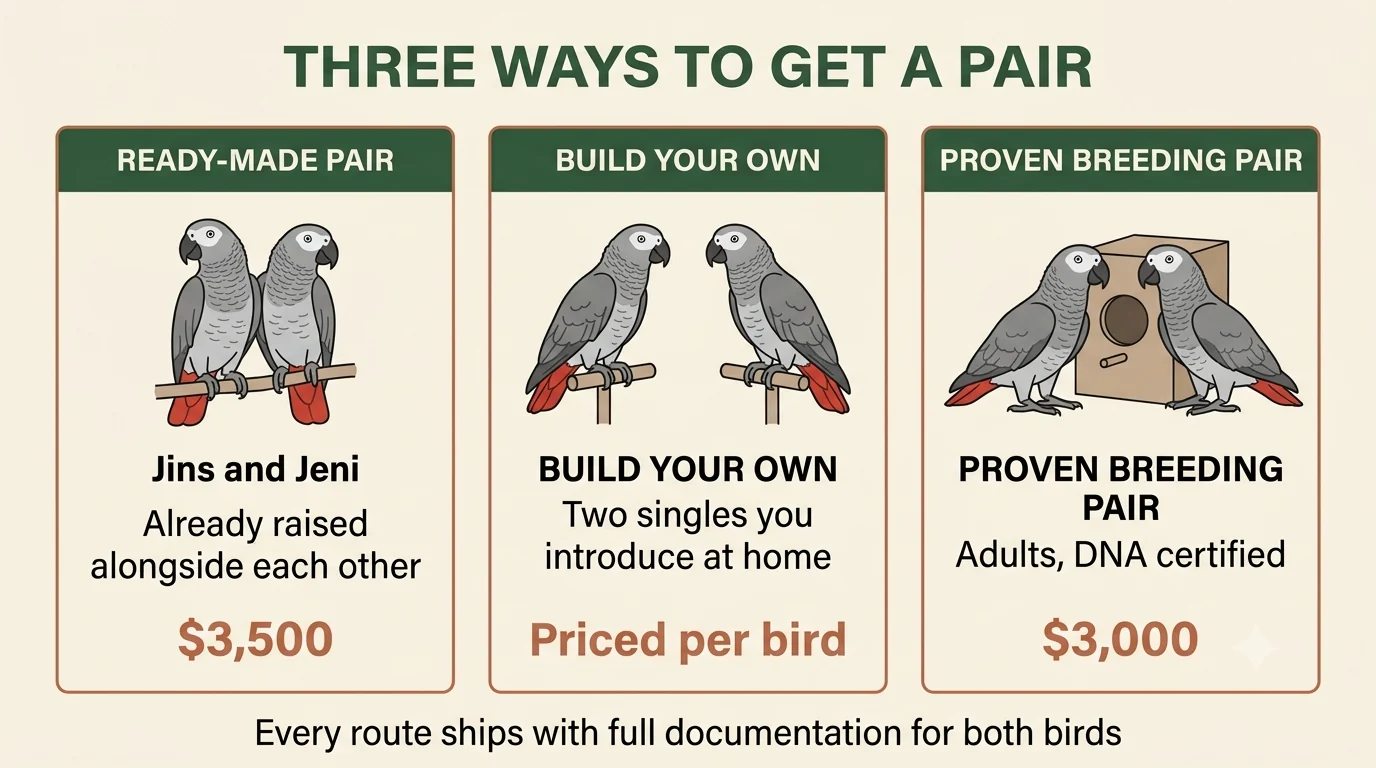
Three genuinely different purchases get called "a pair", and conflating them is how buyers end up with breeding stock in a living room. Here is what separates them.
Three routes to owning two African Greys
Route
What you get
Best for
Price
Ready-made pair
Two birds already raised alongside each other
Households out of the house on weekdays
$3,500
Build your own
Two singles you introduce yourself at home
Owners who want both birds people-focused
Sum of the two birds
Proven breeding pair
Bonded adults, closed-banded, kept for production
Established aviaries, not companions
$3,000
Three purchases the market calls one word. Every route ships full documentation for both birds.
Ready-Made Pair Versus Two Singles You Introduce
A ready-made pair is easier on arrival and harder afterwards. Two singles are harder on arrival — you run the introduction yourself — and easier afterwards, because neither bird arrives already committed to the other.
Why a Proven Breeding Pair Is a Different Purchase Entirely
Aviary stock valued on its breeding record is priced by what it produces rather than by how it behaves on a hand, and most of it is not hand-tame at all. If someone offers you a proven breeding pair as a family companion purchase, they are selling you the wrong animal.
Which Route Suits a First-Time Grey Owner?
None of them, honestly. A first-time owner is best served by a single hand-raised bird, and we would rather say so here than after your deposit clears.
Does Buying a Pair Cost Less Than Buying Two Single Greys?
Slightly, and we would rather show you the arithmetic than let it look like a bulk discount on animals.
What Two Singles Come To at Our Prices
Jins on his own is $1,900 and Jeni on her own is $1,800, so taking both separately would come to $3,700. Together they are $3,500. The $200 difference is not a volume discount — it is the handling and administration that genuinely only happens once.
What Changes on the Second Bird, and What Does Not
What happens once: the reservation, the crate booking, the flight arrangement, the conversation with you. What happens twice, at full cost: DNA sexing, the avian vet examination, the disease panel, the CITES documentation, and sixteen weeks of hand-feeding and socialisation.
Do You Pay Shipping Twice for Two Birds?
No. Airport pickup stays $185 and home delivery stays $350 for the reservation rather than per bird.
One Reservation, One Crate Booking, Two Sets of Papers
That sentence is the entire economics of a pair, and any seller offering a much steeper pair discount is discounting something else.
From the Aviary: What the Second Bird Adds to a Booking, and What It Does Not
A second bird adds paperwork, screening and rearing time. It does not add a second flight, a second crate fee, or a second round of our time on the phone with you.
What Does a Documented Congo Pair Cost on the Open Market?
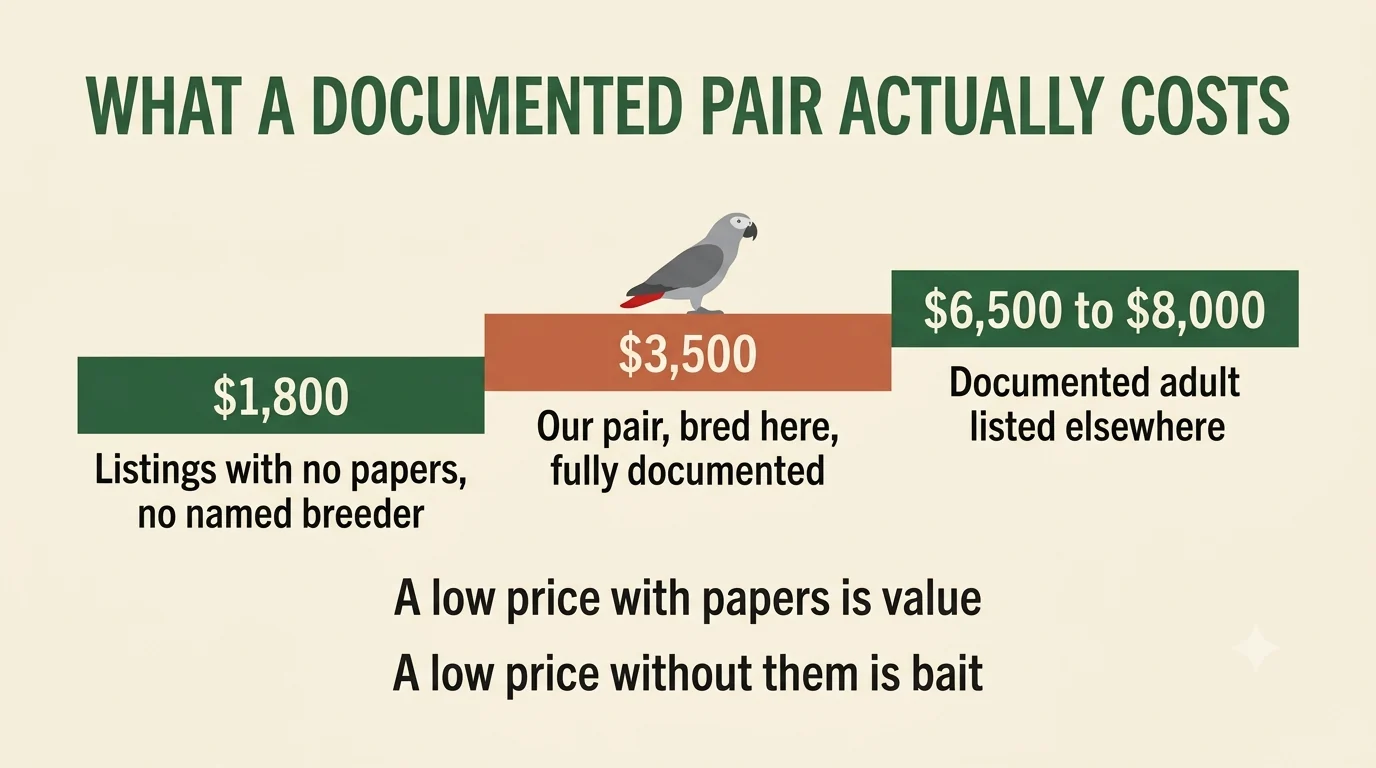
Pair pricing is the widest spread in the whole African Grey market, and the spread itself is informative. Our $3,500 sits between two very different kinds of listing.
$6,500 to $8,000 Is the Going Rate for a Documented Adult Pair
Browse the classified boards and documented adult Congo pairs are asking between $6,500 and $8,000 — a DNA-tested pair in Georgia at $8,000, bonded pairs in Maryland and Illinois at $6,500 each. Those are adult, settled, often proven birds, and the prices are real.
Why Some Listings Show a Pair at $1,800
At the other end, retail sites advertise African Grey pairs around $1,800, frequently with no breeder name, no licence number, no certificates and an add-to-cart button. Those two figures are not measuring the same thing.
The spread itself is the information. What the price sits next to tells you more than the price.
Is a Cheaper Pair Always a Scam?
No, and this is where most anti-scam advice gets lazy. Price alone tells you very little. What the price sits next to tells you everything.
A Low Price With Papers Is Value; A Low Price Without Them Is Bait
Ask for the certificates, the licence number and a live video call with both birds. A legitimate seller under market has a reason. A fraudulent one has an excuse.
Before You Commit: We Breed Ours, So No Reseller Margin Sits in the Price
Jins and Jeni hatched here and were hand-fed here. There is no importer, no broker and no middleman between our aviary and your house, and that gap is the whole reason our pair costs roughly half what a comparable documented pair asks elsewhere.
Who Are Jins and Jeni, and Do They Have to Leave Together?
They are the two birds most people arrive on this page looking for, so here is everything we know about them.
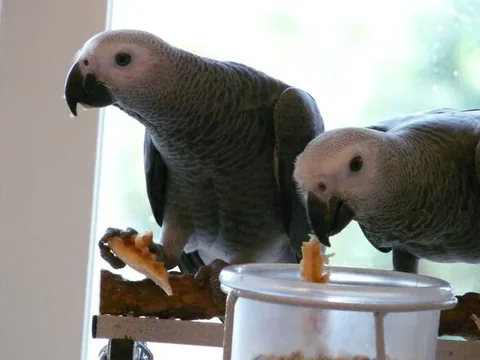
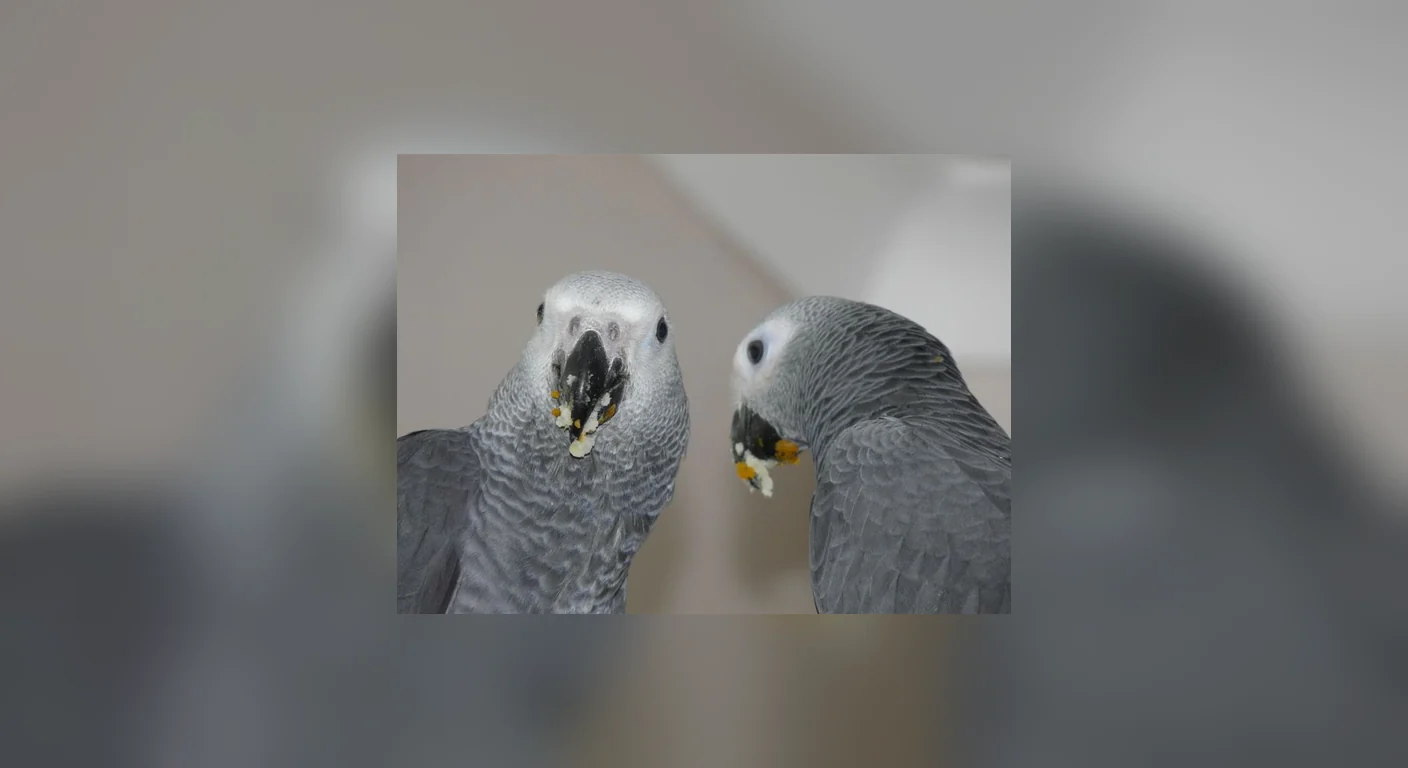
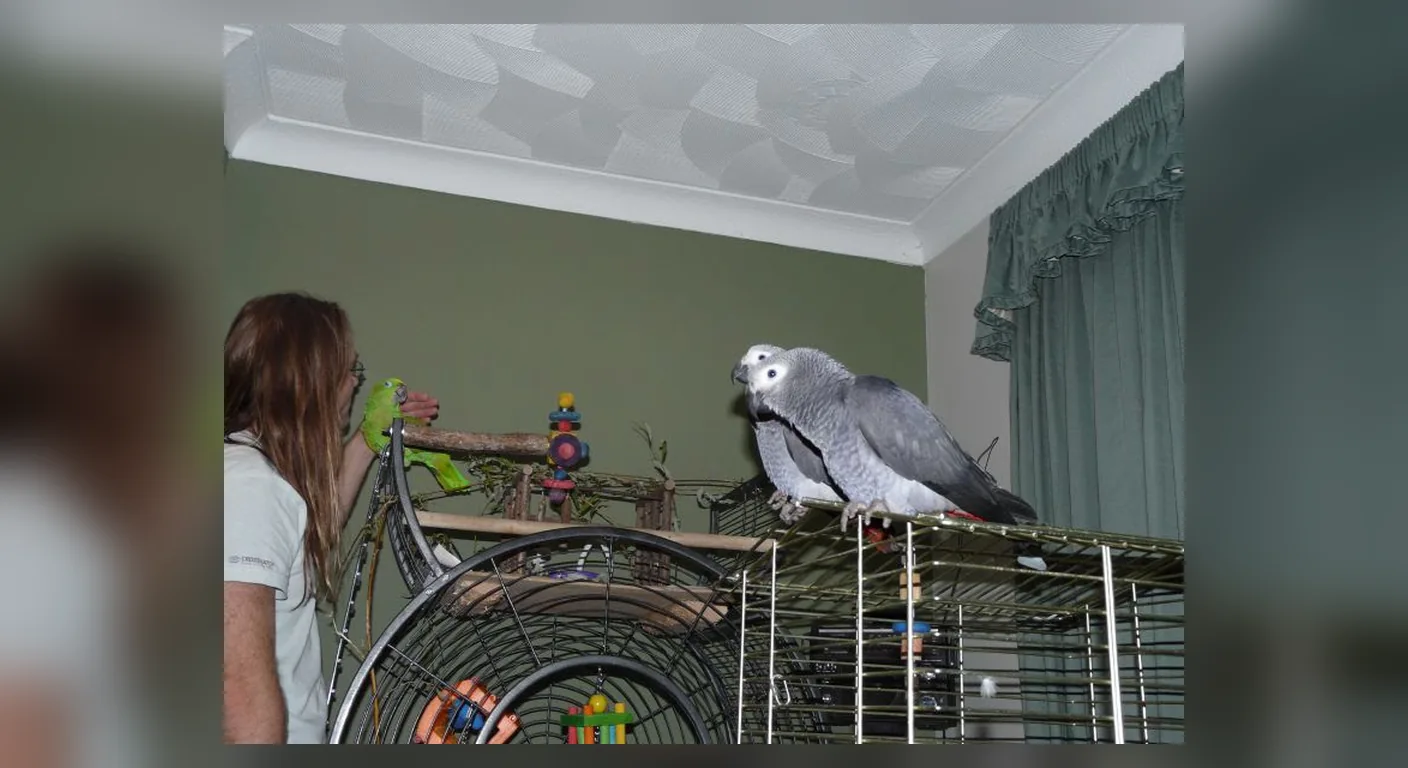
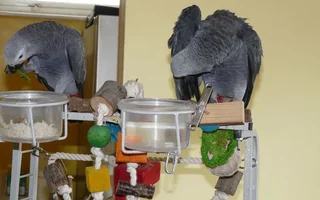
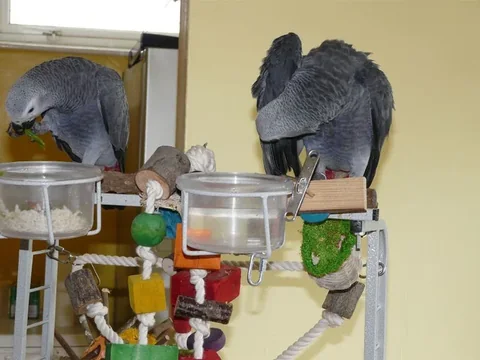
Jins and Jeni in our aviary. Unrelated, hand-raised, and offered together or singly.
Jins, Male, and Jeni, Female — Unrelated and Raised Alongside Each Other
Jins is a male of about six months and Jeni a female of about four. They come from different parents, they were hand-fed by us, and they have shared space since weaning. They are not a mated pair and they are years away from being one.
What We Tell Every Buyer Who Asks About This Pair
We tell them what section six of this page says: these two meet every condition that produces a self-sufficient pair. If you take both, the protocol is not optional. If that sounds like more than you want to take on, take one.
Can You Buy Just One of Them?
Yes. Jins is $1,900 and Jeni is $1,800 on their own. We would rather place one bird into a household that will work with it than push two into a home that wanted one.
They Are Offered as a Pair, but Neither Is Held Hostage to the Other
The pair price exists because they are easy to place together, not because we refuse to separate them. Say which bird suits you and we will talk it through honestly.
Which of Our Single Greys Pair Well Together?
If you want two birds but want both of them people-focused, this is the route we would steer you toward. Two singles, introduced under your own roof, on your own timetable.
Roys and Amie, Both Congo, Both Available
Roys is a confident male at $2,300 and Amie a steadier female at $2,500. They are siblings out of James and Lois, which means they already know each other but were not raised as a bonded unit — a middle ground between a ready-made pair and two strangers.
Elad and Evie, the Timneh Alternative
Our Timneh pair option is Elad at $1,600 and Evie at $1,500, both out of Levi and Rily. A Timneh is smaller, generally calmer and often talking earlier than a Congo, and two of them is the least expensive two-bird route we offer. ↗
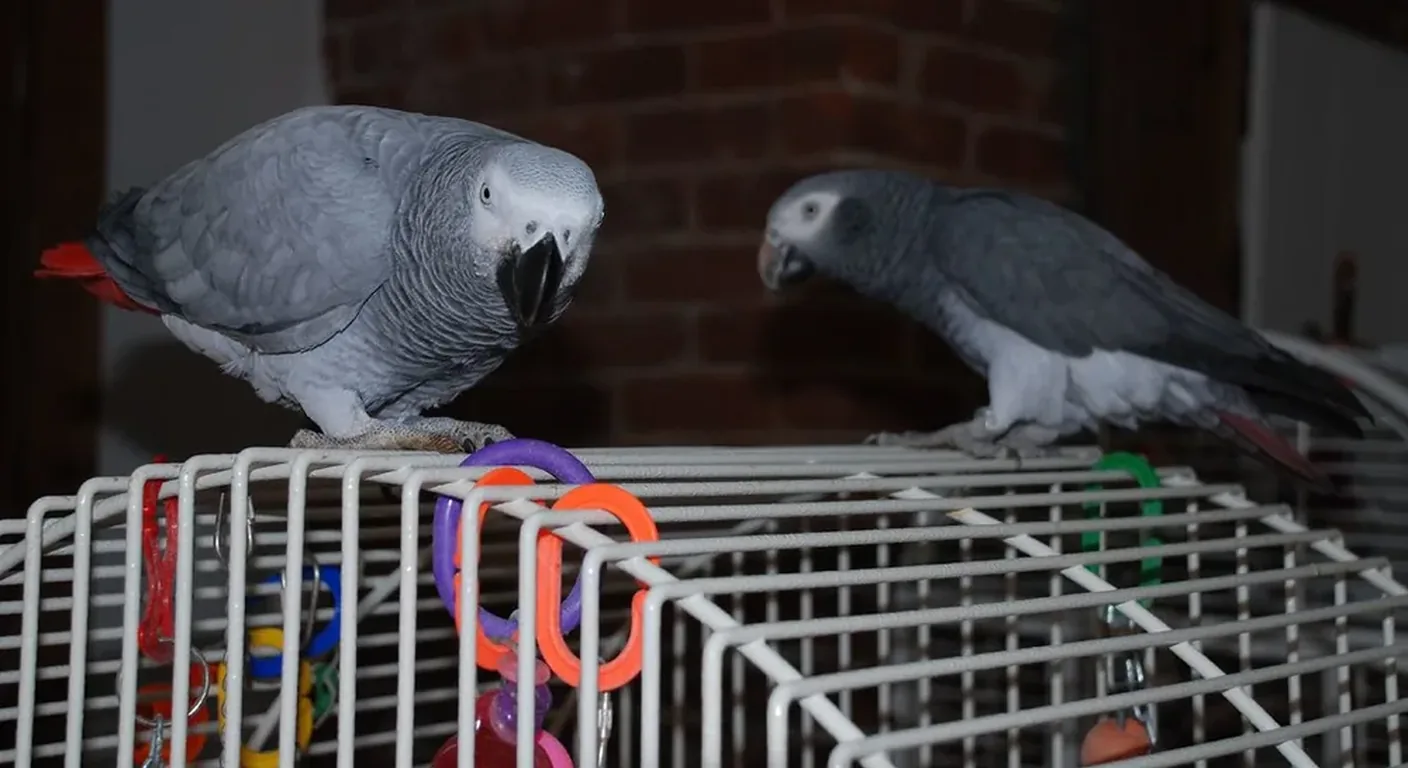
A Congo and a Timneh in our aviary. The subspecies live together perfectly well as companions.
Can a Congo and a Timneh Live as a Pair?
As companions, yes — the photograph above is our own birds. As a breeding pair, no, and we would not set one up. Different subspecies, and it is not what either bird is for.
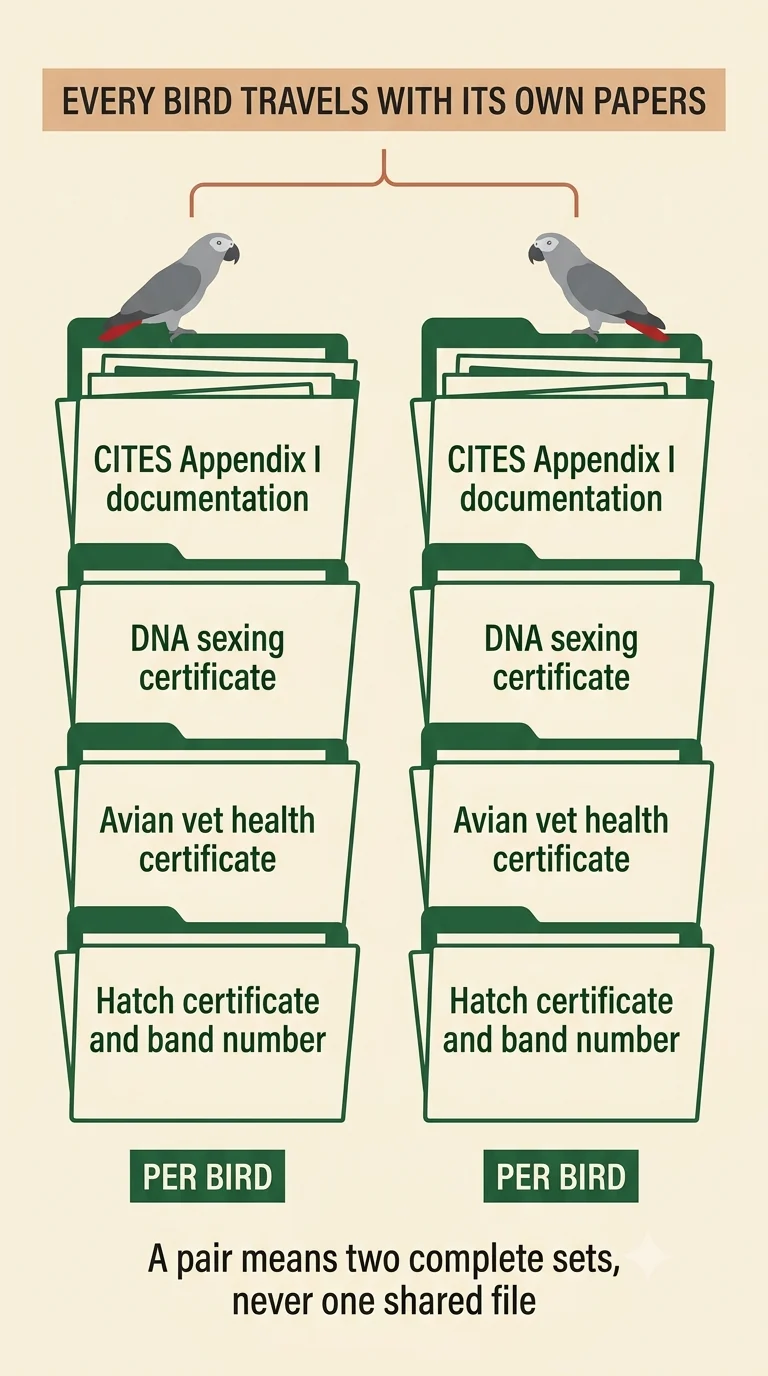
Two birds means two complete document sets. This is where a lot of pair listings quietly fall apart, because papering one bird is cheaper than papering two.
Two Birds Means Two Complete Document Sets
Each grey leaves here with its own CITES Appendix I documentation, its own DNA sexing certificate, its own avian veterinary health certificate, and its own hatch certificate carrying its band number. Nothing is shared and nothing is summarised onto one page.
DNA Sexing on Both Birds, Not Just One
Our DNA-sexing process runs on every bird we list, because a grey is monomorphic and nobody can sex one by eye. A pair sold with one certificate is a pair where somebody guessed. ↗
Two birds, two files. Nothing is shared and nothing is summarised onto one page.
Do You Need Separate CITES Papers for Each Grey?
Yes. The documentation attaches to the bird, not to the transaction, and a pair is two birds.
What Health Screening Do Both Birds Clear Before They Ship?
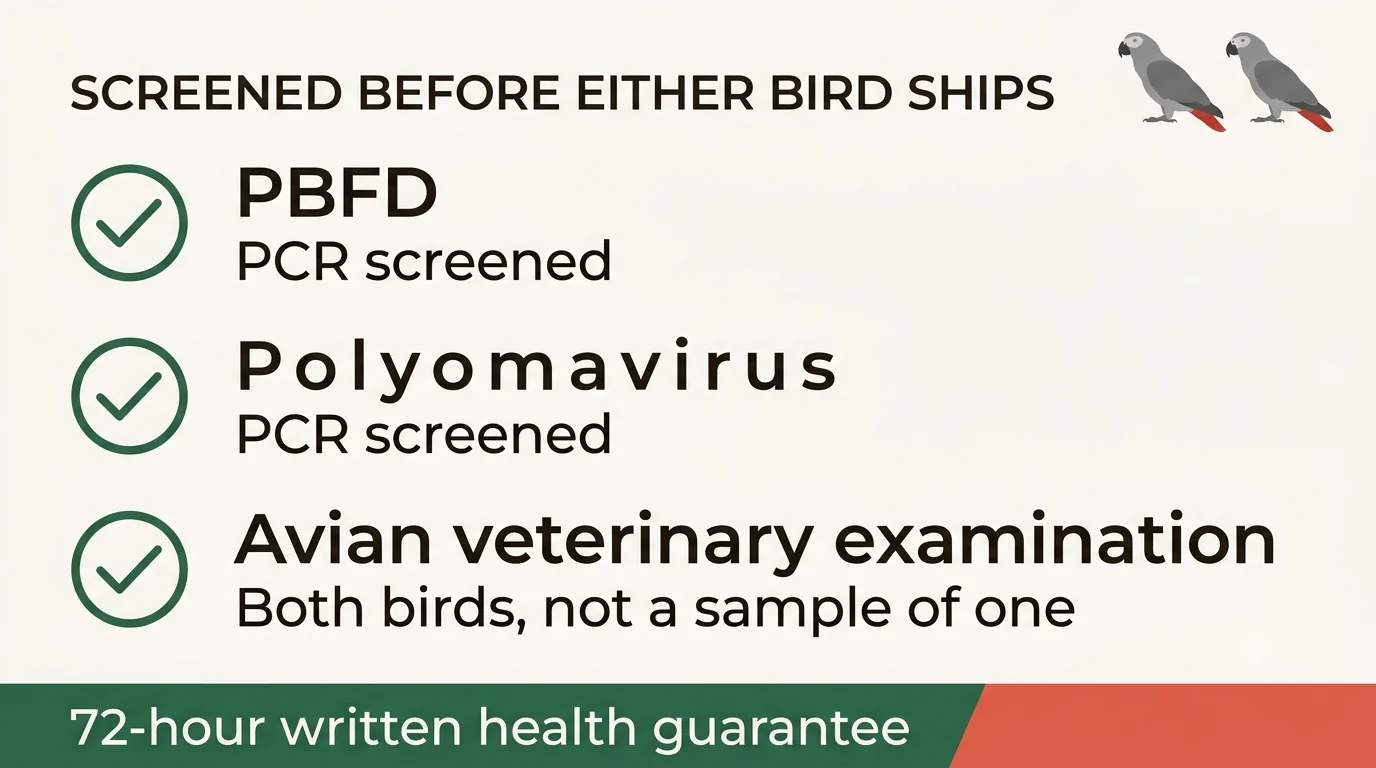
Every bird we list is PCR screened for PBFD and polyomavirus and examined by an avian veterinarian. With a pair that screening carries extra weight.
Two birds in constant contact share everything. An unscreened pair is not two independent risks, it is one shared one — and it is why we will not sell a pair where only one bird has been tested.
Both birds, not a sample of one. Neither ships until both results are back.
What Happens If One Bird of a Pair Tests Positive?
Neither ships. We do not split a pair to move the healthy half, and we do not hold the result back to save a sale. The written health guarantee behind every bird runs seventy-two hours from arrival, with a twenty-four-hour window on shipping. ↗
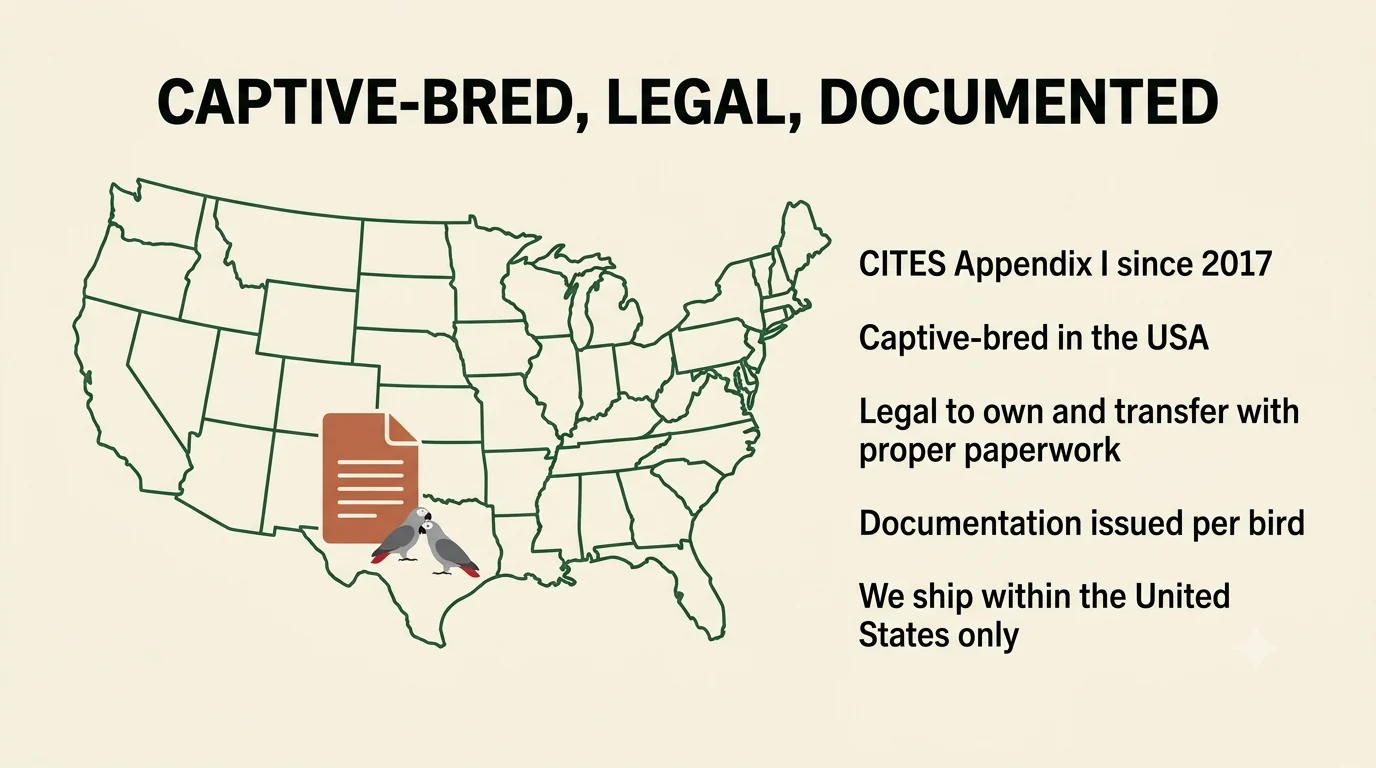
Is It Legal to Own Two Captive-Bred African Greys in the United States?
Yes, with the right paperwork, and owning two changes nothing about the legal position beyond doubling the documents.
CITES Appendix I and What It Means for Domestic Transfer
The CITES appendices listing places Psittacus erithacus in Appendix I, which governs international trade. Captive-bred birds are legal to own and transfer domestically with proper documentation, and every bird we place is captive-bred in the USA. ↗
Appendix I governs international trade. Captive-bred birds transfer domestically with their papers.
Does Owning Two Birds Change Your Legal Obligations?
Not materially. You keep two sets of papers instead of one. USDA APHIS animal-care licensing information covers the breeder side of that arrangement rather than the owner side. ↗
Appendix I Since CoP17, Effective January 2017
The uplisting from Appendix II took effect in January 2017. Any seller still describing greys as Appendix II is working from stale information, and that is worth noticing.
How Do Two African Greys Travel to You Together?
Shipping a pair is genuinely different from shipping one bird, and it is the question the old version of this page got asked most.
One Crate or Two, and How We Decide
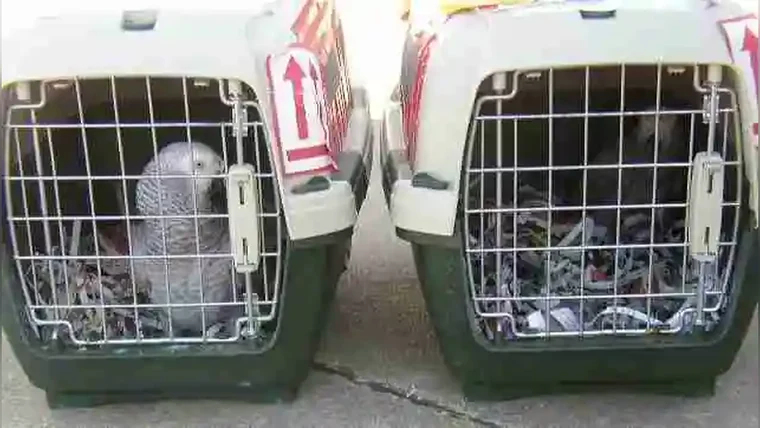
Birds already settled with each other travel together in a single IATA-compliant live-animal container. Birds that are not go into adjacent compartments on the same booking. We make that call per pair after watching them, not by policy, because a stressed bird in a shared crate is worse than two calm birds in separate ones.
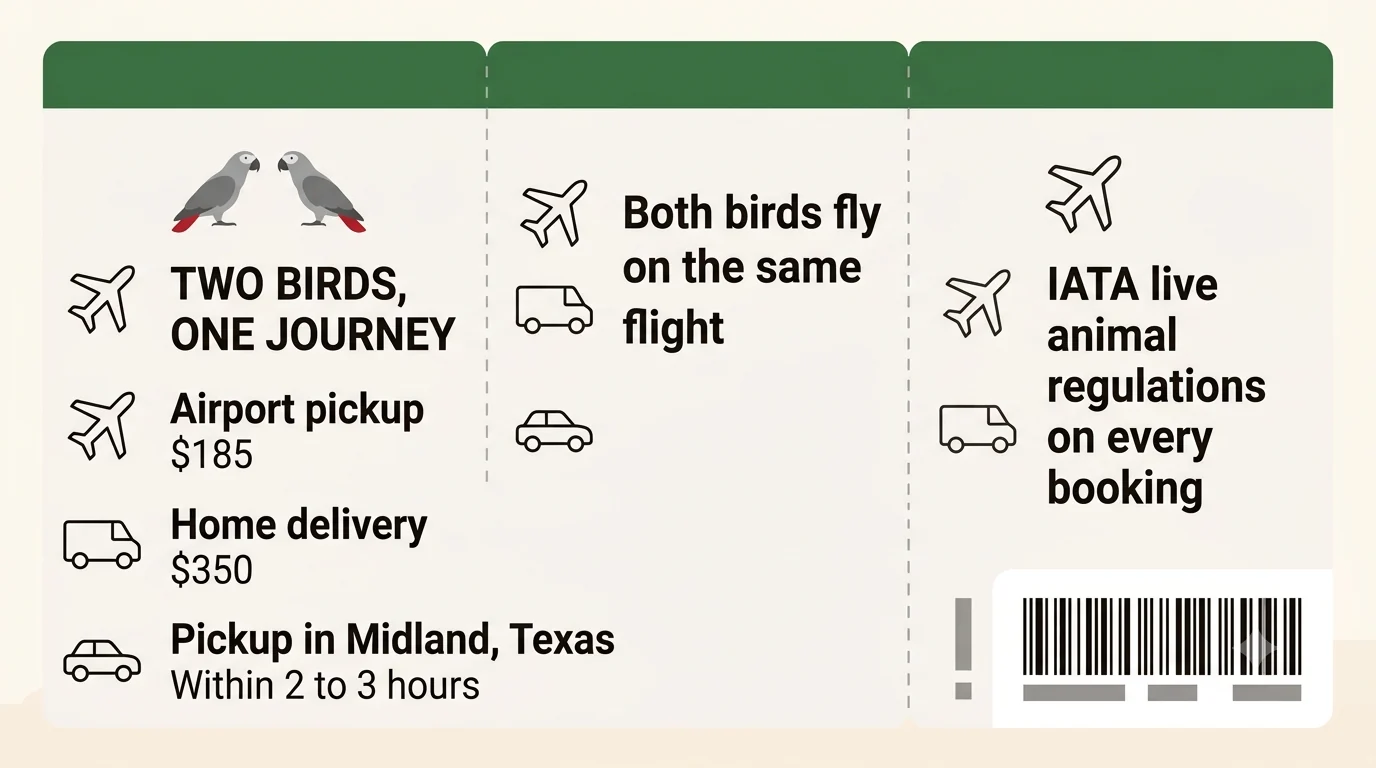
Airport Pickup at $185, Home Delivery at $350
Both figures are per reservation rather than per bird. Airport pickup puts them on Delta, United or American cargo to your nearest major airport; home delivery brings them door to door.
Airport pickup
$185
Charged once per reservation, never twice for a pair. Delta, United or American cargo into your nearest major airport, and you collect both crates at the counter.
Home delivery
$350
Door to door on the same single booking, with both birds handed over in person and each bird's file handed over with it.
If you are inside a two-to-three-hour radius of Midland you are welcome to collect in person, meet both birds first, and skip shipping altogether. It is the arrangement we prefer for a pair.
One booking, one flight, three ways to collect. The figures are per reservation, not per bird.
Do Both Birds Fly on the Same Flight?
Always. We will not split a pair across two bookings, because the arrival is stressful enough without separating them for it.
IATA Live Animal Regulations Govern Every Booking We Make
The container, the labelling, the temperature limits and the handling all follow IATA Live Animals Regulations, which is the standard the airlines enforce at the counter.
The first month sets the pattern for the next forty years, and with two birds it is the month that decides whether you get a pair or a flock of two that tolerates you.
The First Thirty Days, Cage by Cage
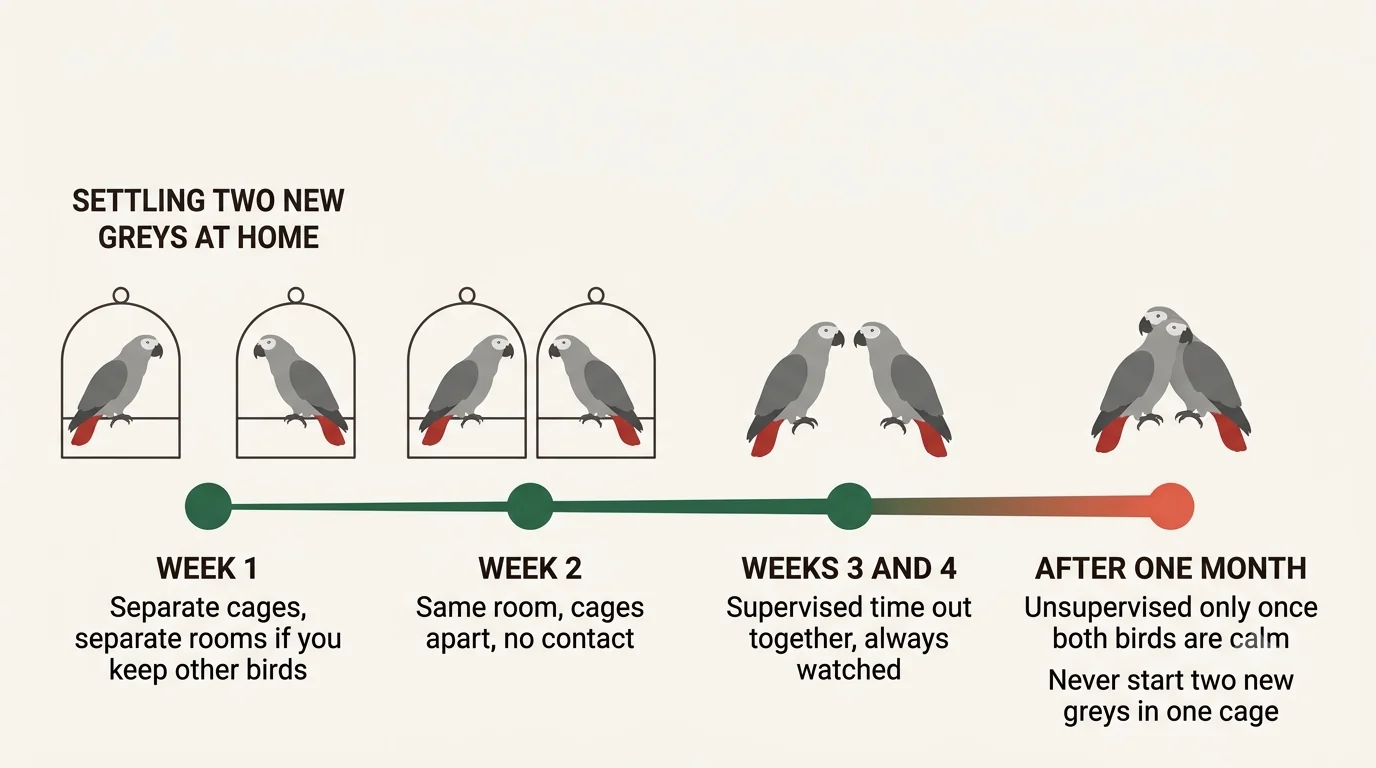
Week one is separate cages and, if you keep other birds, separate rooms. Week two brings the cages into the same room with no contact. Weeks three and four allow supervised time out together, always watched. Only after a month, and only once both birds are calm, would we leave them unsupervised.
Quarantine If You Already Keep Birds
Thirty days minimum, in a separate airspace, before any new grey meets an existing bird. Both of ours arrive screened, but screening is not a substitute for quarantine.
Four weeks, cage by cage. Never start two new greys in one cage on day one.
How Long Before You Let Them Interact Unsupervised?
A month, at the earliest, and longer if either bird is showing territorial behaviour at the cage bars.
Introduce Across a Gap Before You Ever Share a Cage
Every introduction we have seen go badly started with two birds put straight into one cage on day one.
Two-Bird Note: The Thirty-Day Separation We Ask Every Pair Buyer to Keep
It is the one thing we ask of pair buyers, and it costs nothing but patience. Our full care routine covers the rest of that first month. ↗
How Do You Verify Anyone Selling You an African Grey Pair?
Pair listings attract fraud because the ticket is bigger. These are the checks we would run on ourselves, and they take about ten minutes.
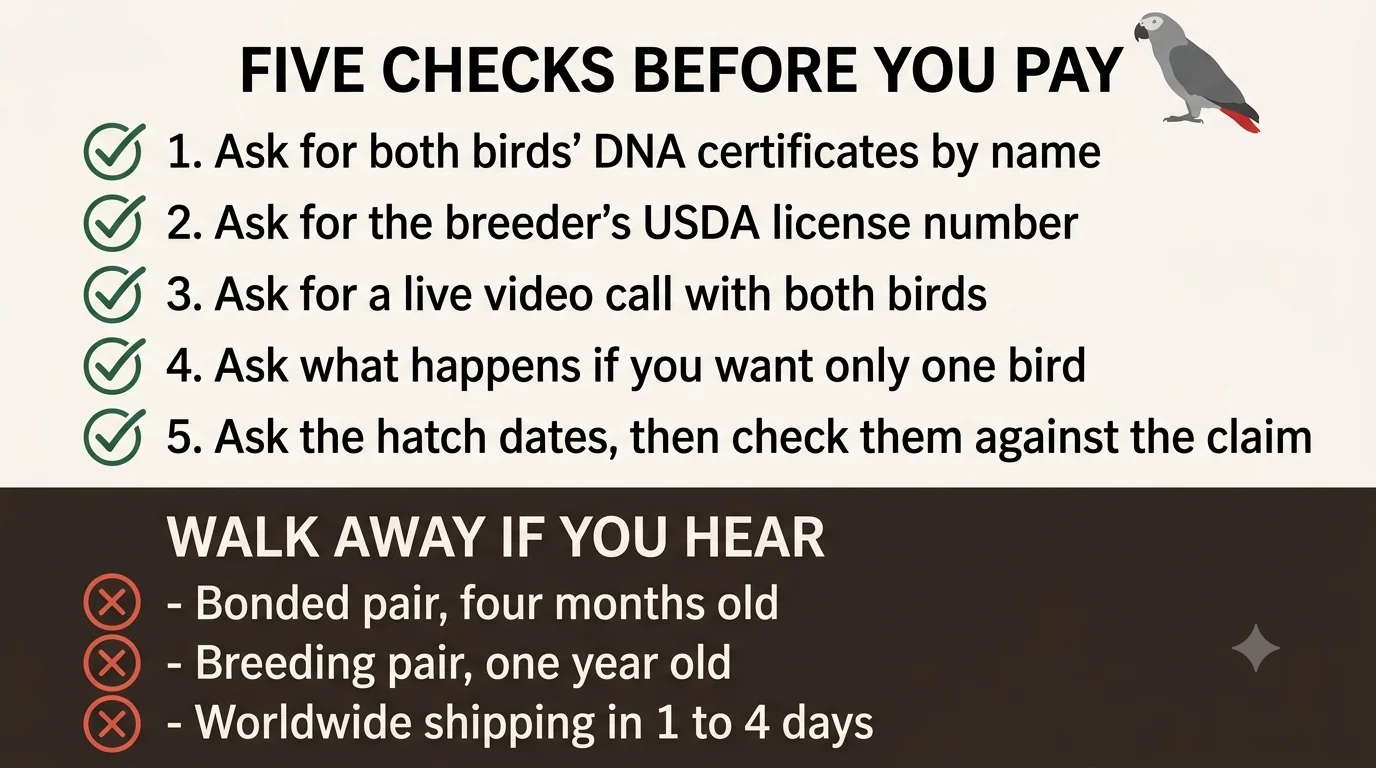
Ask any seller for a live video call with both birds. We will do one on request.
Five Checks That Take Under Ten Minutes
Ask for both birds' DNA certificates by name. Ask for the breeder's USDA licence number. Ask for a live video call with both birds in frame. Ask what happens if you only want one. Ask the hatch dates, then check them against whatever the listing claims about the birds' status.
The Claims That Should End the Conversation
Our full scam-pattern breakdown covers the rest, but three claims are immediately disqualifying on a pair listing: a bonded pair of four-month-olds, a breeding pair of yearlings, and worldwide shipping inside a few days. ↗
Ten minutes of questions. Any seller who cannot answer these is telling you something.
Why Does "Bonded Pair, Four Months Old" Make No Sense?
Because a four-month-old grey is barely weaned. It can have a companion. It cannot have a pair bond in any sense that survives contact with the word.
Greys Reach Sexual Maturity at Three to Five Years, Never Months
That single fact disqualifies a large share of the pair listings currently ranking for these searches.
From the Aviary: A Pair Advertised as Breeding at Fifteen Months Cannot Breed
We have watched that exact listing rank first for breeding-pair searches. Whatever those birds are, they are not a breeding pair, and the seller either does not know or is counting on you not to.
Both of these buyers came to us looking for two birds, and both are quoted exactly as they wrote it.
After weeks of searching for an affordable African grey parrot pair, I finally found C.A.G.s, and the experience exceeded every expectation. Teri patiently answered all my questions, provided recent photos, health records, and explained the personalities of both birds before I committed. The pair arrived healthy, well-socialized, and already comfortable around people. It's rare to find such quality, transparency, and fair pricing in one place. If you're looking for an affordable African grey parrot pair, I highly recommend C.A.G.s for their professionalism, ethical breeding practices, and exceptional customer service.
★★★★★ Walter Zander — Fort Washington, PA
Finding a reliable African grey parrot pair for sale wasn't easy until I discovered C.A.G.s. Their honesty, professionalism, and knowledge immediately gave me confidence. The birds were exactly as described—healthy, affectionate, and beautifully cared for. Even after delivery, the team continued providing advice on diet, enrichment, and acclimation. I couldn't be happier with my experience, and I highly recommend C.A.G.s to anyone searching for an African grey parrot pair for sale from a breeder that genuinely cares about both the birds and their new families.
★★★★★ Alene Murphy — Savannah, GA
How Does Our Pair Offer Compare With the Listings Beside Us?
We went through the pair listings currently ranking for these searches and checked them against what we publish. This is what the difference looks like line by line.
Our birds, our bowls, our light. Every photo on this page was taken here, which is the first row of the table below.
Our pair offer against typical ranking pair listings
Check
C.A.Gs
Typical listing
Both birds DNA sexed
✔ Certificate per bird
✗ Often one, or none
Named breeder and licence
✔ Mark & Teri Benjamin, USDA AWA
✗ No name, no number
Birds named and photographed
✔ Jins and Jeni, our photos
✗ Stock or reused images
Will sell you one bird
✔ Either bird singly
✗ Pair only, no exceptions
States the bonding risk
✔ Section four of this page
✗ Never mentioned
Shipping claim
✔ United States only
✗ "Worldwide, 1–4 days"
Written health guarantee
✔ 72 hours, in writing
✗ "5 year guarantee", unenforceable
More Reading Before You Reserve Two Greys
Three guides cover the ground a pair buyer usually wants next.
These are the questions that come up on the phone, answered the way we answer them on the phone.
If I buy two African Greys, will they bond to each other instead of me?
They can, and it is the single most common regret we hear about pairs. Two greys housed together all day, close in age and unrelated, will often make each other the primary relationship and treat people as staff. It is not automatic. What decides it is husbandry: separate cages, daily one-to-one time with each bird, and training them individually rather than as a unit. If you cannot commit to that time every day, one bird will give you a closer relationship than two.
Does a pair have any advantage over a single grey?
Yes, and it is worth stating honestly because most sellers only give you one half of this. A single grey that bonds hard to one person is prone to jealousy and can become aggressive toward everyone else in the household. A pair spreads that. They also have company during the hours you are out, which matters for a bird this intelligent. You trade intensity of human attachment for stability and company.
Do Jins and Jeni have to be bought together?
No. We offer them together at $3,500 because they were raised alongside each other, but either bird can go on its own — Jins at $1,900, Jeni at $1,800. We would rather place one bird in the right home than push two into the wrong one.
How much daily time does each bird in a pair actually need?
Plan on fifteen to thirty minutes alone with each bird, every day, on top of whatever time they spend out together. That is the number that keeps both birds people-focused. Two birds do not halve the work; they roughly double it.
Can a Congo and a Timneh live together?
Yes, as companions. We keep Congos and Timnehs alongside each other here and the photograph on this page is our own aviary. What we would not recommend is pairing a Congo with a Timneh as a breeding pair — different subspecies, and that is not what either bird is for.
Should the two birds be male and female?
For a companion pair it does not matter. Two hens or two cocks will keep each other company perfectly well. Sex only becomes decisive if you intend to breed, which is a different purchase and a different page.
Can two African Greys share one cage?
Not on arrival, and in our experience not ever, if you want both birds tame. We ask every pair buyer to run two cages. Shared housing accelerates the pair bond and removes the separation you need in order to work with each bird individually.
What paperwork comes with a pair?
Two complete sets, never one shared file. Each bird travels with its own CITES Appendix I documentation, its own DNA sexing certificate, its own avian vet health certificate, and its own hatch certificate and band number.
Do two birds ship in one crate or two?
It depends on how settled they are with each other. Birds that already share space travel together in one IATA-compliant container; birds that do not go in adjacent compartments. Either way both birds fly on the same flight, and we make that call per pair rather than by policy.
Do I pay shipping twice for two birds?
No. Airport pickup is $185 and home delivery is $350 for the reservation, not per bird. What does double is the paperwork and the handling, which is why a pair is not simply half price per head.
Why do some pairs cost $6,500 and others $1,800?
Documented adult pairs are currently listed elsewhere between $6,500 and $8,000, and undocumented listings advertise pairs around $1,800. Ours sits at $3,500 because we bred and raised both birds here, so no reseller margin sits in the price. A low price with papers is value. A low price without them is bait.
At what age can a pair actually breed?
Congo African Greys are not sexually mature until roughly three to five years. Any listing advertising a four-month-old or fifteen-month-old bonded or breeding pair is describing something that cannot happen, and that alone tells you what the listing is worth.
Reserve a Congo African Grey Pair, or a Single Bird
Tell us which birds you are looking at and how much time you realistically have each day. We will tell you honestly whether a pair or a single is the better fit, and we reply within twenty-four hours.


 Ready-Made Pair