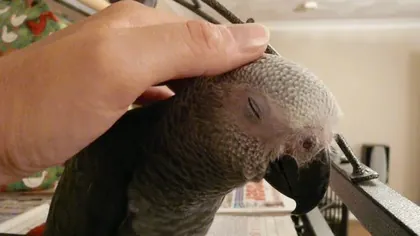
Every parrot rivalry, settled from one Grey-centred verdict
African Grey Parrot Comparison: How the Grey Stacks Up Against Every Rival
Seven honest head-to-heads in one place — the Grey against macaws, cockatoos, Amazons, and its own Congo and Timneh variants. We raise and place these birds, so this hub ranks them the way a breeder actually weighs them, then points you to the exact comparison you need.
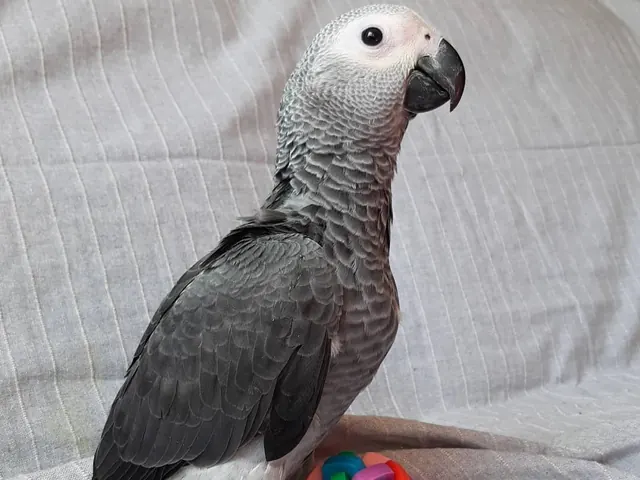
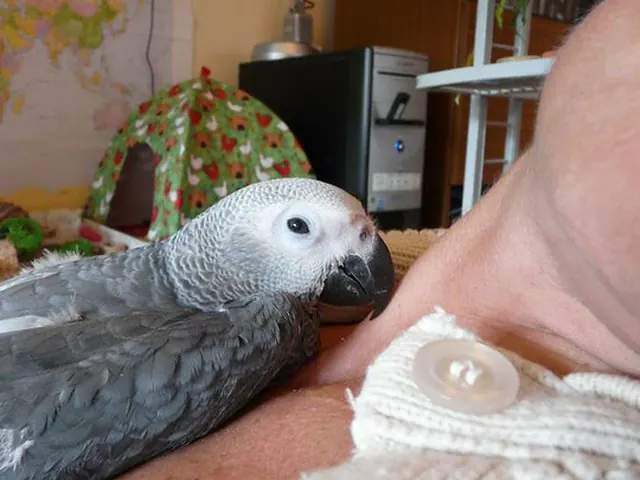
Quick answer: What sets the African Grey apart is its mind. It is the most intelligent and clearest-talking companion parrot — child-level problem-solving and the largest working vocabularies in aviculture — at a noise level most homes can live with. It is not the biggest, cuddliest or quietest bird, and it is rarely the easiest first parrot. Every comparison on this page turns on that trade-off: unmatched cognition and talking, in exchange for a demanding, sensitive, decades-long companion.
The One-Line Verdict
Across our whole species guide, one line holds: the Grey wins on talking and intelligence, trades away size, cuddliness and beginner-friendliness, and sits in the middle on noise. Hold that against whatever rival you are weighing and most of the decision answers itself.
How to Use This Comparison Hub
Start with the master matrix below for the whole field on one screen, jump to any head-to-head that interests you, or let the interactive selector route you. Every rival section is a short, honest synthesis that links out to the full comparison — the hub is the map, the spokes are the territory.
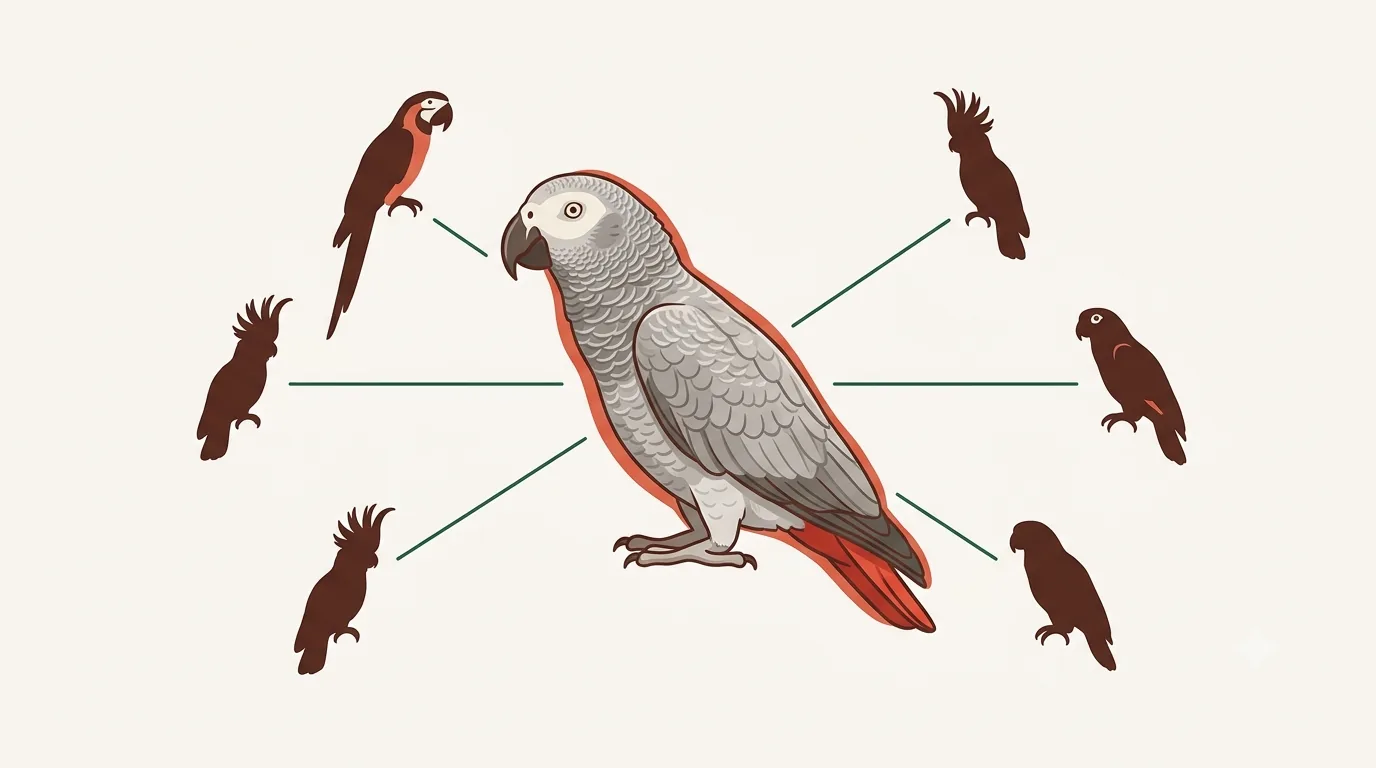
African Grey vs the Field: The Master Comparison Matrix
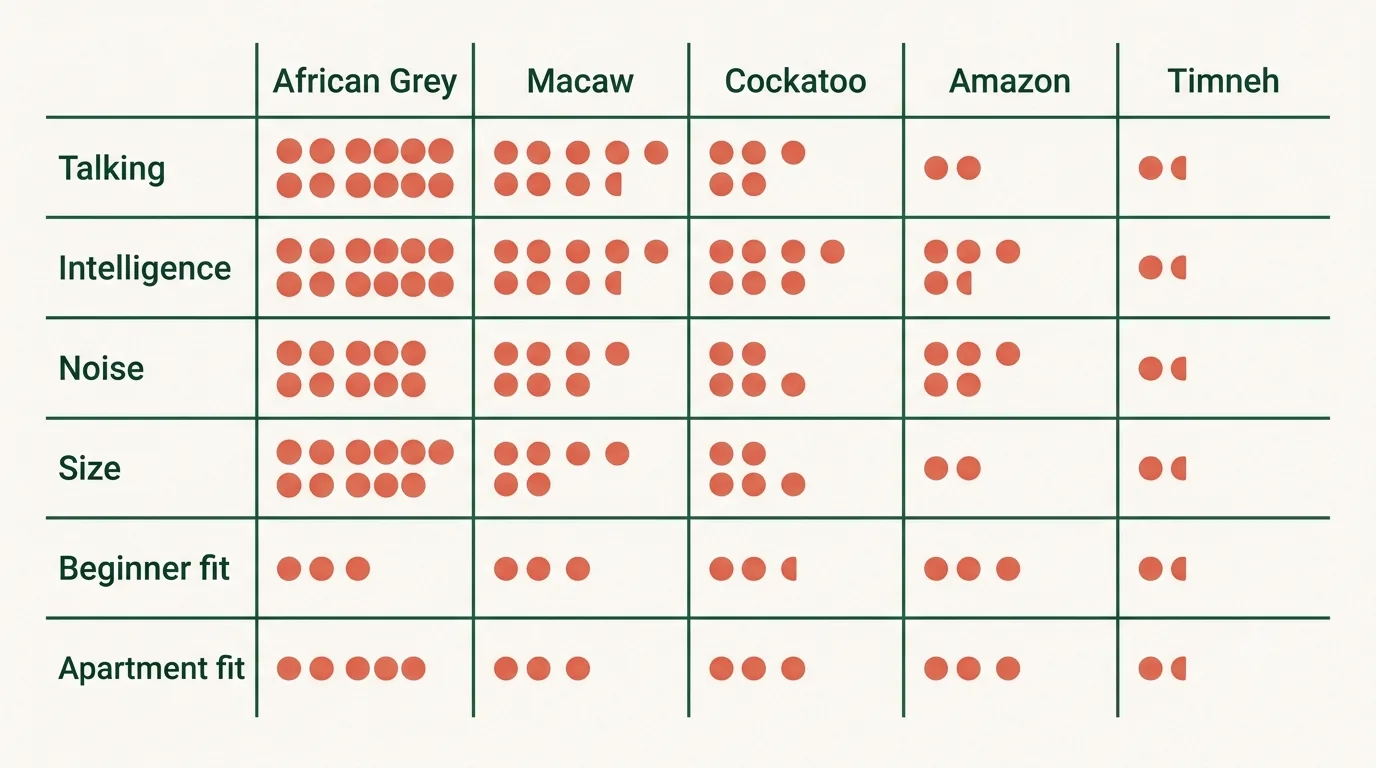
Here is the whole field on one screen. Read down the talking column and the Grey and Timneh lead; read across noise and size and the picture flips. Tap any bird to open its full comparison.
The pattern holds down every column: the Grey and Timneh lead on talking and intelligence, the macaw takes size, the cockatoo takes cuddliness, and the Amazon takes musical flair — so your right pick is whichever trait tops your own list.
What We Scored, and Why
We scored the six traits buyers ask about most — talking, noise, size, owner level, and the best-fit home — because they decide the vast majority of placements. Price and lifespan get their own sections below.
What the Matrix Does Not Capture
A grid cannot score the individual bird in front of you. Two Greys from the same clutch can differ in talkativeness, boldness and cuddliness, so treat the matrix as the starting shape of the decision, not the last word on any single parrot.
Breeder note: personality varies bird to bird
In our nursery the quietest chick in a clutch sometimes grows into the biggest talker. We match temperament to household case by case, which is why we never promise a specific personality from a species row alone.
Is the African Grey the Best Talking Parrot?
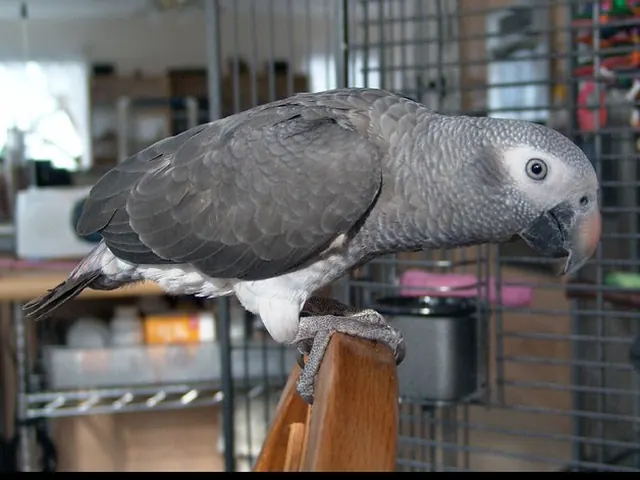
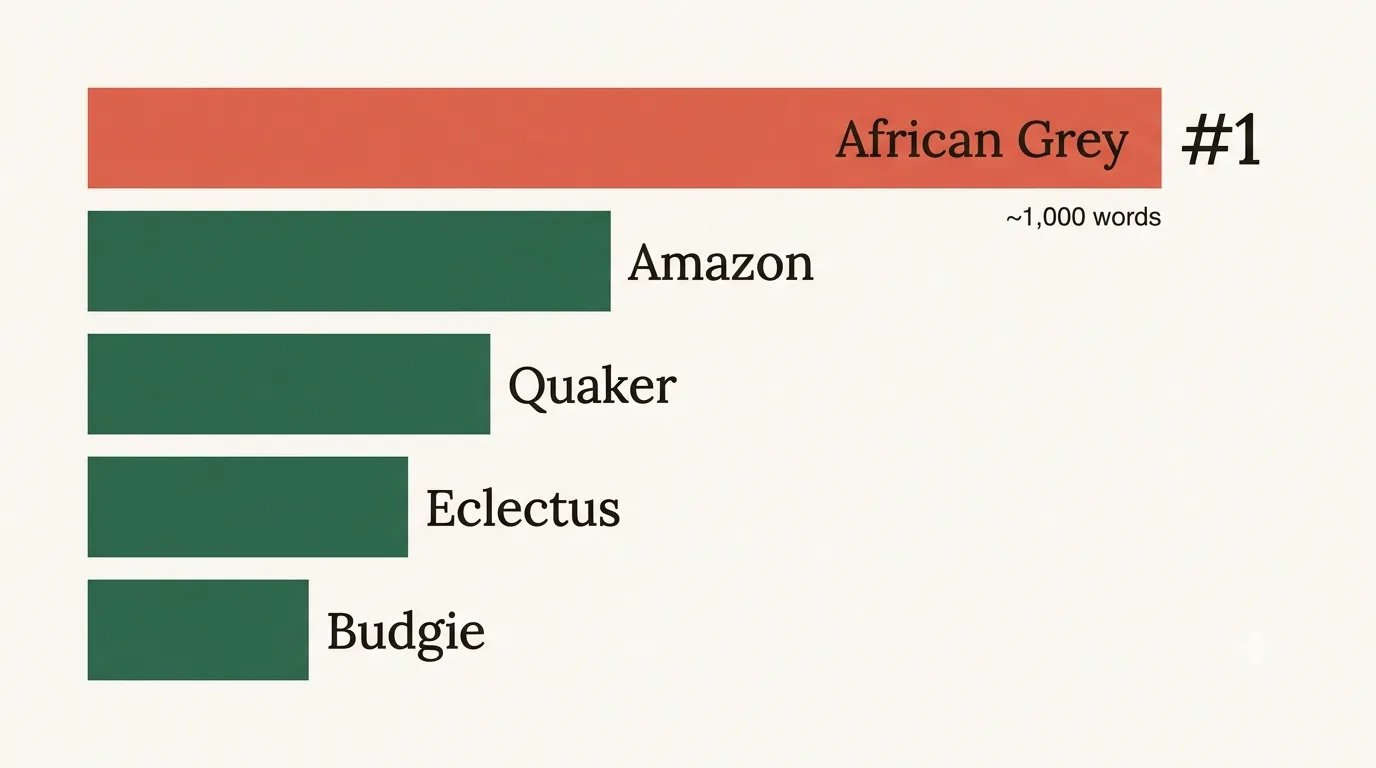
Short answer: yes, and it is not especially close. The African Grey heads essentially every published best-talking-parrot list, and the reason is not raw word count but clarity and context — a Grey uses words in the right moment in a way no other companion parrot reliably does.
01African GreyThe benchmarkLargest working vocabularies and the clearest contextual use — every published ranking's number one
02Amazon ParrotStrong talker with a musical, sing-song delivery
04Quaker ParakeetChatty and clear for its size, a budget talker
05BudgieCan out-word a Grey in count, but mumbled and hard to parse
Where the Grey Ranks Against Every Talker
Above the Grey there is nothing; below it, Amazons talk well with a musical delivery, Eclectus stay clear but quieter, and a budgie can technically bank more words in a mumble no one can parse. For usable, contextual speech, the Grey is the ceiling.
Why Clarity Beats Raw Vocabulary
Buyers do not want a bird that mutters two hundred blurred words; they want the phone-ring, the greeting and the joke delivered clearly, at the right moment. That is the Grey's real advantage, and it is why our African Grey facts guide keeps returning to contextual use over sheer count.
Citation: the talking-parrot rankings
Across mainstream avian references and pet-care roundups from Lafeber, PetMD and The Spruce Pets, the African Grey is placed first for talking ability, with Amazons the usual runner-up.
Data note: how we compiled the ranking
Our order reflects the consensus of those published rankings plus our own placements, weighted toward clarity and contextual use rather than maximum vocabulary — a single number of words is the metric that most misleads first-time buyers.
African Grey vs Macaw
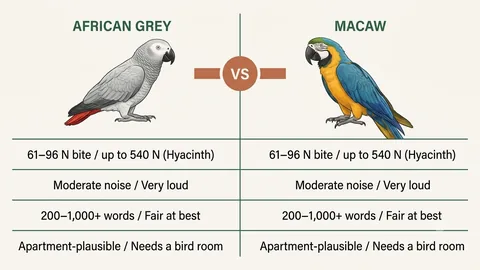
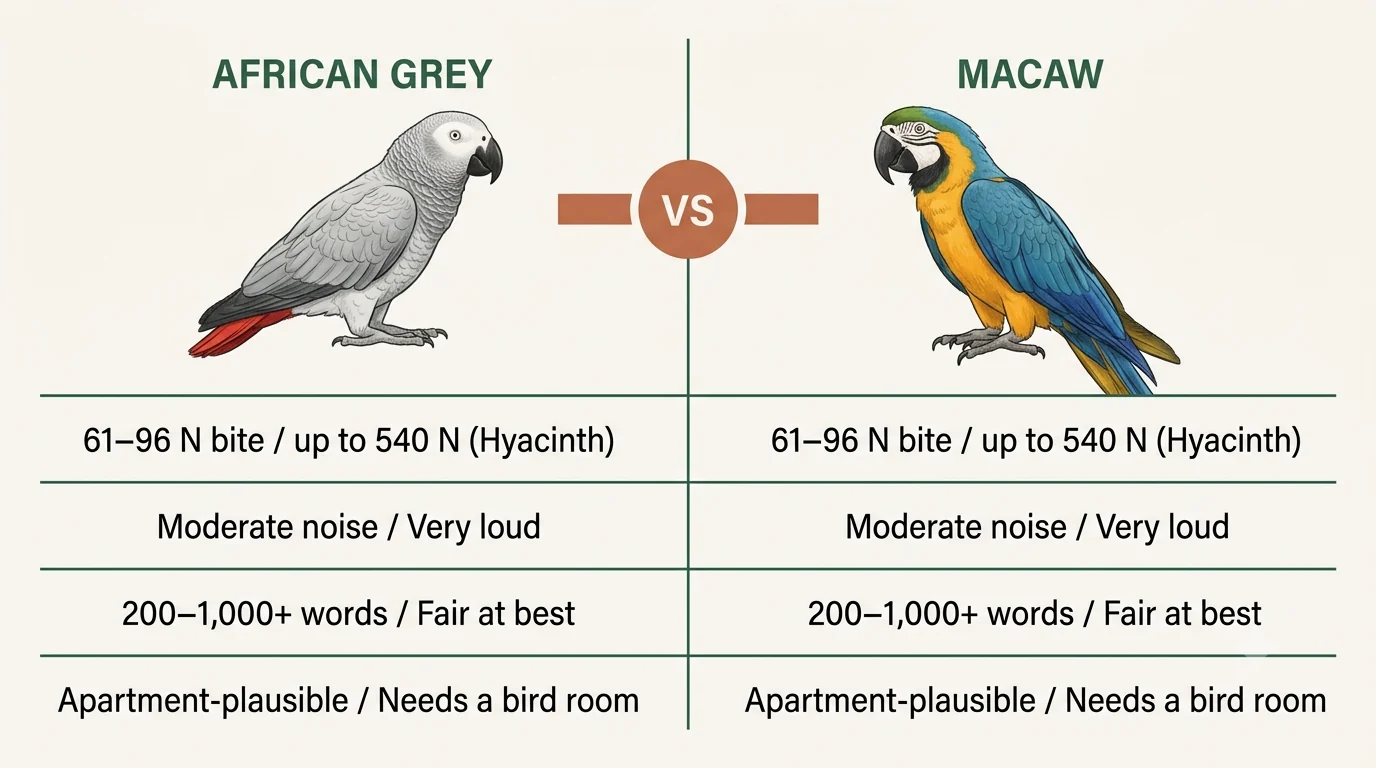
Wondering whether an African Grey or a macaw makes the better companion parrot? This is the honest shape of that match-up — the quiet thinker against aviculture's biggest personality — with the full head-to-head one click away.
TalkingGrey wins
SizeMacaw ~2×
NoiseMacaw far louder
Talking, Size and Noise at a Glance
The macaw is the showstopper — a metre of wingspan and a voice to fill a warehouse — but on talking clarity and apartment-livability the Grey wins comfortably. The trade is space and volume for cognition and quiet.
Who Each Bird Suits
A Grey suits a talking-focused owner in a normal-sized home; a macaw suits an owner with room, a tolerance for real volume, and a love of a big, bold, physical parrot.
Read the full African Grey vs Macaw comparison
Our complete African Grey vs Macaw comparison scores eleven macaw species against the Grey on talking, bite force, cost and lifestyle fit — the depth this summary only points at.
At a glance: the macaw takeaway
Choose the Grey unless the macaw's size and drama are exactly what you want and your home can absorb the noise.
African Grey vs Cockatoo
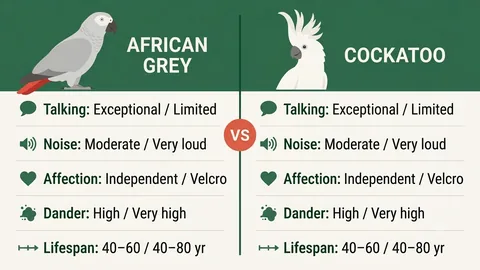
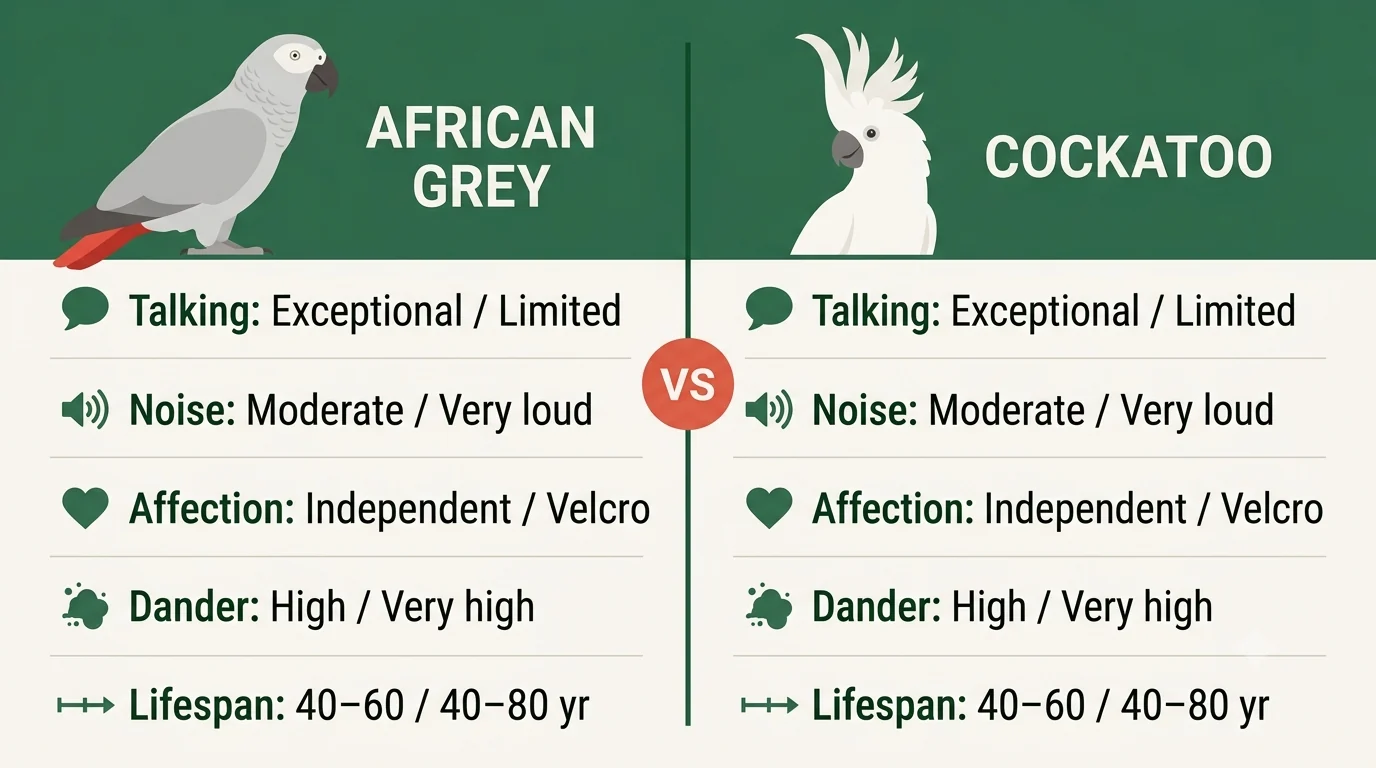
People ask us whether cockatoos are more affectionate than African Greys almost weekly, and the truthful answer starts with what each bird demands from you, not what it gives. Here is the short version of the cuddler-versus-talker decision.
BondGrey independent
CuddlesCockatoo wins
NoiseCockatoo extreme
Independence, Noise and Dander at a Glance
Both are powder-down birds, so dust is a fact either way. The real split is temperament: a Grey is an independent worker happy to problem-solve alone, while a cockatoo is a velcro cuddler whose demand for contact — and whose scream — can overwhelm an unprepared home.
Who Each Bird Suits
Choose a Grey for talking and a workable noise level; choose a cockatoo only if you actively want a hands-on cuddle bird and can meet its intensity. Our African Grey vs Cockatoo breakdown weighs the cuddle-versus-talk trade in full.
African Grey vs Amazon Parrot
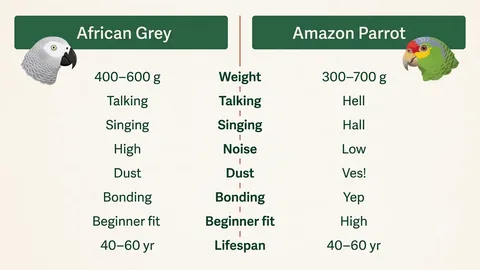
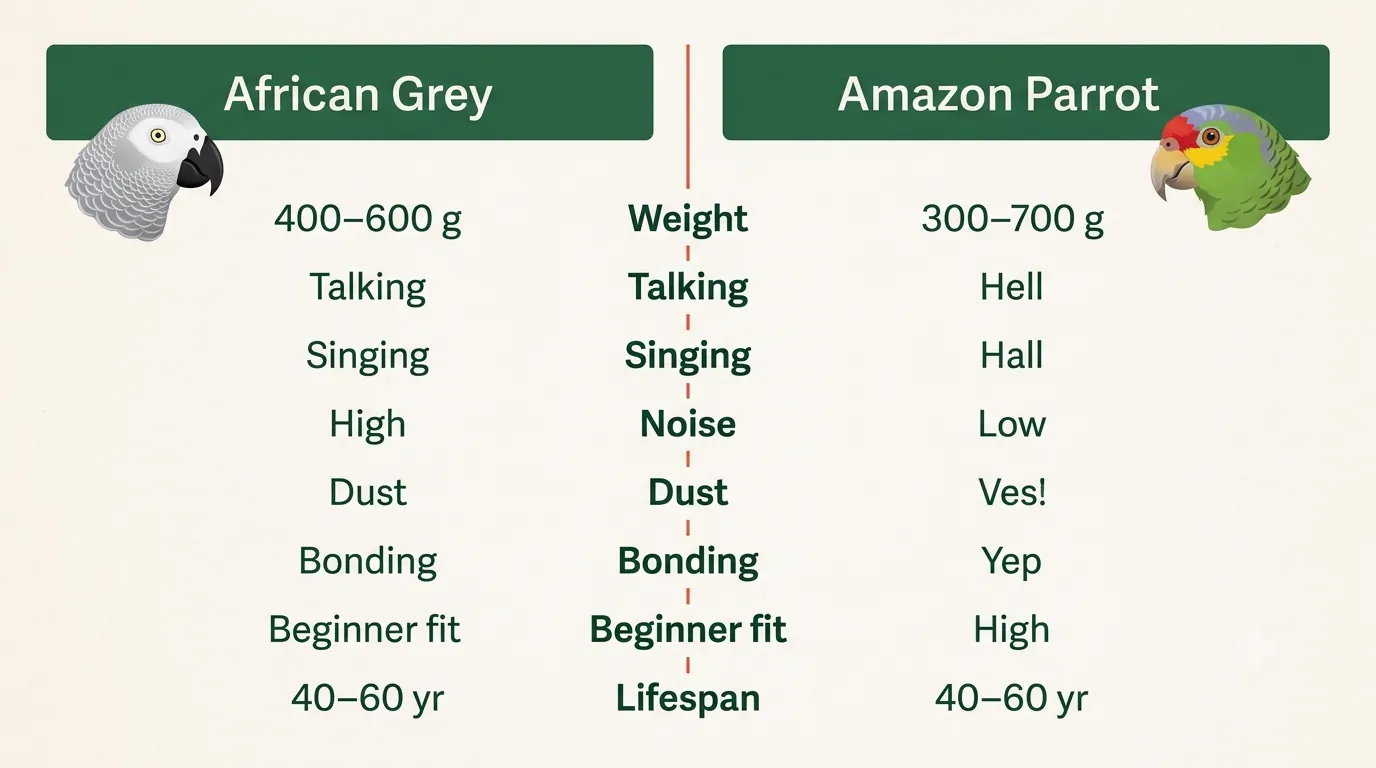
Torn between an African Grey and an Amazon parrot? In the inquiries we read, that choice nearly always comes down to talking versus singing — contextual words from the Grey, confident performance from the Amazon — plus a dust difference nobody mentions.
SpeechGrey: context
AmazonSings, performs
DustGrey dustier
Talking vs Singing, Temperament and Dust
The Amazon is the extrovert of the pair — a confident singer and performer with loud, seasonal outbursts — while the Grey is the quieter thinker whose speech carries context. The Amazon produces less powder-down, but its hormonal seasons ask more of an owner's patience.
Who Each Bird Suits
Choose a Grey for contextual talking and a steadier temperament; choose an Amazon for an outgoing, musical bird in a household ready for its seasonal drama. The African Grey vs Amazon comparison covers the talking-versus-singing split in depth.
Congo vs Timneh African Grey
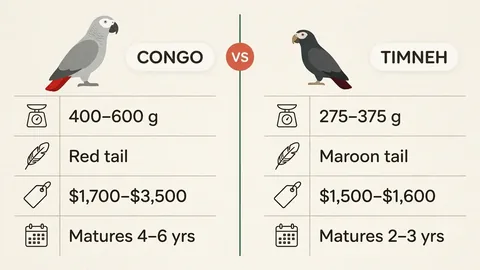
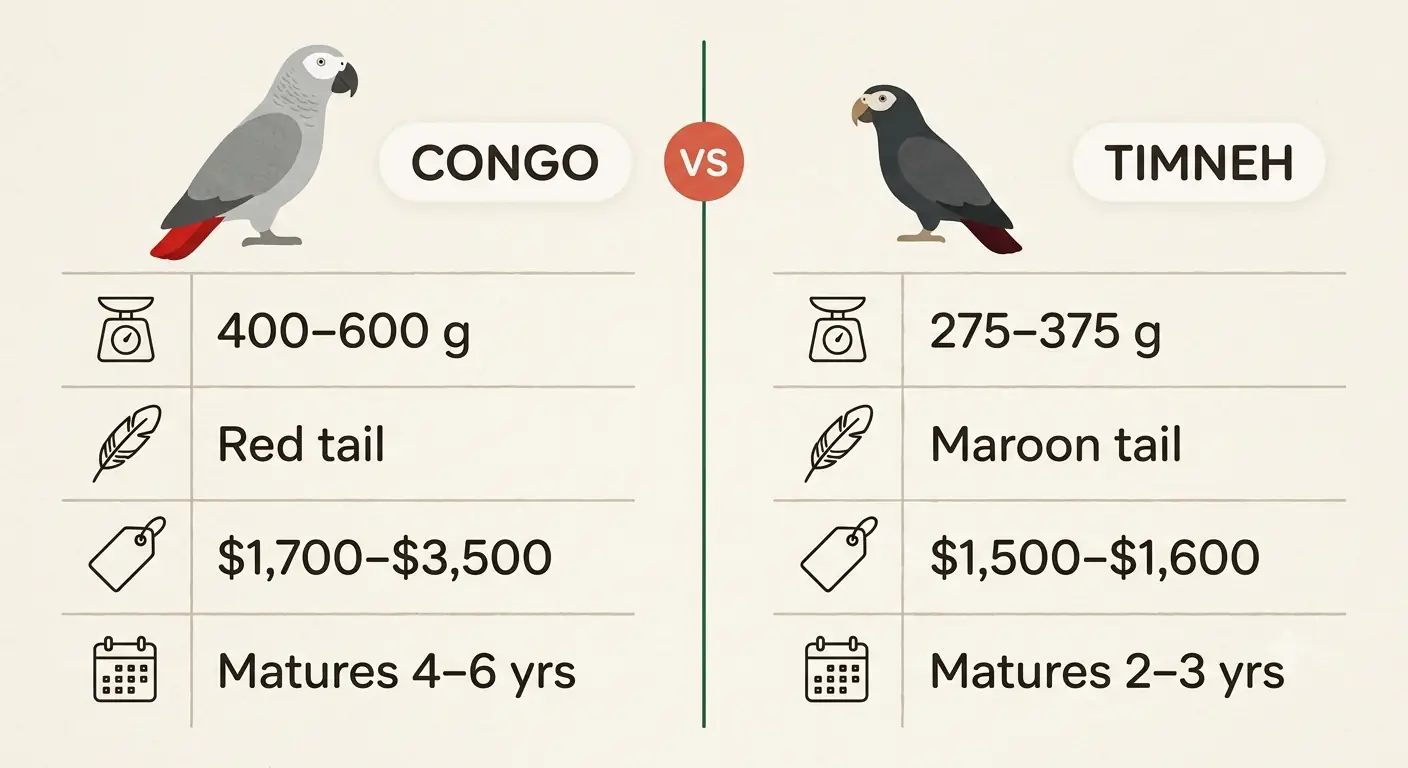
Choosing between a Congo and a Timneh African Grey is less about better and more about fit: the two subspecies share the same intelligence, but size, price, tail colour and talking onset all differ enough to matter.
SizeCongo larger
TailRed vs maroon
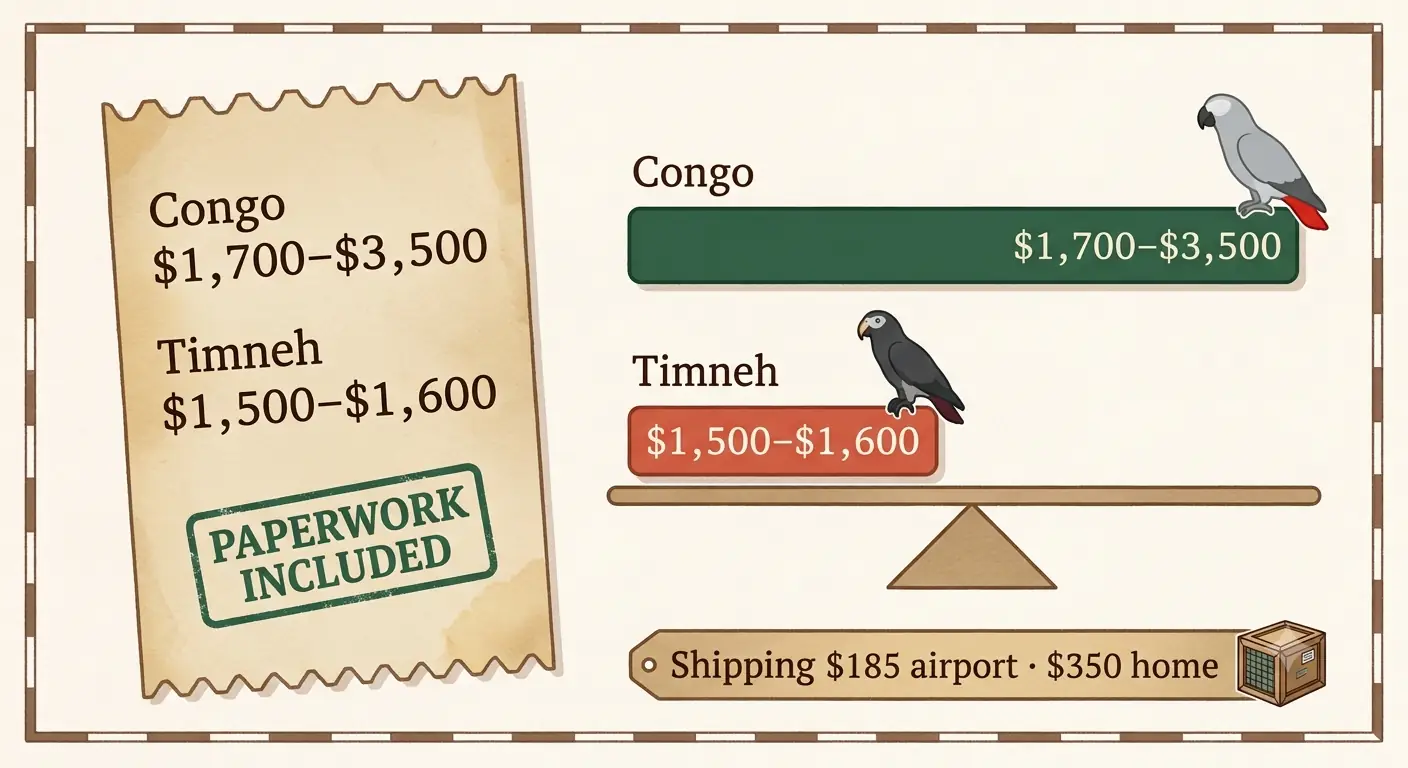
Price$1,700+ / $1,500+
Size, Price and Talking Onset
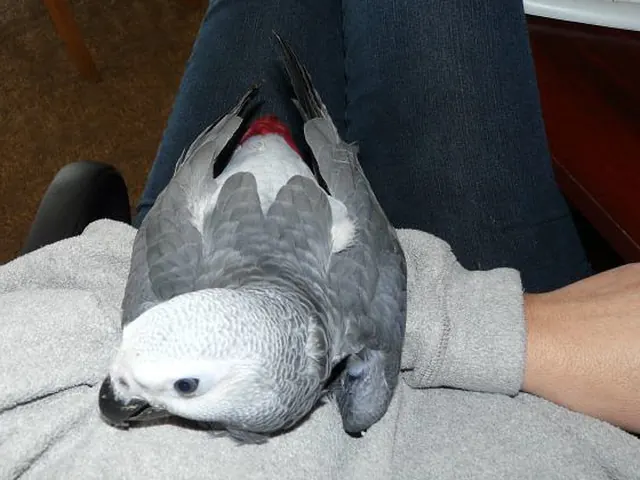
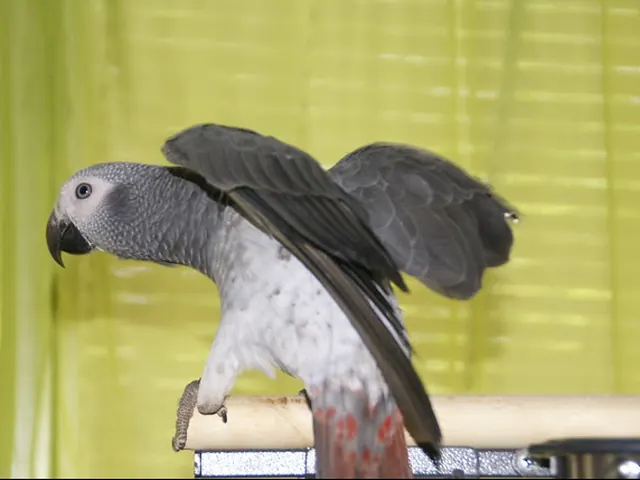
These are two subspecies of one bird with the same intelligence. The Congo is larger with the iconic bright red tail and runs $1,700–$3,500; the Timneh is smaller, often a touch calmer, tends to start talking earlier, wears a maroon tail and horn-coloured beak, and runs $1,500–$1,600.
Which Grey Fits Your Home
For an apartment or a first grey, many owners lean Timneh for its calmer, quieter nature; for the classic look and presence, Congo.
Read the full Congo vs Timneh guide
Our Congo-vs-Timneh breakdown raises both subspecies side by side and settles the size, price and talking-onset questions with the depth a summary cannot.
At a glance: the variant takeaway
Same brilliant bird, two sizes — choose Timneh for calm and apartments, Congo for the iconic red-tailed look.
Male vs Female African Grey
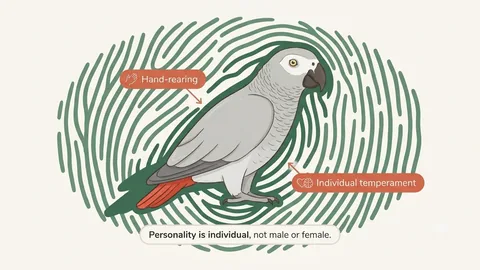
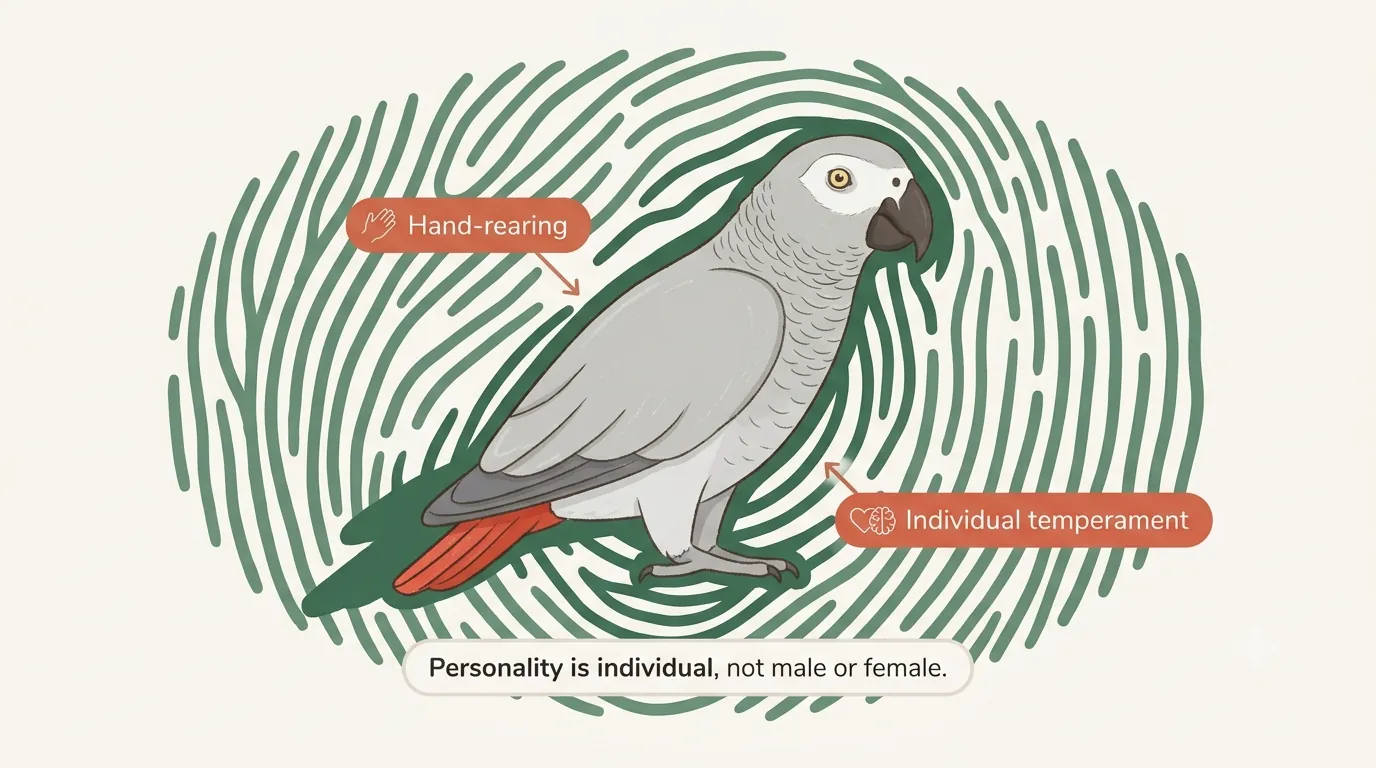
Should you get a male or a female African Grey parrot? Buyers ask us this every week, and the honest answer surprises most of them — you cannot tell the sexes apart by eye, personality does not follow sex, and it is why we PCR DNA-sex every chick we place.
LooksIdentical
BehaviourIndividual
SexingDNA only
Appearance, Behaviour and DNA Sexing
African Greys are monomorphic — males and females look alike and behave alike as pets. Personality is individual, not sex-linked, and the only reliable way to know a Grey's sex is a PCR DNA test, which is why every bird we place is DNA-sexed.
Does Sex Actually Matter for a Pet Grey?
For a companion bird, almost never. Choose the individual whose temperament fits your home rather than a sex, and let the DNA certificate settle the paperwork.
Read the full male vs female guide
Our male-vs-female guide explains why you cannot eye-sex a Grey, what DNA-sexing proves, and when sex genuinely matters — for breeding, not for a pet.
At a glance: the gender takeaway
Pick the bird, not the sex — they are identical in looks and temperament, and DNA is the only certainty.
Which African Grey Comparison Is Right for You?
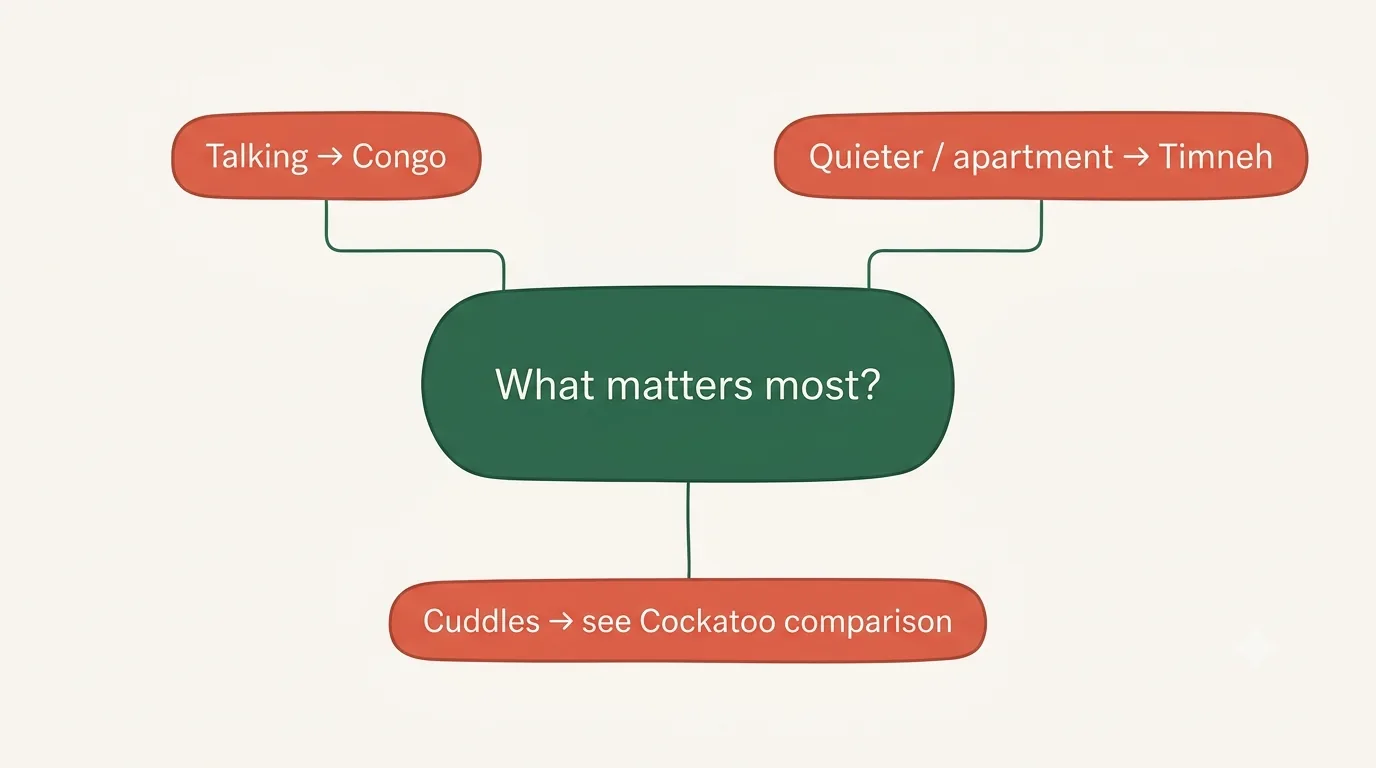
Not sure which parrot comparison actually answers your question? Instead of reading all seven head-to-heads, let the selector below weigh what matters most to you — talking, quiet, cuddles, size or song — and route you straight to the right guide.
Answer Three Quick Questions
Rather than read all seven comparisons, tell the selector what matters most and it will route you to the one that answers your decision. No email, no sign-up — just a signpost.
How the Selector Routes You
The selector weighs your top priority first, then your space and experience. Want cuddles and it sends you to the cockatoo comparison; want a quiet apartment bird and it lands on the Timneh; want the best talker in a house and it points at the Congo — always ending on a comparison you can act on.
If a Different Parrot Suits You Better
Sometimes the honest answer is not a Grey at all. If your priority is cuddling or sheer size, the selector will send you to our African Grey vs Cockatoo or vs Macaw comparison rather than pretend a Grey fits — because the right bird matters more than the sale.
Breeder note: honesty over the sale
We would rather route you to a rival comparison and lose the sale than place a Grey in a home built for a different bird. A mismatched parrot comes back; a well-matched one sends us year-two photos.
The Best Parrot by Use Case
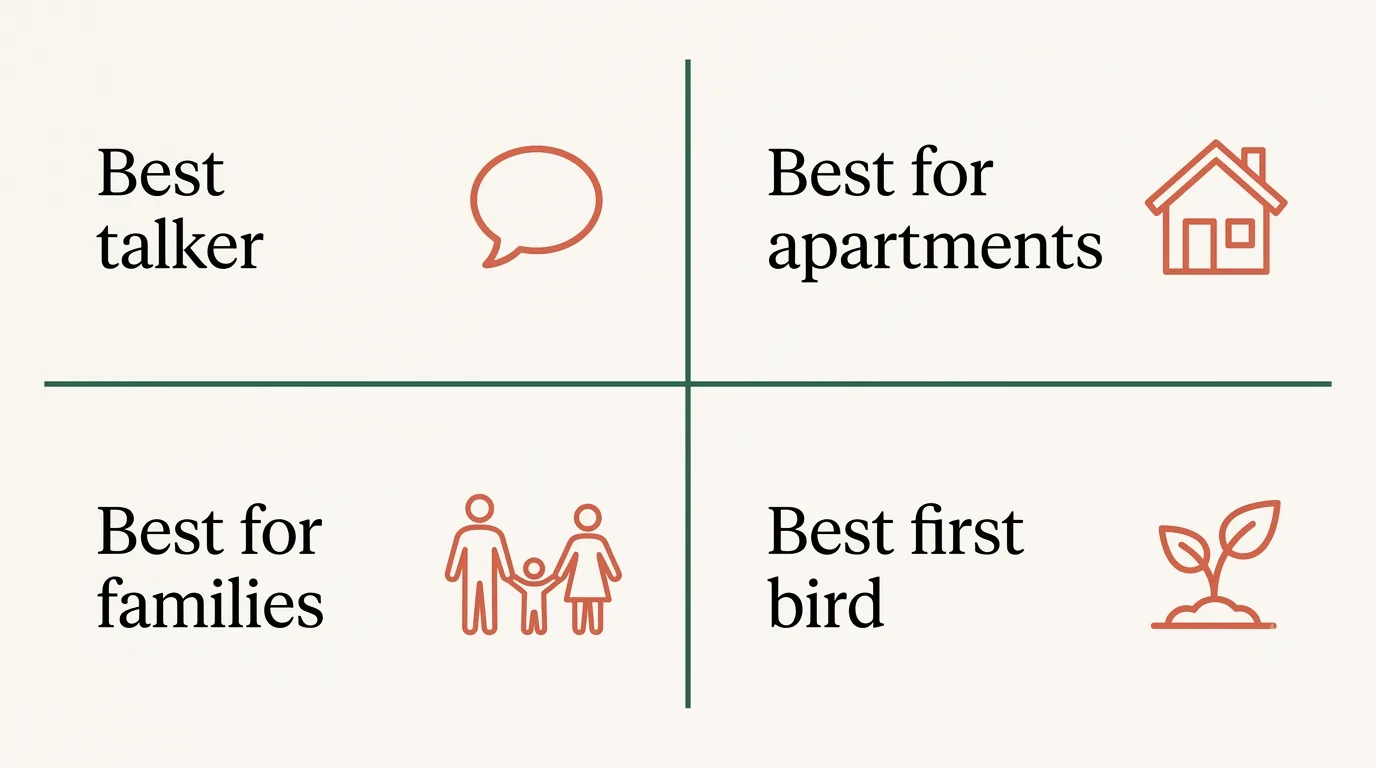
Search for the best talking parrot, the best apartment parrot or the best first bird and you get a different winner every time — because the right parrot depends entirely on the job you are hiring it for. Here is the honest pick per goal.
The Honest Pick for Each Goal
If you are shopping by need rather than by species, here is the honest pick for each common goal — and the one case where the answer is usually not a Grey at all.
It is the one use case where the Grey loses on purpose. A first bird should forgive mistakes, and a Grey's sensitivity does the opposite — our guide on whether a Grey suits a first-time owner explains when a beginner can still take one on responsibly.
African Grey Pros and Cons, in Brief
Every African Grey we place is a trade: the clearest-talking, most intelligent companion parrot in aviculture, in exchange for real daily demands and a commitment measured in decades. Here is that ledger at its shortest.
The Honest Trade-Off in Three Lines
On the pro side: unmatched talking, child-level intelligence, and a bond that can last decades. On the con side: a 40–60 year commitment, hours of daily attention, powder-down dander, and a bird that plucks or bites when its needs go unmet. Our honest African Grey pros and cons guide weighs both columns in full, with a self-assessment to tell if a Grey actually fits your home.
How Do You Choose an African Grey Breeder?
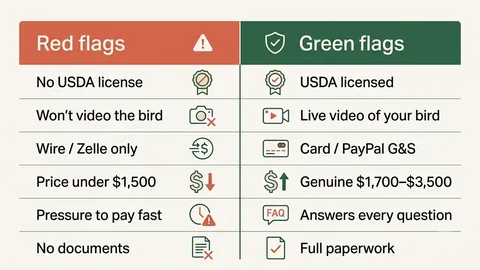
Picking the breeder is the step where an African Grey purchase goes right or wrong — the bird follows from it. One minute of document-checking separates a licensed aviary from a deposit scam, and this is that minute.
Verification in One Minute
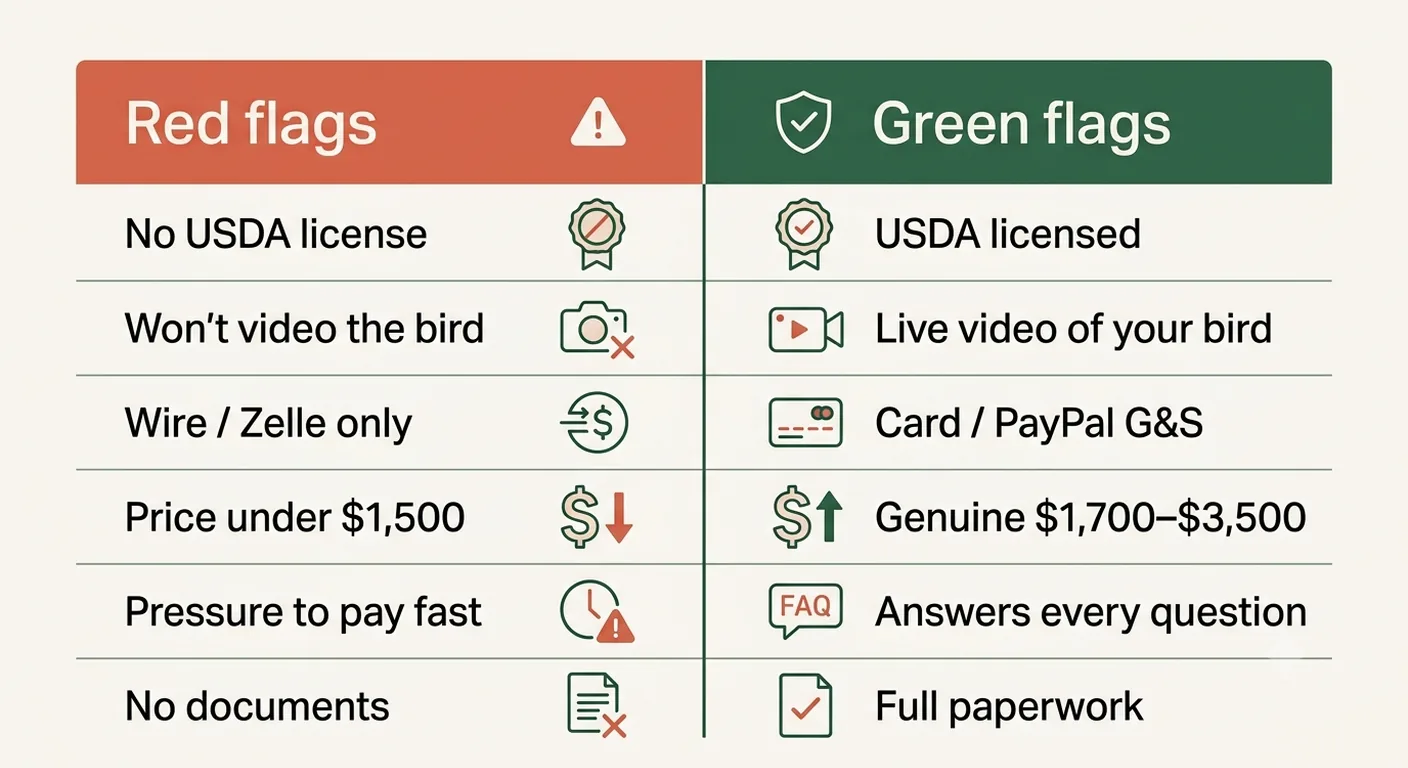
Whichever bird wins your comparison, the seller decides whether you get a healthy, documented parrot or a deposit-and-vanish scam. Ask for the CITES paperwork, a closed leg band, DNA-sexing and PBFD results, and a live video call with the bird — a real breeder produces all four without hesitation. Our guide on how to compare African Grey breeders turns that into a checklist and names the red flags to walk away from.
What Does an African Grey Cost?
African Grey prices confuse buyers because scam listings sit in the same search results as real aviaries. These are the honest figures — what a documented Congo or Timneh actually costs from a licensed U.S. breeder, and what a too-good price really means.
Congo and Timneh Price Ranges
Our full price guide itemizes it bird by bird, but the band is steady: expect $1,700–$3,500 for a documented Congo and $1,500–$1,600 for a Timneh from a licensed U.S. breeder, plus $185 airport or $350 home-delivery shipping, then annual cage, food, enrichment and avian-vet costs. On every species here, a figure that looks impossibly cheap signals a scam rather than a deal.
The 40 to 60 Year Commitment
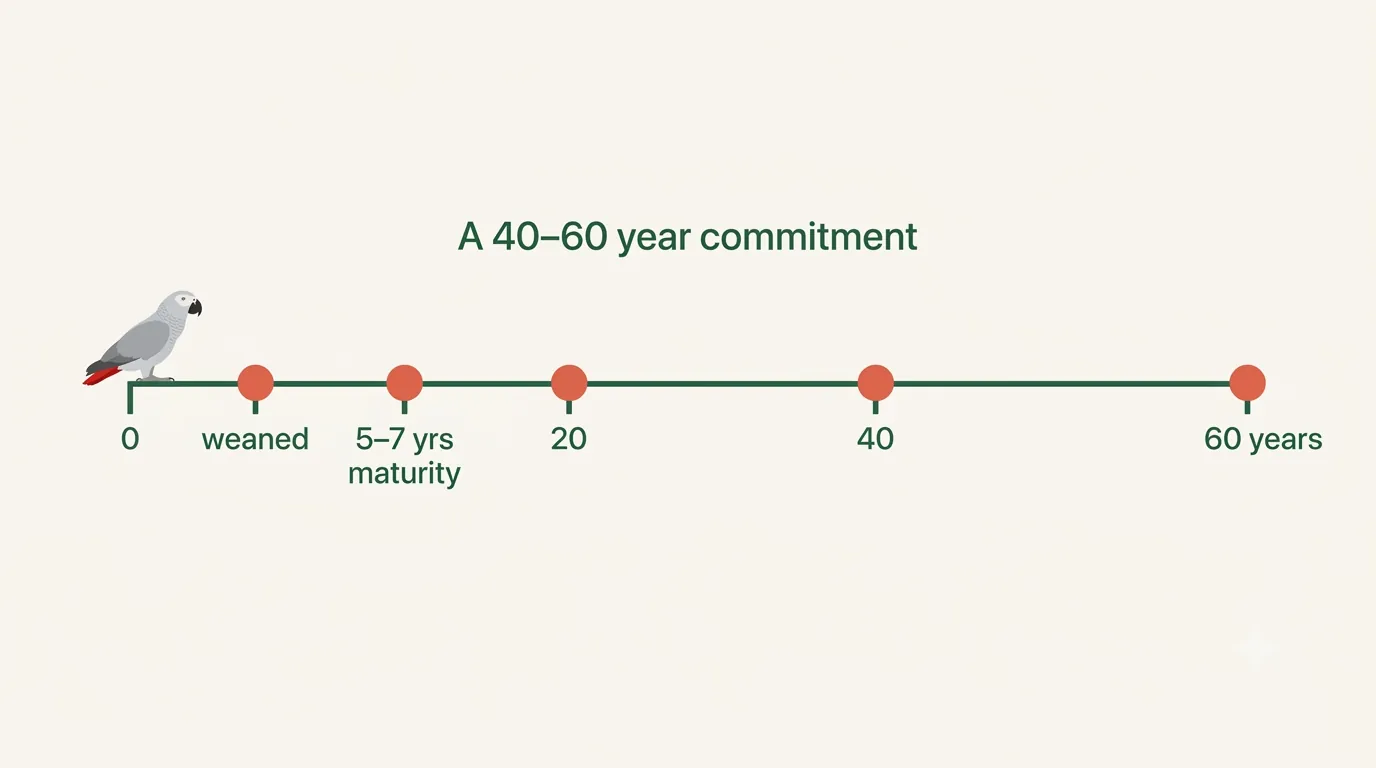
A healthy African Grey routinely lives forty to sixty years — long enough to outlast careers, homes and sometimes owners. Before any comparison crowns a winner, this is the commitment every one of these parrots asks for.
Planning Honestly for a Lifetime Bird
Every parrot compared here is a long-lived bird, and the Grey is squarely a lifetime commitment — a healthy Grey commonly reaches 40 to 60 years, sometimes beyond. That single line reshapes the decision: it means naming a caretaker, budgeting for decades, and treating the choice as a multi-decade relationship rather than a purchase. Our African Grey lifespan guide covers the succession planning most buyers never think to do.
Health, Documentation and Shipping
Option 1Airport Pickup$185
IATA live-animal cargo on a Delta, United or American flight into your closest airport, documentation folder travelling with the bird
Option 2Home Delivery$350
Door-to-door climate-controlled ground transport, with the paperwork handed to you on arrival
Nationwide Shipping and Two Delivery Tiers
Whichever grey wins your comparison leaves the aviary fully documented and travels one of two ways. Our shipping guide details crate standards, timing and arrival day; on either route the full CITES, DNA, PCR and vet folder rides along. Pick a route below for local availability:
A $200 refundable deposit reserves your chosen bird while we finalize the delivery details.
Ships nationwide · $185 airport · $350 home
An Owner's Story
Comparisons settle the head; the first year settles the rest. Our verified owner reviews collect what buyers say once a documented Grey is actually home — two of them, below, faced the very choice this hub lays out.
Catherine KempfSchaumburg, IL · Congo African Grey
★★★★★
"the experience was flawless"
Her documented Congo arrived healthy and well-trained, and now bonds with her whole household.
Richard WoodardWinter Haven, FL · Congo African Grey
★★★★★
"made the process stress-free"
Unsure about ordering a bird online at first, he now calls his Congo the daily star of the family.
Neither owner mentions regret. Matching the bird to the household is the whole point of a comparison hub — get that right, and that is the sentence no one has to write.
See a Documented African Grey You Can Meet
Once your comparison lands on a grey, these are the documented birds available today — open any card for its full gallery, parentage and paperwork. When a bird sells it leaves this list, so nothing here is a placeholder.
A short heads-up whenever a new documented Grey is ready to reserve.
African Grey Comparison Questions, Answered
These are the exact comparison questions this decision generates. For care and ownership questions beyond choosing a bird, our complete African Grey parrot FAQ picks up where the comparison ends.
Which parrot is the smartest?
The African Grey is widely regarded as the most intelligent companion parrot. The famous studies with a Grey named Alex showed a bird that could label objects, count, and even grasp the idea of zero — cognition on the level of a young child, which is why the Grey heads nearly every smartest-parrot list. Macaws, cockatoos and Amazons are bright, social birds, but none carries the same documented problem-solving record.
Which parrot talks the best?
The African Grey. It combines the largest working vocabularies in aviculture with an unusual knack for using words in the right context, which is why it tops essentially every best-talking-parrot ranking. Amazons talk well and love to sing, and a budgie can technically out-count a Grey in raw words, but for clarity and contextual speech the Grey stands alone.
Is an African Grey better than a macaw, cockatoo or Amazon?
Better is the wrong frame — each bird suits a different home. Choose an African Grey for talking, cognition and a moderate noise level; a macaw for size and boldness if you have the space and volume tolerance; a cockatoo for cuddling if you can meet its intense demand; an Amazon for an outgoing, musical bird that handles a busy household. Our per-species comparisons weigh each head-to-head honestly.
Which African Grey should I get, Congo or Timneh?
Both are the same species of bird with the same intelligence and talking ability. A Congo is larger with the iconic bright red tail; a Timneh is smaller, often a touch calmer, tends to start talking earlier, and its maroon tail and horn-coloured upper beak set it apart. For an apartment or a first grey, many owners lean Timneh; for the classic look, Congo. Our Congo-vs-Timneh guide covers the choice in full.
Is a male or female African Grey a better pet?
Neither. African Greys are monomorphic, meaning males and females look alike and behave alike as pets — personality is individual, not sex-linked. The only reliable way to know a Grey's sex is a DNA test, which is why every bird we place is PCR DNA-sexed. Choose the individual bird whose temperament fits your home, not a sex.
Which parrot is best for a first-time owner?
Rarely an African Grey. A Grey's intelligence and sensitivity make it an intermediate-to-advanced bird that punishes under-preparation. A committed beginner who has genuinely done the research can succeed, but most first-timers do better starting smaller. Our beginner-fit guide covers when a first-time owner can take on a Grey responsibly.
Which parrot is quietest for an apartment?
Among the birds compared here, the African Grey — and the Timneh especially — is the apartment-friendly choice. Greys are prolific talkers rather than screamers, and a Timneh runs quieter still. Macaws and cockatoos are among the loudest parrots kept and are genuinely hard on shared walls; an Amazon lands in between with loud, seasonal outbursts.
Which parrot lives the longest?
All of these are long-lived birds, and the larger species are effectively lifetime commitments. A healthy African Grey commonly reaches 40 to 60 years; large macaws can reach 50 or more, cockatoos 40 to 70, and Amazons 40 to 60. Whichever you choose, plan for a bird that can share most of your adult life and, for some owners, outlive them.
How much does an African Grey cost compared to other parrots?
A documented Congo African Grey runs $1,700–$3,500 and a Timneh $1,500–$1,600 from a licensed U.S. breeder, before $185 airport or $350 home-delivery shipping. Large macaws and Moluccan cockatoos often cost more; smaller Amazons can be less. Across every species, a price that looks impossibly low is the classic signal of a deposit-and-vanish scam, not a bargain.
Are all these parrots captive-bred and legal to own?
The birds we place are. African Greys sit at CITES Appendix I, so a legal sale depends on captive-bred documentation — a closed leg band, hatch record and CITES paperwork that a wild-caught bird can never produce. Wild-caught trade harms threatened wild flocks and is illegal; a documented, captive-bred bird from a USDA-licensed breeder is the ethical and lawful choice.
Explore Every African Grey Comparison
The full cluster, in one place — seven honest head-to-heads, each raising the Grey against a real alternative. Whether you searched "African Grey vs macaw", "Congo or Timneh", or "should I get a male or female Grey", one of these cards answers the exact question you brought here. Open the one your decision needs.
Our aviary library carries the answers a head-to-head can't hold. Once a comparison points you at a Grey, these three guides cover what owning one actually looks like — how smart the species really is, what daily care involves across a 40–60 year life, and what a documented bird truly costs beyond the sticker price.
Here at C.A.Gs, every inquiry lands with Mark or Teri directly — no call centre, no auto-responder. Tell us which Grey your comparison pointed to (or that you're still weighing the field) and we'll reply within 24 hours with current availability, the full documentation folder, and honest guidance if a different bird actually fits your home better.

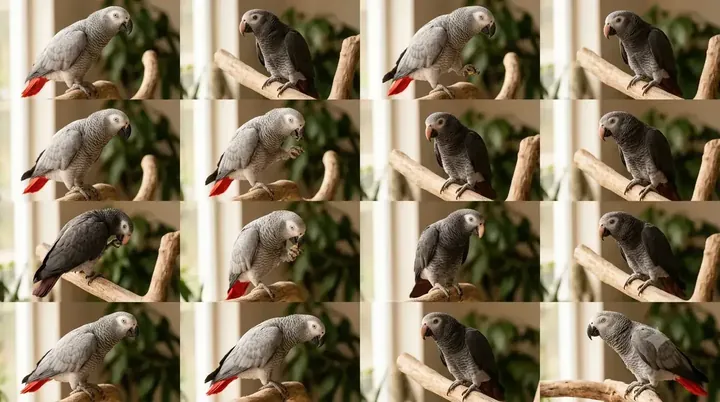





 Catherine KempfSchaumburg, IL · Congo African Grey★★★★★
 Richard WoodardWinter Haven, FL · Congo African Grey★★★★★