
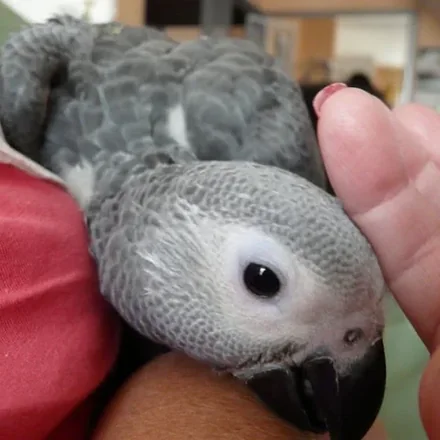
 Just weaned
 Amie
$2,500Steady, deliberate, and the first of this clutch to take pellets from a bowl without being shown twice.
Ask about Amie →This month's clutch · 3, 4, 5 and 6 months old · Midland, TX
Six hand-raised babies are in our USDA-licensed nursery right now — the youngest is three months old, the oldest is six, and every one of them is captive-bred here in Texas. Not one will travel while it is still taking formula from a syringe. That single rule is the reason this page reads differently from the listings either side of it.
4.9 from 52 buyer reviews
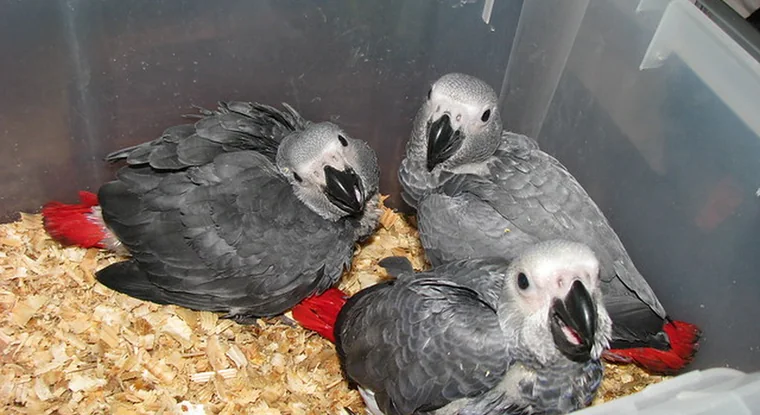
Six birds are reservable from this clutch, and every baby African Grey parrot for sale on this page is a real bird with a name, a hatch date and a weight chart rather than a stock photograph. Four are Congos and two are Timnehs, they range from three to six months old, and the prices below come straight from our inventory file — no discounts, no sale banners, and no different figure for a cock than for a hen.
Just weaned Steady, deliberate, and the first of this clutch to take pellets from a bowl without being shown twice.
Ask about Amie →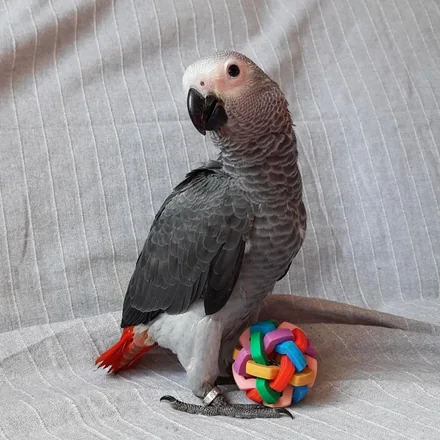 Just weaned
 Busy, food-motivated, and happiest in a kitchen with people moving through it all day.
Ask about Roys →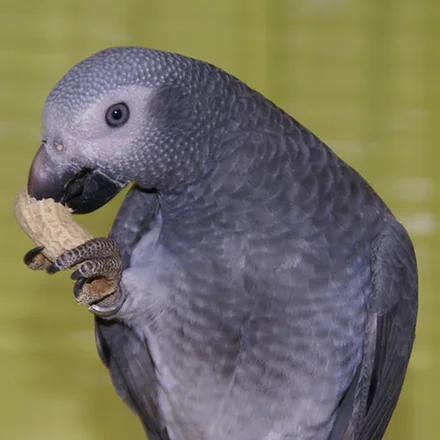 Fledged
 Already mimicking the microwave. Timnehs tend to find their voice early, and he is proving it.
Ask about Elad →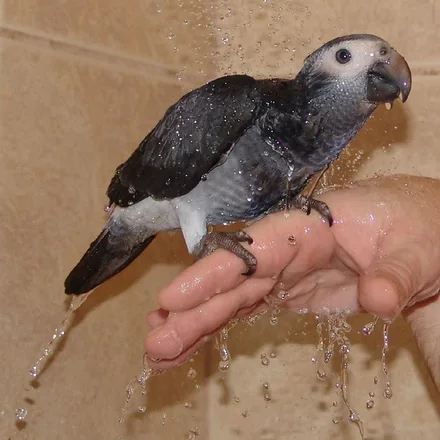 Fledged
 The quietest bird in the room until she decides otherwise. Gentle with hands from week one.
Ask about Evie →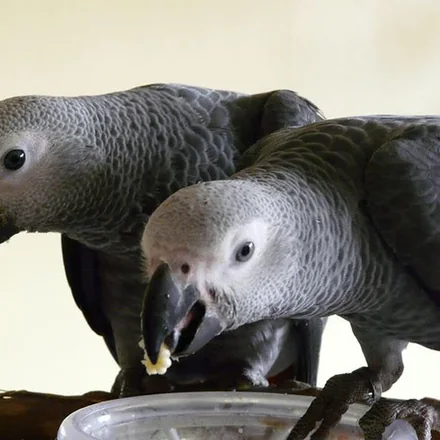 Bonded pair
 Unrelated, raised side by side, and now inseparable — which is why they leave together or not at all.
Ask about Jins & Jeni →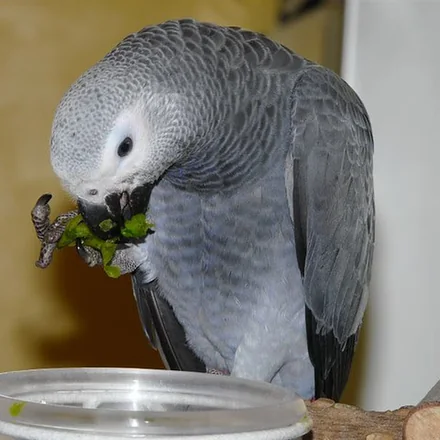 Past baby stage
 No longer a baby, and priced accordingly. Settled, forgiving, and an easier first bird than most chicks.
Ask about Bery →Evie, Elad and Jins have all cleared weaning and could travel this week. Each has been eating unassisted for longer than a fortnight, holding weight through the morning weigh-in, and flying confidently around the fledging room — the three things we insist on before a crate is ever booked.
Amie and Roys are close but not finished, and Jeni goes when Jins goes. We will take a reservation on any of them today and hold the bird until it is genuinely done, which is usually a matter of weeks rather than months.
A $200 deposit takes the bird off the page and stops us showing it to anyone else. You get photographs as the bird changes, you pay the balance when we confirm the weaning date, and if the bird turns out to need another three weeks then it gets another three weeks. We have never shortened that window to suit a travel booking, and we are not going to start.

Most of what goes wrong when someone buys a baby African Grey parrot goes wrong before any money changes hands, in the gap between what a listing implies and what it actually promises. Here is the short version of everything below, so you can carry it to whichever breeder you end up choosing.
The ledger, in plain figures
Before you send anyone a deposit
A baby African Grey should leave its breeder at twelve to sixteen weeks old, fully weaned and eating on its own. Ask that question of ten sellers and you will get answers ranging from six weeks to six months, which tells you the number is not really about the bird — it is about what the seller finds convenient.
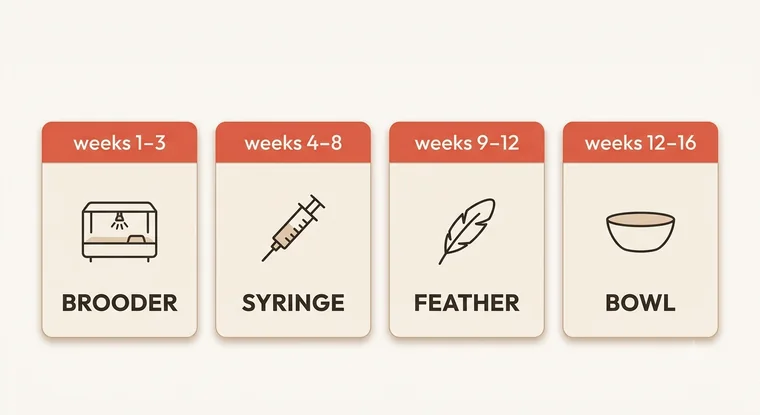
Avian veterinary guidance on weaning baby parrots states plainly that the profession does not support the sale of unweaned birds, and that hand-feeding belongs with people who already do it daily. A grey reaches independence later than most parrots — the species is famously slow about it — so twelve weeks is the earliest realistic date and sixteen is entirely normal.
Weaning is not a food event, it is a confidence event. A chick that has never flown has no reason to leave a syringe, because everything it needs still arrives at its beak. Once it can cross a room under its own power, the bowl starts to look interesting.
Flight burns energy, and a bird that is burning energy gets hungry between feeds. That hunger is the entire mechanism — it is what makes a chick investigate the food in front of it rather than wait for the next syringe. Clip a baby's wings early, or keep it in a tub past fledging age, and weaning can stall by weeks.
The moment we watch for is unglamorous: a chick that turns its head away from the syringe and goes to look at the bowl instead. Roys did it on day sixty-one. That refusal is the first real signal, and everything after it is a matter of holding our nerve.
In our nursery it means fourteen consecutive days of eating unassisted with a stable morning weight, verified on a scale rather than by eye. It does not mean the bird has merely stopped begging for formula, and it does not mean it picks at pellets while still taking two feeds a day. Those distinctions are exactly where buyers get caught.
Because a six-week-old chick costs the seller ten more weeks of formula, labour and risk that a sold chick does not. Search this page's own keyword and the results at the very top will tell you, in their own words, that they are currently hand-feeding babies in the six-to-eight-week range and taking money for them now.
The first is cash flow — money today beats money in April. The second is attrition: chicks die, and a chick that has already been paid for becomes somebody else's loss. The third is volume, because a brooder that empties in February can hold the next clutch.
No, and this is the most profitable myth in the trade. The pitch is that feeding the bird yourself creates a deeper attachment, which conveniently transfers ten weeks of skilled work onto the buyer while raising the price rather than lowering it.
Grey owners discussing purchase age on r/AfricanGrey are blunt about it — the most upvoted reply to someone offered a five-week-old chick reads "don't buy an unweaned bird, your bond won't be stronger, there is a ton of risk involved and many view it as unethical." That is not a breeder protecting a margin. That is the people who have already lived it.
The veterinary reading is narrower and colder than the forum one: hand-feeding is a clinical skill with a real complication rate, and handing it to an untrained buyer at the precise moment the bird is also adjusting to a new home compounds two stresses that are each survivable alone.
Three things go wrong often enough to be predictable, and all three are avoidable by simply waiting. Spend an hour in any parrot owners' group and you will find the same posts on repeat — someone holding an eight-week-old, a syringe they were handed at the door, and a question nobody prepared them for.
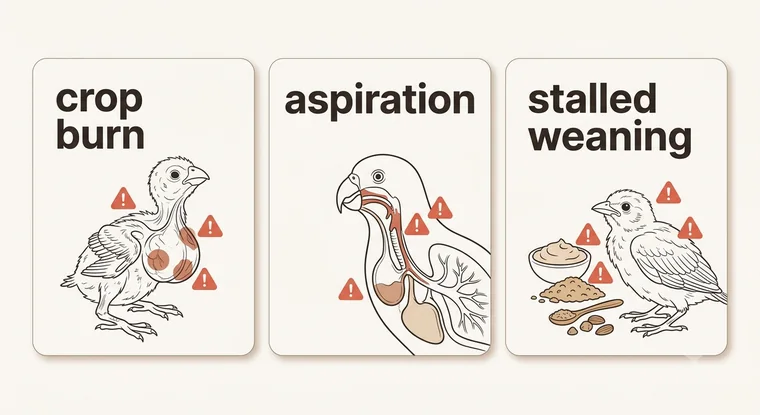
Crop burn comes from formula a few degrees too hot and can open a hole straight through the crop wall. Aspiration comes from formula delivered too fast, going into the airway instead of the crop, and it kills quickly. Stalled weaning is the quiet one — no emergency, just a bird that never quite learns to feed itself.
Because weaning is a window rather than a switch, and a bird that misses it does not simply catch up later. One owner in a grey group described a nine-month-old still taking two formula feeds a day, bought at four months and never properly finished. At that stage you are not weaning a baby, you are unpicking a habit.
An avian consultation, a crop culture and a follow-up will comfortably exceed the few hundred dollars that made the cheap bird look attractive, and that is the good outcome. The bad one involves a bird that never reaches a normal adult weight.
Evie was the slowest bird we have raised — she took nearly nineteen weeks and cost us most of a season's patience. She is also the steadiest hand-tame hen currently in the aviary. We have stopped treating slow as a problem to be managed.
Everything above is easy to claim, so here is ours in the open. This is the room the babies on this page came out of, the routine they were raised on, and the footage to go with it — because "hand-raised" is a word anybody can type and very few will show you.
A chick this young lives in a temperature-controlled brooder and is weighed every morning before its first feed. The scale is the whole diagnostic at this stage — a chick that has not gained overnight tells us something is wrong long before it looks unwell.
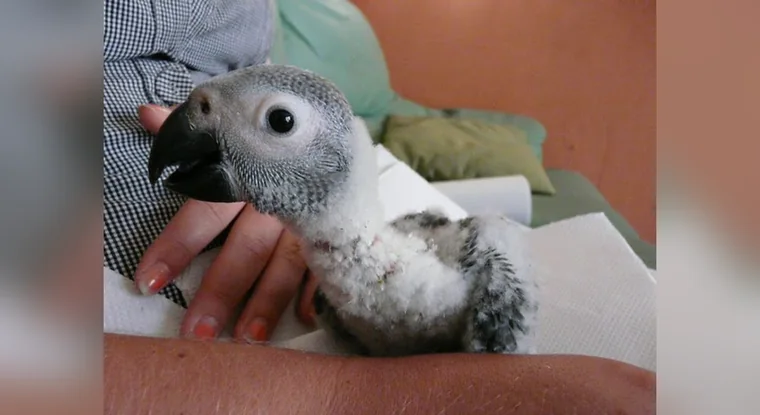
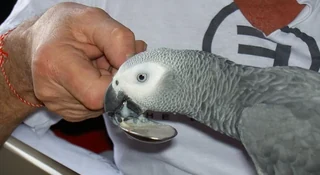
This is a chick at pin-feather stage in our own hands — not a bird for sale at this age. A baby at this point is ten to thirteen weeks away from going anywhere.
Clinical hand-feeding formula guidance puts the daily feed count and the temperature window where we keep ours: feeds drop from five a day toward three as the crop grows, pin feathers break through, and the chick starts to notice the room. This is precisely the age band at which most sellers advertise a baby African Grey parrot for sale as ready to go home. It is not ready.
The babies move to a fledging room with low perches and a lot of floor, and they learn to fly badly before they learn to fly well. Chopped vegetables, soaked pellets and millet go down where they can be walked on, sat in and eventually eaten.
Formula tapers to nothing, and the bird meets the rest of the household — the vacuum, the doorbell, our grandchildren, the cat who has no interest in it whatsoever. A grey that meets ordinary domestic chaos here is far less startled by yours later.
Fourteen consecutive days of independent eating with a stable morning weight, and no supplementary feeds inside that fortnight. If we break the streak, the streak restarts.
Every bird has a running daily weight from hatch to homing, and it travels with the bird when it leaves. Your avian vet will find that chart considerably more useful than anything we could tell you about the bird's temperament.
Day sixty-one, first refused feed. Day sixty-eight, eating soaked pellets unassisted. Day seventy-four, a twelve-gram dip after a growth spurt that put him back on one evening feed for four days. Day ninety-one, streak complete. That dip is why we do not publish a homecoming date in advance.
A baby African Grey parrot for sale from a documented United States breeder costs between $1,500 and $3,500. Our own birds sit inside that band, the figure depends on subspecies and age rather than on sex, and it is the same number whether you found us this morning or have been reading for a month.
Evie is our floor at $1,500 and Amie our ceiling at $2,500, with the bonded pair at $3,500 because two birds leave together. Bery, at a year old, is $1,700 — she is past the baby stage, and we would rather say so than quietly describe a yearling as a baby.
Less demand, not less bird. Congos carry the name most people searched for, so they clear faster and hold a higher price, while Timnehs are smaller, generally calmer and often talking sooner. Our Timneh listing sets the two side by side if you are genuinely undecided.
It includes the bird, the DNA certificate, the veterinary health certificate, the hatch record, the closed band, the CITES captive-bred paperwork and the weight chart. It does not include travel, which is $185 or $350, and it does not include a cage — we would rather you chose that yourself than pay us to choose badly.
Two hundred dollars holds the bird and comes off the total. The balance falls due when we confirm the weaning date, not before, and the payment method is agreed at reservation. Nobody here will ever ask you to send money by a method that cannot be traced.
The advertised price of a baby African Grey in the United States currently spans about ten to one, and both ends of that range should slow you down. We went and looked at what is actually being asked, and the spread is not a market — it is two different problems.
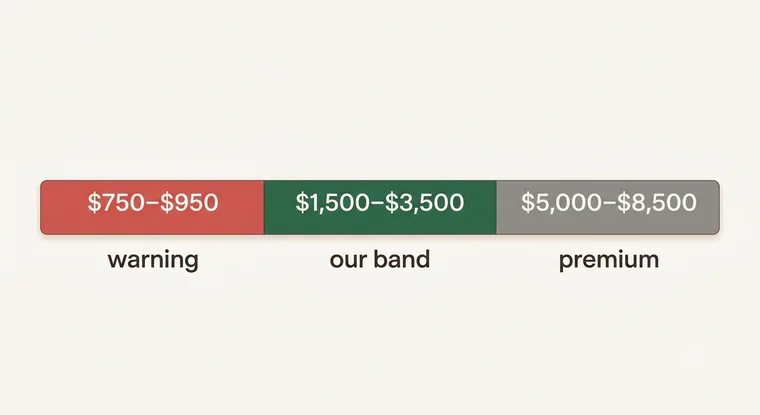
Screening a chick for beak and feather disease and polyomavirus, sexing it, having a vet examine it and feeding it formula for four months does not leave change out of $850. So a bird at that price has had something removed from it, and the question worth asking is which thing — the testing, the weaning time, or the bird's existence.
Two patterns turn up constantly and both are tells. The first is the permanent sale, where a bird is "reduced" from $2,900 to $1,800 and has been for as long as the page has existed. The second is charging differently for a cock and a hen, which puts a price on a coin toss.
Because sex is settled by a laboratory before the bird is listed, and it has no bearing on what the bird cost us to raise. Evie and Elad are a hen and a cock, four months apart, and the hundred-dollar gap between them is age and nothing else.
Our floor is $1,500, and we know how that lands on someone who has read that greys go for six to eight thousand. Owners comparing grey prices on r/parrots describe exactly that trap — one asking why the bird is $5,000 to $6,000 from every breeder they can find, another simply begging for anyone not charging eight grand. The honest answer is that the middle of that range exists. It is just badly advertised.
No, and any listing offering one is telling you something. At $600 nothing on the documentation list has been paid for, so either the bird will not arrive after the deposit, or it will arrive with a history that will not survive being asked about. If your budget is genuinely under a thousand dollars, the right move is to keep saving or to look at a rescue — not to find a cheaper website.
You do not need to be an expert to sort a real nursery from a photograph farm — you need seven questions and the patience to wait for the answers. Ask a legitimate breeder these and numbers come back within a day. Ask a fraudulent one and the subject changes.
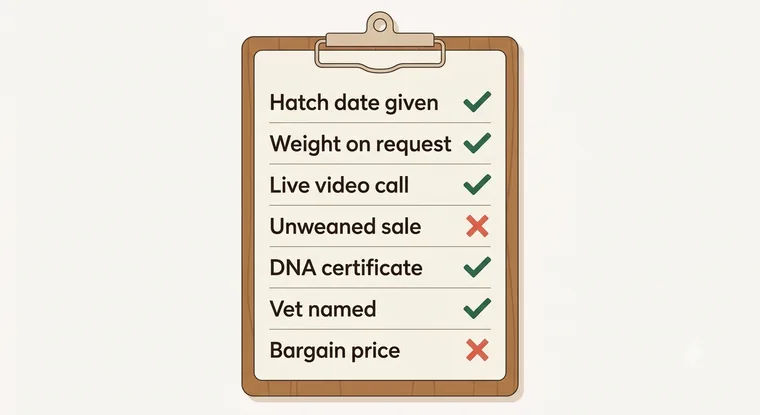
Those three come first because they are the hardest to fake and the fastest to check. A seller who cannot produce a weight has never kept one, and a nursery that does not weigh its chicks daily is not really running a nursery.
Owners cataloguing ethical-breeder signals on r/parrots put missing disease testing and absent DNA verification near the top of their list, alongside hidden aviaries and cages nobody is allowed to see. Those items separate a hobbyist with good intentions from an operation with something to hide.
"Who were this bird's parents?" A nursery that keeps its own breeding adults can name them without pausing. A reseller who bought the chick in cannot, and will usually answer a slightly different question instead.
The most striking thing in those owner threads is what they flag as the single biggest warning sign — a breeder who shows no interest whatsoever in the home the bird is going to. Buyers hunting for a legitimate grey seller on r/AfricanGrey are told, in the top-voted reply, that there are none worth trusting online at all. We do not think that is quite true, but we understand entirely how they got there.
Whether anyone is home during the day, whether there are other birds already and when they were last screened, whether the kitchen has non-stick pans in daily use, and who takes the bird if your circumstances change in twenty years. We have declined sales over the answers.
We raise both, so we have no reason to push you toward either. At four months the difference is already obvious in the hand — the Congo heavier and louder, the Timneh smaller and quicker to imitate — and which of those you want depends far more on your house than on the bird.
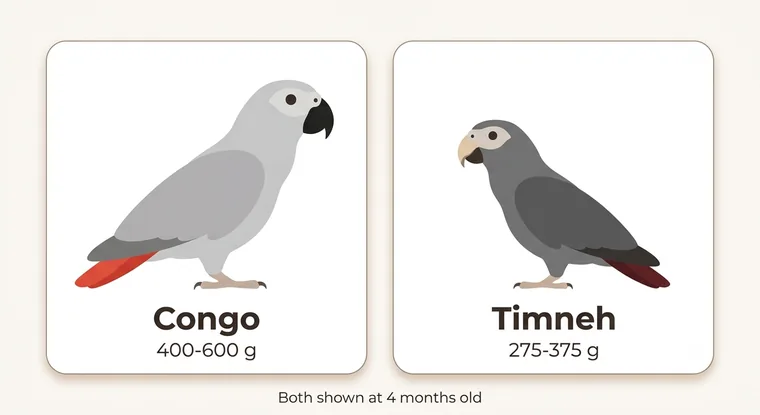
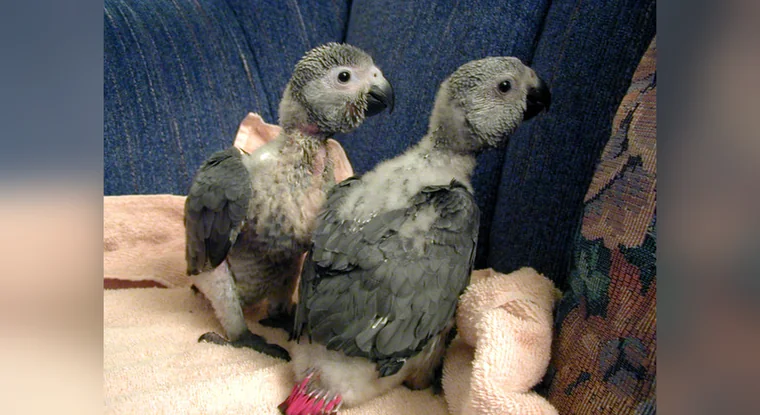
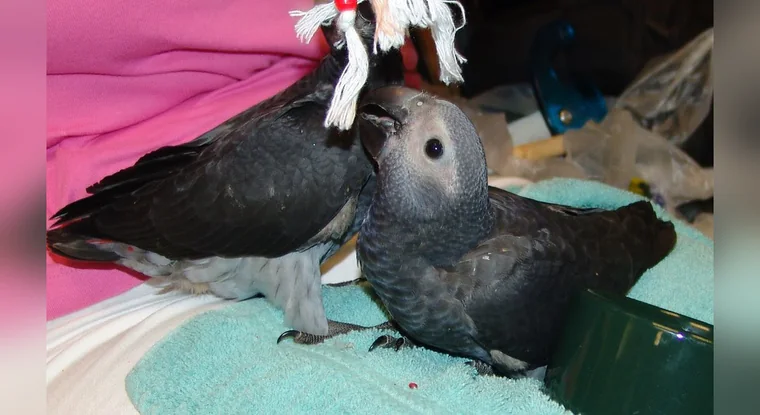
The diagram is drawn to scale. The photograph under it is two of our own chicks at fledging age — whichever subspecies you choose, this is roughly what it looks like on the day the weaning clock really starts.
A four-month Congo runs 400 to 600 grams with a scarlet tail; a Timneh of the same age is 275 to 375 grams with a darker maroon one and a horn-coloured upper beak. Amie fills a hand at three months. Evie, three months older, does not.
Usually the Timneh, for unglamorous reasons — less volume in an apartment, a steadier reaction to household noise, and a tendency to start talking a few months earlier, which keeps a new owner encouraged through the dull stretch. Choose the Congo if you want the headline voice and have the room for it.
Not always, and we would rather say so here than have you find out afterwards. Ask in any owners' group whether to buy a baby and a substantial number of experienced keepers will tell you to adopt instead — and for a lot of households they are right.
A known history, and the whole of it. An African Grey lives 40 to 60 years in good conditions, so a three-month-old is very nearly the entire span — you get the hatch date, the parents, the screening results and the weight chart, and no accumulated fear of hands, brooms or particular voices. For a first-time owner that predictability is worth a great deal, because you are learning the species at the same time the bird is learning you.
When somebody wants a bird that already talks, when the budget is genuinely under a thousand dollars, or when they are away from home ten hours a day. A baby will not fix the third one, and buying under pressure on the second is how people end up on a scam site. Our honest adoption page makes the same argument at more length.
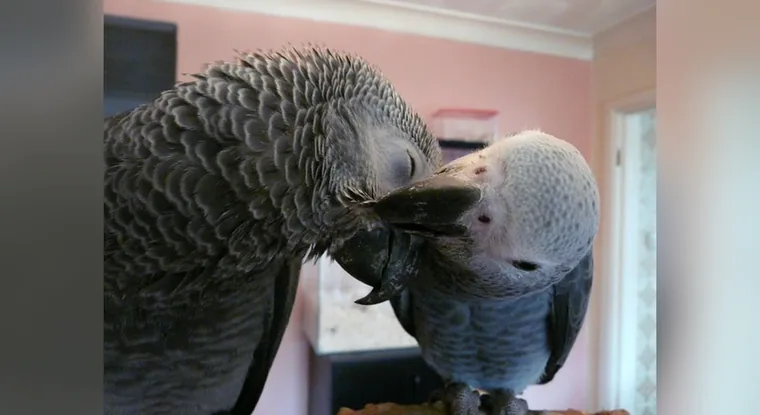
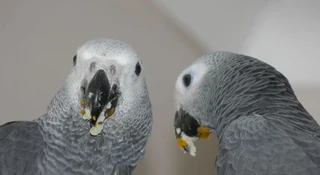
Grown greys, mid-preen, in somebody's front room. This is the outcome an adopted adult can reach as readily as a hand-raised chick — it simply gets there by a different route.
They stay. We have kept birds back for a year rather than send them to a home we had doubts about, and Bery is on this page at twelve months for exactly that reason.
A yearling has already fledged, already weaned and already met a household, so nothing about its first month with you is developmentally fragile. You trade the blank slate for a bird that is simply harder to get wrong.
Bery weaned uneventfully at fifteen weeks and then stayed, because the family who reserved her had a change of circumstances. She is a year old, priced below the babies, and we describe her as what she is rather than stretching the word "baby" to cover her.
Five documents leave with every bird, and they are the reason a documented baby costs more than an undocumented one. None of this is decorative — each item answers a question that somebody, at some point, is going to ask you about your bird.

Federal animal-welfare licensing rules set the standard we are inspected against, and the paperwork follows from it. The hatch certificate ties the baby African Grey parrot to a date and a clutch, the band ties it to this aviary permanently, and the DNA result settles the sex with a laboratory's name attached. Together they make the bird traceable, which is the entire point.
A closed band goes on while the foot is still small enough to pass through it, which can only happen in the first fortnight of life. That is why it is meaningful evidence of captive breeding — an imported adult bird physically cannot be given one.
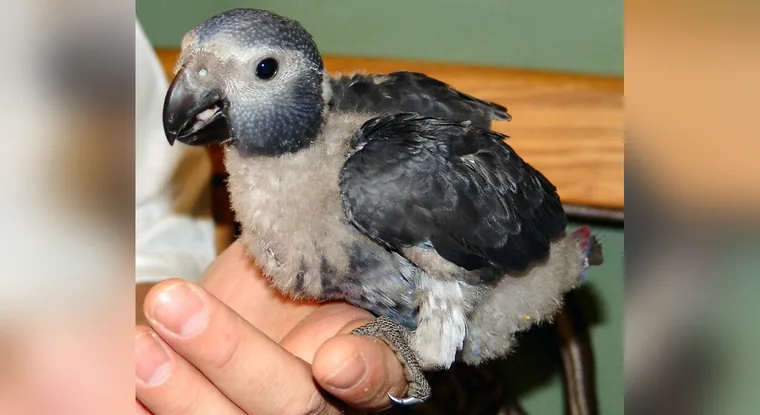
That ring on her ankle is the band itself, photographed here in our own hand. She is Evie — the same hen listed further up this page at six months old, which is the shortest way we can show you that a bird and its paperwork started in the same room.
Because removing it destroys the one piece of proof that cannot be reprinted. If a seller offers to take a band off for you, or explains that a bird's band "came off", treat that as the answer to a question you had not yet asked.
Every chick is screened by PCR for psittacine beak and feather disease and for avian polyomavirus before it appears on this page. Both are diseases that end a young grey, both move through a nursery, and neither is visible by looking at a bird.
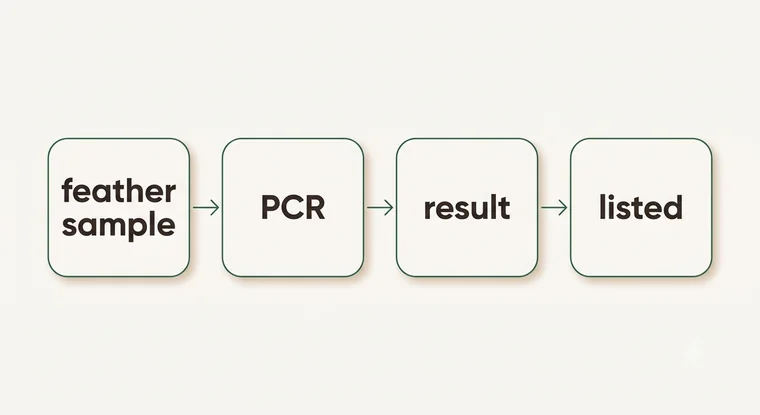
Published research on psittacine circovirus describes a virus that attacks feather follicles and the immune system, with young birds most at risk and no cure once it is established. PCR finds it before symptoms do, which is the only useful time to find it.
Because chicks share air, surfaces and hands. One untested bird brought into a brooder room can end a whole season, which is why we screen rather than assume, and why we ask what other birds you already keep.
Weight against the chart, crop function, keel condition, vent, eyes, nares and feather quality, plus a listen to the air sacs. The certificate that comes out of it is dated close to travel, because a month-old health certificate describes a month-old bird.
Nothing feathered enters the brooder room without thirty days of separation first, and that includes birds coming back from a show or a vet visit. It is inconvenient, unglamorous, and the reason we have never had an outbreak.
Every baby on this page came out of an adult pair we own and keep, which is why we can answer the parentage question without checking. It is also the slowest possible way to run an aviary, and the reason there are six babies here rather than sixty.
Amie and Roys are siblings out of James and Lois, our steadiest Congo pair. Jins and Jeni are not related to each other at all — they came from separate clutches, were raised alongside one another, and bonded anyway, which is why they are sold together.
Elad and Evie are both out of Levi and Rily. Timneh clutches come around less often here than Congo ones, so when people ask why there are only ever two or three Timnehs listed, that is the reason rather than a sales tactic.
Because a pair that stays produces a documented line, and a documented line is what lets us put a hatch certificate in your hand. We do place a proven adult pair occasionally, and those are listed well away from the nursery so nobody confuses the two.
Two pairings gave us six birds this season. That is an ordinary result and it is why we cannot promise you a specific bird in a specific month — the clutch decides, not the diary.
Four Congo chicks and two Timneh out of two pairings, all six weaned without intervention, one growth-spurt dip logged, no crop incidents. That is an ordinary season, and ordinary is exactly what we are aiming for.
African Greys have been listed on CITES Appendix I since January 2017, and a captive-bred baby African Grey parrot is entirely legal to own and to transfer inside the United States with the right paperwork. Conservation status data for the grey parrot explains why the uplisting happened — wild trapping pressure, not captive breeding. The listing restricts international commercial trade in wild-taken birds; it does not make your baby illegal.
The CITES appendices themselves set out the distinction, and the practical version for you is short: buy captive-bred, keep the documentation, and a domestic move between states is unremarkable. Our documentation page walks through what each paper does.
Because an Appendix I export needs permits at both ends and cannot honestly be promised in twenty-four hours, whatever a competing site tells you. We ship domestically only, and we would rather lose the enquiry than pretend otherwise.
Photograph everything the day it arrives, keep the originals somewhere dry and unremarkable, and give your avian vet a copy at the first appointment. Twenty years from now the band number and the hatch certificate are what will answer questions about this bird.
Three ways exist to get a baby from our nursery to your house, and the cheapest one is to come and fetch it. We are in Midland, West Texas, and a surprising number of our buyers turn out to be within a morning's drive.

Airport collection is $185 and puts the bird into your nearest major cargo terminal on a Delta, United or American flight. Home delivery is $350 and a courier hands the bird and the document folder to you at your door. Both travel under IATA live-animal transport standards in an approved crate with water and ventilation.
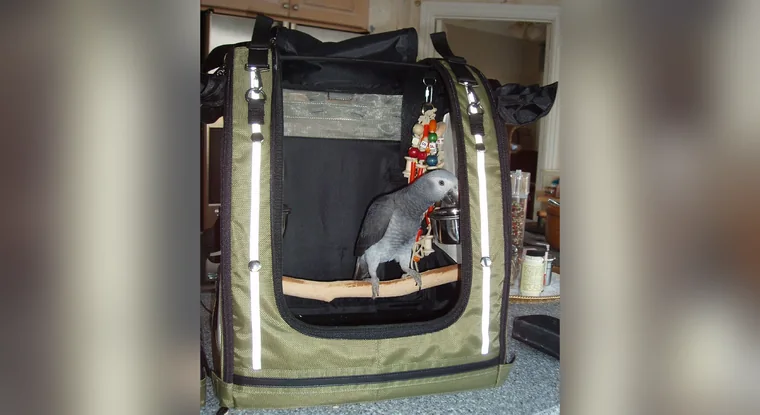
Direct flights wherever one exists, early departures to avoid afternoon heat on the tarmac, a crate the bird has already sat in at home, and a full crop before it leaves us. Most birds are in your hands within four to six hours of the aviary door closing.
Because a bird that needs feeding on a timetable cannot be fed inside a cargo hold, and it arrives hungry, cold and behind on weight. This is the hardest conversation we have with buyers in a hurry, and the answer has never changed.
Collection in Midland is free, and if you are within two to three hours we would genuinely rather you did it — you meet the bird, you see the room it grew up in, and it travels in a car with you instead of in a hold. Experienced owners in buyer forums recommend exactly this wherever the drive is survivable, and they are right.
The month after arrival decides more about the next forty years than anything that happens in our nursery. We stay reachable through all of it, because the questions people are embarrassed to ask are almost always the ones worth answering quickly.
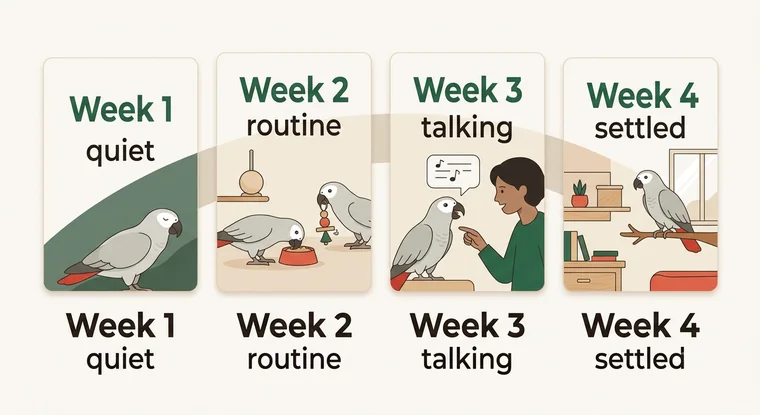
Do very little. Let the bird watch the room, keep it warmer than you think necessary, and weigh it every morning on a kitchen scale. A small drop on day one is ordinary; a drop that keeps going for three days is a telephone call.
Greys settle into rhythm rather than novelty, so a predictable morning matters more than an interesting one. Words start arriving once the bird is comfortable enough to be bored, which is usually later than new owners expect and always sooner than they fear.
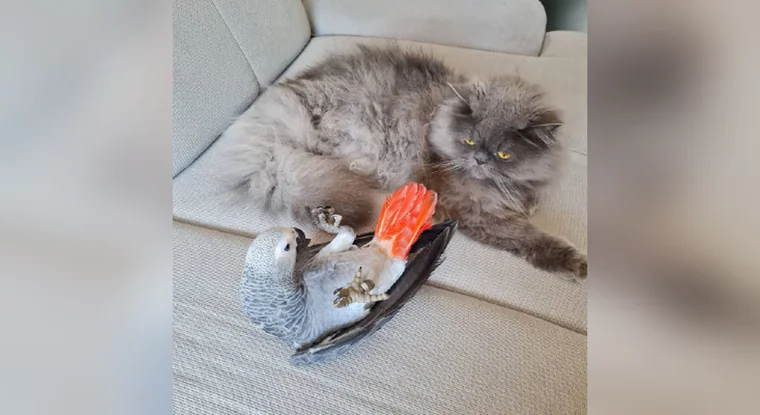
Offer what it ate here first — soaked pellets and warm chop — because a stressed bird returns to a familiar texture before it tries a new one. Telephone us the same day. A young grey has very little reserve, and this is not a thing to sleep on.
Call for fluffed-and-quiet lasting hours, laboured breathing, vomiting, or a weight fall past five percent. Do not panic over a bird that is clumsy, noisy at dawn, or nervous of one particular family member in week one — all three are normal and all three pass.
"It was fine, and now it screams when I leave the room." That is a bird that has decided you are its flock, which is good news arriving in an inconvenient form. We talk people through it most months.
Two buyers from this year, both of whom found us the same way you did. Their words are reproduced exactly as they wrote them.
Rated 5 out of 5I spent weeks looking for a baby African Grey parrot for sale in California, but I wanted a breeder that truly cared about the birds rather than just making a sale. After finding C.A.Gs, I immediately noticed the difference. They answered every question, shared regular updates, and provided health records before my baby Congo African Grey arrived. The parrot is healthy, confident, and already learning new words. If you're searching for a reputable breeder with beautiful, well-socialized African Greys, I highly recommend C.A.Gs. They made the entire experience smooth and stress-free from start to finish.
Joanna Thomas · Oildale, CA
Rated 5 out of 5If you're planning to buy baby Congo African Grey parrots from a breeder you can trust, C.A.Gs is the place to go. My experience exceeded every expectation. Communication was excellent, the bird was healthy and exceptionally well-socialized, and everything promised was included. You can tell they genuinely care about raising intelligent, happy African Grey parrots. My new companion adapted quickly to our family and has already begun mimicking sounds. I wouldn't hesitate to recommend C.A.Gs to anyone looking for a quality baby Congo African Grey with outstanding customer service and ongoing support.
Anthony Tershal · Lakewood, WA
We looked at what the pages ranking around this one actually advertise, and set it against what we do. Nothing in the left-hand column is invented — it is what those listings say about themselves.
| What you are buying | Typical online listing | C.A.Gs |
|---|---|---|
| Age at sale | 6–8 weeks, still hand-feeding | 12–16 weeks, self-feeding |
| Advertised price | $750–$950, or $5,000–$8,500 | $1,500–$3,500 |
| Pricing by sex | Cocks and hens priced differently | Same price, sex confirmed by lab |
| Discounting | Permanent "sale" pricing | One price, no countdowns |
| Disease screening | Rarely stated, or "fully vaccinated" | PBFD + polyomavirus PCR |
| Parentage | Not named | Both parents named per chick |
| Seeing the bird | Photographs only | Live video, or drive to Midland |
The "fully vaccinated" claim is worth pausing on: there is no routine vaccination programme for companion African Greys in the United States, so a listing advertising one is describing something that does not exist.
Four pages worth your time before you commit, each answering a question this one only had room to touch.
 How we hand-raise, week by weekThe method behind every bird on this page
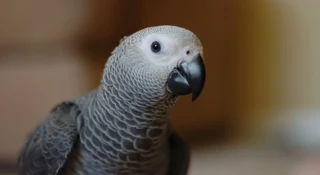
  What a DNA sexing certificate provesAnd why nobody can sex a chick by eye
  Our written health termsThe 72-hour window, in full
  The true first-year costBeyond the price of the bird
 Also from our aviary
Fertile eggs for experienced incubators — the one thing here that cannot be weaned, which is exactly the difference this page has been about.
Adult pairs kept back from the nursery — where next season's babies come from, listed separately so nobody confuses a breeding bird with a companion one.
Two Congos that leave together — Jins and Jeni have their own page, because a bonded pair is a different decision from a single baby.
Ten questions we answer most weeks, in the words people actually use when they telephone.
Between twelve and sixteen weeks, and only once the bird has been self-feeding for a fortnight with a stable morning weight. Amie left the brooder at thirteen weeks; Evie took until nearly nineteen. We let the bird set that date, not the calendar and not the buyer.
No. We have turned down experienced hand-feeders for the same reason we turn down first-timers — a bird that travels on formula arrives stressed, in a new environment, with a new person holding the syringe, and that is precisely when crop problems start. The Association of Avian Veterinarians takes the same position, and we are not going to be the exception to it.
Not from us, and in our view not safely from anyone in the United States. Our floor for a baby is $1,500, which is roughly what disease testing, DNA sexing, sixteen weeks of formula and a veterinary exam actually cost before anyone makes a dollar. Listings at $600 or $850 are either taking a deposit for a bird that does not exist, or moving a bird whose origins will not survive a question.
Neither is better, but Timnehs are usually easier. They are smaller, generally steadier in a busy house, and tend to start talking earlier — Elad was mimicking the microwave at five months. A Congo has the bigger voice and the bigger presence, and asks a little more of you in return.
Yes, and California is where most of our enquiries come from. A baby flies as cargo into your nearest major airport for $185, or a courier brings it to your door for $350. The bird must be weaned before it flies, so a California reservation on a three-month-old means a wait of a few weeks.
You have seventy-two hours to get an independent avian vet to examine the bird, and twenty-four hours from arrival to tell us about anything you saw on the day. If that exam finds a congenital defect or an infectious disease, we replace the bird or refund you, at our discretion. Our written terms set out exactly what is and is not covered.
Yes. We are in Midland, West Texas, and if you are within a two-to-three hour drive you are welcome to collect in person and skip shipping entirely. If you are further out we will do a live video call with the bird in hand instead — the same call, incidentally, that any breeder should be willing to take.
Because you get the certificate with the laboratory's name on it, not our word. A feather or a toenail-tip blood sample goes to Avian Biotech, and the result comes back at roughly ninety-nine percent accuracy in one to two business days. Anyone claiming to sex a grey chick by looking at it is guessing.
We do sell fertile eggs, but only to experienced breeders with their own incubators — and an egg is the one thing on this site that cannot be weaned, which is the whole difference. If you want a companion bird rather than a hatching project, a weaned baby is the right end of that trade.
From adult pairs we keep back rather than sell, which is a slower way to run an aviary and the reason we can name every chick's parents. We do occasionally place a proven adult pair, and those birds are listed well away from the nursery.
Tell us which bird caught your eye and something about your household, and we will reply within twenty-four hours — usually sooner. A $200 deposit holds a baby until it is genuinely weaned, however long that takes.