African Grey vs Amazon Parrot: Which Talker Truly Fits Your Home?
We hand-raise African Greys here in Midland, and the first thing Amazon-curious buyers want settled is almost always the same: do they want a talker or a singer? What follows is the straight comparison we give them — Grey versus Amazon, then Grey against each of the six Amazon species they're really deciding among.
Quick answer: The African Grey is the planet's premier talking parrot — 200 to 1,000-plus words, deployed in context — packaged in a quieter, dustier, more one-person bird. An Amazon is a green, extroverted singer: louder, more confident with strangers, and, in the yellow-headed species, far more hormonal. Greys talk better; Amazons sing better. The catch buyers miss is that "Amazon" isn't one bird — it's a genus of thirty-plus species that behave very differently, while "African Grey" is essentially two.
Choose an African Grey if…
conversation matters more than song, and you want words used in context
you share walls and need the calmer, more predictable voice
you can manage feather dust in exchange for steadier, less hormonal moods
Choose an Amazon if…
you love a confident singer that performs and greets visitors
your home can absorb all-day volume and seasonal hormonal swings
you want a low-dust bird and don't mind smaller, less contextual talking
Search phrasing varies — Amazon parrot vs African Grey, "African gray" with an a, even the merged "Amazon grey parrot" — but the conclusion doesn't: this isn't a better-or-worse contest, it's a wiring match between a contextual talker and an extroverted singer. Since we raise only Greys, we'll flag our bias plainly and still give the Amazon full credit for what it does better. And the rest of the page opens with the question the other results skip — which Amazon are you actually comparing?
8 Fast Facts to Weigh Before You Pick a Grey or an Amazon
Short on time? These are the eight lines Amazon-versus-Grey shoppers screenshot for their partner — the talk-versus-sing split, the all-day noise gap, the dust-for-hormones trade, and the four-to-seven-decade clock. Each one comes out of our own aviary and a decade of replying to these exact messages, not from a reshuffled listicle.
2 vs 30+you're weighing two Grey species against a genus of very different Amazons
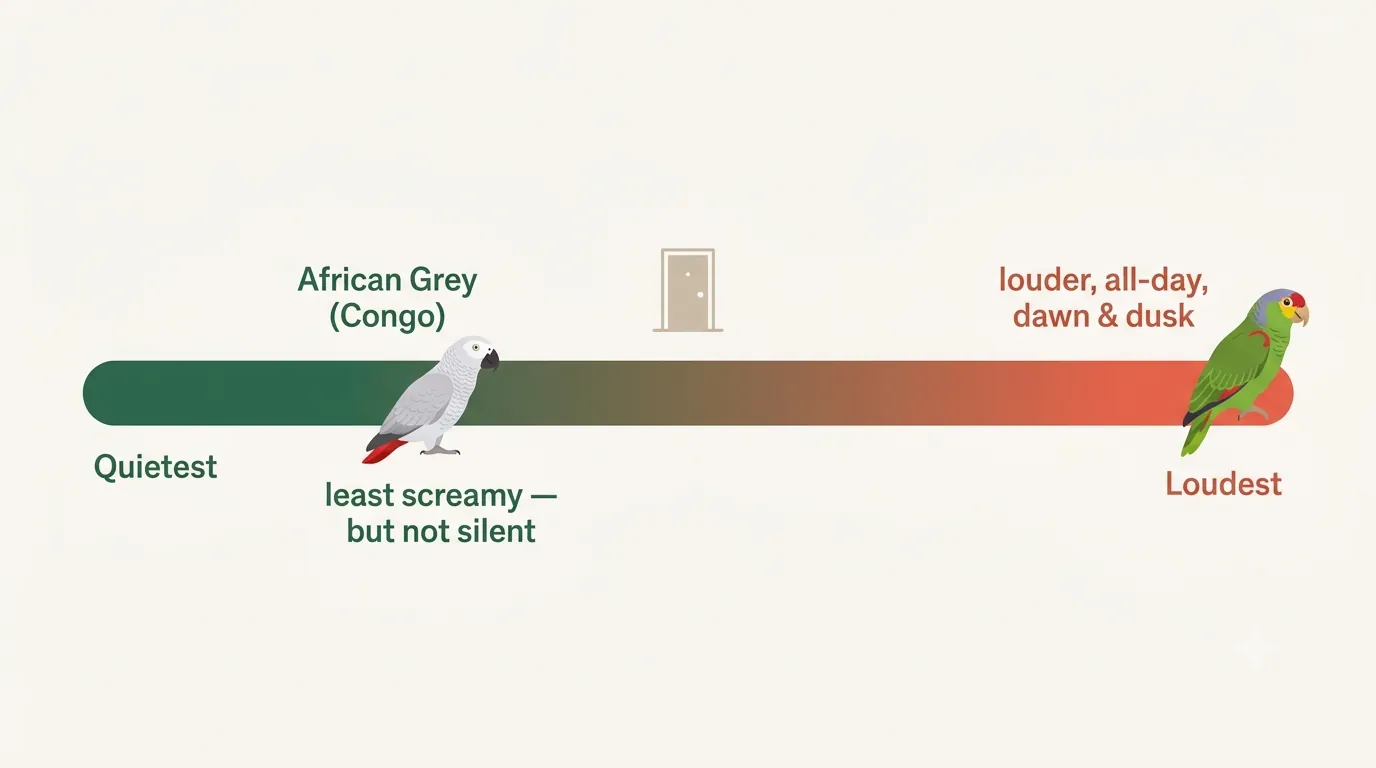
Louder all dayAmazons project across the day; Greys are the least screamy parrots
Dust vs hormonesthe Grey's trade-off is powder-down; the Amazon's is hormonal maturity
40–70 yrseither bird can outlive its owner; a caretaker plan matters
6 specieswe name the Red-Lored, White-Fronted, Yellow-Shouldered, Blue-Fronted, Yellow-Naped & Double-Yellow-Head
100%documented — CITES papers, DNA sexing certificate and PBFD/APV PCR results on every Grey
$185 / $350nationwide airport pickup or door-to-door delivery
Grey and Amazon, Trait for Trait: the Full Table
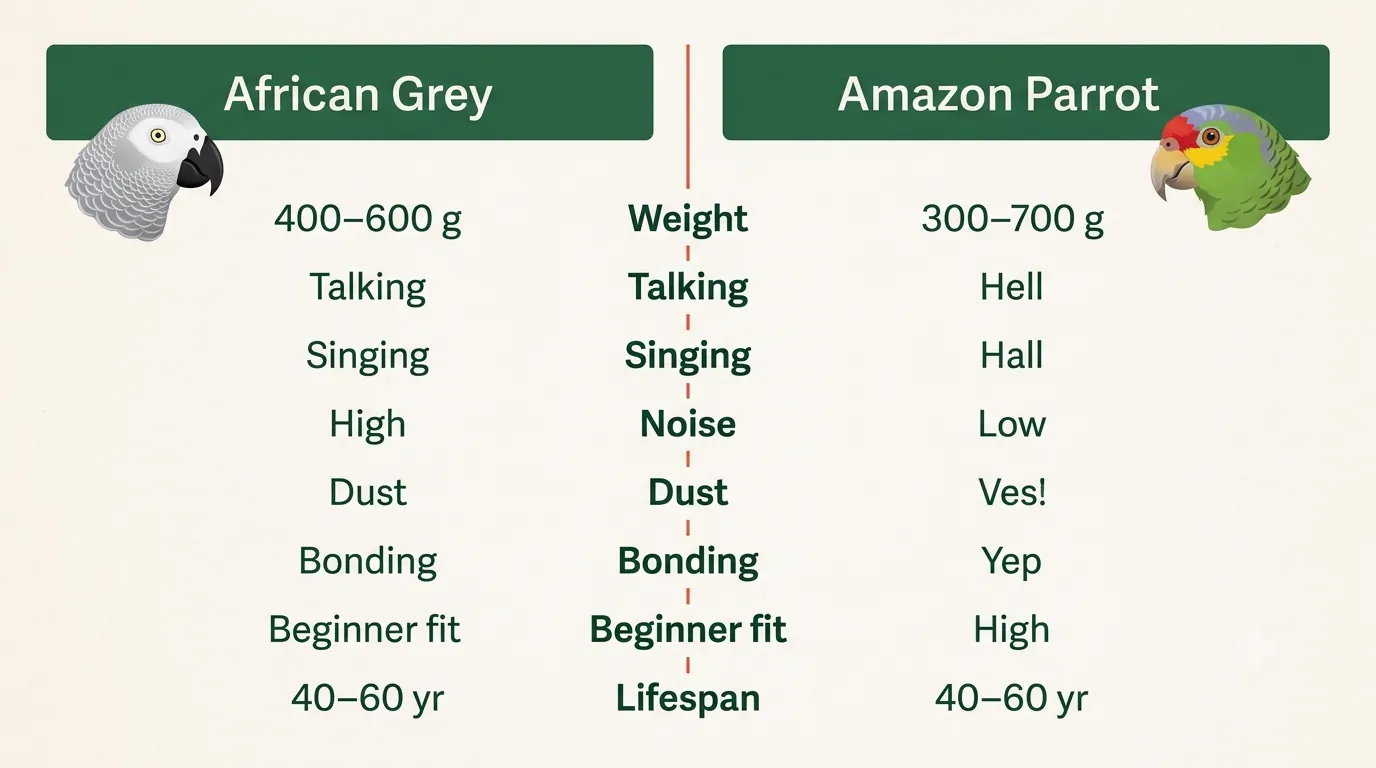
Thirteen attributes, one honest verdict column, and a few rows where the true call is just "depends on you." These are the calls we'd make across the table at the aviary, not padding. Amazon figures cover the whole genus here — the yellow-headed species sing loudest and swing hardest hormonally — so read the column as a range, not one bird. On a phone, tap the bird you're weighing and its column travels with you.
Attribute
African GreyThe world's best talker
Amazon ParrotThe extroverted singer
Edge
Talking (vocabulary & context)
Exceptional — 200–1,000+ words, in context
Good in top species; smaller, less contextual
African Grey
Singing (melody & volume)
Modest — whistles & mimicry
Superb — yellow-heads are 'opera singers'
Amazon
Temperament
Reserved, one-person, sensitive
Extroverted, confident, 'spicy'
Depends on you
Noise level
Moderate — least screamy parrots
Loud, all day
African Grey
Body size
12–14 in · 400–600 g
10–15 in · 200–680 g by species
Comparable
Powder-down dust
High — allergy-relevant
Low
Amazon (less dust)
Hormonal aggression
Mild, plucking-prone if bored
High in yellow-headed species
African Grey
Obesity / fatty liver
Lower risk
High risk on wrong diet
African Grey
Beginner suitability
Demanding but steadier
Demanding; big yellow-heads harder
Grey, marginally
Apartment fit
Plausible with daily time
Louder; small species workable
African Grey
Lifespan
40–60 years
40–70 years
Both lifelong
Typical price
$1,700–$3,500 (our Greys)
Varies by species (external market)
Depends
CITES documentation
Appendix I — included
CITES-listed — we don't sell them
Grey (we document)
Those "Edge" verdicts are our own — grounded in the birds we hatch and the Amazon owners we swap notes with, never scraped from other listings.
Why This Comparison Isn't Symmetric — and Who's Telling You
One side of this comparison lives in our aviary and the other does not, so read our Amazon verdicts as a well-researched outsider's and our Grey verdicts as first-hand. Naming that imbalance is what keeps the rest of the page honest.
Mark & Teri Benjamin
Hand-raising African Greys in Midland, Texas since 2014
Here's the thing most comparisons hide: this matchup is lopsided by nature. "African Grey" is essentially two birds — the Congo and the Timneh. "Amazon" is a genus of more than thirty species that range from the gentle Red-Lored to the operatic, hormonally intense Double-Yellow-Head. Comparing a Grey to "an Amazon" is like comparing a specific dog to "a hound" — you have to name which one. That asymmetry is the whole reason we built the species section below, and it's why a single blanket "Amazons are…" sentence is almost always wrong.
We're Mark and Teri Benjamin, hatching and hand-feeding African Greys at C.A.Gs since 2014, and "should I get an Amazon instead?" is a question we answer most weeks. Our Grey observations come straight from the nursery; our Amazon observations come from the owners, rescues and avian vets we've traded notes with for years. So here's the line no advertisement volunteers: a good Amazon out-sings any Grey we've raised, and it will charm your visitors in a way our one-person Greys simply won't.
Why We Put Health Paperwork Above First Impressions
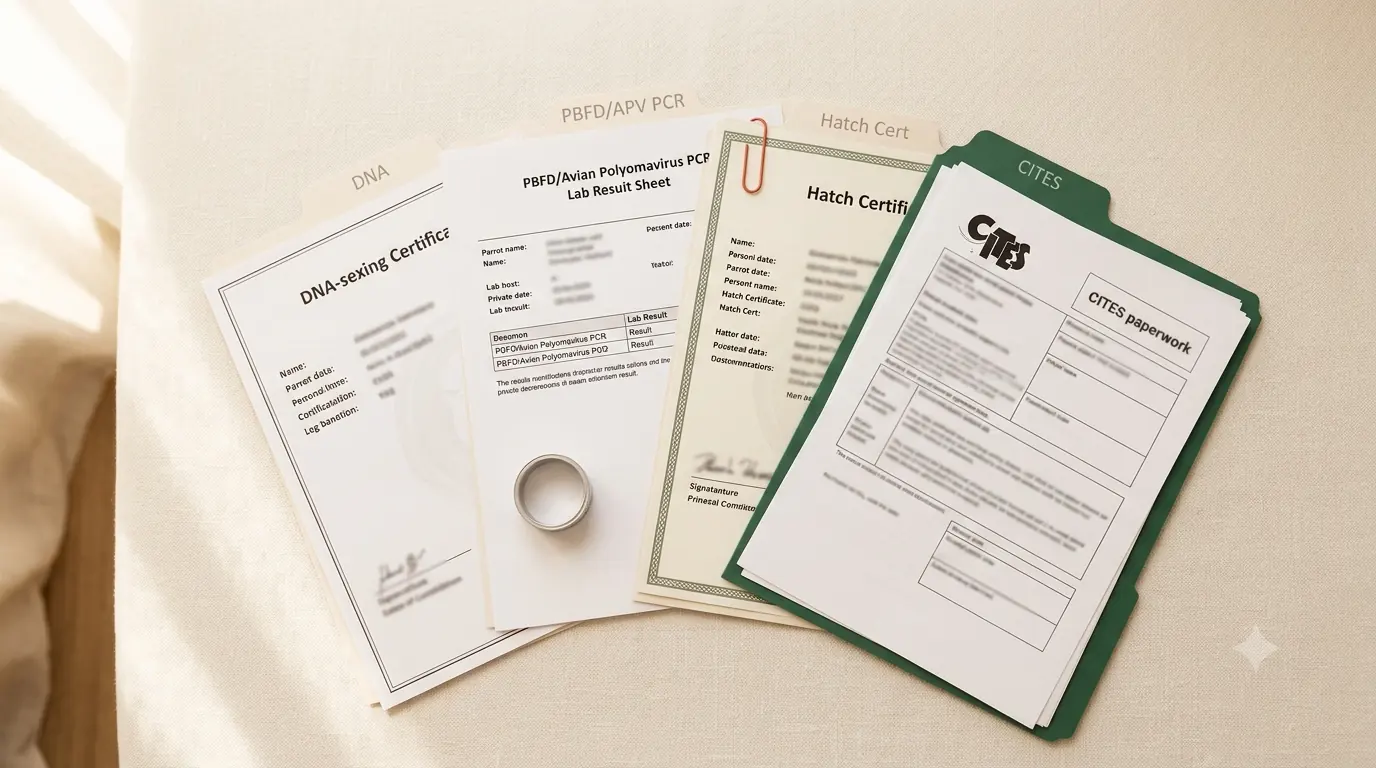
With a bird that may share your home for half a century, the sticker price is trivial next to the decades of care behind it — so we front-load the documentation that protects those decades. Each Grey ships with PBFD and Avian Polyomavirus PCR results, a DNA sexing certificate, an avian-vet health certificate, a hatch record and closed band, and the CITES Appendix I papers proving captive breeding on US soil. Our health guarantee page commits the entire stack to writing.
Why Does the African Grey Out-Talk Most Amazons?
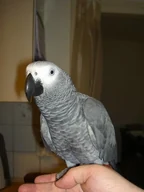
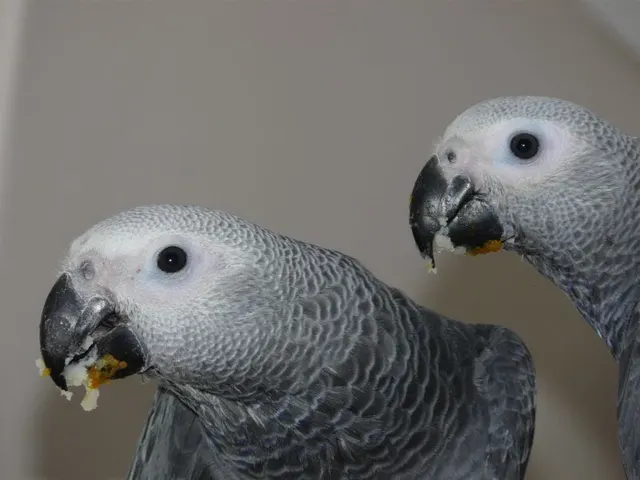
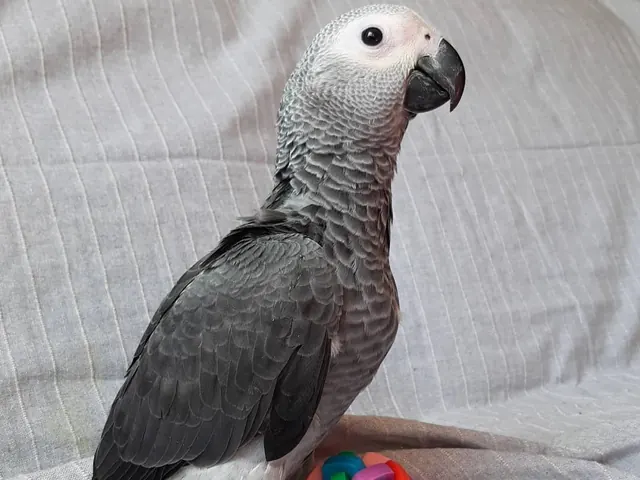
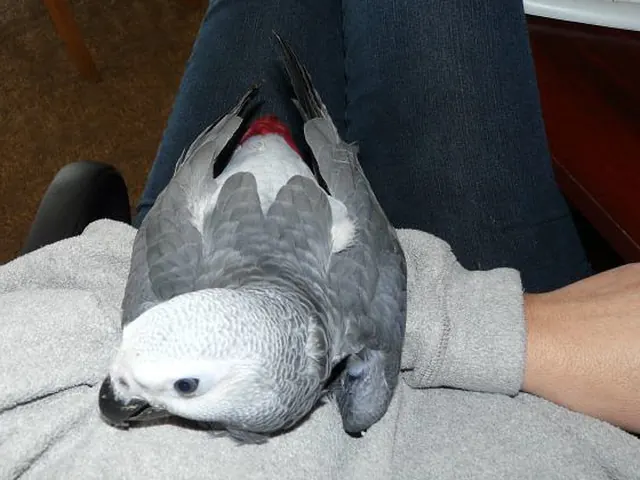
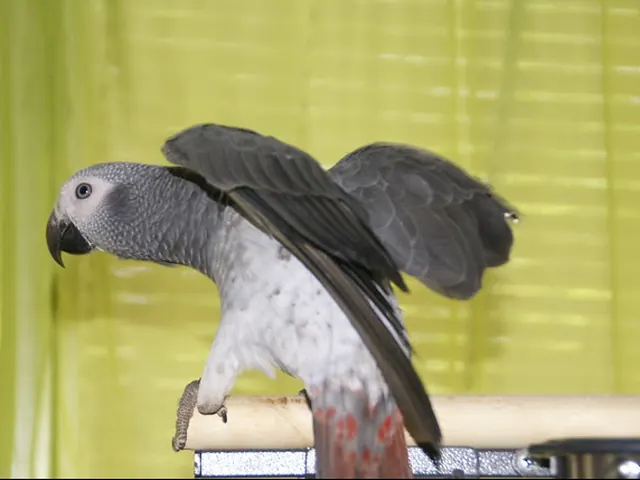
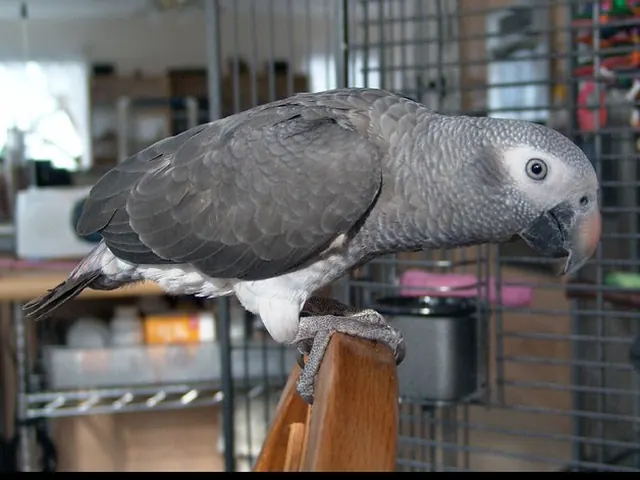
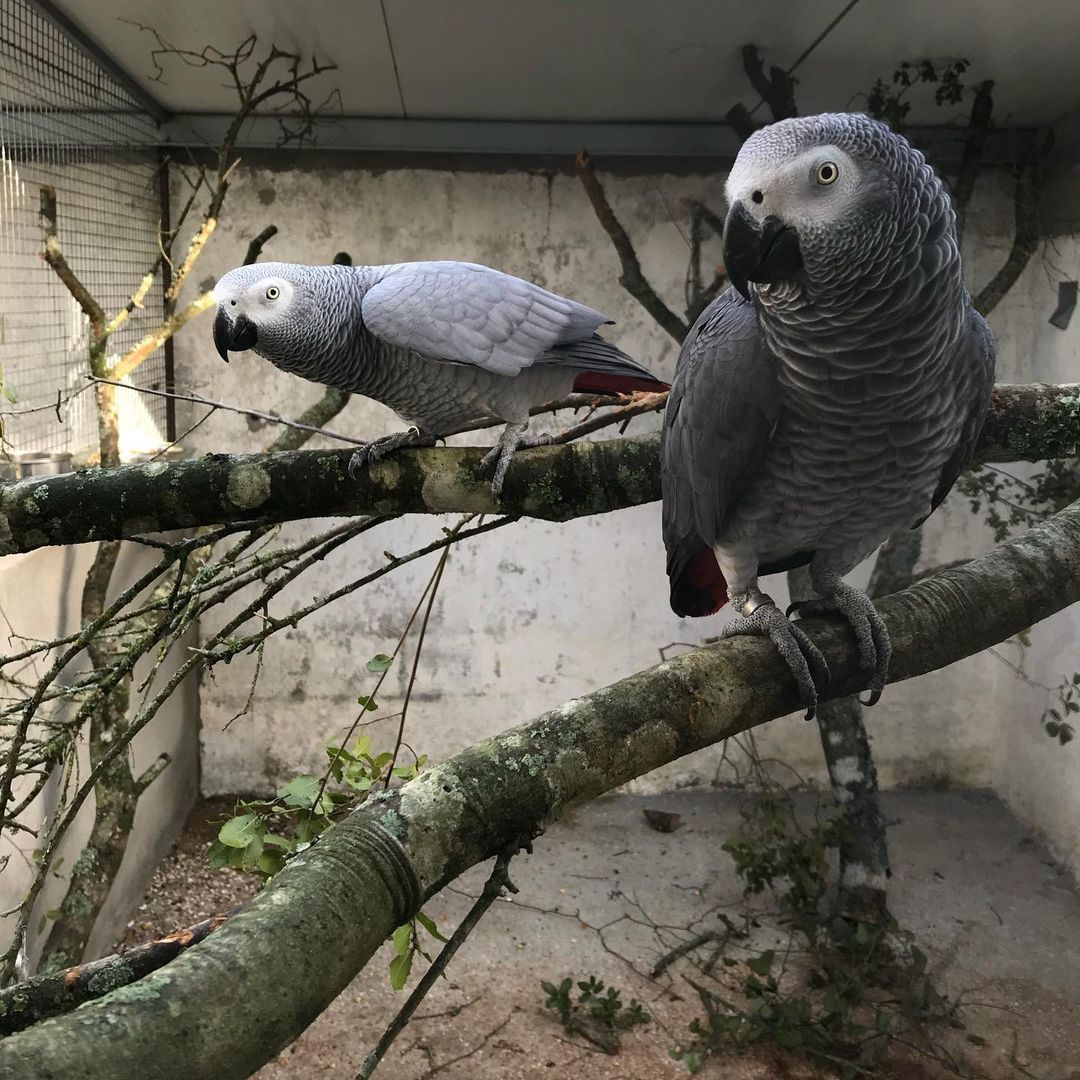
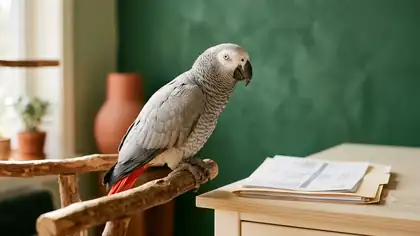
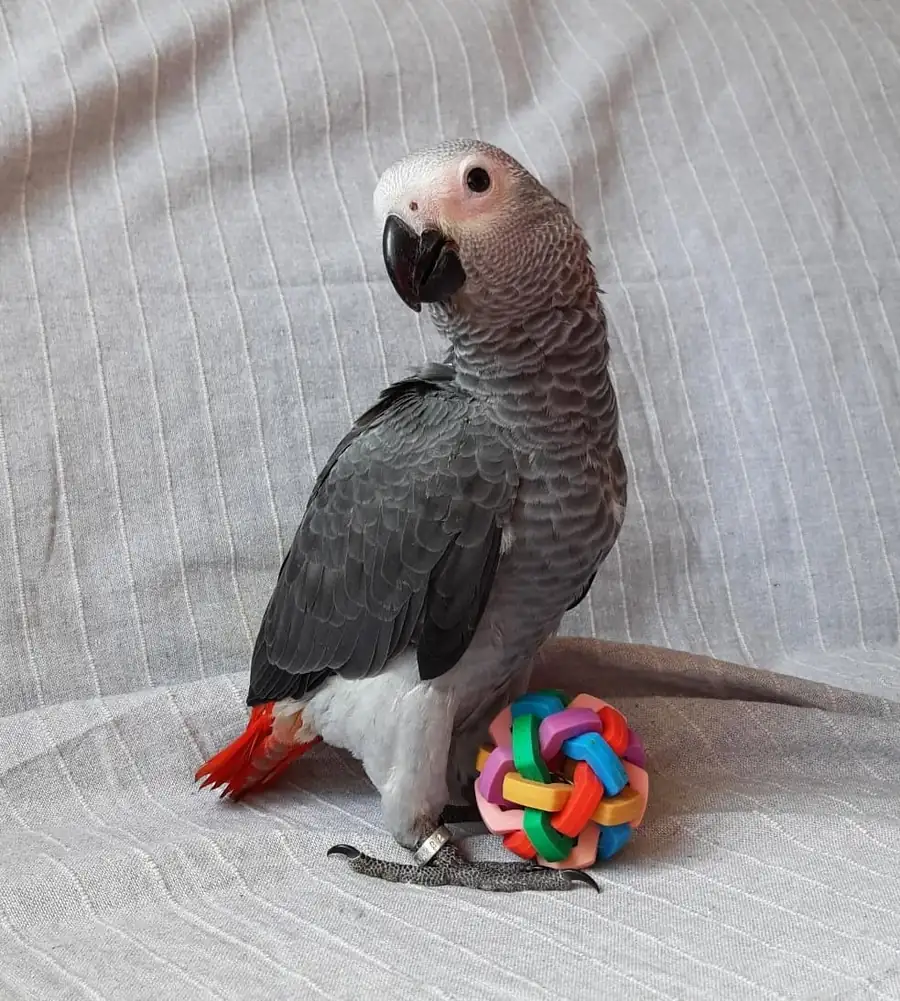
Beside a vivid green Amazon, the Grey looks understated — silver body, fine scalloping, a dark beak, and the Congo's one flash of colour in that bright red tail. The showmanship is all on the Amazon's side. What the Grey brings instead is the mind that landed the species in cognition research: words used in context, puzzles worked through, a quiet intelligence rather than a loud one. Buyers weighing "are African Greys good pets?" against an Amazon are really weighing substance against spectacle. The chicks weaning in our nursery now sit on our Congo Grey and Timneh Grey pages.
African Grey Size and Lifespan, Set Beside an Amazon
Unlike the Grey-versus-macaw mismatch, this one is a fair fight on size. A Congo tips the scale at 400–600 grams across 12–14 inches, the Timneh a notch below — right in the Amazon band, heftier than a pocket White-Fronted and just shy of a Double-Yellow-Head. Cage footprints are comparable, so square footage won't decide it. Longevity won't either: budget 40–60 years for a Grey and up to 70 for an Amazon. Whichever you pick, you're signing up for a companion that may see your children into adulthood.
How Does a Grey's Temperament Read Next to an Amazon's?
Introverted, and intensely observant. Rearrange the living room and a Grey notices before you've finished; that same radar is why it needs a stimulating home and why it reads as "sensitive." An Amazon fills a room — struts, sings, works the crowd — while the Grey studies the room from the edge of it. Think of the Amazon as the extrovert at the party and the Grey as the one quietly running the household. Both are devoted; only one performs the devotion.
Can a Grey Live Where an Amazon Can't — a Small, Quiet Home?
Better than almost any Amazon. A Grey's default soundtrack is whistles, muttered words and a pitch-perfect impression of your microwave, concentrated into short morning and evening bursts — livable through a shared wall. An Amazon runs a longer, louder programme all day, and the yellow-headed singers carry furthest of all. You'll never silence a Grey (nor should you), but you can house one where a full-voiced Amazon would cost you the lease.
Does a Grey Bond as Readily With a Whole Family?
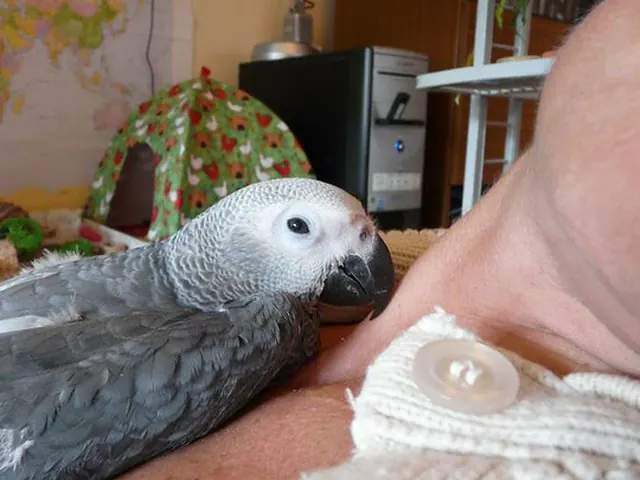
No — and naming that honestly is half the choice. A Grey usually appoints one person after a slow, private audition, then treats the rest of the household as trusted staff. Owners on the r/parrots "African Grey's VS Amazons" thread ↗ describe exactly that ("bonded to me — my little shadow"), and it matches our nursery. An Amazon spreads its affection more freely across a family. Want a bird everyone can handle? Lean Amazon. Want one heart wholly yours? That's the Grey.
A Grey's First Week: Reconnaissance, Not Sulking
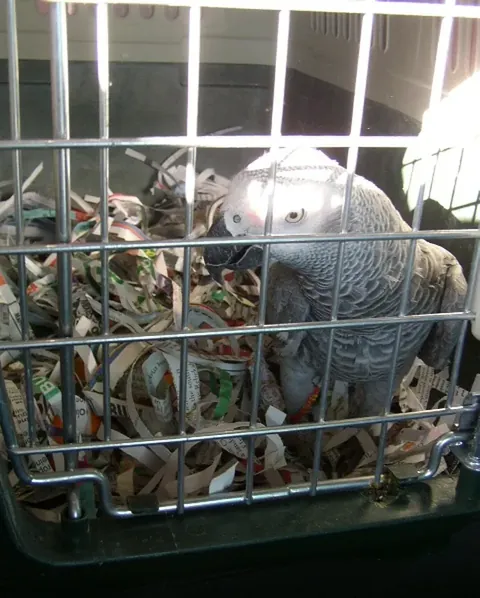
Families sometimes phone us on day three worried their new Grey is "depressed." It isn't — it's running reconnaissance. A settling Grey perches low, watches more than it moves, and often waits for an empty room before it eats. That caution is a healthy bird taking the measure of its new world, and it lifts as the second week arrives and the personality steps forward. An Amazon typically bounces back louder and faster; a Grey earns its confidence slowly, then keeps it for decades.
Breeder note: the day Maxy turned words into tools
Maxy, the talking Congo in our homepage clip, learned the way Greys tend to — by latching onto whatever word got him a result. "Teri" came first because it summoned someone; "bye bye" and "come here please" followed once he'd clocked that words move humans around. That is language as a tool, not a party trick, and it's the exact faculty an Amazon's singing never touches. An Amazon will out-perform Maxy on any melody; Maxy will out-reason it every time.
Which Health Screens Come Standard on a C.A.Gs Grey?
A Grey's risk profile is metabolic and viral where an Amazon's is dietary and hormonal, so the screening we prioritise differs from what an Amazon keeper watches for. Calcium comes first: Greys metabolise it atypically, and Lafeber's veterinary library ↗ lists hypocalcemia as a well-documented, species-specific danger — which is why UV-B lighting and a calcium-aware diet are in our care sheet from day one. Feather-destructive behaviour is the second watch-item. The Amazon's own weak spots get their own section below; on both sides, none of this is destiny, and all of it is why our buyer questions run as long as our paperwork.
The Grey's Metabolic Weak Spots: Calcium and Feathers
Low blood calcium shows up as trembling or weakness and, untreated, as seizures — largely preventable with pellets, calcium-rich vegetables and real UV-B exposure so the bird can actually use that calcium. Plucking is usually boredom wearing a medical disguise: give a Grey genuine foraging work and the feathers generally stay put. The plain-language write-ups at VCA Animal Hospitals ↗ cover both, and our diet-and-lighting plan ships with every bird on paper.
What Our PCR Panel Rules Out Before a Grey Ships
Psittacine Beak and Feather Disease and Avian Polyomavirus are the two viruses that quietly convert a "bargain" parrot into a heartbreak — and they don't discriminate between a Grey and an Amazon. Every Grey we place carries an individual PCR result for both, a real lab report on that specific bird rather than a soothing line in an ad. Ask any seller of either species for the same panel; if it doesn't exist, neither does your safety margin.
Citation: the World Parrot Trust species profile
These species-level points track the World Parrot Trust profile of Psittacus erithacus ↗ — the same organisation whose trade work helped end the wild-capture era that once shadowed Greys and Amazons alike.
Thinking Grey? Get First Word on New Chicks
Add your name and we'll reach out the instant a hand-raised, DNA-sexed Grey chick is cleared to reserve.
What Are Amazon Parrots Really Like to Live With?
Amazons are the Americas' green extroverts, and sharing a home with one feels nothing like sharing one with a Grey. The Grey wins you with its mind; the Amazon wins you with sheer personality — confidence, showmanship, singing, and a swagger owners affectionately call "spicy." One keeper of both on the r/parrots comparison thread ↗ put it plainly: the grey is the shy shadow, the Amazon is the one that "would fall for most people who came over." The catch is the one this whole page keeps returning to — "Amazon" is thirty-plus species, and they are not interchangeable.
Are Amazon Parrots Cuddly, or Just Confident?
Mostly confident rather than cuddly. As one owner on the same thread warned, "I would definitely not describe most amazons as 'cuddly' — head scritches are tolerated, and beak kisses are allowed," but many Amazons prefer to be near you and performing rather than tucked under your chin. They're sociable and bold, often warming to a whole household faster than a Grey does. If you picture a bird that greets your guests and sings on the windowsill, that's the Amazon; if you picture a quiet one-person shadow, that's the Grey.
How Loud and How "Spicy" Is an Amazon?
Loud, and seasonally spicy. Amazons project across the whole day, and the yellow-headed species are famous for volume that carries. "Spicy" is the community's word for the confident, sometimes-nippy streak that intensifies with hormones — an Orange-Winged owner described an Amazon that would "divebomb and attack women on sight" in breeding season. That's the extreme, not the norm, but it points at the Amazon's real cost: not neediness like a cockatoo, but the hormonal-maturity swing covered in its own section below.
Why Are Amazons Prone to Obesity?
Because they love a rich diet and, in many homes, get one. Amazons are built to work for their food and, given a seed-heavy bowl and a quiet cage, they gain weight and develop fatty liver disease at rates that worry avian vets. It's the Amazon's single most preventable health problem, and it's the mirror image of the Grey's calcium issue — a species-specific weak spot that good husbandry manages. A pellet-forward diet and real out-of-cage exercise keep it in check.
Are Amazons Smart Like Greys?
Bright and shrewd, yes — but their genius is social and musical rather than the Grey's contextual language. Amazons read a room, manipulate a household, and learn songs with a melodic accuracy no Grey matches. They can talk, and the top species talk well, but the science that made "parrot intelligence" a field was done with Greys, not Amazons. The practical read: an Amazon out-charms a Grey; a Grey out-reasons an Amazon.
The Amazon's Best Trick: Singing
If a Grey's headline talent is contextual talking, an Amazon's is song. The Double-Yellow-Head and Yellow-Nape are called "opera singers" for good reason — they belt melodies with a prosody and volume a Grey's whistles never reach. Owners who love Amazons often love them for exactly this. It's the clearest single reason the Amazon isn't simply "a worse talking bird," and why the honest framing is talk-versus-sing, not better-versus-worse.
Breeder note: why we still raise Greys, not Amazons
We're asked often why we don't add Amazons to the aviary. The honest answer: the hormonal-maturity swing in the yellow-headed species is a genuine welfare and rehoming risk we'd rather not sell into, and our whole model — DNA sexing, PCR screening, one-person-friendly hand-raising — is tuned to Greys. We'll happily point an Amazon-set buyer to a reputable Amazon breeder. What we won't do is pretend our Grey is an Amazon, or vice versa.
Which Amazon Are You Actually Comparing?
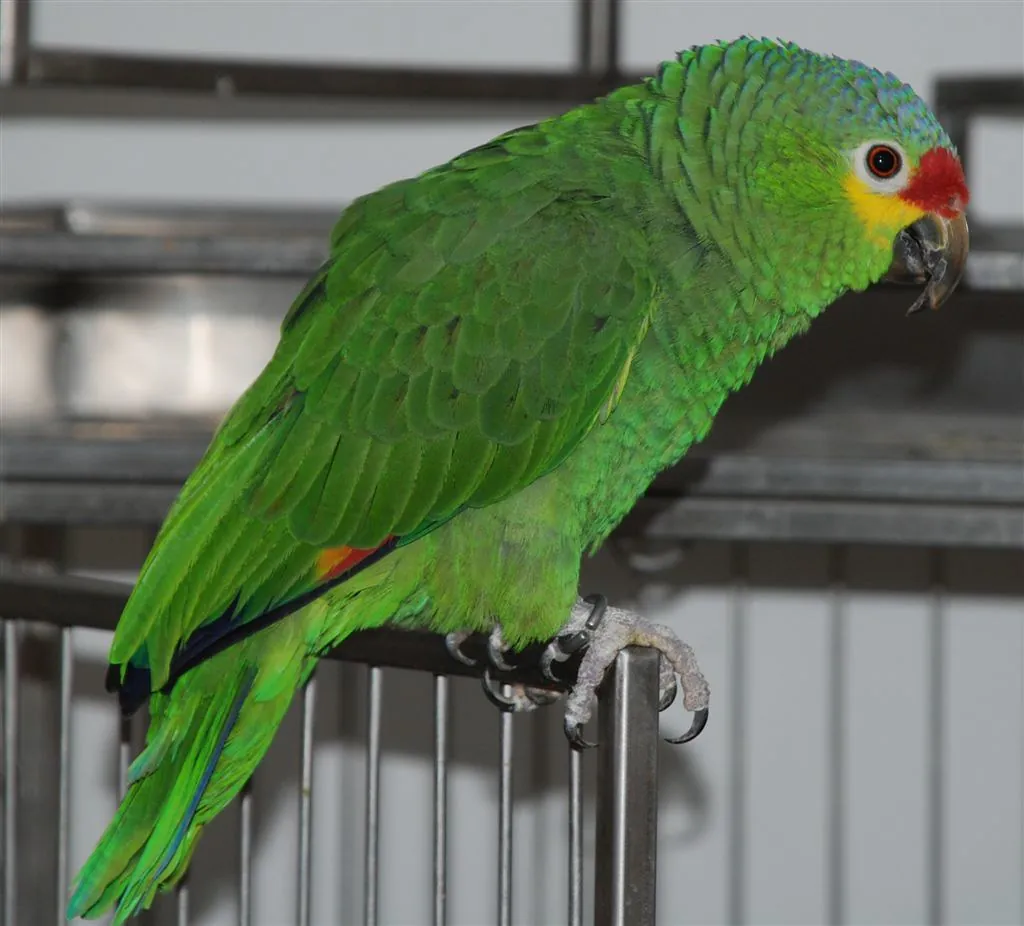
This is the section no other page gives you. "Amazon" isn't one bird — it's a genus of more than thirty species, and the six most often set against a Grey vary as widely among themselves as any of them does from the Grey. A gentle Red-Lored and an operatic, hormonal Double-Yellow-Head are barely the same pet. Here's the honest head-to-head for each, using real photos. If you searched a specific matchup like African Grey vs Blue-Fronted Amazon or African Grey vs Yellow-Naped Amazon, start here.
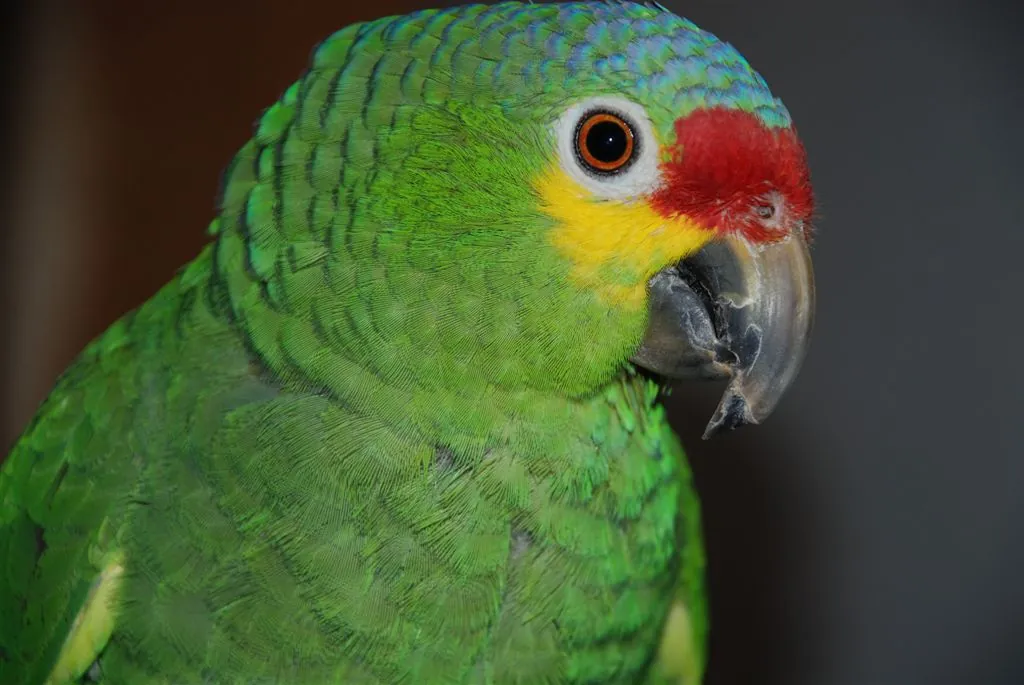
African Grey vs Red-Lored Amazon
Amazona autumnalis · One of the calmer Amazons
Size13 in · 310–480 g
NoiseModerate for an Amazon
TalkingModest talker
The Red-Lored — green with a red forehead and a butter-yellow cheek — is among the more even-tempered Amazons, which is exactly why it leads this list. It talks in a smaller vocabulary than a Grey and with less of the context a Grey brings, but it hormones less ferociously than the big yellow-headed Amazons below. Beside our Greys the trade is the recurring one on this page: the Amazon gives up vocabulary and clarity, the Grey gives up the Amazon's easy, extroverted confidence with strangers.
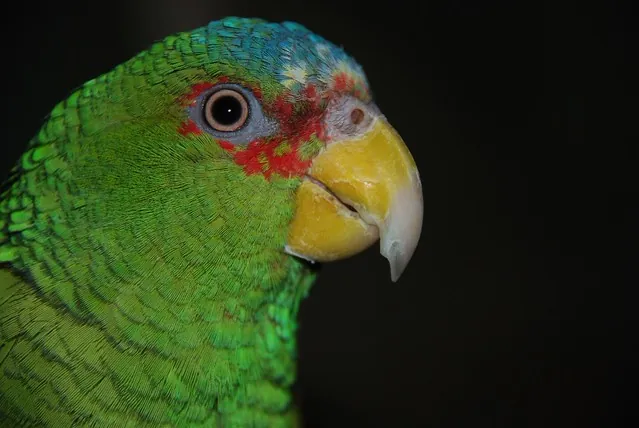
African Grey vs White-Fronted Amazon
Amazona albifrons · The smallest Amazon
Size10 in · 200–250 g
NoiseModerate
TalkingLimited talker
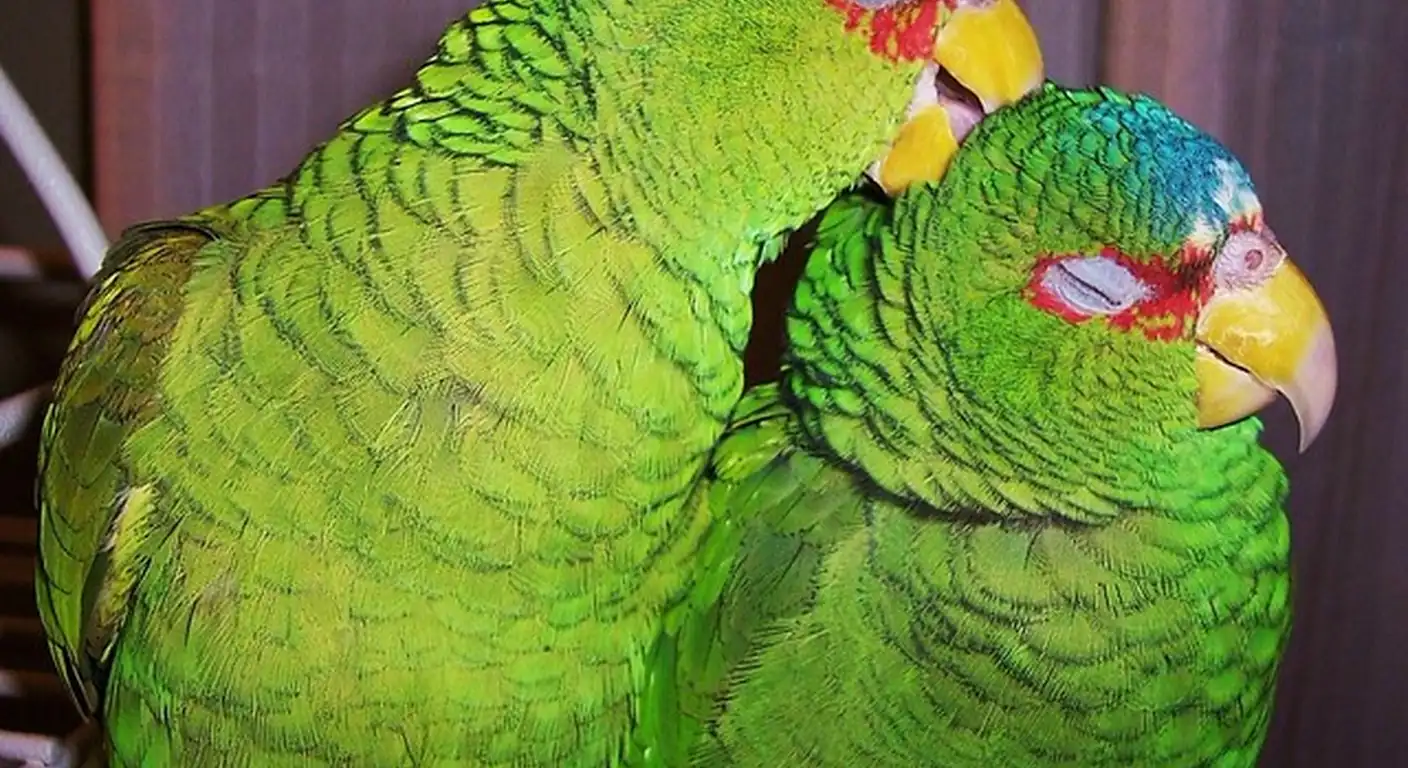
The White-Fronted is the smallest Amazon — roughly a third the weight of a Congo Grey — with a white forehead, red eye-ring, and (in males) red wing coverts you can actually sex by eye, which almost no other Amazon offers. It's feisty for its size and a modest talker at best. If apartment footprint is driving the decision, this is the Amazon that competes with a Grey on space; on talking and contextual smarts, the Grey still wins comfortably.
African Grey vs Yellow-Shouldered Amazon
Amazona barbadensis · Rare, endangered in the wild
Size13 in · 470–550 g
NoiseModerate to loud
TalkingModest talker
The Yellow-Shouldered wears a yellow crown and a yellow bend-of-wing, and it is genuinely uncommon as a pet — endangered in its arid island range, which makes captive-bred provenance and paperwork more important here, not less. Temperament sits in the Amazon middle: sociable, seasonally spicy, a fair but unremarkable talker. Against a Grey it underscores the point of this whole section — 'Amazon' is a genus of very different birds, and this one behaves nothing like the opera-singing yellow-heads that follow.
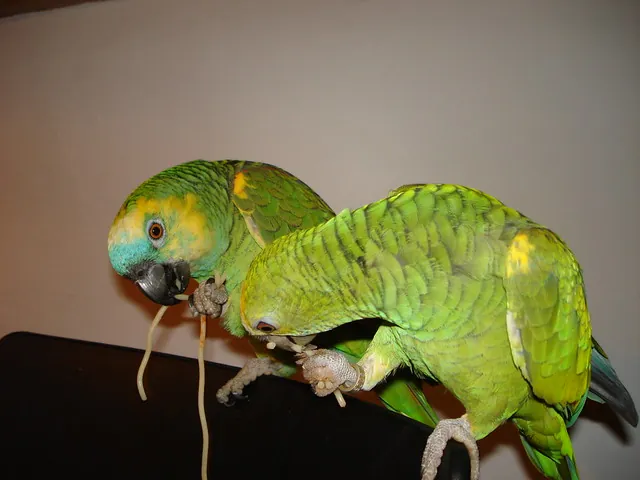
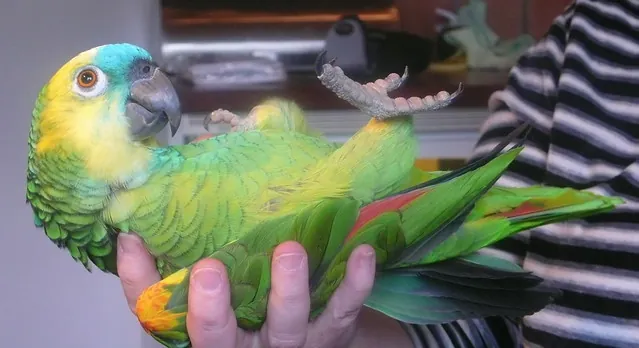
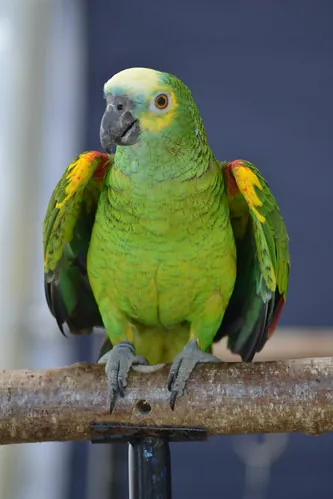
African Grey vs Blue-Fronted Amazon
Amazona aestiva · A classic pet Amazon
Size15 in · 350–500 g
NoiseLoud
TalkingStrong talker & singer
The Blue-Fronted — blue brow over a variable yellow face — is one of the classic companion Amazons and a genuinely strong talker and singer, the point where the Amazon starts to close the talking gap on volume and melody even if not on vocabulary or context. It is also where hormones start to bite: mature Blue-Fronts can turn seasonally aggressive. This is the first of the three Amazons owners on Reddit specifically warn new keepers about — worth reading the hormonal-maturity section below before you fall for the face.
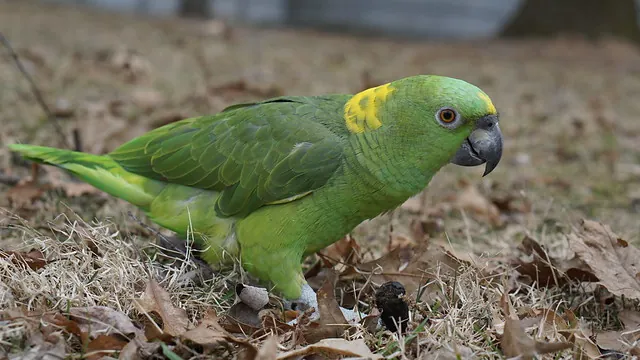
African Grey vs Yellow-Naped Amazon
Amazona auropalliata · Best-talking Amazon — and very hormonal
Size14 in · 480–680 g
NoiseVery loud
TalkingElite talker & singer
The Yellow-Naped, marked by a yellow band across the back of the neck, is the Amazon that actually rivals a Grey for talking — many keepers rate it the best-talking Amazon, and it sings with a prosody no Grey matches. The catch is temperament: it is highly intelligent, very loud, and among the most hormonally intense parrots kept, capable of real aggression in breeding season. It is also endangered. A Grey gives you the clearer, more contextual talker with far steadier behaviour; the Yellow-Nape gives you a showman you must manage.
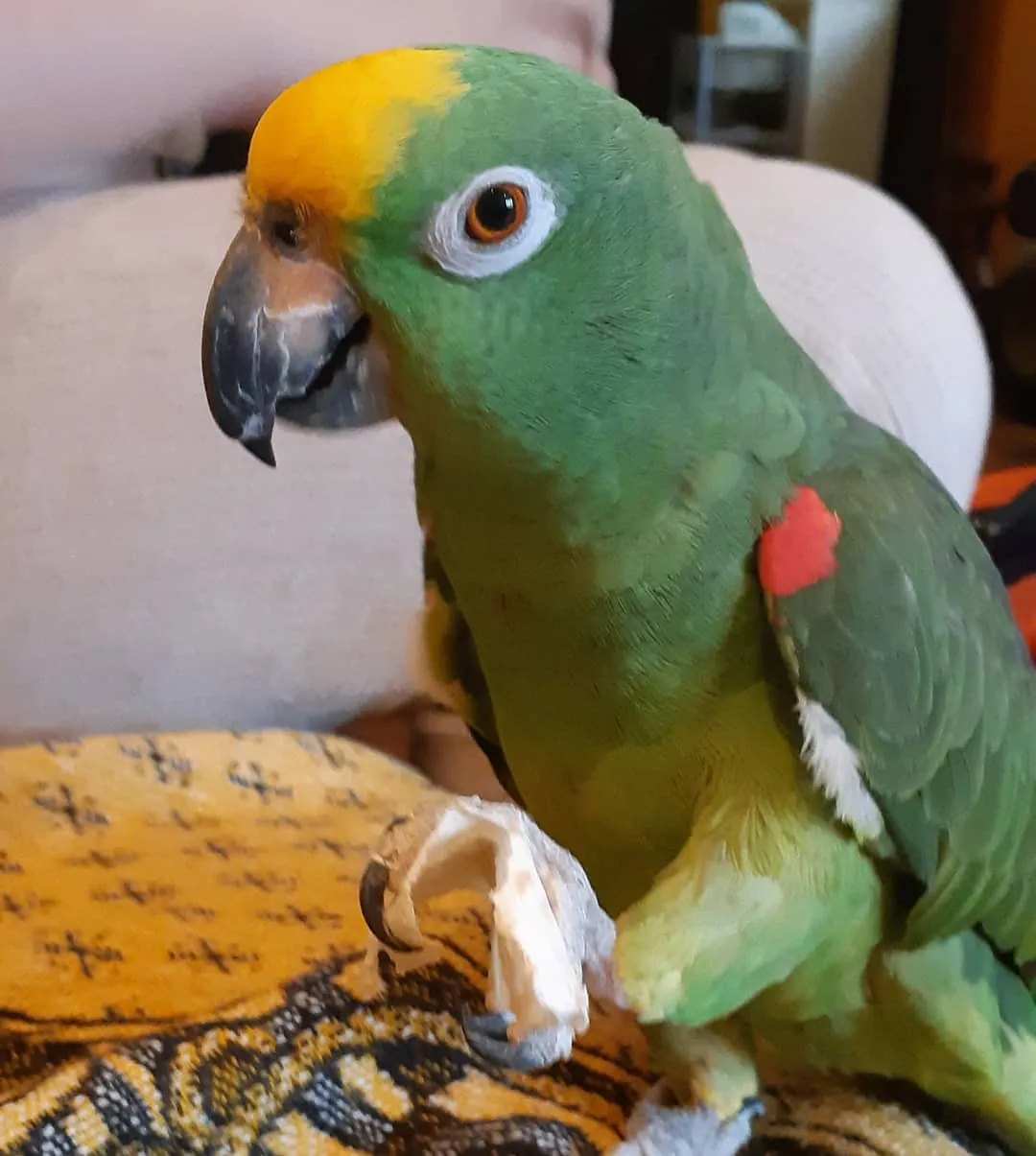
The Double-Yellow-Headed grows a fully yellow head at maturity and is the Amazon of legend — an operatic singer and top-tier talker that owners adore. It is also the Amazon most associated with hormonal aggression as it matures, the bird behind the forum warnings about a sweet baby becoming a challenging adult. Endangered in the wild and demanding in the home, it belongs with experienced keepers. Beside a Grey it is the sharpest version of this page's whole argument: dazzling performance for serious behavioural commitment, versus the Grey's quieter, steadier brilliance.
Across all six, the pattern shifts as you move down the list: the easygoing Red-Lored demands the least and the yellow-headed singers the most, while the Grey stands off to one side as the quieter, dustier, more contextual talker. Pick the wrong Amazon for your household and you've made a harder choice than picking between "an Amazon" and a Grey ever was — which is exactly why naming the species first matters.
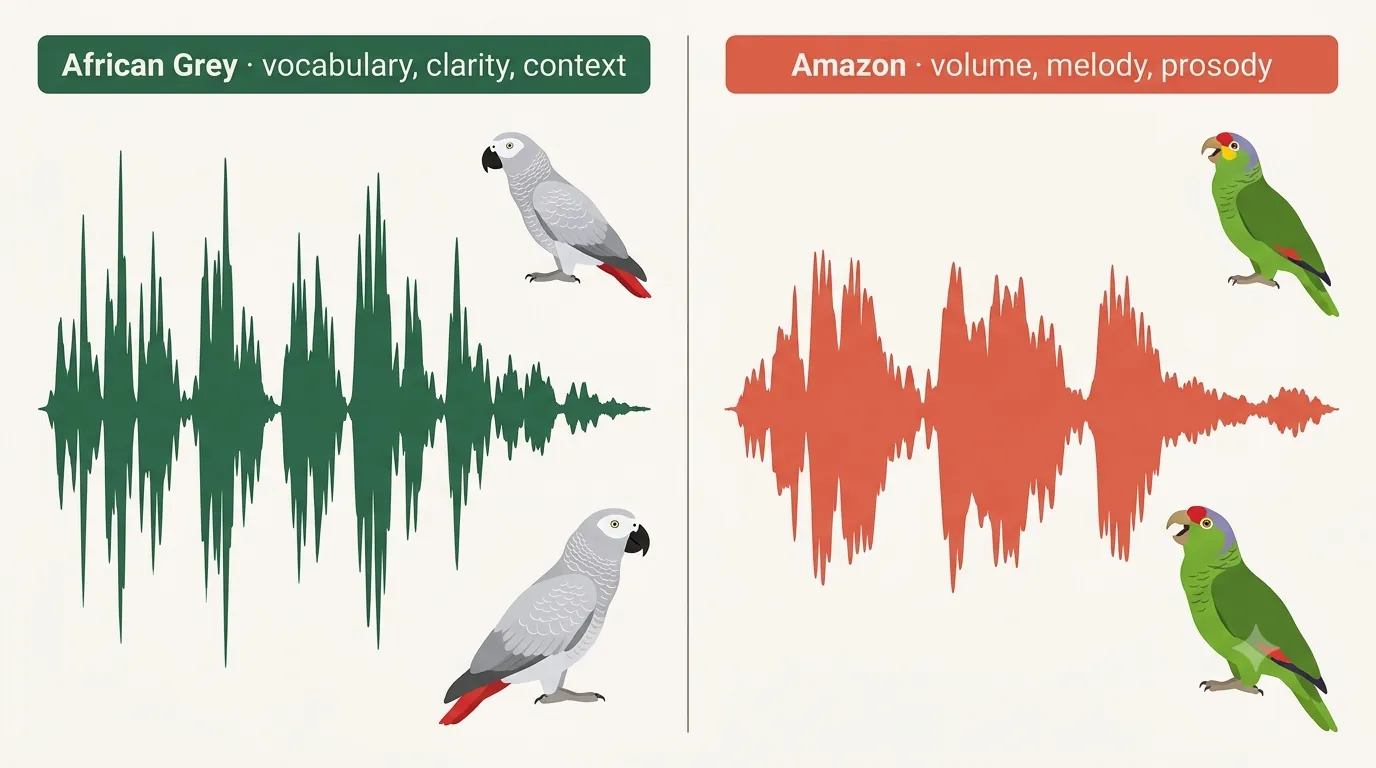
Do Greys Talk Better While Amazons Sing Better?
Broadly, yes — and it's the single most useful way to frame this choice. The Grey takes vocabulary and context; the Amazon takes melody and volume. A Grey can hold 200 to 1,000-plus words, articulate them crisply, and — the decisive part — apply them in context. The best Amazons — the Yellow-Naped and Double-Yellow-Headed — talk well too, but their headline gift is song, belted with a prosody a Grey never reaches. Owners of both say it cleanly: the grey is "much more vocal" with words, the Amazon is "the best singer out of all parrots."
Vocabulary vs Comprehension: Where the Grey Pulls Ahead
Word count is only half the story; understanding is the rest. Over three decades, Dr. Irene Pepperberg's African Grey, Alex, learned to name colours, shapes and numbers and to answer questions he'd never been drilled on — proof of language with meaning behind it, not mimicry. Amazons mimic well and read a room shrewdly, yet that particular ceiling — words with comprehension — belongs to the Grey. Our African Grey talking-ability guide sets realistic month-by-month expectations.
Can Amazons Talk Well?
Yes — the top species genuinely can. A Yellow-Nape or Double-Yellow-Head can build a real vocabulary and deliver it with theatrical flair, and many owners rate them the best-talking Amazons. What they add is song and volume; what they give up, against a Grey, is the contextual precision and the sheer clarity. Judging an Amazon only on vocabulary misses the point — you'd be grading a singer on its diction.
Why No Bird Is a Guaranteed Talker
Feathered exceptions break every rule. We've raised reserved Greys that whistle more than they speak, and Amazons that run silent or non-stop. Averages tell you the smart wager, never the outcome for one specific bird — which is why we place a companion rather than a promised performer, and say so plainly. No honest breeder of either bird will hand you a talking guarantee.
Citation: Alex, Pepperberg and the Britannica record
The record backs it: Encyclopaedia Britannica ↗ describes the African Grey as "unsurpassed as a talker," and Pepperberg's thirty years with Alex are still the reference study in parrot cognition.
Louder All Day: Can an Amazon Share Your Walls?
More parrots lose their homes to noise than to cost, so anyone in an apartment should linger here. Quick answer: the African Grey is the quieter, more apartment-plausible bird; the Amazon is louder and projects all day.
On the parrot volume scale the Grey lands mid-band: whistles, chatter, a mimicked appliance or two, concentrated into fairly reliable morning and evening sessions. Owners describe Greys as among "the least 'screamy' parrots." Amazons run louder and, crucially, more all-day: two separate Reddit threads on "Amazon Parrot Noise Level (Apartment or Not)" exist for a reason. We won't invent a decibel figure — the ones floating around comparison articles are fabricated — but the direction is not in doubt: through shared walls, the Grey is the safer bet.
Is Any Amazon Quiet Enough for Neighbours?
If your heart is set on an Amazon but you have neighbors, the smaller species — a White-Fronted, for instance — are the least overwhelming, while the yellow-headed singers are the loudest. None of them is quieter than a Grey. There is no silent Amazon; there is only "less carrying," and the small species are where that road ends. For thin walls, the Grey wins this round, with dust — not noise — as its own trade-off.
Dust & Dander: the African Grey Question for Allergy Homes
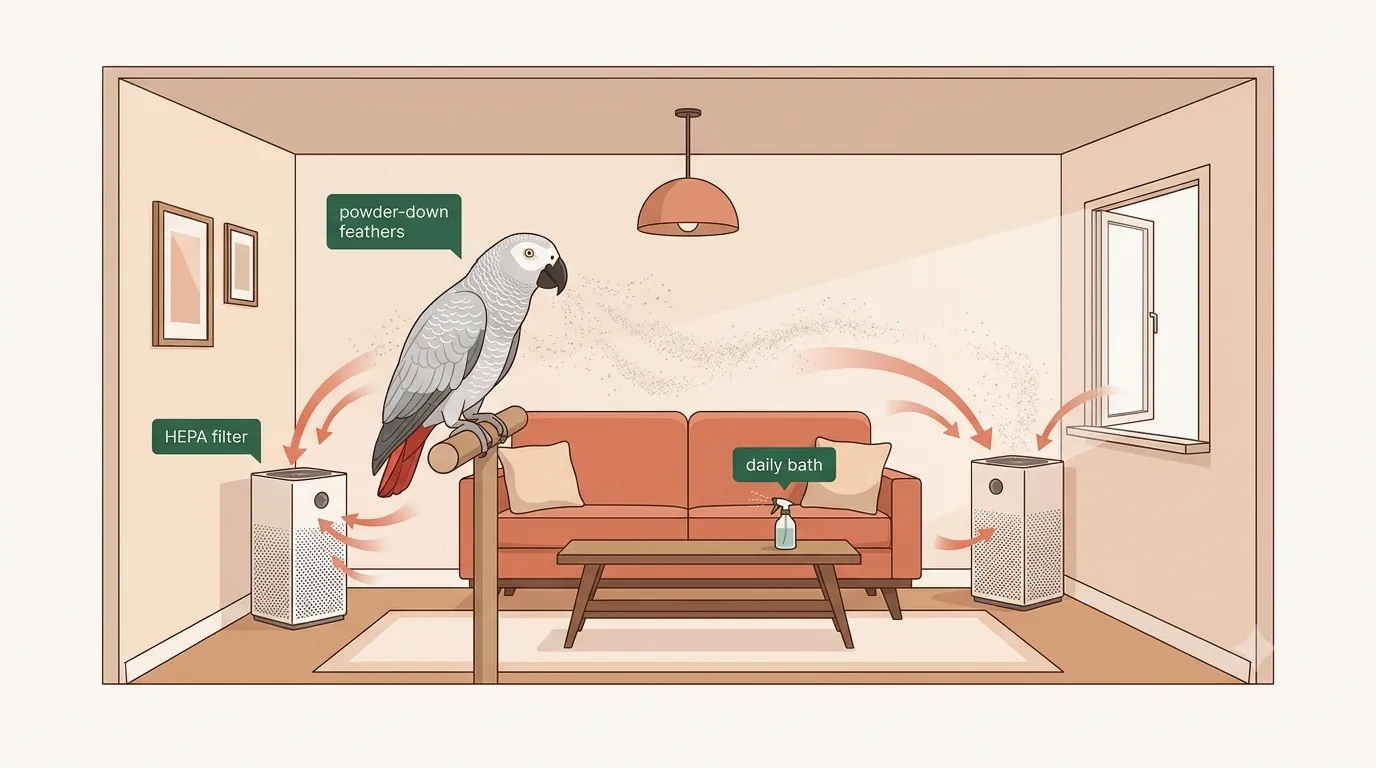
Here the comparison flips. Against a cockatoo, both birds are dusty; against an Amazon, the Grey is decisively the dustier one. African Greys are heavy powder-down birds, producing a fine feather dust that settles on shelves and stays airborne. Amazons are South American parrots and produce noticeably less. If someone in your home has asthma or bird allergies, this single section may decide the whole choice — and it's the one comparison article that Google currently sources to an unverified Facebook comment.
Owners of both are blunt about it. On the r/AfricanGrey cross-post, one keeper wrote "the f'n dust. Jesus. It never ends," and another that a HEPA filter came out "absolutely caked with feather dander." Per avian welfare educators ↗, African and Australasian parrots are the dustiest groups while South American parrots (the Amazons) produce less. So if allergies are the constraint, the honest steer for once points at the Amazon — and away from our own bird.
What Is Bird Fancier's Lung?
Bird Fancier's Lung is a hypersensitivity pneumonitis — an allergic lung inflammation some people develop after prolonged exposure to feather dust and droppings. It is uncommon, but it is real, and powder-down species like the Grey carry more of the dust that can trigger it. This is not a reason to fear a Grey; it is a reason to be honest with yourself about your household's lungs before committing to a four-to-six-decade dust source.
Can You Own a Grey With Asthma or Allergies?
Often yes — with management, and eyes open. Frequent misting or bathing tamps the powder down, a HEPA purifier beside the cage catches what floats, and wipeable surfaces mop up the remainder. But if a Grey's dust is a genuine medical problem in your home, an Amazon is the lower-dust bird, and we'd rather tell you that than sell you a Grey you can't breathe around.
Our Dust Verdict After a Decade of Greys
If asthma or bird allergies run in the family, sit with an adult Grey for an afternoon before deciding, and factor a purifier into the budget if the Grey wins. We'd rather lose a sale than place a dusty powder-down bird in a home that can't breathe with it — an Amazon may simply be the kinder fit.
Citation: a documented grey-parrot lung case
It's documented, not theoretical: a peer-reviewed report in the U.S. National Library of Medicine ↗ traced an owner's hypersensitivity pneumonitis to their African Grey's feather dust. Powder-down dander is a real respiratory variable, and it's the Grey's, more than the Amazon's.
Reading a Bite: Telegraphed vs Unsignalled
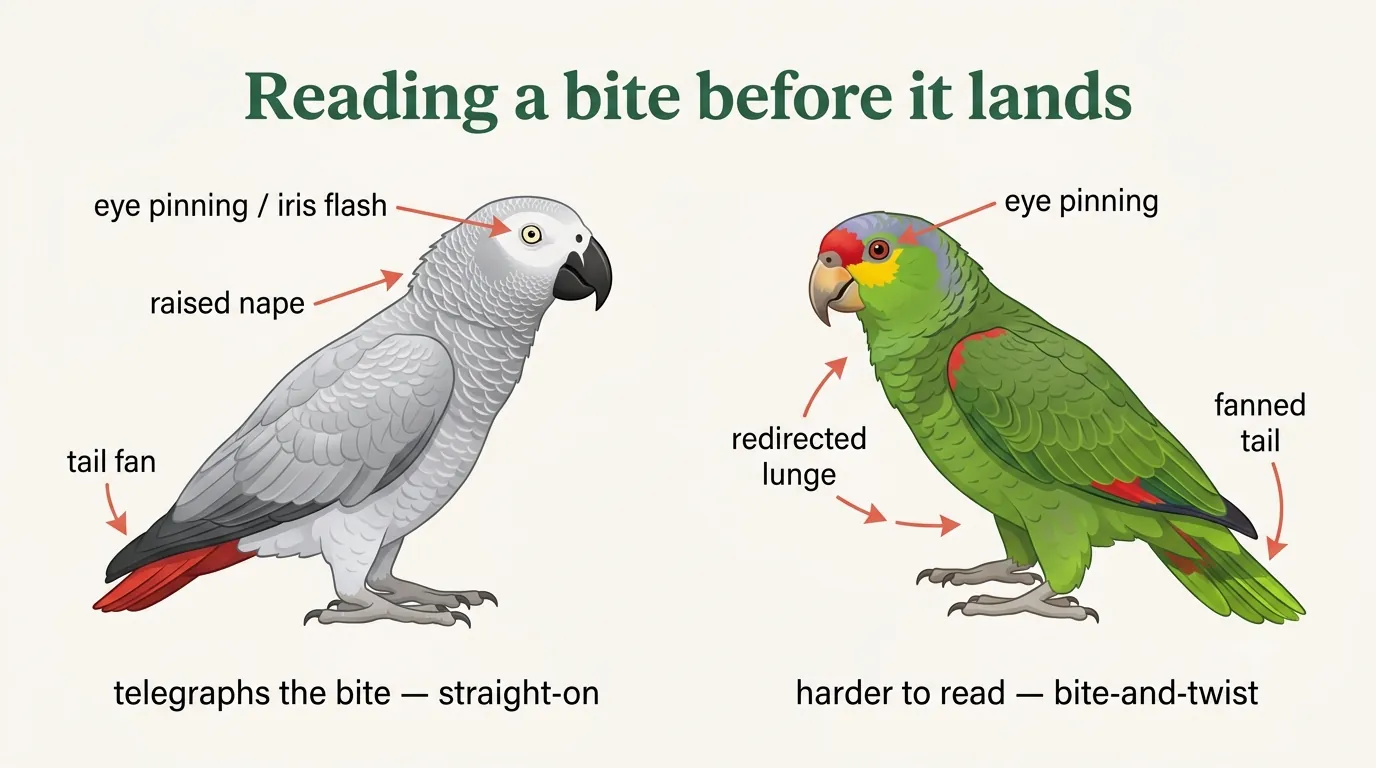
Sooner or later a serious buyer asks the awkward part out loud: how badly can it hurt me, and will there be a warning? Bite force is comparable between these two — both are strong-beaked mid-sized parrots. The real difference, and the thing no article states as behaviour, is bite style: a Grey tends to bite straight-on and telegraphs it; an Amazon is more likely to redirect, and its bite "twists."
How an African Grey Telegraphs a Bite
A Grey usually warns you. Eye-pinning (the iris flashing), a raised nape, a stiff lean-away — the cues arrive before the beak does, and a Grey's bite tends to land straight-on. Owners describe it exactly that way: "a grey will bite you straight on." Respect the warning and most Grey bites never happen. When one does, it hurts and can draw blood, but it heals; a once-a-year event for a well-read bird, usually tied to something obvious like a vacuum near the cage.
Why an Amazon's Bite Is Harder to Predict
An Amazon is the trickier read, especially in hormonal season. Owners warn that "Amazons tend to redirect their bites on the closest person or thing," and that an Amazon bites "and twists, making it comparatively a more painful bite." One keeper described a scar earned simply because the bird "didn't like the new house plant." None of this makes an Amazon dangerous by default — it makes body-language literacy non-negotiable, and it's why families with young kids should weigh the hormonal section next.
Health Risks by Species: What Actually Threatens Each Bird
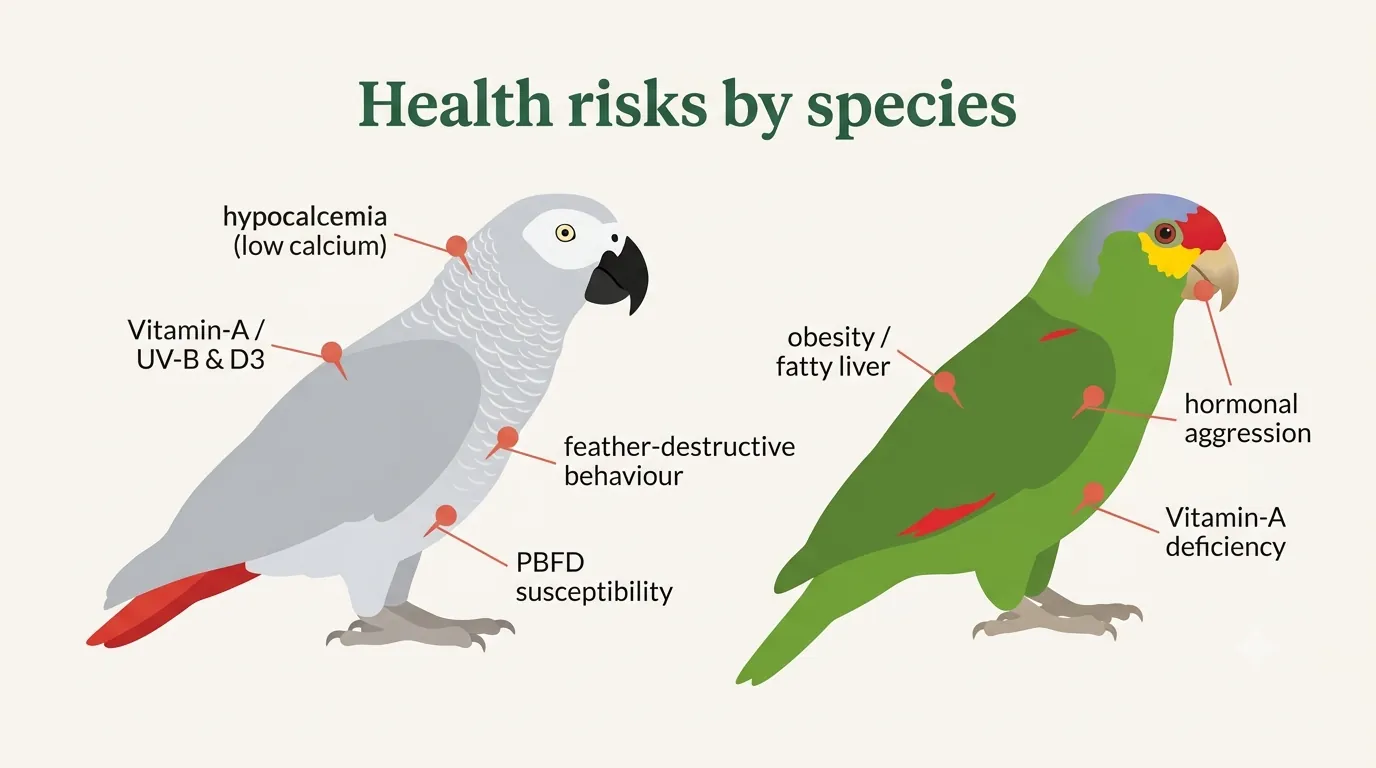
Every parrot has a species-appropriate weak spot, and knowing your bird's is half of good ownership. The Grey's risks and the Amazon's are genuinely different animals — one leans metabolic and viral, the other dietary and hormonal — so a single "which is healthier?" answer misleads. Here's the honest, ledger-bounded map, with the external authorities clustered where a claim needs one.
Health Conditions to Watch in African Greys
Greys carry two well-documented risks. Hypocalcemia — low blood calcium — is a grey-specific hazard the Lafeber veterinary resources ↗ flag clearly, held off with pellets, calcium-dense greens and daily UV-B light. The second is feather-destructive behavior, an enrichment problem more than a medical one. Both are why every C.A.Gs Grey ships with PBFD and Avian Polyomavirus PCR results and a written diet-and-lighting plan.
Why Hypocalcemia Hits Greys Hardest
Greys metabolise calcium unusually, so a diet that suits another parrot can leave a Grey deficient — presenting as weakness or, at worst, seizures.
Calcium, Vitamin D3 and UV-B in Practice
The remedy is dull but reliable: enough dietary calcium alongside UV-B light, so the bird makes the Vitamin D3 it needs to put that calcium to use. Full-spectrum lighting is in our care notes from day one for exactly this reason.
Amazons trade the Grey's calcium worry for two of their own: obesity with fatty liver disease, and hormonal aggression in the yellow-headed species. Both are managed — diet and exercise for the first, routine and realistic expectations for the second — but they're the Amazon's real long-term risks, and they're why we flag the yellow-heads as experienced-keeper birds.
Obesity and Fatty Liver Disease in Amazons
Amazons gain weight readily, and a seed-heavy bowl plus a quiet cage is the classic road to fatty liver disease — the Amazon's most preventable serious illness.
The Diet-and-Exercise Warning
A pellet-forward diet, measured portions and real out-of-cage flight time keep an Amazon lean. It's the mirror of the Grey's calcium plan: a species-specific husbandry habit that quietly prevents the big bill.
Sourced to Lafeber nutrition guidance
The Lafeber companion-bird nutrition library ↗ covers Amazon obesity and the pellet-versus-seed question in plain terms; the Vitamin-A deficiency both genera share is covered there too.
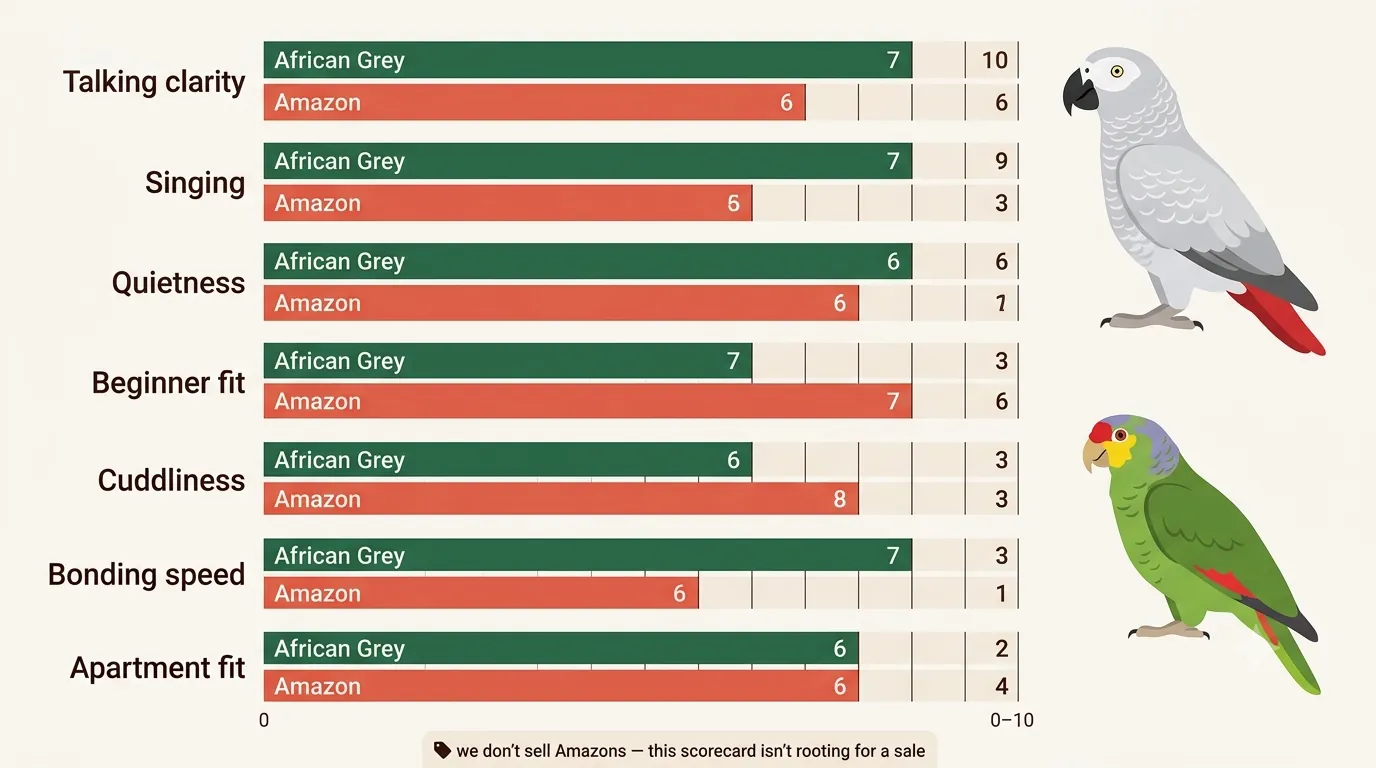
Grey vs Amazon: Our Seven-Trait Scorecard
Arrived on a "which is better, African Grey or Amazon" search? Here it is as figures. We set every 0-to-10 mark ourselves, out of raising Greys and comparing notes with Amazon owners — considered judgment, not laboratory readings — and, because we don't sell Amazons, the scorecard isn't quietly rooting for a sale the way a seller's would.
Trait
African Grey
Amazon
Our note
Talking (vocabulary & context)
10
7
the Grey's signature; top Amazons come close
Singing (melody & volume)
5
10
the Amazon's signature
Quietness
7
3
Amazons are loud all day
Low dust / dander
4
8
the Grey is the dusty one here
Steady (low-hormonal) temperament
8
4
yellow-head Amazons swing hard
Beginner-friendliness
5
4
neither is truly easy
Apartment fit
7
4
the Grey is quieter for shared walls
Read the pattern, not the totals: the Grey owns talking, quiet, low-hormonal steadiness and apartment fit; the Amazon owns singing and low dust outright. Neither column is a bad bird — you're choosing between a contextual talker and an extroverted singer.
Grey or Amazon: Which Suits Your Household?
Scores are useful; households are specific. Whether you're after the quietest parrot for apartment life, a bird that greets a busy family, or a low-dust companion for an allergy-prone home, the fit really comes down to who's home during the day, how much sound your walls forgive, and whether you'd rather converse with your bird or listen to it perform. Locate your circumstances below — it mirrors the rundown we send by email, and the point where a Reddit veteran's line applies: "you'll be ready when you can list the reasons you prefer one over the other."
Match Your Household to the Bird
Five real household situations, five candid verdicts — one of them being "maybe wait a year."
For a First Parrot
Lean African Grey, with eyes open — it's the steadier of the two in behaviour. Neither is a true beginner bird, but a big yellow-headed Amazon's hormonal swings and volume overwhelm most first-timers. If an Amazon is the dream, a smaller, calmer species and heavy research is the safer entry.
For Families With Young Children
Lean African Grey, on temperament and predictability. A hormonal yellow-head Amazon can redirect a bite onto the nearest person, and its bite "twists." Keep either bird supervised and at a distance from toddlers; this is a multi-decade responsibility, not a first pet.
For Apartments and Condos
African Grey, clearly — the quieter bird through shared walls. An Amazon projects all day, and the big singers carry. The Grey's trade-off here is dust, not noise, so pair the choice with an air purifier. Both need daily out-of-cage time regardless of square footage.
Allergy-Prone Households
This is the Amazon's column. Greys are heavy powder-down birds; Amazons produce far less dust. If asthma or bird allergies are in the home, the lower-dust Amazon is the kinder fit — one of the few rows where the honest steer points away from our own bird.
For Long-Workday Households
Think hard, then think again — for either bird. Leave any parrot solo for ten-hour stretches and you invite plucking in a Grey and screaming in an Amazon. If your days are genuinely packed, waiting a year may beat buying this one.
Still undecided? Good — that's our favourite conversation. The form at the bottom reaches Mark and Teri directly, and "Grey or Amazon for a home like ours?" is a message we love answering.
Context talker, close bond
A talker in our nursery
The Bird That Talks Back in Context
Our chicks are hand-fed, DNA-sexed and PCR-screened before they leave — we'll email you as the next one comes available.
What Does the First Year Actually Cost?
Almost no comparison prices out year one — so here it is, plainly. Our papered Congo Greys sit at $1,700–$3,500 and Timnehs at $1,500–$1,600, with a $200 deposit reserving a bird. Amazon prices vary widely by species and are set by other sellers, not us — we raise Greys only, so we won't quote an Amazon figure as if it were ours. The African Grey price guide keeps the live per-bird figures, updated as each clutch weans.
Why the Purchase Price Is the Cheapest Part
For either bird, the sticker is a rounding error next to forty-plus years of food, avian-vet bills, toys and caging ahead. The trap sits at the cheap end of both markets: the "bargain" ads with no CITES paperwork, no sexing certificate and no vet check are the ones behind the fraud reports, and they're the listings buyers most often forward for us to inspect. A documented bird carries its price because the documentation is real work; an undocumented one isn't cheaper, it's a fundamentally different and riskier thing to buy.
What a C.A.Gs Grey's Price Already Covers
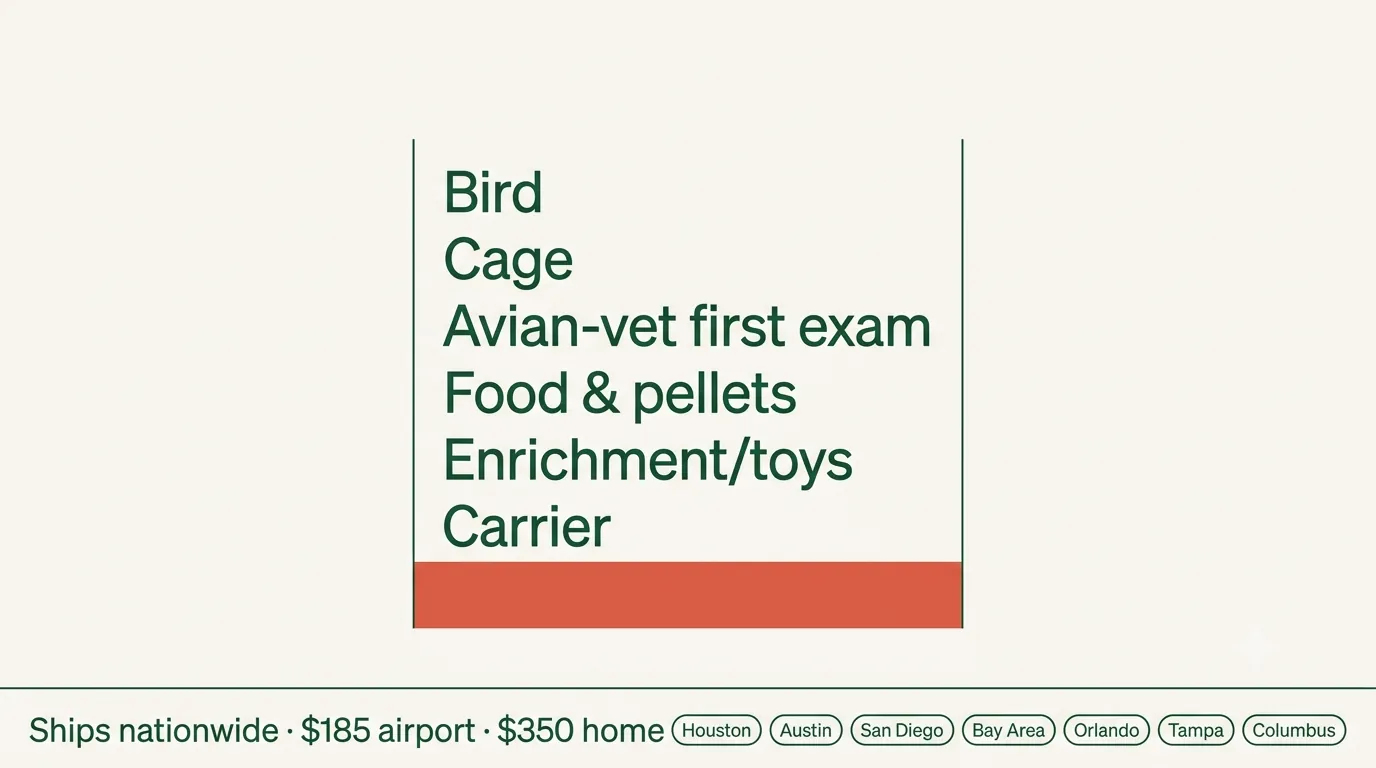
One price covers the whole trust stack, nothing tacked on afterward: captive-bred CITES papers, DNA sexing certificate, an avian vet's health certificate, a hatch record carrying the closed-band number, and PBFD and Polyomavirus PCR results. The only add-on is delivery — $185 to your nearest airport or $350 to your front door.
First-Year Costs After Your Grey Lands
Set aside roughly $825 to $2,000 in year one on top of the bird: a properly large cage ($300–$800), first perches and toys ($100–$300), an initial wellness exam ($75–$200 — find certified avian vets by area via the Association of Avian Veterinarians ↗), a year of quality pellets ($200–$400), and a rotating toy budget ($150–$300). After year one, plan on roughly $375 to $1,350 annually — and note that an Amazon's obesity risk makes the pellet-and-vegetable line non-negotiable, not optional.
Breeder note: why we place only fully weaned birds
The internet is full of cut-price unweaned chicks, Grey and Amazon both. We refuse to sell one at any figure: mishandled hand-feeding — crop burns, aspiration — kills babies in inexperienced hands, and "finish weaning it yourself and save" is the worst bet in the whole hobby. Each bird leaves us fully weaned, and that work is already priced in.
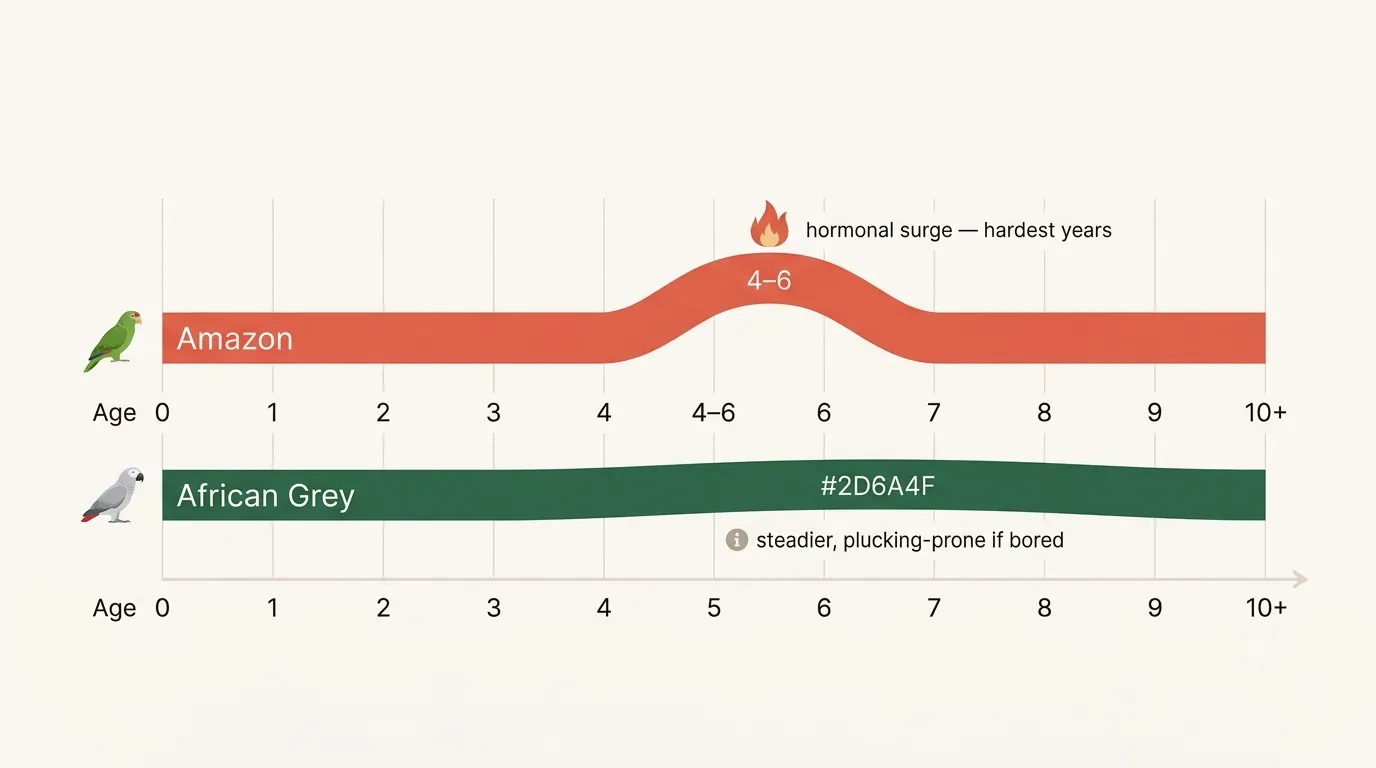
The Hormonal-Maturity Timeline Nobody Warns You About
This is the section forums talk about and articles skip — and it's the thing that actually ends more Amazon ownerships than noise or cost. Both birds change as they mature, but the shape of that change is different, and it's the sharpest reason the "sweet baby" you meet is not the whole story. One breeder's line captures it: an Amazon is often harder at six years than six months, while a Grey trends the other way.
How Each Bird Changes From Baby to Adult
Save this — it's what separates "my bird turned on me" from "my bird grew up on schedule."
10–1 yr · The Sweet Baby
Both a hand-raised Grey and a young Amazon are gentle, cuddly and easy at this age. This is the bird everyone meets — and the reason people underestimate the years ahead.
22–4 yr · Personality Sets
The Grey settles into its watchful, one-person self and, if bored, may start plucking. The Amazon grows confident and "spicy," and the yellow-heads begin flexing the volume and attitude they're known for.
34–6 yr · The Amazon Surge
Sexual maturity hits the yellow-headed Amazons hardest — seasonal aggression, divebombing, unpredictable bites. This is the window that fills rescues with Amazons whose owners weren't warned.
4Lifelong · The Steadier Grey
A Grey's hormonal season is milder; its lifelong risk is boredom-driven plucking, not aggression. Enrichment and routine manage it. Neither bird is "fixed" — both are managed, in different directions.
None of this makes an Amazon a bad bird — it makes it a bird you buy with the six-year-old in mind, not just the six-month-old. It's also why our whole model is built around Greys: the steadier maturity curve suits the one-person, hand-raised companion we place.
Grey-and-Amazon Myths a Breeder Corrects
This niche repeats a handful of confident claims that simply aren't true, and buyers arrive quoting them. We won't name-and-shame the pages that print them; we'll just correct the claim against real birds. Reliable guides such as The Spruce Pets' smartest-birds overview ↗ keep to what can be checked — so here's where the folklore diverges from the birds.
The Myths Landing in Our Inbox
Two fast ones, then the anatomy whopper that earns its own reality check.
Myth
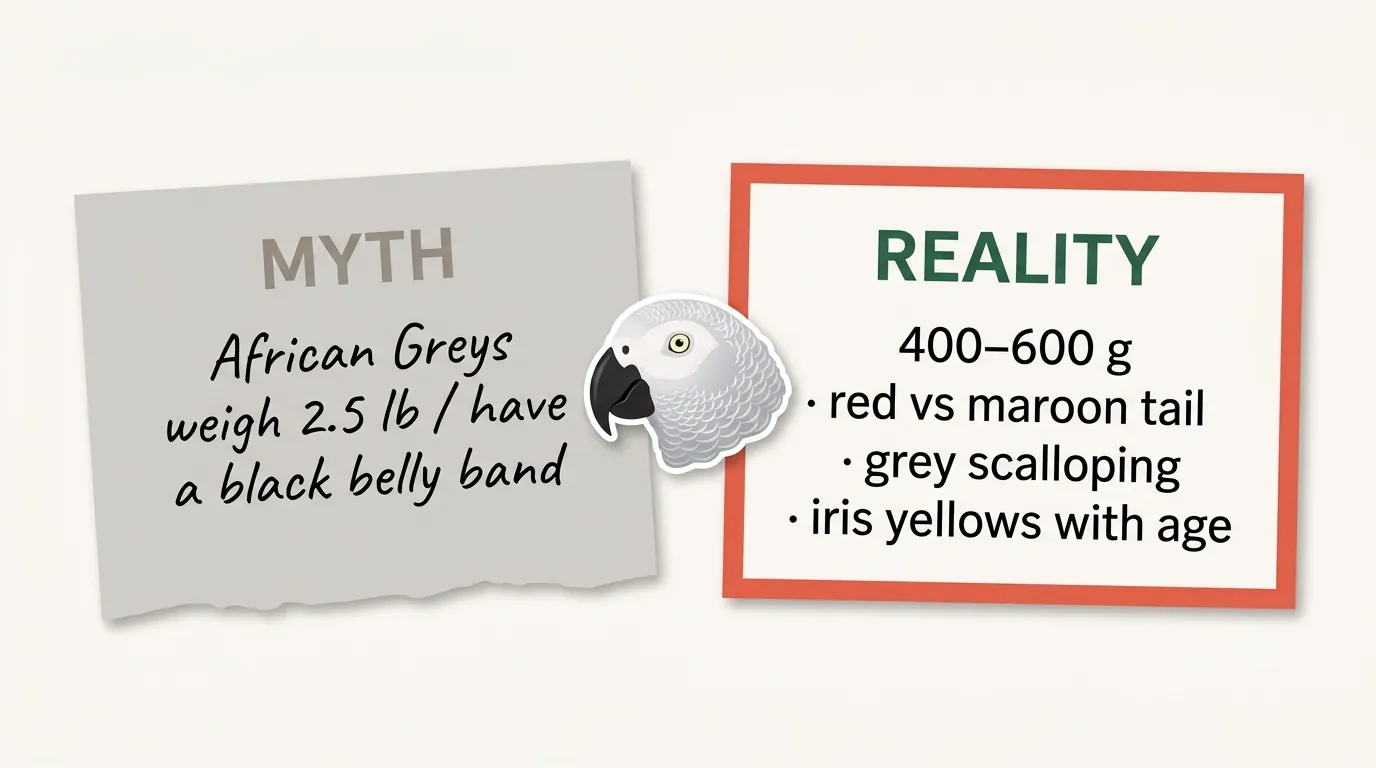
"An African Grey weighs about 2½ pounds." A figure that circulates online, and it's roughly double reality. A Congo African Grey is 400–600 grams and most pet Amazons 300–700 grams — comparable, mid-sized birds, sourced to our own weights and Lafeber/VCA, not the inflated numbers some listings repeat.
Myth
"The Amazon is the better first bird." Repeated often, and shaky. A big yellow-headed Amazon's hormonal swings make it harder for a first-timer than a steadier Grey — the weight of attributed owner consensus, not our sales pitch, points the other way.
The Big One: "African Greys Have a Black Belly Band"
A claim you'll actually find in circulation — and it's simply wrong.
How to Really Tell the Two Apart
No, African Greys don't have a black belly band. The real field marks are a silver-grey body with fine scalloping, a bright red tail (maroon on the Timneh), a bare white face mask, a dark beak, and an iris that yellows with maturity. Amazons are green with species-specific head colour — red lores, a yellow nape, a blue front. If a page invents a "black band," it's describing a bird that doesn't exist.
Citation: field marks per World Parrot Trust and our own birds
The corrected marks match the World Parrot Trust grey-parrot profile ↗ and what we see in every clutch — red vs maroon tail, grey scalloping, the maturing iris — none of which involves a belly band.
Should You Buy Either Bird At All?
Here's the section a seller isn't supposed to write. The forums say it constantly and no article will: for a lot of people, the honest answer to "Grey or Amazon?" is neither, or not yet. A veteran on the r/parrots comparison thread put the bar plainly — "you'll be ready when you can list the reasons you prefer one over the other." If you can't yet, that's not a failure; it's useful information, and we'd rather you find it here than a year into a rehoming.
Buy Neither If…
Buy neither, this year, if you're chasing a talking bird as a novelty — the ones who want "a talking bird" and little else are exactly who fills rescues. Buy neither if you work ten-hour days with no one home, if thin walls and a strict lease can't absorb any noise, or if a four-to-seven-decade commitment doesn't fit a life still in flux. A cockatiel or a budgie is a genuinely better first parrot, and saying so costs us a sale we didn't want to make.
And No Bird Is a Guaranteed Talker
We'll state it plainly because no one else here does: we sell a companion, not a talking product. A Grey is the safest bet for contextual speech and an Amazon for song, but talking is a possibility, never a promise, and a bird bought purely to perform is a bird set up to disappoint. If the conversation is the only reason you want one, reconsider.
Planning for a Bird That May Outlive You
Both birds can outlive their owners — a Grey lives 40–60 years, an Amazon 40–70 — which is why rehoming is so common: not bad birds, but birds that outlast jobs, marriages and health. Either way, responsibility means a written succession plan: a named future caretaker who has actually met the bird, all its documents in a single folder, and a small fund set aside for the handover. Do that, and you've cleared the highest bar of responsible ownership before you've chosen a species at all.
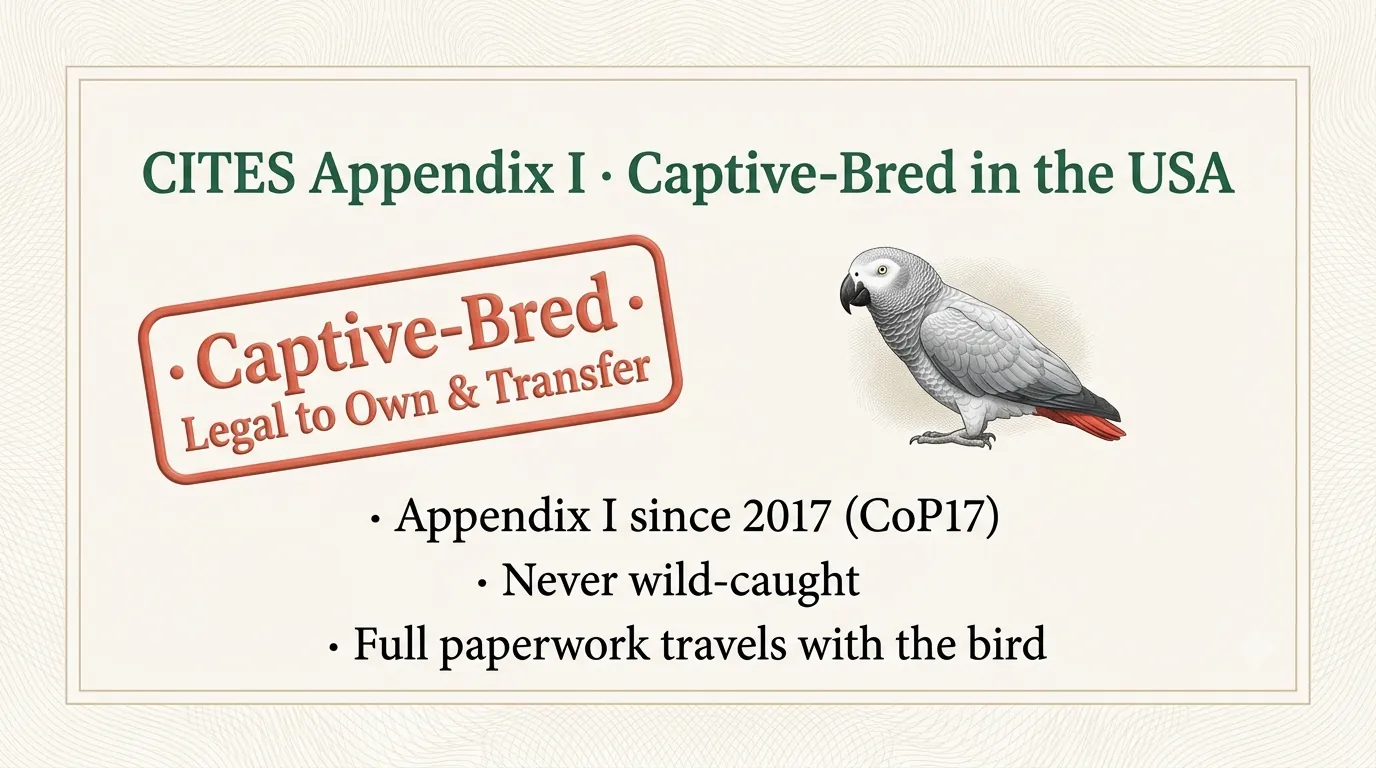
Are African Greys and Amazons Wild-Caught? The CITES Answer
This is the question no comparison page in this niche answers — and one page in the field gets it backwards, hinting an African Grey is fine "if not wild-caught," which quietly implies wild-caught birds are on the table. They are not, from anyone reputable. The African Grey carries the treaty's top protection, CITES Appendix I, a status granted in 2017 after wild trapping had hollowed out native populations — history Encyclopaedia Britannica ↗ sets out clearly. Plenty of Amazons are CITES-listed as well. None of this bans ownership — it simply makes documented captive-bred origin the whole ballgame.
The Document Folder Every Grey Travels With
Every Grey we send goes with its whole dossier — captive-bred CITES papers, a hatch record tied to the closed band number, a sexing certificate from the DNA lab and a health certificate from the avian vet. If any seller of any parrot — Grey, Amazon or otherwise — hesitates when you request those four, the hesitation is your answer.
What Appendix I Actually Means for a Buyer
The Wild Bird Conservation Act, laid out by the U.S. Fish & Wildlife Service ↗, is the barrier that keeps wild-trapped Appendix-I parrots out of US homes. Documented, home-bred birds change hands legally. Your Grey's band, meanwhile, was closed over its foot in the nest and can't be slipped onto a wild-caught adult afterward — which is why it counts for more than any sales receipt.
What IUCN Status Means for Greys and Amazons
In their native ranges the Congo Grey is listed Endangered and the Timneh Vulnerable; of the Amazons on this page, the Yellow-Naped and Yellow-Shouldered face the gravest conservation concern. None of that clouds the legality of your captive-bred bird — but it's why we frame paperwork as ethics, not marketing. Every documented, home-bred placement removes one more market incentive to take a bird from the wild.
Every Grey we place travels with its complete CITES and health paperwork. Get on the list and we'll email you as soon as the next documented, hand-raised chick opens up.
How We Fly or Drive a Grey to You
Tier 1Airport Pickup$185
Live-animal cargo booked to IATA standards on Delta, United or American, routed to your nearest major airport
Tier 2Home Delivery$350
A temperature-controlled van delivers your Grey to the door, paperwork folder included
Whichever Grey you reserve, there are two nationwide delivery options — and every bird flies or rides with its health certificate and full document folder, exactly the standard we'd want on the receiving end.
The Metros Our Greys Fly to Most
A solid share of the Greys leaving Midland each season head to these seven metros; the full African Grey shipping process has its own page. Every pill below opens that area's availability page:
Our written health guarantee protects your Grey from arrival onward — full terms sit on the health guarantee page. A $200 deposit holds the bird, and the remaining balance is settled before it travels.
Ships nationwide · $185 airport · $350 home
The Greys in Our Nursery Right Now
If this page has you leaning Grey over an Amazon, these are the chicks and young birds in our nursery today. Tap any card to open that bird's full profile — photos, parents and paperwork included.
Meet EvieShips nationwide · $185 airport · $350 home
Looking for a Breeding Pair or Fertile Eggs?
Some buyers arrive wanting more than a single companion chick. Seasoned aviaries ask after our bonded, proven-producing Grey pair, and experienced incubator keepers ask about candled fertile hatching eggs — each has its own page, and each ships with the same documentation stack our companion Greys do.
Bonded Proven-Producer PairFrom $3,000Closed-banded and actively producing — suited to established aviaries rather than first-time homesSee the pair pageShips nationwide · $185 airport · $350 home
Candled Fertile Hatching Eggs$95 eachCandled and incubator-ready before they ship — for seasoned hatchers only; buy five eggs and we cover US shippingView the hatching-eggs page
Ten years of talking families through the Grey-or-Amazon call has shown us a pattern steady enough to sign our name to. Real, verified buyer reviews — full names and cities — sit on our African Grey reviews page.
"Fit the bird to the home — talker or singer — and 'I regret this' stops being a sentence our buyers ever have to write."
Mark & Teri Benjamin · C.A.Gs, Midland, TX
The families who write back happy are the ones who chose by wiring — a Grey for conversation, an Amazon for song — rather than by plumage. Choose that way and regret seldom finds an opening.
Grey-or-Amazon: the Questions Buyers Still Ask
Once the tables and scorecard have done their work, these are the messages that follow — genuine inbox questions from people caught between a talking Grey and a singing Amazon. Answers stay short and straight; the wider African Grey parrot FAQ covers care, diet and daily ownership beyond this matchup.
What is the difference between an African Grey and an Amazon parrot?
The African Grey is a silver-grey, red-tailed parrot prized as the best-talking bird on earth — a quiet, contextual, one-person thinker. An Amazon is a green, extroverted parrot that sings and projects, bonds more readily with a whole household, and comes in many species with sharply different temperaments. In short: the Grey out-talks and out-thinks with words; the Amazon out-sings and out-socialises. The Grey is dustier and more sensitive; the Amazon is louder and more prone to hormonal swings.
What are the cons of the Amazon parrot?
The main drawbacks are volume, hormones and obesity. Amazons are loud all day, not just at dawn and dusk, and the yellow-headed species can turn seasonally aggressive as they mature — the single most common reason Amazon ownerships end. They are also prone to obesity and fatty liver disease on the wrong diet. On the plus side they are hardy, confident, sociable birds and superb singers; the cons are manageable for prepared owners but real.
What are the disadvantages of the African Grey parrot?
Greys are sensitive, dusty and easily bored. They produce fine powder-down dander that bothers allergy households, they are prone to feather-plucking if under-stimulated, and they bond so specifically that they can be reserved with strangers. They also need calcium, Vitamin A and UV-B attention to avoid hypocalcemia. None of this makes them bad companions — it makes them a bird for owners who will enrich, bathe and vet them properly for decades.
What is the friendliest parrot to own — a Grey or an Amazon?
For an outgoing, whole-family bird, an Amazon usually reads as friendlier: extroverted, confident with visitors, quick to perform. A Grey is deeply devoted but often to one person, and warms to strangers slowly. Neither is objectively friendlier — they're social in different ways. If you want a bird that greets guests, lean Amazon; if you want a profound one-person bond, lean Grey. Both need daily interaction to stay friendly at all.
Which parrot has the highest IQ, the African Grey or the Amazon?
The African Grey is the benchmark for parrot intelligence. Decades of research by Dr. Irene Pepperberg with Alex the Grey demonstrated counting, categorisation and contextual language use that reset expectations for bird cognition. Amazons are bright, trainable and socially shrewd, but the Grey is the species science reaches for when it studies parrot reasoning. If cognitive depth and contextual talking are the draw, the Grey leads.
How much does an African Grey cost compared to an Amazon?
Our documented Congo African Greys run $1,700 to $3,500 and Timnehs $1,500 to $1,600, every bird DNA-sexed, disease-screened and CITES-documented. Amazon market prices vary widely by species and are set by other sellers, not us — we raise Greys only. On either side, the number that matters is documentation, not the sticker: a cheap, undocumented parrot is a different and riskier purchase. Our full breakdown lives on the African Grey price page.
How long will an Amazon parrot live, and how does that compare to a Grey?
Both are multi-decade commitments. Amazons commonly live 40 to 70 years with good care, and African Greys 40 to 60 — either bird can outlive the person who buys it. So a written succession plan — spelling out who takes over the bird's care — is simply part of owning either species responsibly. Lifespan is not a tiebreaker here; the honest question is whether your next several decades have room for a demanding parrot.
Can an African Grey and an Amazon parrot live together?
Only in separate cages, with supervised out-time and never left alone together. Both are strong-beaked, opinionated birds, and Amazons can be pushy — a bad interaction can injure a Grey fast. Experienced multi-bird keepers manage it with slow introductions and constant supervision, but for most homes a single demanding parrot is already a full-time commitment. Two at once is a serious step up in noise, dust, cost and conflict management.
Do Greys talk better while Amazons sing better?
Broadly, yes — and it's the most useful way to frame the choice. Greys win on vocabulary, clarity and contextual use of words; owners of both consistently say the Grey is the more articulate mimic. Amazons win on volume, melody and prosody — the yellow-headed species are famous 'opera singers.' Neither guarantees anything for an individual bird, but if you dream of conversation, choose the Grey; if you love a bird that belts songs, choose an Amazon.
Is an African Grey a good first bird compared to an Amazon?
Neither is a true beginner's parrot — both are intelligent, loud enough, long-lived and demanding. A well-researched first-timer can succeed with a Grey, which is steadier in behaviour, provided they commit to enrichment and dust management. A big yellow-headed Amazon, with its hormonal swings and volume, is better left to experienced keepers. If this is your first parrot, the honest advice on both sides is: start smaller, or go in with your eyes fully open.
Are African Greys and Amazon parrots wild-caught?
Reputable ones are not. Both African Greys and Amazons are CITES-listed — the Grey on Appendix I since 2017 — and every bird we place is captive-bred in the USA with full paperwork, never wild-caught. Captive-bred, CITES-documented birds are legal to own and transfer domestically. Any listing that is vague about origin, or that hints at imported or wild-sourced birds, is a listing to walk away from for either species.
Which is quieter for an apartment, an African Grey or an Amazon?
The African Grey, clearly. Greys are among the least screamy parrots, with fairly predictable dawn-and-dusk vocal sessions, while Amazons are loud across the day and the big species can carry through shared walls. Neither is silent, and both need daily out-of-cage time, but for thin walls and close neighbours the Grey is the far safer apartment bird. The main Grey trade-off in a small space is dust, not noise.
More Grey-and-Amazon Reading
A parrot is a decades-long commitment, so research it like one. These three reads pick up where the comparison stops — when a Grey actually starts talking, the real lifetime cost behind the price, and whether a Grey belongs in a first-time home.
Whether it was the talking, the noise or the temperament that tipped you, what comes next doesn't change: describe your home and we'll tell you honestly which Grey suits it — or that an Amazon might serve you better, if that's the truth.

 Choose an African Grey if…
 Choose an Amazon if…