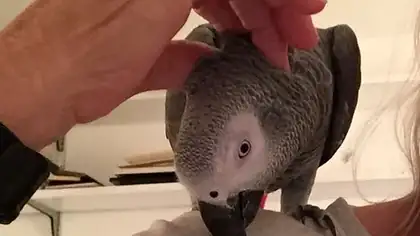
African Grey vs Cockatoo: Which Parrot Fits Your Life?
We hand-raise African Greys here in Midland, and the question cockatoo-curious buyers ask us most is the same one every time — talker or cuddler? This is the honest side-by-side we give them: the Grey against the cockatoo, and against each cockatoo species by name.
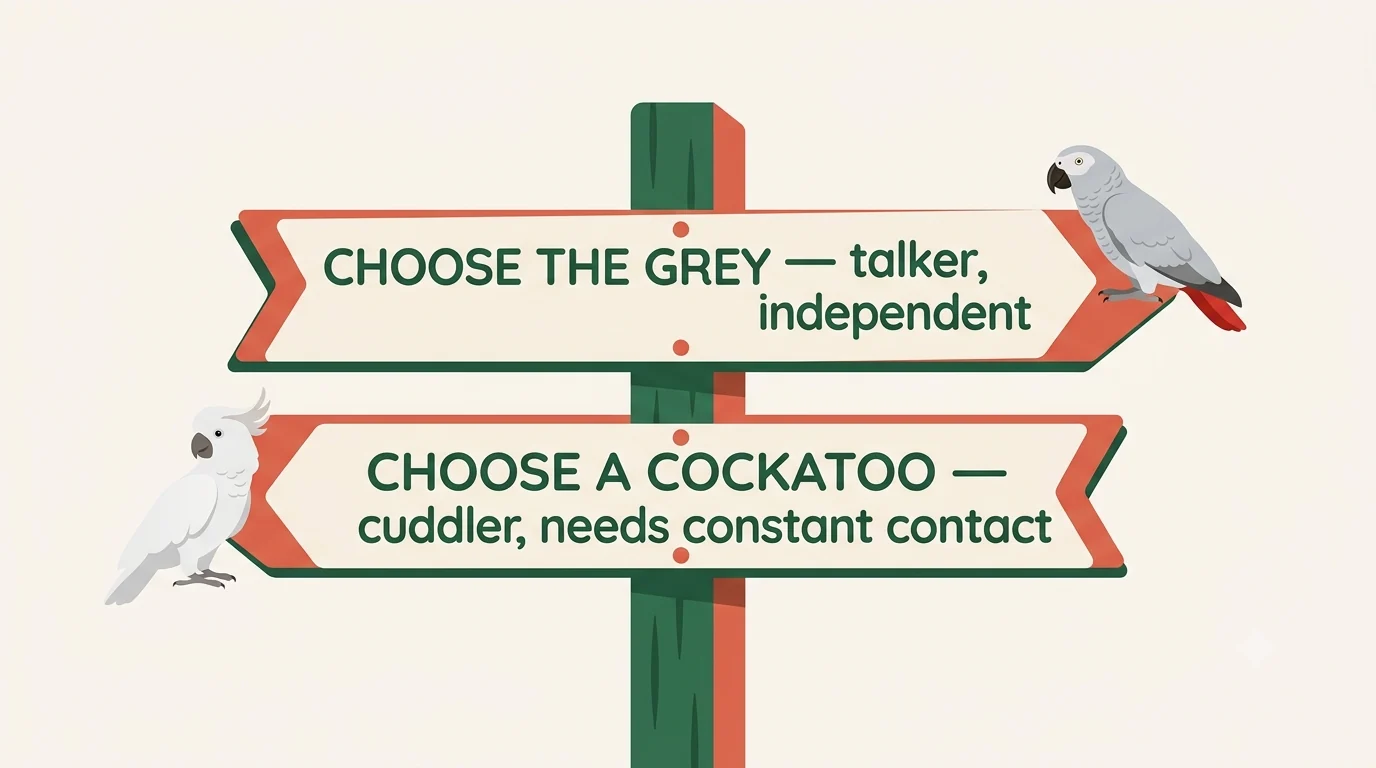
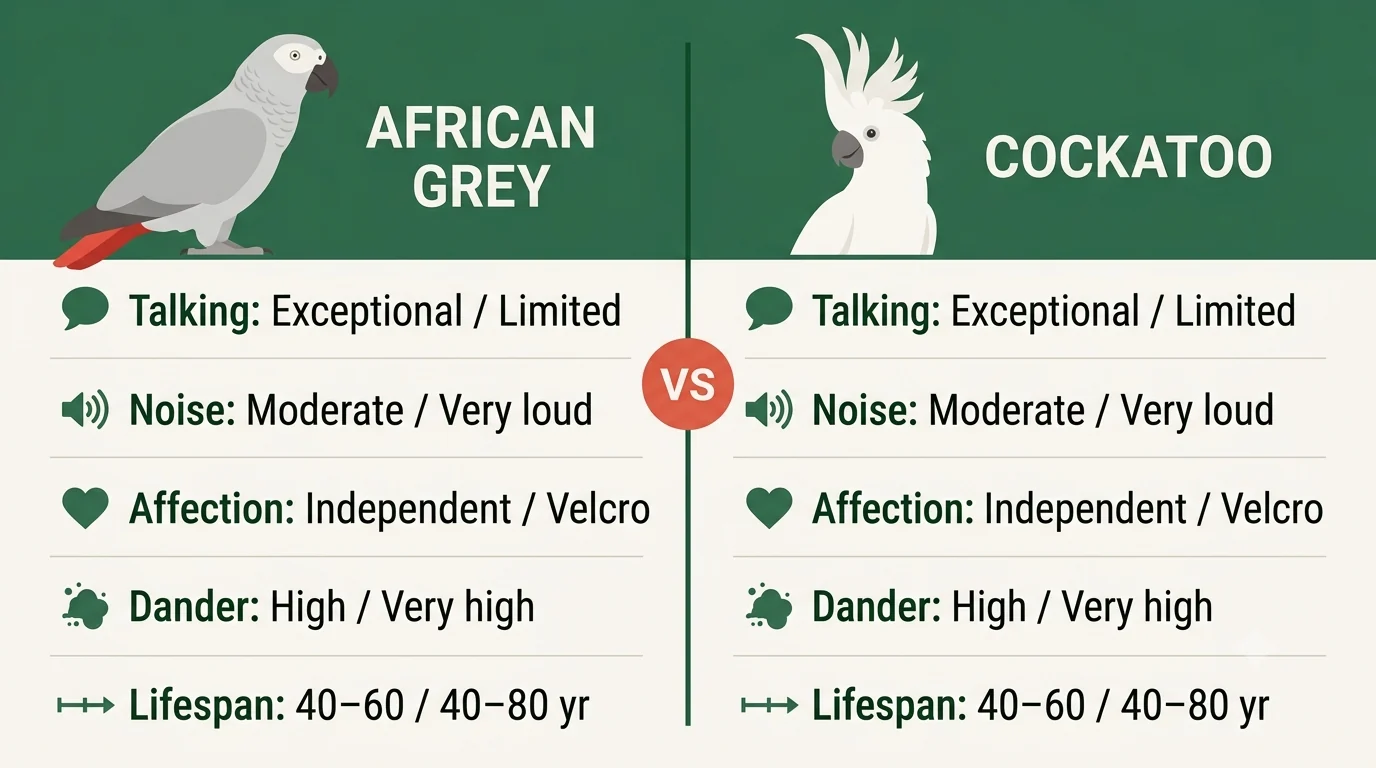
Quick answer: The African Grey is the world's best-talking parrot, 200 to 1,000-plus words with near-human clarity and a deep but independent bond that suits a moderate-noise, apartment-plausible home. A cockatoo is a physically affectionate "velcro bird" that trades talking for constant contact, serious volume and heavy dander. The Grey talks; the cockatoo cuddles, and no training swaps those two wiring diagrams.
Choose an African Grey if…
you want a bird that genuinely talks and reasons in context
you live in an apartment or need moderate, predictable noise
you'd rather a companion near you than glued to you
Choose a cockatoo if…
you want a "velcro bird" that craves hours of physical contact
your home can absorb serious volume and extra feather dander
cuddling matters to you more than conversation
Buyers reach this page from every phrasing — cockatoo vs African grey, "African gray" with an a, or a specific matchup like African Grey vs Umbrella cockatoo — and the honest answer holds across all of them: neither bird is "better," they're wired for different owners. We raise Greys, so we'll name our bias up front and then hand you the cockatoo's real advantages anyway. The rest of this page settles which wiring fits your household, right down to a per-species breakdown of the Umbrella, Moluccan, Goffin's, Galah and Citron.
8 Things to Know Before You Choose
Short on time? These are the facts cockatoo-versus-Grey shoppers screenshot and text to their partner — the talking gap, the noise reality, the powder-down dander both birds share, and the lifespan that outlasts most plans. Every line comes from raising Greys and answering these exact emails for years, not from a rewritten listicle.
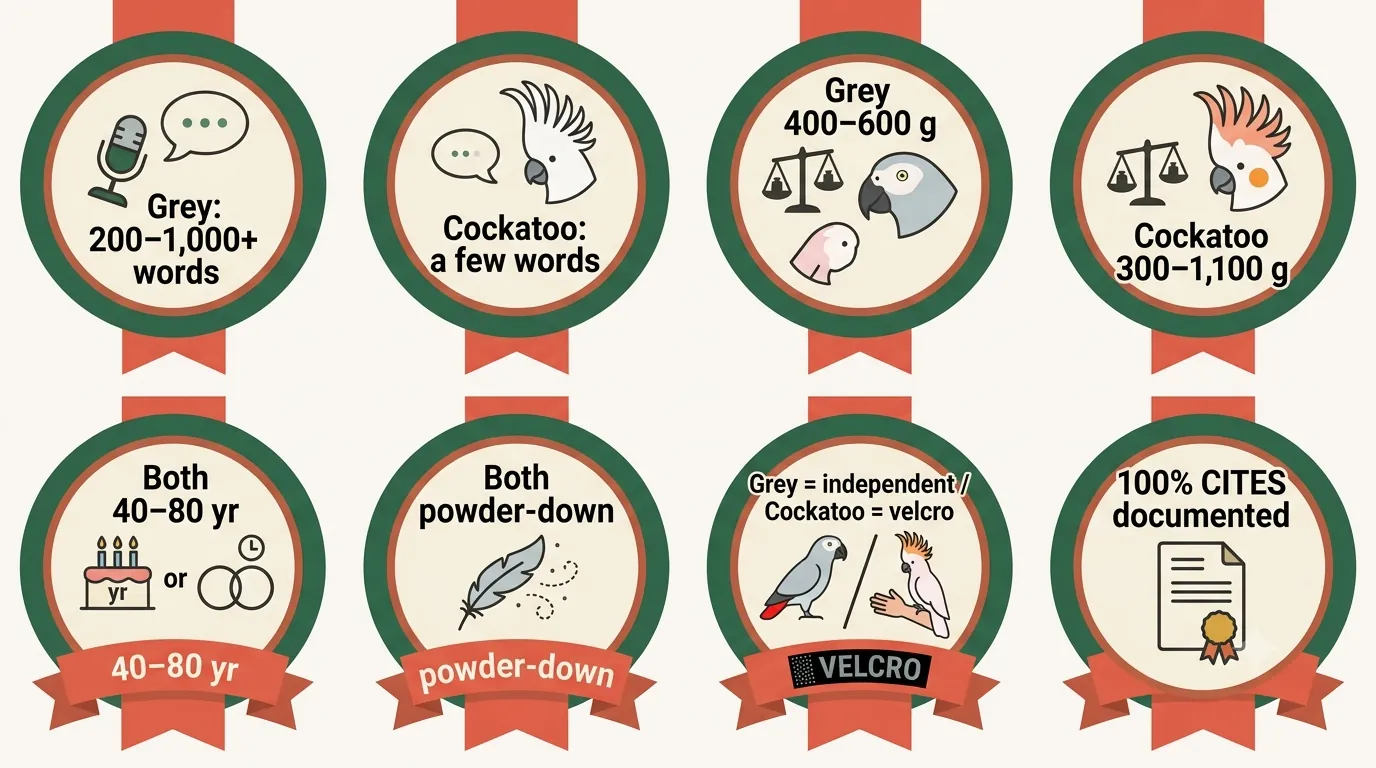
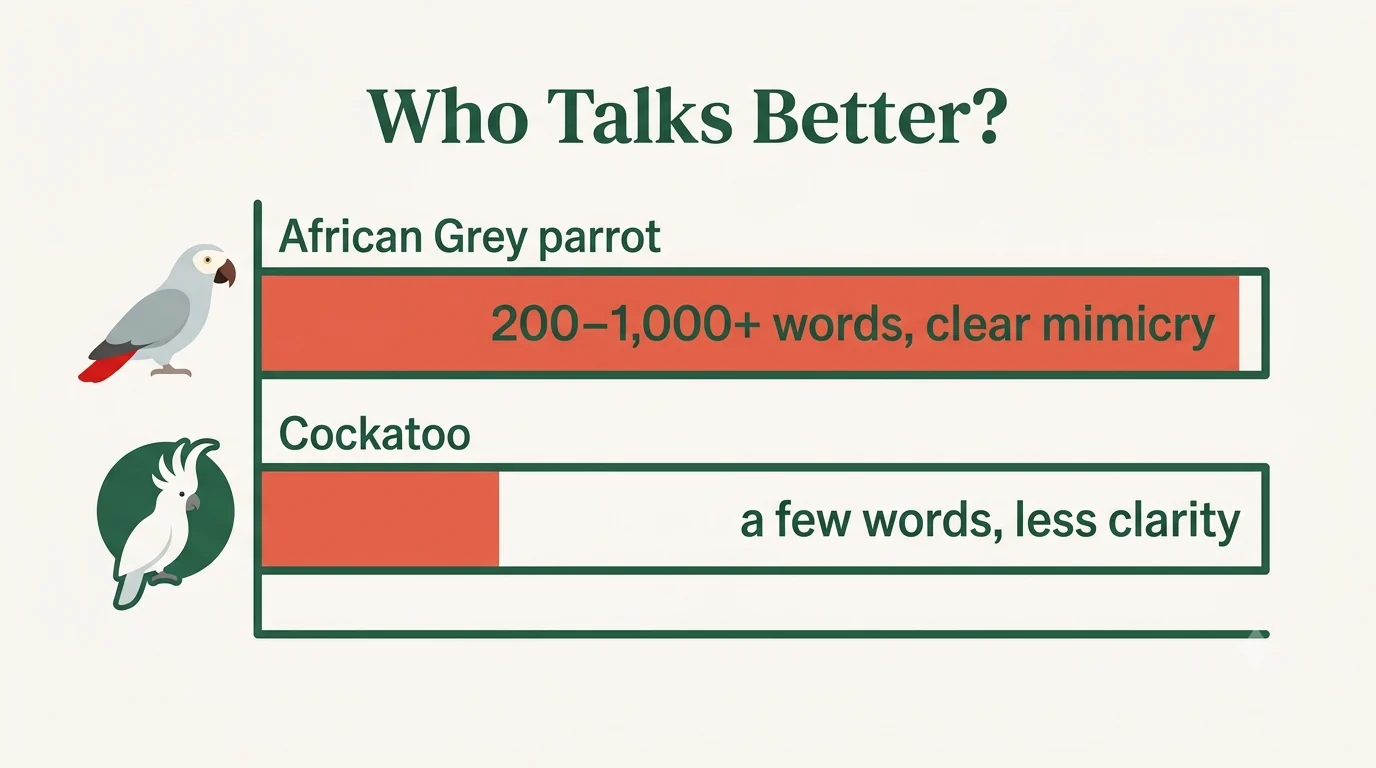
200–1,000+ wordsan African Grey's talking range; cockatoos manage a few
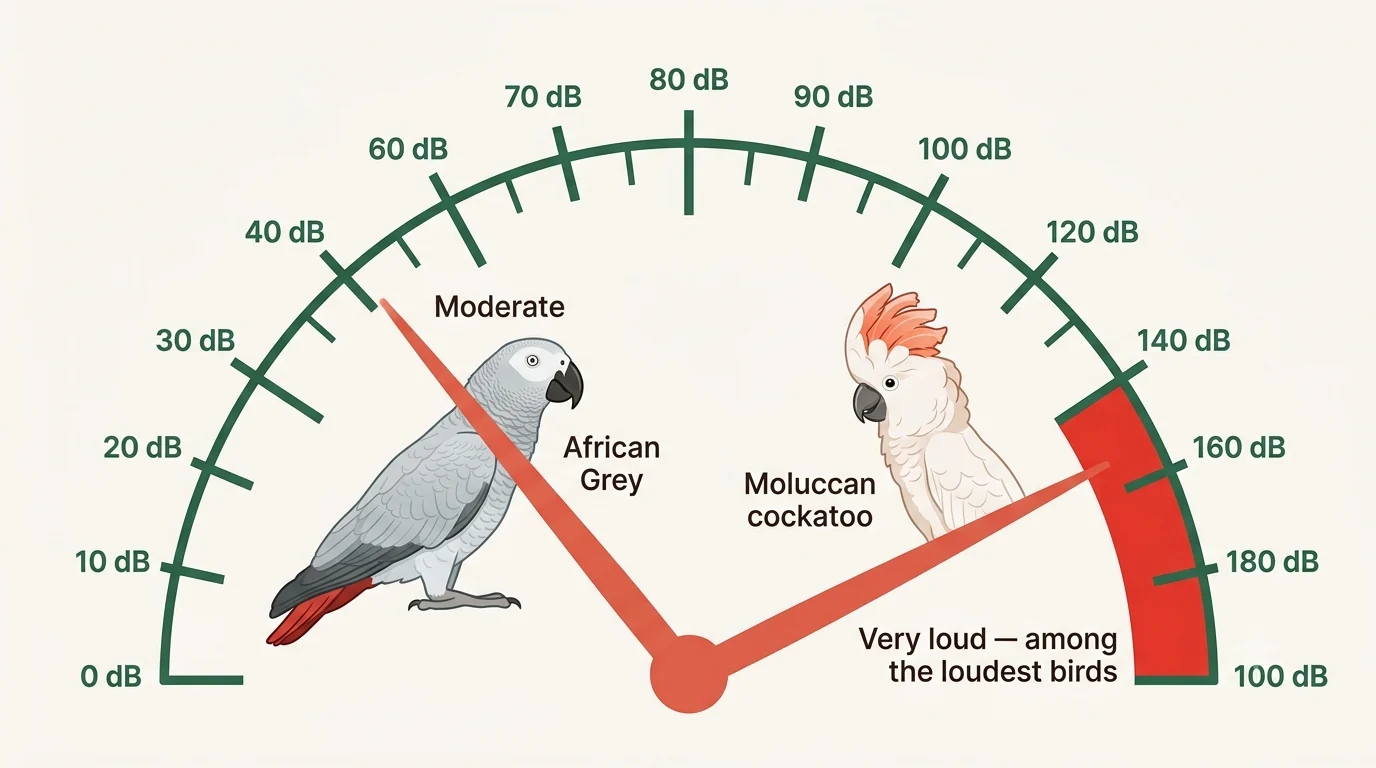
Very loudthe cockatoo baseline — Moluccans rank among the loudest birds alive
Velcro vs near youcockatoos crave constant contact; Greys bond deeply but independently
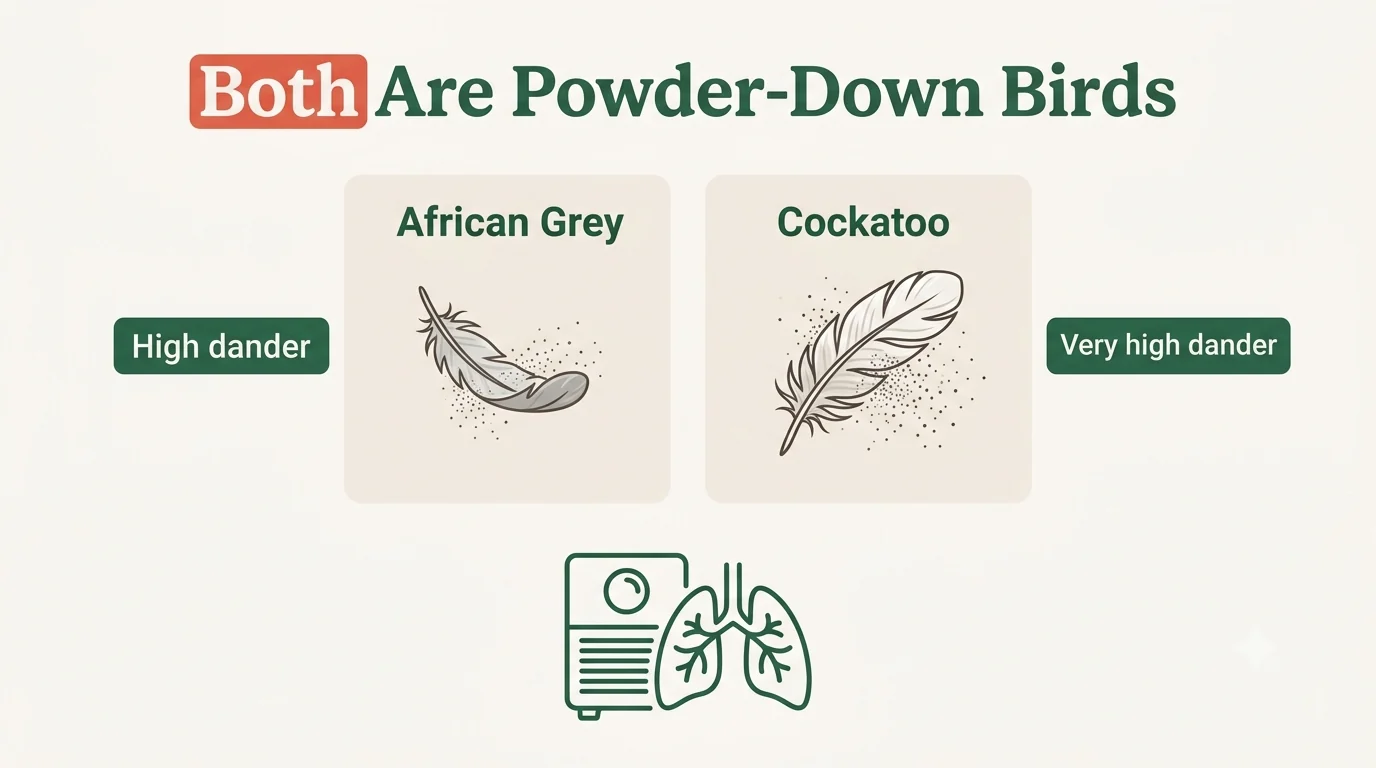
Both dustyGreys and cockatoos are powder-down birds — neither is allergy-safe
40–80 yrseither bird can outlive its owner; a caretaker plan matters
5 specieswe compare the Grey to Umbrella, Moluccan, Goffin, Galah & Citron
100%every Grey ships with CITES papers, a DNA sexing certificate and PBFD/APV PCR results
$185 / $350airport pickup or door delivery, anywhere in the US
The Side-by-Side: Grey and Cockatoo, Trait for Trait
Twelve attributes and a single honest verdict column — rows included where the truthful call is simply "depends on you." We answered it the way we would face to face at the aviary, not the way a listicle pads it out. On a phone, tap whichever bird you're weighing and the column comes with you.
Attribute
African GreyThe world's best talker
CockatooThe affectionate velcro bird
Edge
Talking ability
Exceptional — 200–1,000+ words, clear
Limited — a few words
African Grey
Affection style
Deep bond, but independent
Velcro — craves constant contact
Depends on you
Noise level
Moderate
Very loud (Moluccan among the loudest)
African Grey
Body size
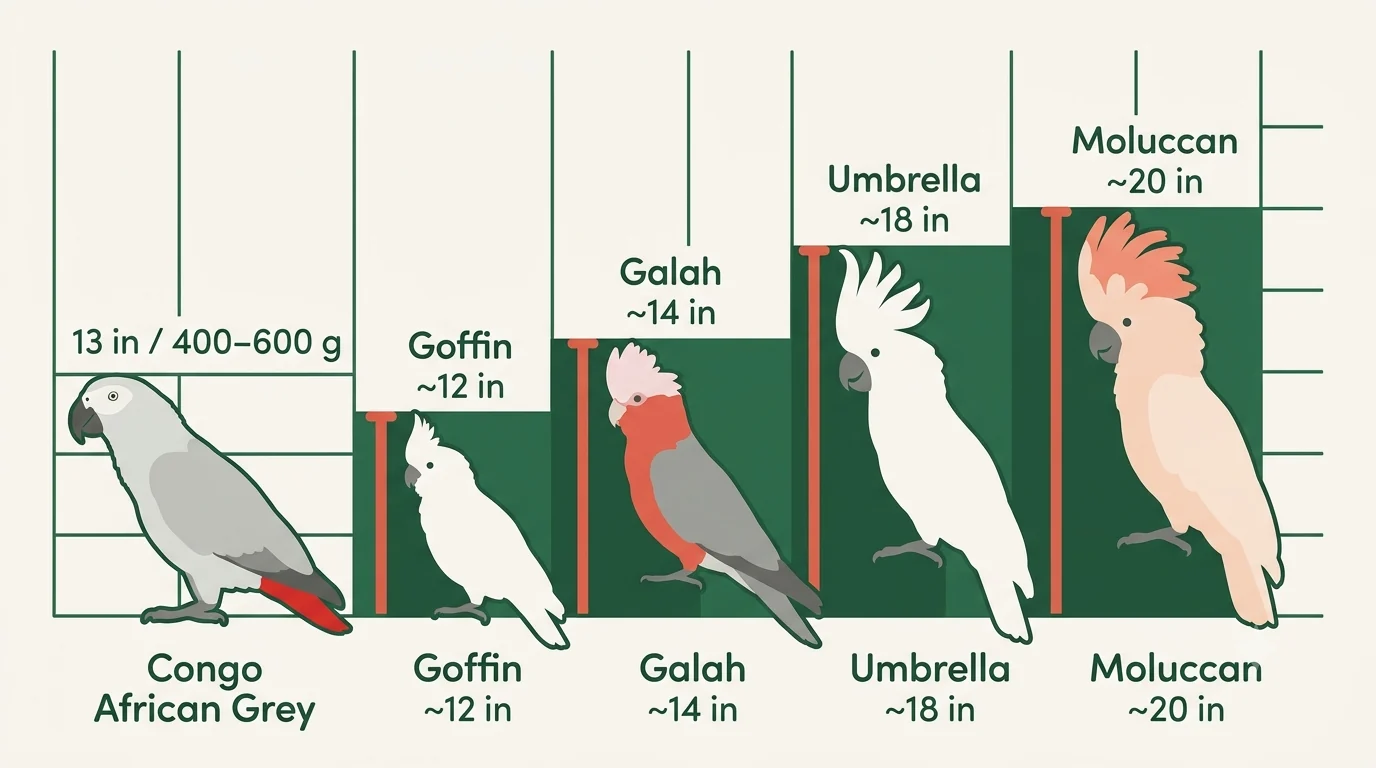
12–14 in · 400–600 g
12–28 in · 300–1,100 g by species
Grey (apartment)
Powder-down dander
High
Very high
Grey, slightly
Feather-plucking risk
Moderate if under-stimulated
High — common in cockatoos
African Grey
Bite force
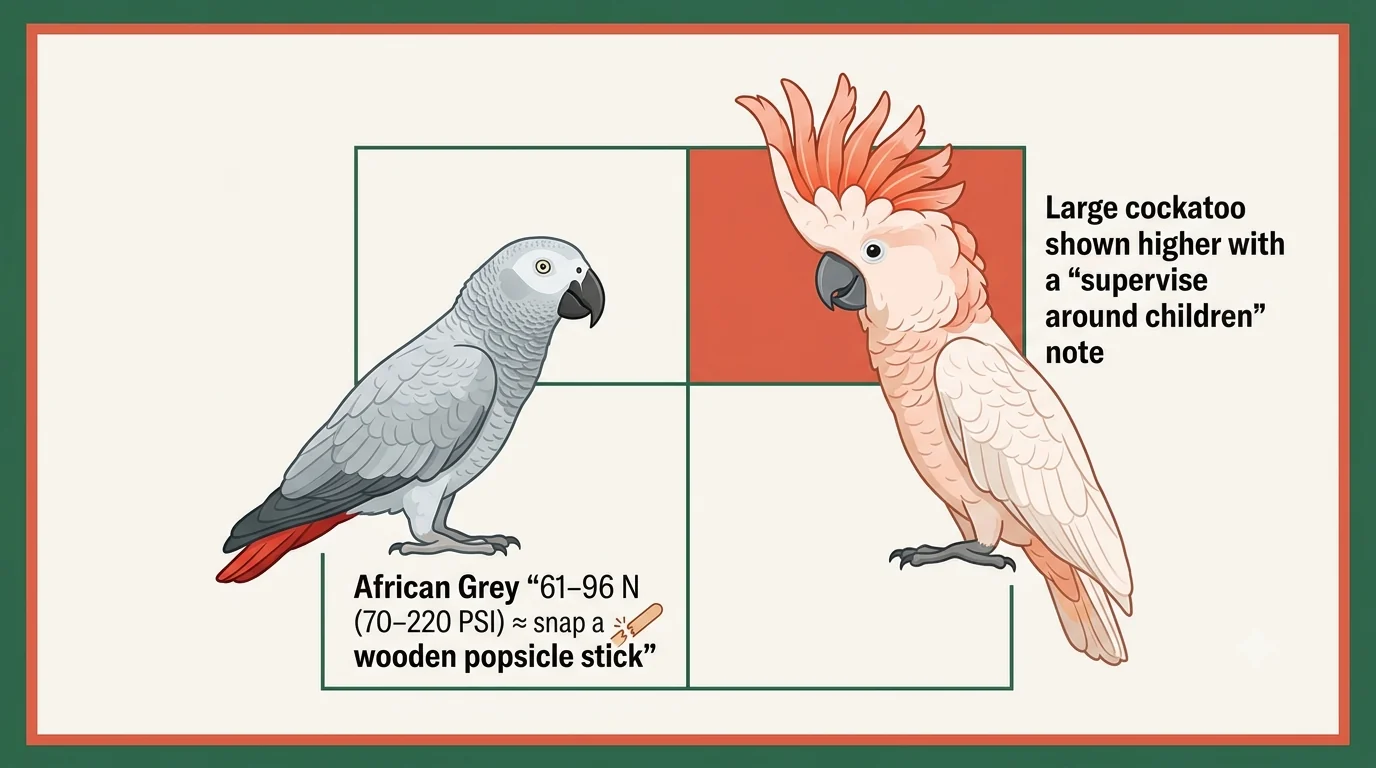
61–96 N (70–220 PSI)
Much higher in large species
Grey (safer)
Beginner suitability
Demanding
More demanding
Grey, marginally
Apartment fit
Plausible with daily time
Only the small Galah, and still loud
African Grey
Lifespan
40–60 years
40–80 years
Both lifelong
Typical price
$1,700–$3,500 (our Greys)
$1,000–$4,000 by species
Depends
CITES documentation
Appendix I — included
Many Appendix I or II
Grey (we document)
Every "Edge" call above is ours, from raising Greys and studying the cockatoos we're regularly asked about — not aggregated from other websites.
What Qualifies Us to Rank Greys Against Cockatoos?
We raise African Greys, not cockatoos, and a fair comparison starts by saying so. What we bring instead is a decade of placing Greys with families who weighed a cockatoo first — and hearing exactly how that decision aged.
Mark & Teri Benjamin
Raising African Greys in Midland, TX since 2014
USDA-licensedCITES papersDNA-sexedPCR-screened
Most African-Grey-versus-cockatoo articles are written by people selling neither bird. We're Mark and Teri Benjamin, and we've hand-raised African Greys here at C.A.Gs since 2014 — weighing chicks at 6 a.m. and fielding the "should I get a cockatoo instead?" question year-round. When we describe a Grey trait on this page it comes from our own nursery; when we describe a cockatoo, it comes from the owners, rescues and avian vets we've spent a decade comparing notes with.
That honesty runs both ways. We'll tell you plainly that a cockatoo out-cuddles any Grey, and that a Goffin's may out-think one at raw problem-solving — because a comparison that only flatters the bird we sell is an ad, not a comparison. What we won't do is repeat the internet's confident folklore about either species without checking it against real birds first.
Why We Put Health Paperwork Above Cuddle Appeal
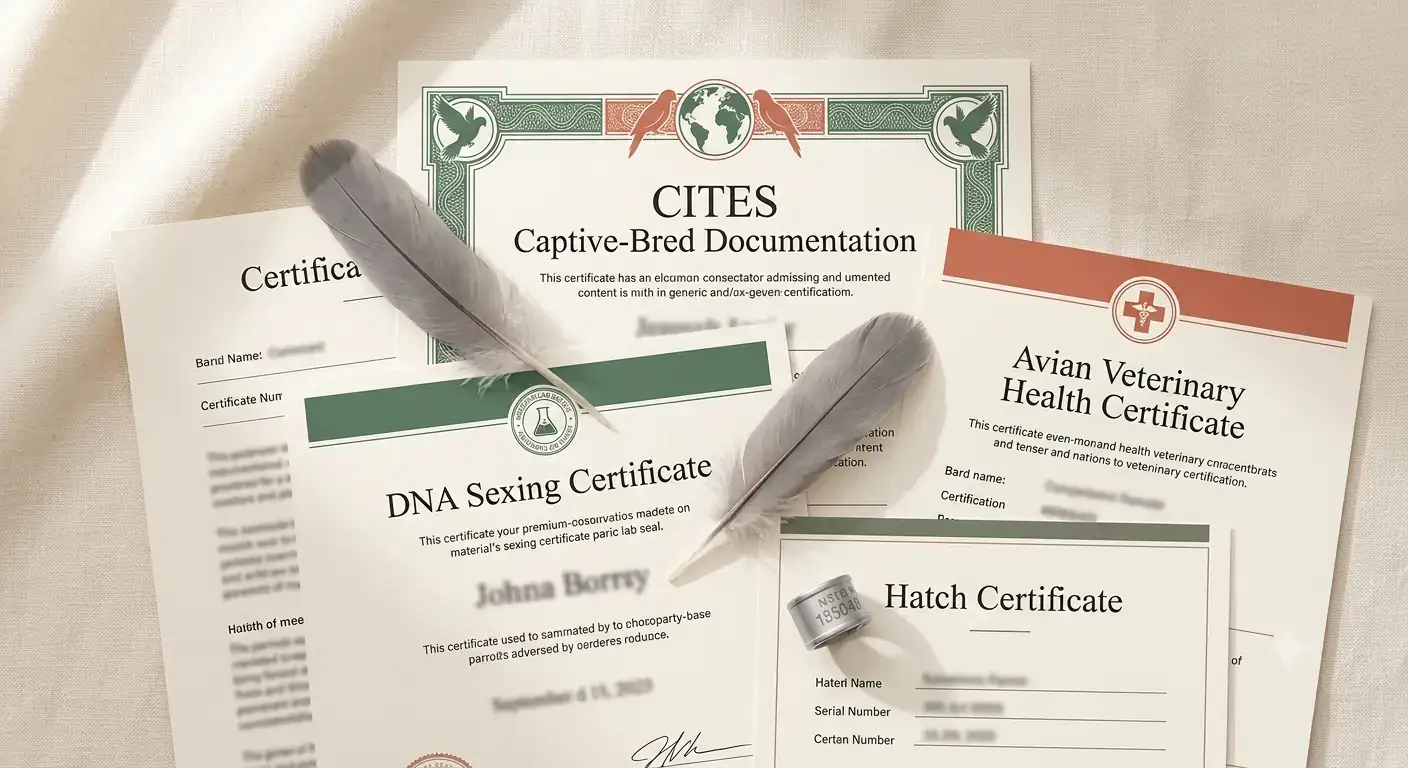
For any parrot the purchase is the cheap part; the real expense is the four to eight decades that follow. So we load the unglamorous paperwork up front to guard those years: PBFD and Avian Polyomavirus PCR screening, a DNA sexing certificate, an avian vet's health certificate, a hatch record with closed band, and the CITES Appendix I documents establishing that your Grey was bred in captivity here in the States. Whichever bird wins you over, our health guarantee page puts that whole stack in writing.
Why Does the African Grey Out-Talk Every Cockatoo?
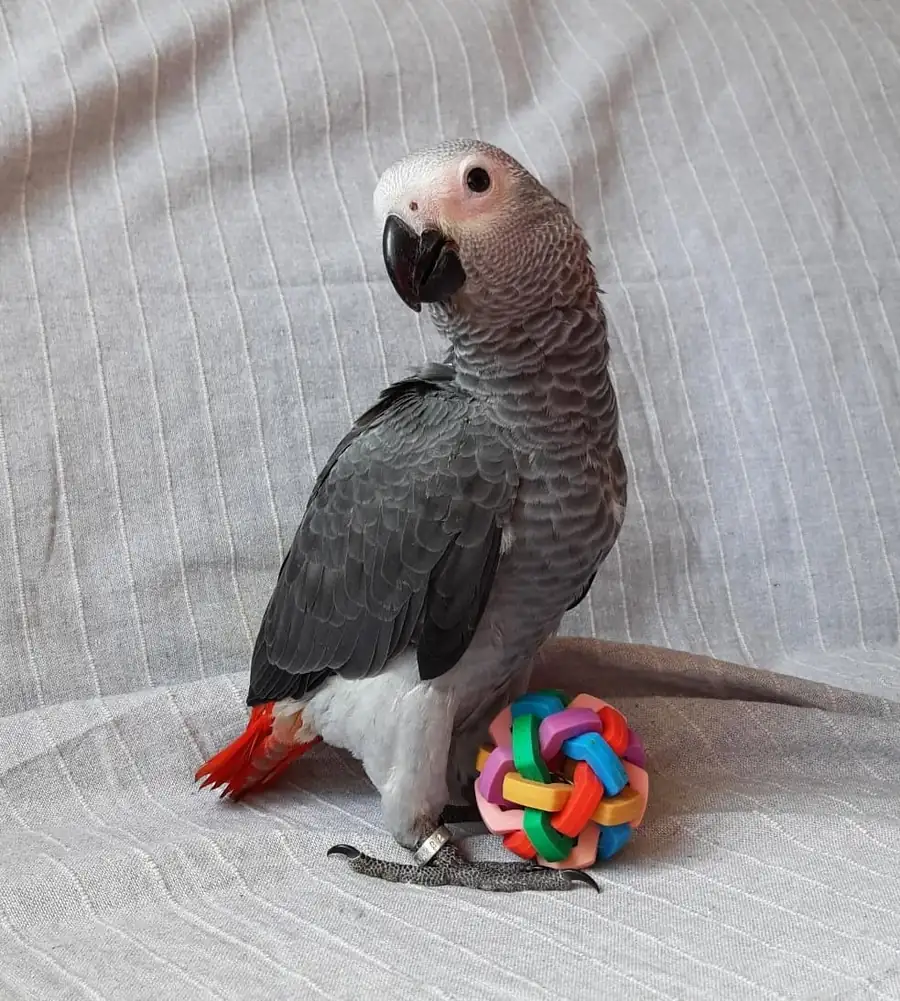
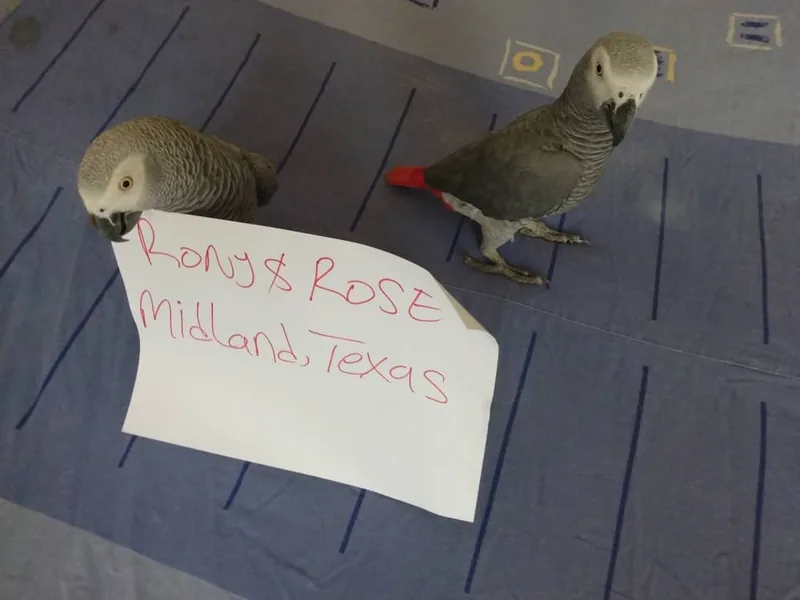
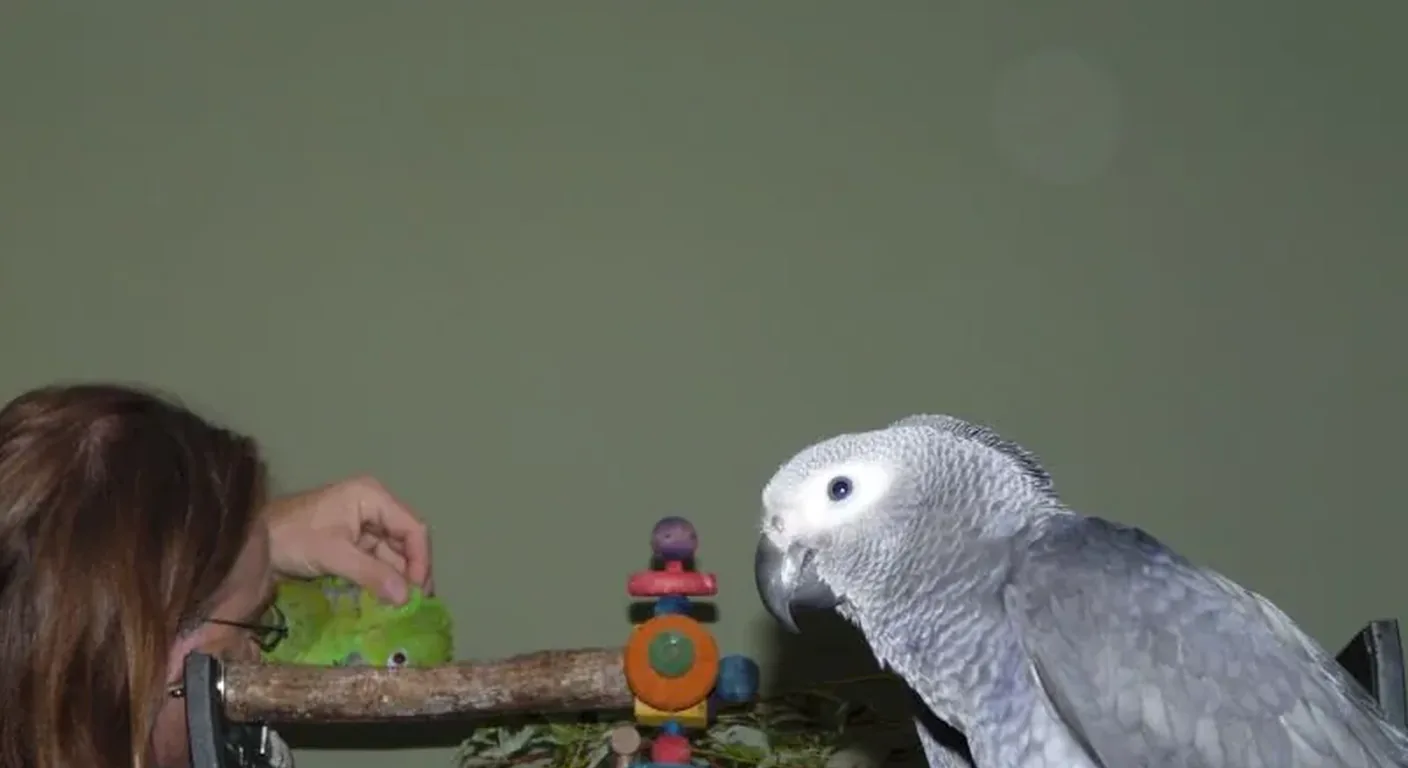
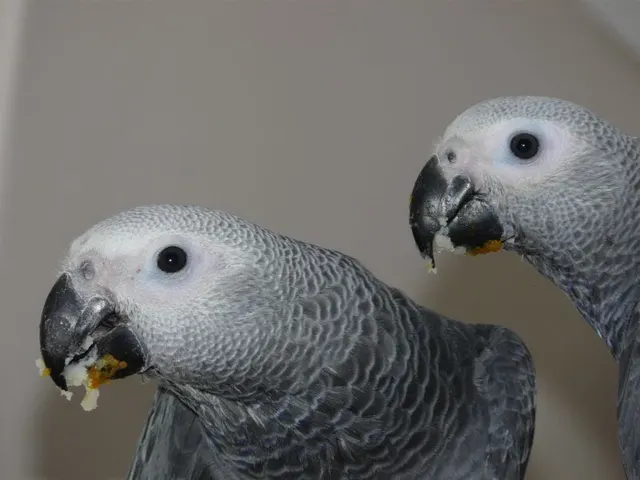
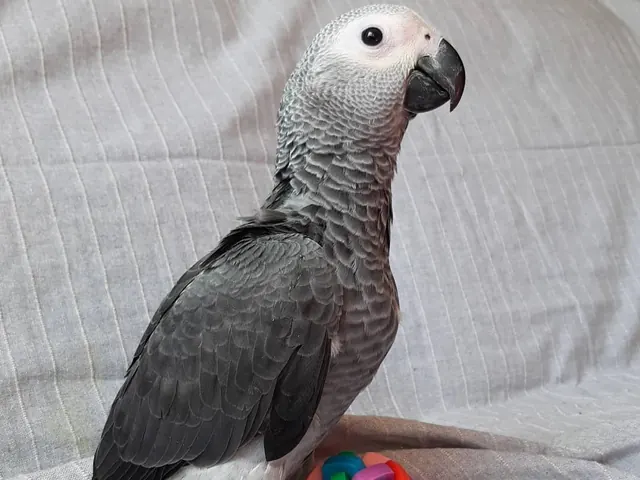
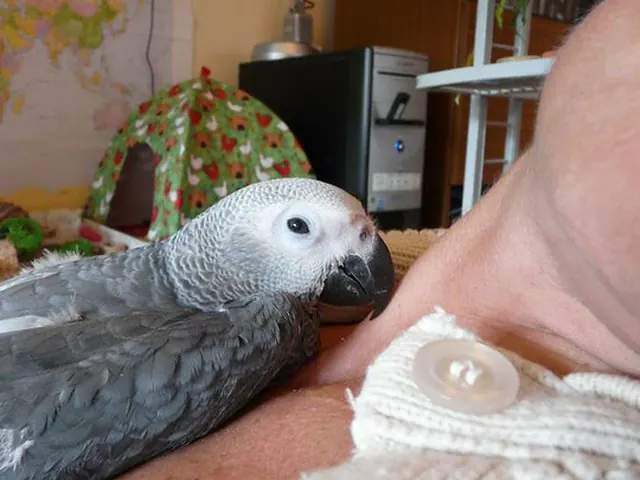
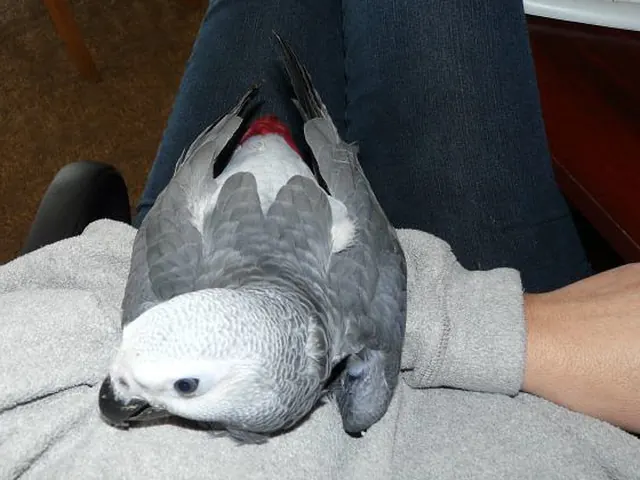
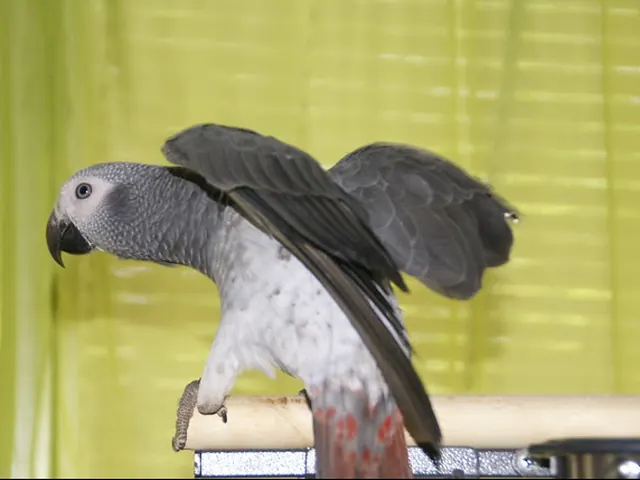
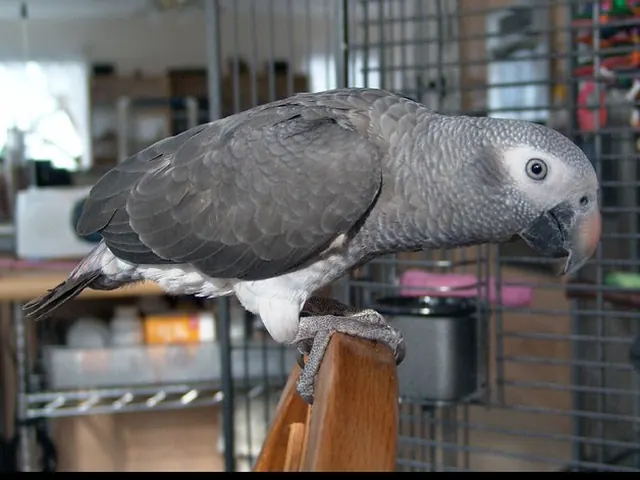
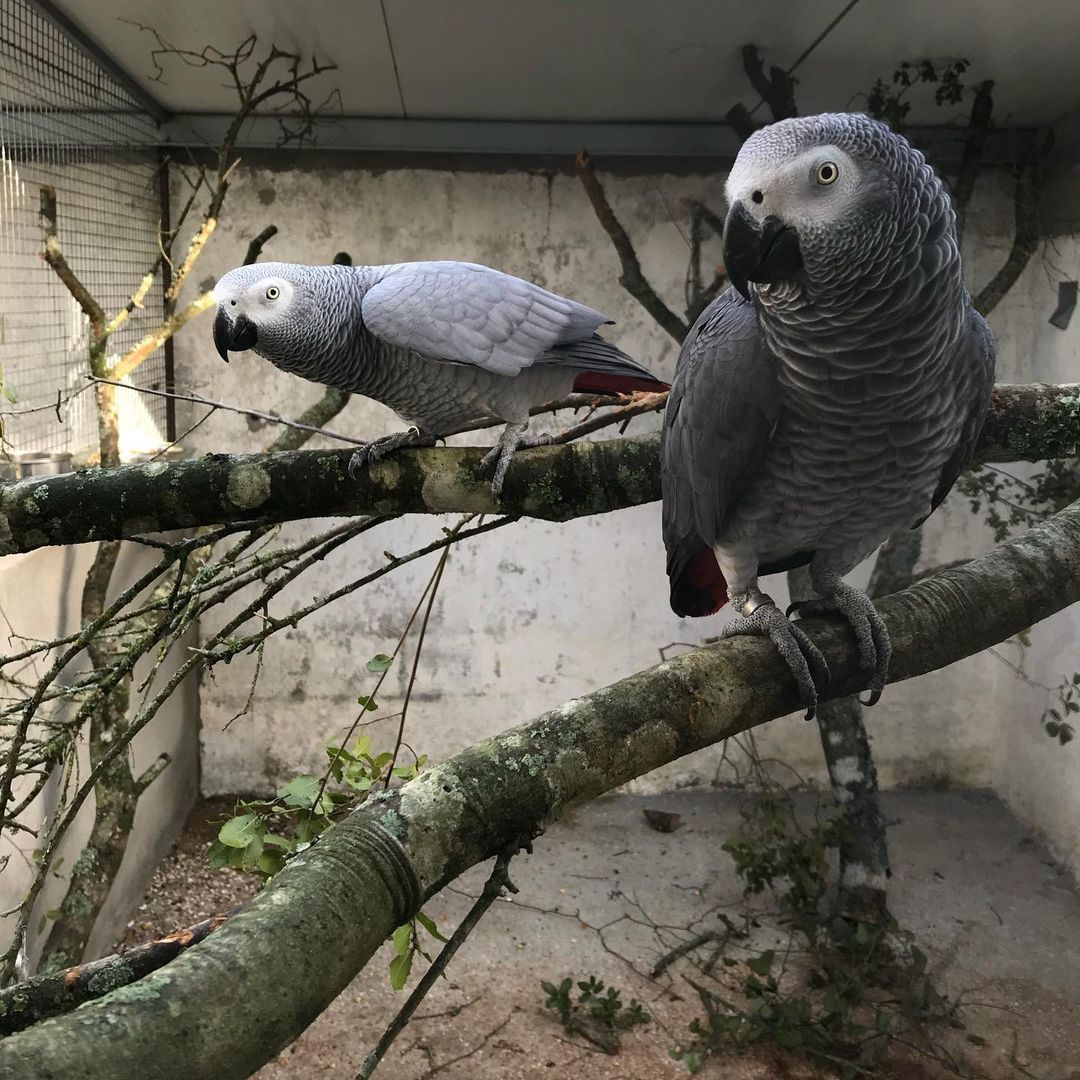
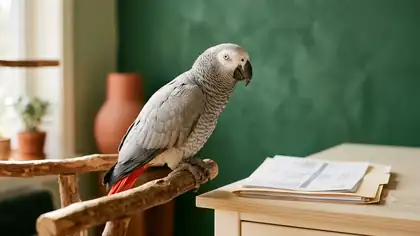
The African Grey is the parrot that made "talking bird" mean something. Silver-grey body, dark beak, a bright red tail on the Congo — and behind that plain plumage, the vocabulary and contextual reasoning that put the species in psychology textbooks. Against a cockatoo, the Grey's whole case is the mind: it talks, it problem-solves, and it entertains itself for stretches instead of demanding to be worn like a scarf. If you've searched "are African Greys good pets" or "best talking parrot," this is the from-the-nursery answer. You can meet the chicks weaning now on our available Congo Grey and Timneh Grey pages.
How Big Is an African Grey, and How Long Does It Live?
A healthy Congo African Grey weighs 400–600 grams at 12–14 inches beak to tail; the Timneh runs smaller. That places the Grey below most cockatoos on the size chart — a Goffin's is close, but an Umbrella or Moluccan dwarfs it. Smaller bird, smaller cage footprint, and a bite that stops well short of a big cockatoo's. Lifespan is the sobering match: 40–60 years with proper diet, UV-B light and avian-vet care, which is squarely in cockatoo territory. Either bird is a decades-long promise.
How Does a Grey's Temperament Read Next to a Cockatoo's?
Watchful. A Grey clocks everything — new shoes, moved furniture, which mug you grabbed — and that vigilance is both the appeal and the maintenance bill: a bird that notices everything needs a home worth noticing. Where a cockatoo wears its heart on its crest and demands contact, the Grey is more reserved and observational, happier supervising you from a perch than riding your chest. It bonds hard, but on its own terms.
How Does a Grey Handle a Small, Quiet Home?
Usually yes — and here the Grey pulls decisively ahead of a cockatoo. Greys aren't screamers by disposition; their signature sounds are whistles, talking and appliance mimicry, with real but predictable dawn and dusk peaks. A cockatoo's contact scream, by contrast, is an eviction risk through shared walls. Expect your microwave beep back at you forever, but expect it at a volume thin walls survive. A Moluccan they would not.
Does a Grey Bond Like a Velcro Cockatoo Does?
Deeply, and often with one favorite person, after weeks of quietly deciding who's trustworthy — a pattern owners on r/parrots ↗ describe exactly as we see it in the nursery. It's a steadier devotion than a cockatoo's full-body clinginess: a Grey wants to be in the room with its person, not welded to them. If you want a bird that interacts more than it clings, that's the Grey. If the cuddle is the whole point, the cockatoo section below is about to sound good.
Week One With a Grey: the Quiet Surprise
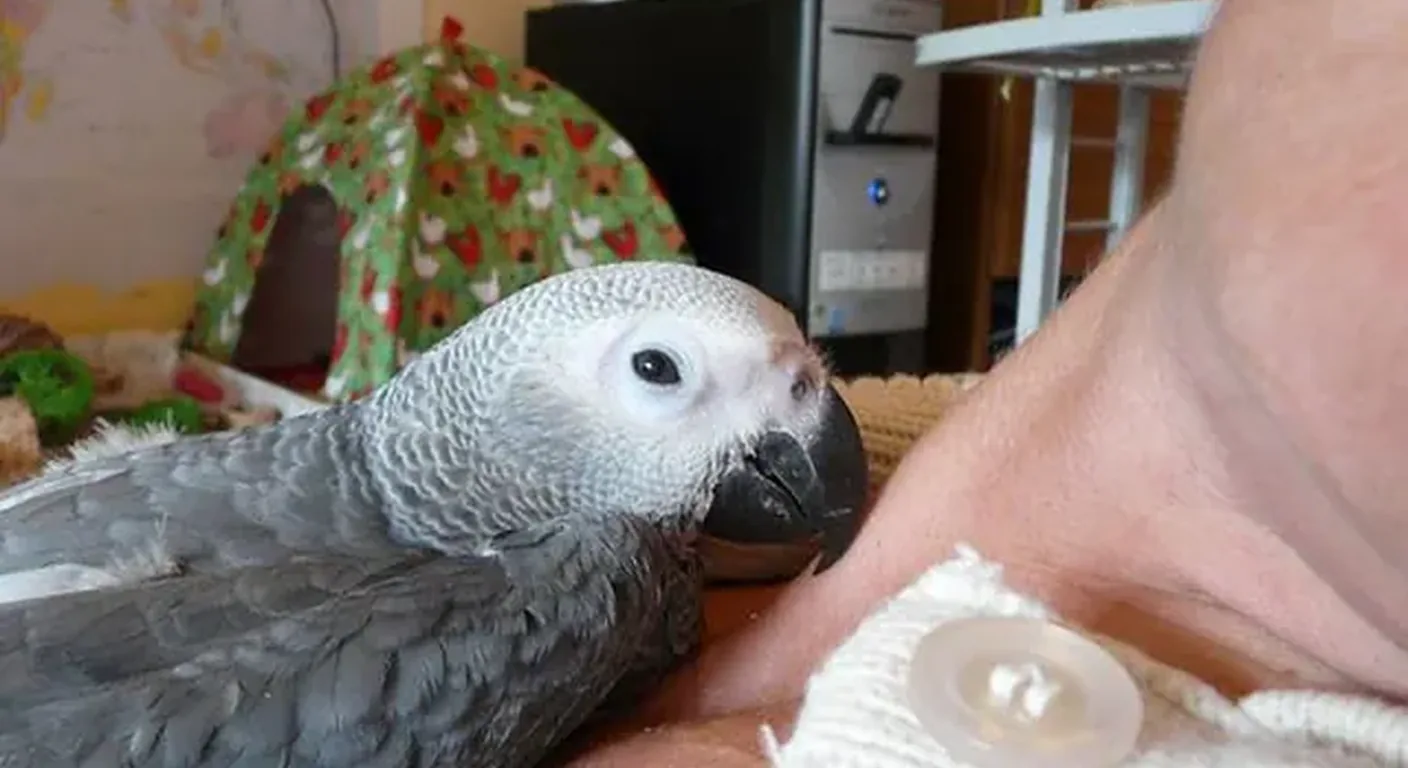
A new Grey that looks "boring" in its first week is anything but — it's quietly sizing you up. It'll perch low, observe far more than it acts, and wait until you've left the room to eat. By the second week that assessment wraps up and the character starts showing through. Our line to every family: a hushed opening week is the mark of a well-adjusted Grey, not a disappointed one.
Breeder note: how Maxy's first words arrived
Maxy — the Grey you'll see in our homepage video — began exactly the way the species tends to, by seizing on the single handiest word around him. He picked up calling "Teri," and the moment that paid off, "bye bye" and "come here please" arrived close behind. That's not idle mimicry; it's vocabulary aimed at an outcome. We've yet to meet a cockatoo that does it, and it's the entire reason the Grey takes the talking round.
Which Health Screens Does Every C.A.Gs Grey Pass First?
Two conditions deserve a spot on every Grey buyer's radar — and, tellingly, both trouble cockatoos as well. The first is hypocalcemia: Greys handle calcium unlike most parrots, and the veterinary literature summarized at Lafeber's avian resources ↗ flags low blood calcium as a well-documented grey-specific hazard, headed off with the right diet and UV-B light — the reason full-spectrum lighting appears in our care notes from day one. The second is feather-destructive behavior, where an unstimulated Grey grooms itself raw, precisely as a bored cockatoo will. Neither outcome is fated, and both are why we screen our buyers as closely as they screen us.
Hypocalcemia and Plucking: the Grey's Two Weak Spots
Low calcium presents as weakness or, at its worst, seizures — and it's largely headed off with a pellet-forward diet, calcium-rich fresh foods and UV-B exposure. Feather-destructive behavior is really an enrichment failure wearing a medical mask: a Grey with genuine work to do seldom shreds its plumage, and a cockatoo is no different. The owner guides at VCA Animal Hospitals ↗ walk through both in plain terms, and every buyer of ours receives our precise diet and lighting plan on paper.
PBFD and Polyomavirus: What the PCR Panel Rules Out
Beak and Feather Disease and Avian Polyomavirus are the pair of viruses that turn a "cheap parrot" into an expensive mistake, and they strike cockatoos just as readily as Greys. We run a PCR panel on every Grey for both — an actual laboratory result on the individual bird, not a reassuring sentence on a listing. It's also why we urge buyers to leave any seller, of either species, who can't hand over the same lab work.
Citation: World Parrot Trust grey parrot encyclopedia entry
The species-level claims above line up with the World Parrot Trust profile of Psittacus erithacus ↗ — a group whose trade research helped break the wild-capture habit that once hung over Greys and cockatoos alike.
Leaning Grey? Hear About New Chicks First
Get on our list and we'll message you the moment a hand-raised, DNA-sexed African Grey is ready to reserve.
What Are Cockatoos Really Like to Live With?
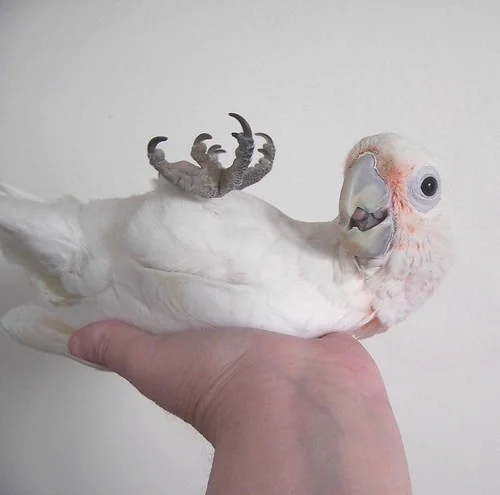
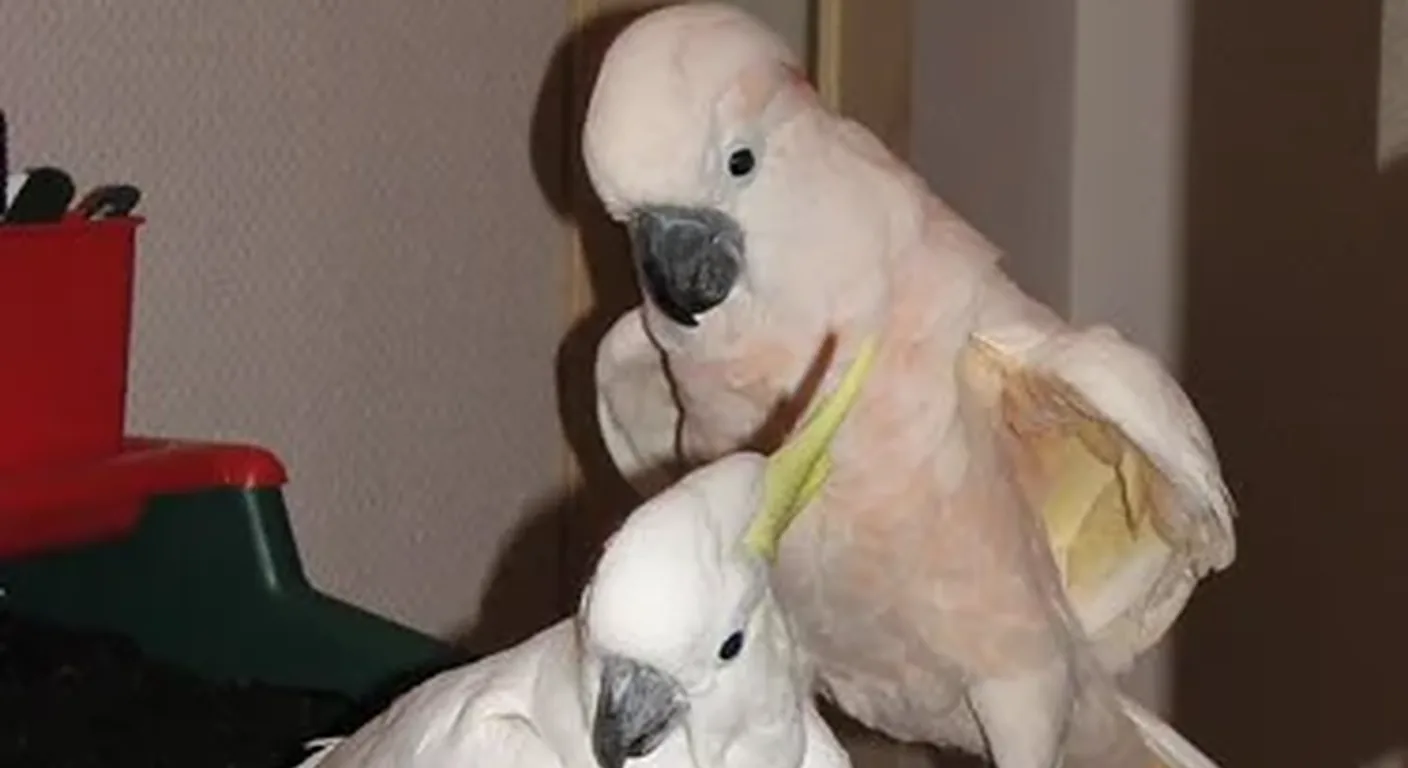
Cockatoos are the white (and pink, and salmon) crested parrots of Australasia, and living with one is a different proposition from living with a Grey. Where the Grey leads with its mind, a cockatoo leads with its heart — enormous affection, enormous volume, and an emotional dependency that makes them the most rewarding and most surrendered parrots in the trade at the same time. The pet-kept species range from the pocket-sized Goffin's to the enormous Moluccan, and we'll take each by name further down. First, the traits they share.
Why Are Cockatoos Called "Velcro Birds"?
Because they attach. A well-bonded cockatoo wants physical contact for hours — on your shoulder, under your chin, tucked into your neck — in a way no African Grey ever asks for. For the right owner that constant cuddling is the entire appeal, the thing a reserved Grey will never give. The catch is that the need is not optional: a cockatoo denied contact doesn't become independent, it becomes distressed. Buy the cuddle and you buy the obligation behind it.
How Loud and Demanding Is a Cockatoo?
Loud enough to reset the whole comparison. A cockatoo's contact call is instinctive and can run for long stretches, and the largest species produce some of the loudest sounds in aviculture — a Moluccan's scream is measured near the top of the companion-bird chart. Forum owners are blunt about the workload: on Avian Avenue ↗ a keeper of both put cockatoos at "seven times more work" than a Grey. That gap is the single biggest reason we point apartment buyers toward the Grey.
Why Do So Many Cockatoos Get Surrendered?
The volume and the neediness together. When a cockatoo's emotional needs outrun what a household can give, the results are screaming, biting and self-mutilation — and owners who weren't ready describe, in the words of one r/parrots ↗ thread, "100% insanity for years." Rescues fill with cockatoos for exactly this reason. Greys are surrendered too, usually from boredom-driven plucking, but the cockatoo rehoming pipeline is in a category of its own. Going in clear-eyed is the whole job.
Are Cockatoos Smart? The Contrafreeloading Question
Very — just in a different direction than the Grey. Cockatoos are elite problem-solvers; Goffin's have been filmed spontaneously making and using tools, a feat that rivals the Grey's language résumé. That intelligence is also why an under-stimulated cockatoo self-destructs: a mind built for foraging and manipulation, with nothing to work on, turns on its own feathers.
Enrichment Prevents Plucking — in Both Species
The research backs the practical advice. In Dr. Irene Pepperberg's lab, umbrella cockatoos and African greys both showed "contrafreeloading" — choosing to work for food that was also freely available — because the working itself is enriching. The takeaway for a buyer is identical for both birds: a parrot with real foraging work rarely plucks, and a bored one often does. Neither species is a cage ornament; both are full-time enrichment projects.
Citation: Dr. Irene Pepperberg's contrafreeloading study
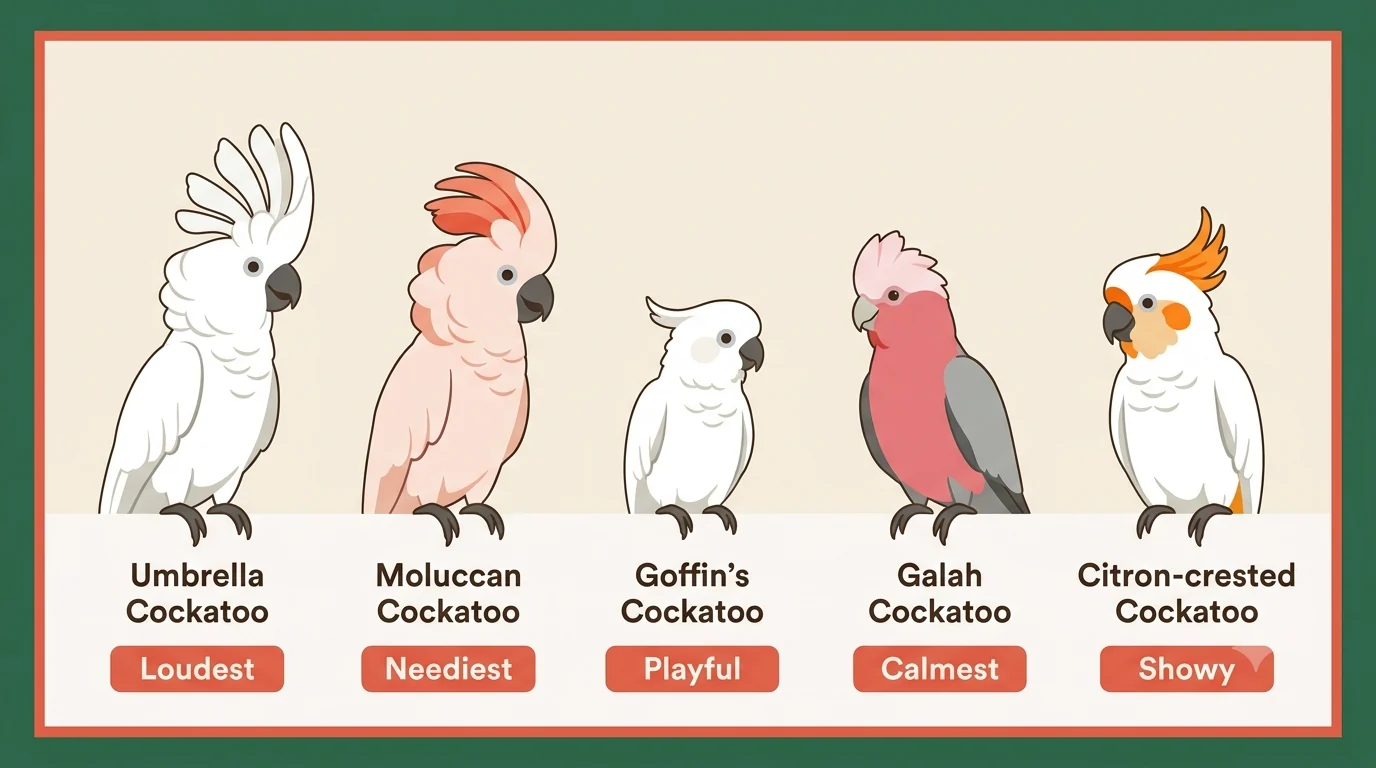
"Cockatoo" isn't one bird. The five species people actually cross-shop against a Grey differ as much from one another as they do from the Grey — in size, volume and temperament. Here's the honest head-to-head for each, using the photos our buyers send us. If you searched a specific matchup like African Grey vs Umbrella cockatoo or African Grey vs Galah, start here.
African Grey vs Umbrella Cockatoo
Cacatua alba · The classic velcro bird
Size18 in · 400–650 g
NoiseVery loud
TalkingA few words
The Umbrella is the cockatoo most people picture: all-white, a broad recurved crest, and an emotional need for contact that reads as devotion and behaves like dependency. Against a Grey the contrast is stark — the Umbrella wants to be on you, the Grey wants to be near you. Umbrellas are also among the most-surrendered parrots in the country precisely because that neediness overwhelms unprepared owners. Want a talker who entertains itself for stretches? The Grey wins on paper. Want a feathered barnacle? No Grey will ever cling like an Umbrella.
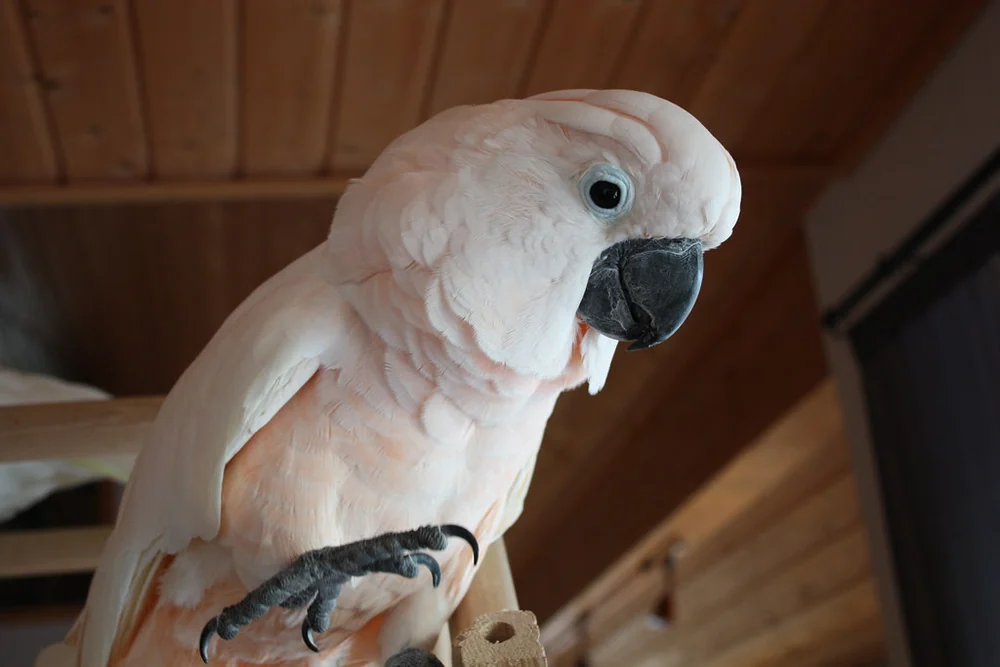
African Grey vs Moluccan Cockatoo
Cacatua moluccensis · Biggest, loudest, most demanding
Size20 in · 640–1,100 g
NoiseAmong the loudest birds alive
TalkingLimited
The salmon-crested Moluccan is the largest white cockatoo and produces a scream ranked among the loudest sounds any companion bird makes — a contact call built to carry over a mile in the wild, and through several walls in an apartment. Beside a Grey's dawn-and-dusk chatter, a Moluccan's volume is a different category of decision. They bond intensely and grieve loudly. We raise Greys, not Moluccans, and we'll say why plainly: the Grey is the apartment-plausible bird here, and the Moluccan is not.
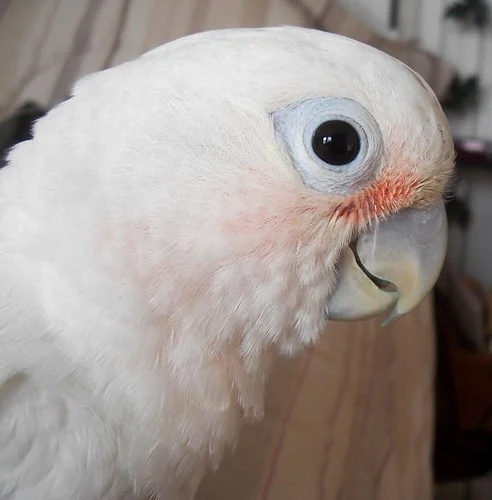
African Grey vs Goffin's Cockatoo
Cacatua goffiniana · The tool-using escape artist
Size12 in · 250–350 g
NoiseLoud for its size
TalkingA few words
The Goffin's is the small, scrappy cockatoo — closest to the Grey in body size and, tellingly, the cockatoo with the best-documented problem-solving mind. Researchers under Alice Auersperg have watched Goffin's spontaneously make and use tools, a cognitive résumé that rivals the Grey's famous vocabulary. The trade is direction: the Grey aims its intelligence at language, the Goffin's aims it at lock-picking, foraging and escape. Both demand relentless enrichment; neither is a starter bird. But a Goffin's out-mischiefs a Grey by a wide margin.
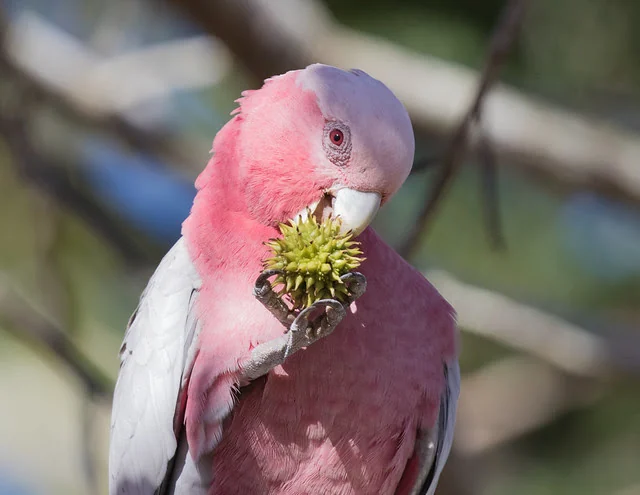
African Grey vs Galah (Rose-Breasted) Cockatoo
Eolophus roseicapilla · The calmest, most balanced cockatoo
Size14 in · 270–350 g
NoiseModerate for a cockatoo
TalkingModest
The pink-and-grey Galah is the cockatoo we'd steer a cockatoo-set buyer toward: calmer than the big whites, quieter, smaller, and famously good-natured — owners describe them as affectionate without the crushing neediness of an Umbrella. Against a Grey the Galah gives up talking clarity and mimicry depth but asks for less emotional bandwidth than its larger cousins. If your heart is set on a cockatoo but your walls are thin, the Galah is the honest compromise. If talking is the dream, it's still the Grey.
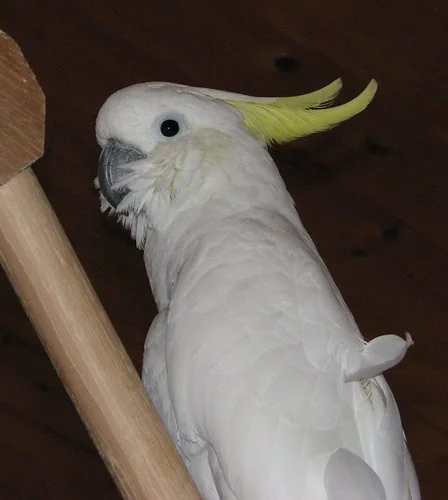
African Grey vs Citron-Crested Cockatoo
Cacatua sulphurea citrinocristata · The rarer sulphur-crested cousin
Size13 in · 350–420 g
NoiseLoud
TalkingLimited
The Citron-crested is a subspecies of the lesser sulphur-crested cockatoo, set apart by its soft orange crest and orange cheek patch — and it stands in here for the sulphur-crested cockatoos generally, which share its loud voice and playful, demanding streak. Critically endangered in the wild, it's a bird for committed, experienced keepers. Beside a Grey the pattern holds one last time: the cockatoo trades the Grey's talking and independence for showmanship and contact-hunger. A Grey narrates your house; a Citron performs in it, at volume.
Across all five, the pattern is the same shape at different volumes: the cockatoo trades the Grey's talking and independence for contact and showmanship. The Galah asks the least of you, the Moluccan the most, and the Grey sits apart from all of them as the one you can hold a conversation with.
Can a Cockatoo Keep Up With a Grey's Vocabulary?
Here's the honest version, and it's not close: the African Grey wins talking outright. Greys command vocabularies of 200 to 1,000-plus words with near-human clarity and — the part that matters — a documented capacity to use words in context. Cockatoos can pick up a few words and phrases, but speech isn't their headline talent. If a bird that genuinely converses is the goal, this chapter ends the comparison.
Does a Bigger Vocabulary Mean the Bird Understands You?
Vocabulary is only half the Grey's edge; comprehension is the other half. Alex, the African Grey studied for thirty years by Dr. Irene Pepperberg, could label colors, shapes and quantities and answer novel questions — evidence of contextual language, not just parroting. That's the ceiling no cockatoo approaches. Our African Grey talking-ability guide walks through what to realistically expect month by month.
Can Cockatoos Talk at All?
Yes — modestly. Most pet cockatoos learn a handful of words, a whistle or two, and the occasional startling phrase, usually in a gravelly, less articulate voice than a Grey's. But nobody buys a cockatoo for its vocabulary; they buy it for the dancing, the affection and the sheer personality. Judging a cockatoo on talking is like judging a Grey on cuddling — you're grading the wrong subject.
Why Individual Birds Beat the Averages
Every rule here has exceptions in feathers. We've weaned quiet Greys that whistle more than they talk, and there are famously chatty cockatoos on the internet. Averages tell you which way to bet, not what your specific bird will do. If talking is non-negotiable, the Grey is the safe bet — but "guaranteed talker" is a promise no honest breeder of either species makes.
Citation: Dr. Pepperberg's Alex studies via Britannica
The species-level claim rests on the record: Encyclopaedia Britannica ↗ calls the African Grey "unsurpassed as a talker," and Pepperberg's three decades with Alex remain the benchmark study of parrot cognition.
Which Is Louder — and Can It Live in an Apartment?
Noise ends more parrot placements than price ever does, so apartment dwellers should read this section twice. Quick answer: the African Grey is far quieter, and the only realistically apartment-compatible bird of the two.
A Grey sits in the moderate band of the parrot noise chart — whistles, talking, appliance mimicry, and predictable dawn and dusk vocal sessions. Cockatoos occupy the top of that chart, and a Moluccan's contact scream is measured among the loudest sounds any companion animal makes, built in the wild to carry over a mile. Through shared apartment walls, that gap isn't a nuance; it's a lease.
Which Cockatoo Is Quietest?
If your heart is set on a cockatoo but you have neighbors, the Galah is the least loud of the common species — smaller, calmer and easier on the walls than an Umbrella or Moluccan. It is still louder than a Grey. There is no silent cockatoo; there is only "less catastrophic," and the Galah is where that road ends.
Powder Down Showdown: Why Both Birds Dust Your Shelves
Neither bird is allergy-safe. This is where we part ways with pages that sell the Grey as the "clean" option: African Greys and cockatoos are both powder-down species, producing a fine feather dust that settles on shelves and, more importantly, stays airborne.
Allergy-Prone Home: Grey Dust or Cockatoo Dust?
Cockatoos produce even more powder than Greys — enough that owners run air purifiers as standard kit — but that's a difference of degree, not kind. Per avian welfare educators ↗, parrots from Africa (greys) and Australasia (cockatoos) are the dustiest groups; South American parrots produce less. So "get a Grey instead" is not an allergy solution.
What Reduces Feather Dust in Either Species
Regular bathing or misting keeps powder down, a HEPA air purifier near the cage clears what goes airborne, and a wipeable surface routine handles the rest. These are the same measures for both birds — the cockatoo just needs them turned up.
Our Allergy Verdict After Years in the Aviary
If bird allergies or asthma run in your household, spend an afternoon around adult birds of either species before you commit, and budget for an air purifier regardless. We'd rather lose a sale than place any bird in a home that can't breathe with it.
Citation: hypersensitivity pneumonitis from a grey parrot
This isn't hypothetical: a peer-reviewed case in the U.S. National Library of Medicine ↗ documents hypersensitivity pneumonitis in an owner, confirmed against their African Grey's feathers. Powder-down dander is a real respiratory variable for both species.
Bite Force & Home Safety
Late-stage buyers ask the question nobody likes to say out loud: how much damage can it do? Both birds can bite hard; the cockatoo can bite much harder.
An African Grey bites at roughly 61–96 newtons — about 70–220 PSI, enough to break skin and, memorably, to snap a wooden popsicle stick. A large cockatoo generates substantially more, with a beak built to crack hard nuts and, if it decides to, a finger. Neither bird bites without reason, and both telegraph it, but the margin for error around children is plainly wider with a Grey.
The Popsicle-Stick Test
Here's the tangible version: a Grey's worst bite lands near the force of snapping a sturdy popsicle stick — it hurts and can draw blood, but it heals. A big cockatoo's bite is in a different tier and warrants genuine supervision around small children and other pets. Respect the beak, read the body language, and neither bird ever has to bite at all.
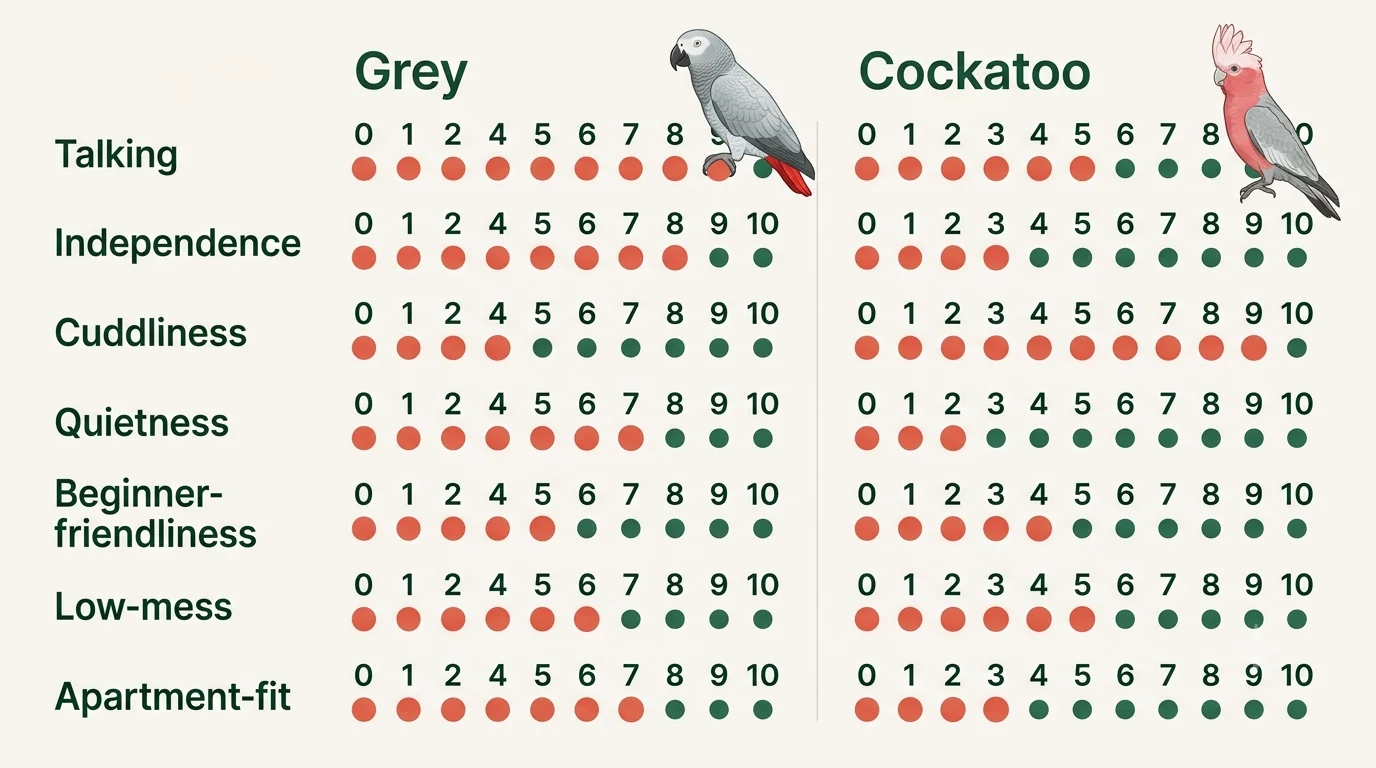
Grey vs Cockatoo Decision Scorecard: Who Wins Each of 7 Traits?
Landed here from a "which parrot is better, African Grey or cockatoo" search? Here's the verdict as numbers. Every score below is our own on a 0-to-10 scale, drawn from raising Greys and trading notes with cockatoo keepers and rescues — judgment calls rather than lab readouts — and we've kept them honest about the columns where the cockatoo comes out ahead.
Trait
African Grey
Cockatoo
Our note
Talking & mimicry
10
4
the Grey's signature
Independent play
8
4
cockatoos need constant contact
Cuddliness / contact
5
10
the cockatoo's signature
Quietness
7
3
cockatoos scream
Beginner-friendliness
5
3
neither is truly easy
Low dander / mess
5
3
both are powder birds
Apartment fit
7
3
the Grey is plausible; big 'toos aren't
Read the pattern, not the totals: the Grey owns talking, independence, quiet and apartment fit; the cockatoo owns cuddliness outright. Neither column is a bad bird — you're choosing between a companion that converses and one that clings.
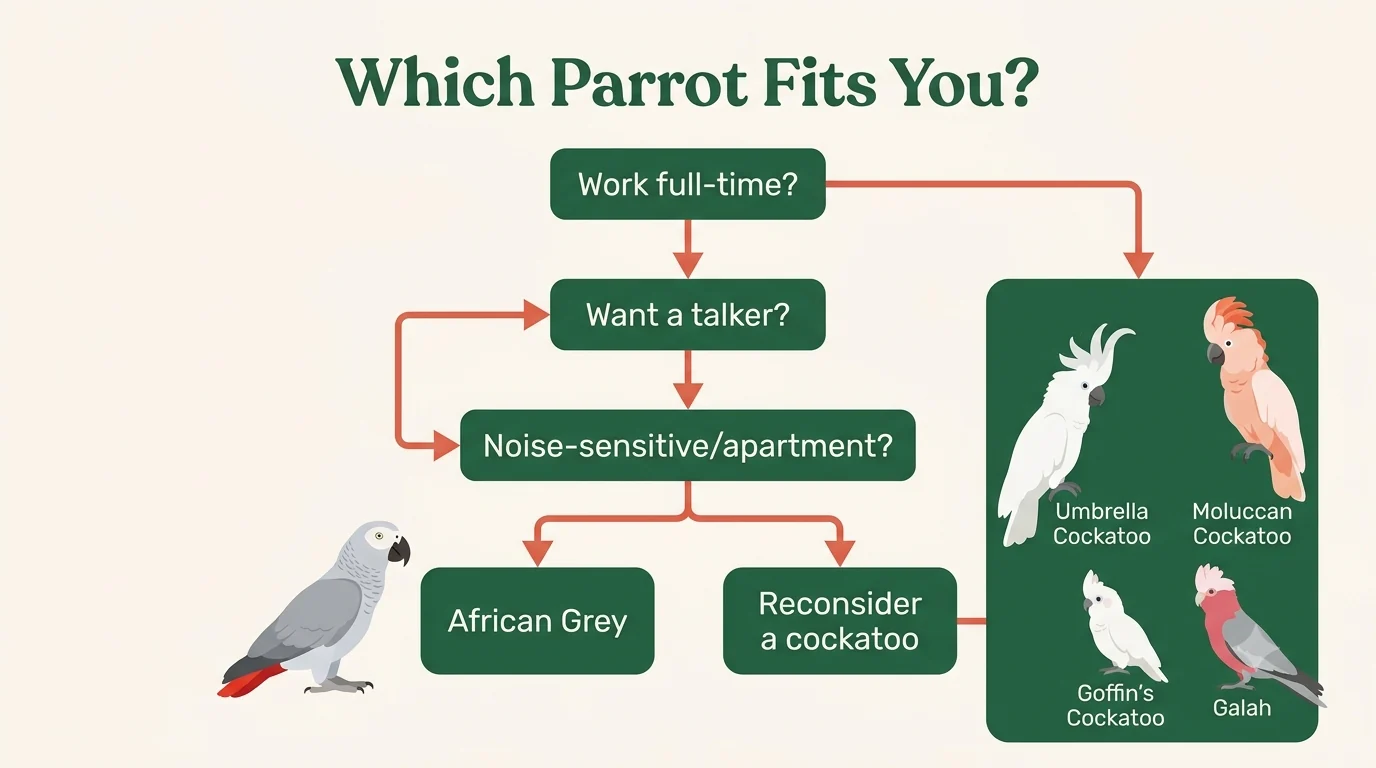
Grey or Cockatoo: Which Belongs in Your Home?
Scores are useful; households are specific. Whether you're after the best parrot for apartment life, a bird that fits a busy family, or a companion for a quiet retirement, the real match turns on who's home, how much noise you can absorb, and whether you'd sooner talk to your bird or hold it. Find your situation below — it's the very rundown we give over email.
Household-by-Household Matchups
Five genuine household types, five straight answers — including the one where the honest reply is "perhaps hold off this year."
First-Time Bird Owners
Lean African Grey, with eyes open. Neither species is a true beginner bird, but a Grey is more forgiving than a large cockatoo, whose volume and neediness overwhelm most first-timers and fill rescues. If a cockatoo is the dream, start with a smaller Galah and heavy research.
Families With Young Kids
Lean African Grey, on bite force and noise. A big cockatoo's beak and volume are a lot for a house with young children, and its one-person intensity can leave the kids out. Either bird needs supervised distance from toddlers — this is a decades-long commitment, not a starter pet.
Apartment and Condo Dwellers
African Grey, clearly — the only one of the two thin walls reliably survive. If a cockatoo is non-negotiable, only a Galah is even in the conversation, and your neighbors still get a vote. Both birds need daily out-of-cage time regardless of square footage.
You Want to Be Cuddled
This is the cockatoo's household. If the dream is a bird that sits on you for hours and craves contact, no Grey will deliver it — choose the species by that honest want, then commit to the noise and neediness that ride along. A Galah or Umbrella, not a Grey.
Busy Professionals With Long Workdays
Think hard, then think again — for either bird. A parrot alone ten hours a day is how plucking starts, and a lonely cockatoo unravels faster than a lonely Grey. If your schedule is genuinely full, this may be the year to wait rather than the year to buy.
Not settled even after all that? That's exactly our job — the form at the foot of this page lands straight with Mark and Teri, and "is it a Grey or a cockatoo for us" is one of our favorite messages to reply to.
A conversation, not a scream
Talker in the nursery
The Parrot You Can Hold a Conversation With
Every Grey we place is hand-raised, DNA-sexed and disease-screened. We'll email the moment the next talking chick can be reserved.
How Do Grey and Cockatoo Price Tags Actually Compare?
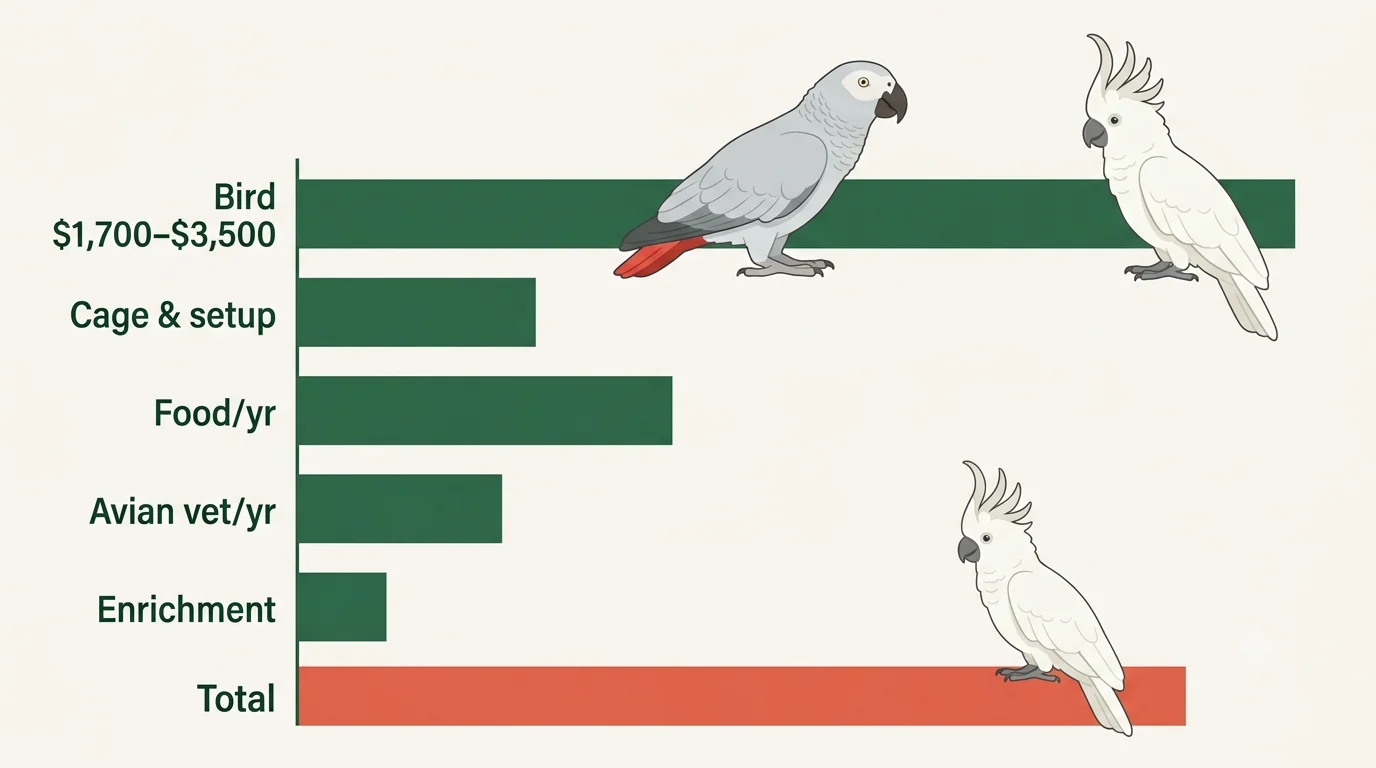
Prices up front, since a page that hides them earns no trust: our documented African Greys run $1,700–$3,500 (Congo) and $1,500–$1,600 (Timneh), and a $200 deposit holds one. Cockatoos span roughly $1,000–$4,000 by species, Moluccans and Umbrellas at the top with Goffin's and Galahs lower down. The price guide carries our current per-bird pricing, refreshed as clutches wean.
Why Is the Purchase Price the Smallest Bill You'll Pay?
For either species the purchase price is a rounding error against the four to eight decades of food, vet visits, toys and caging still to come. The danger lurks at the bottom of both markets: those $800 "bargain" listings with no CITES papers, no sexing certificate and no vet check are the ones that generate the fraud complaints, and they top the list of ads buyers forward us to vet. A papered bird costs what it does because the paperwork represents genuine labor; a paperless one isn't a bargain, it's a wholly different — and riskier — purchase.
Everything Bundled Into a C.A.Gs Grey's Price
Our price folds in the entire trust stack with nothing itemized on top: captive-bred CITES papers, a DNA sexing certificate, an avian veterinarian's health certificate, a hatch record with the closed band number, and PBFD plus Polyomavirus PCR results. The one extra you'll ever pay is transport — $185 to your airport or $350 to your door.
Year-One Costs Once the Carrier Comes Home
Budget somewhere around $825 to $2,000 in the first year beyond the bird itself: a genuinely large cage ($300–$800, and a cockatoo wants the top of that range), starter perches and toys ($100–$300), that first wellness exam ($75–$200 — the Association of Avian Veterinarians ↗ lists certified avian vets by area), twelve months of good pellets ($200–$400), and rotating enrichment ($150–$300, more if a cockatoo is demolishing it). After year one, plan on roughly $375 to $1,350 annually.
Breeder note: unweaned chicks never leave our aviary
Cheaper unweaned chicks — Grey and cockatoo alike — are all over the internet. We won't sell one at any price: botched hand-feeding, from crop burns to aspiration, kills babies in unpracticed hands, and "wean it yourself and pocket the difference" is the single worst gamble in this hobby. Every bird we place has already been fully weaned, and that's built into what you pay.
Your Grey's First 30 Days, Mapped Out
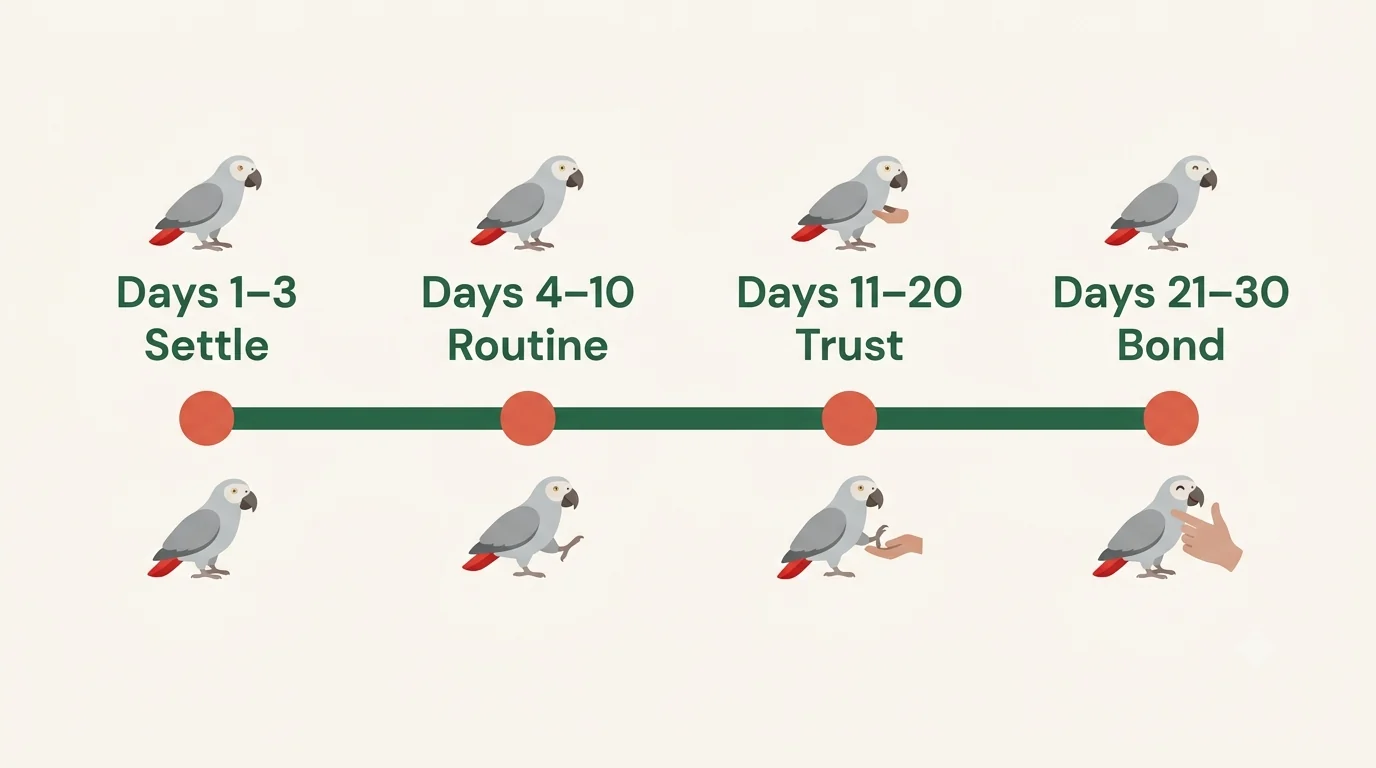
This section is written for the Grey we actually place, though the arc is similar for any large parrot, cockatoo included. Teri talks every new owner through four phases so nothing in the first month arrives as a shock:
Four Phases Every New Grey Works Through
Save this somewhere — it's what separates "my new Grey hates me" from "my Grey is right on track."
1Days 1–3 · Landing
Expect a still, watchful bird that perches low and only eats once the room empties. That quiet caution is a healthy Grey finding its feet, not a sad one.
2Week 1 · Learning the House
Your Grey is mapping the place — who comes and goes, which noises mean what, when meals appear. Hold your routine steady and predictable on purpose.
3Week 2 · Earning Trust
Now the step-ups turn willing, treats are taken softly from your fingers, and you'll catch the first tentative mimics of sounds from your home.
4Weeks 3–4 · Settling In
The real personality surfaces, right about when we phone to check in. Every one of our buyers keeps our direct number through that opening month.
Grey-vs-Cockatoo Myths, Fact-Checked by a Breeder
Every parrot forum repeats the same confident claims about these two birds, and buyers arrive quoting them. Even solid care guides like The Spruce Pets' smartest-birds overview ↗ stick to the verifiable, so here's where the folklore parts ways with real birds.
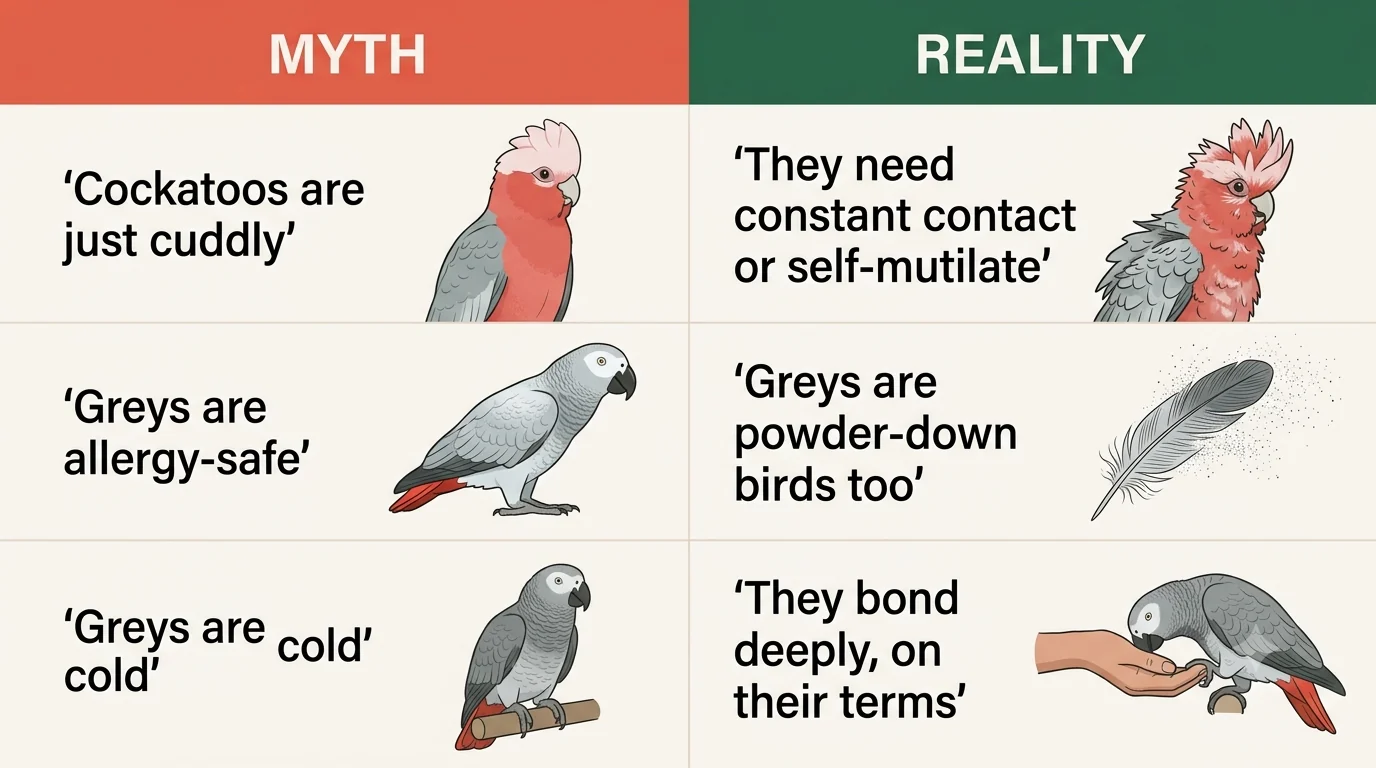
The Myths Buyers Repeat to Us Weekly
A couple of fast ones, then the whopper that earns its own reality check.
Myth
"African Greys are allergy-safe." They aren't — Greys are powder-down birds, and a peer-reviewed case tied an owner's lung disease to one. Cockatoos are dustier still. Both species need real dander management, not a "clean bird" assumption.
Myth
"Cockatoos are just cuddly." The cuddle is real, but it's inseparable from the screaming, the neediness and the plucking when contact stops. A cockatoo's affection comes with a bill attached, and unprepared owners are the ones who fill the rescues.
The Big One: "Greys Are Cold, Cockatoos Are Loving"
The most repeated framing online, and the most misleading.
Two Species, Two Love Languages
A Grey bonds as deeply as any cockatoo — it just shows it through attention, conversation and proximity instead of constant physical contact. "Cold" describes a Grey that's under-socialized or newly moved, not the species. And a cockatoo's affection is inseparable from its demands. Neither is warmer; they love on different terms.
Citation: owner reports across both species
The pattern matches discussions across the large parrot communities (Reddit's r/parrots, the major Facebook groups): Greys interactive but independent, cockatoos affectionate but demanding — trends real, guarantees nonexistent.
Planning for a Bird That May Outlive Its Owner
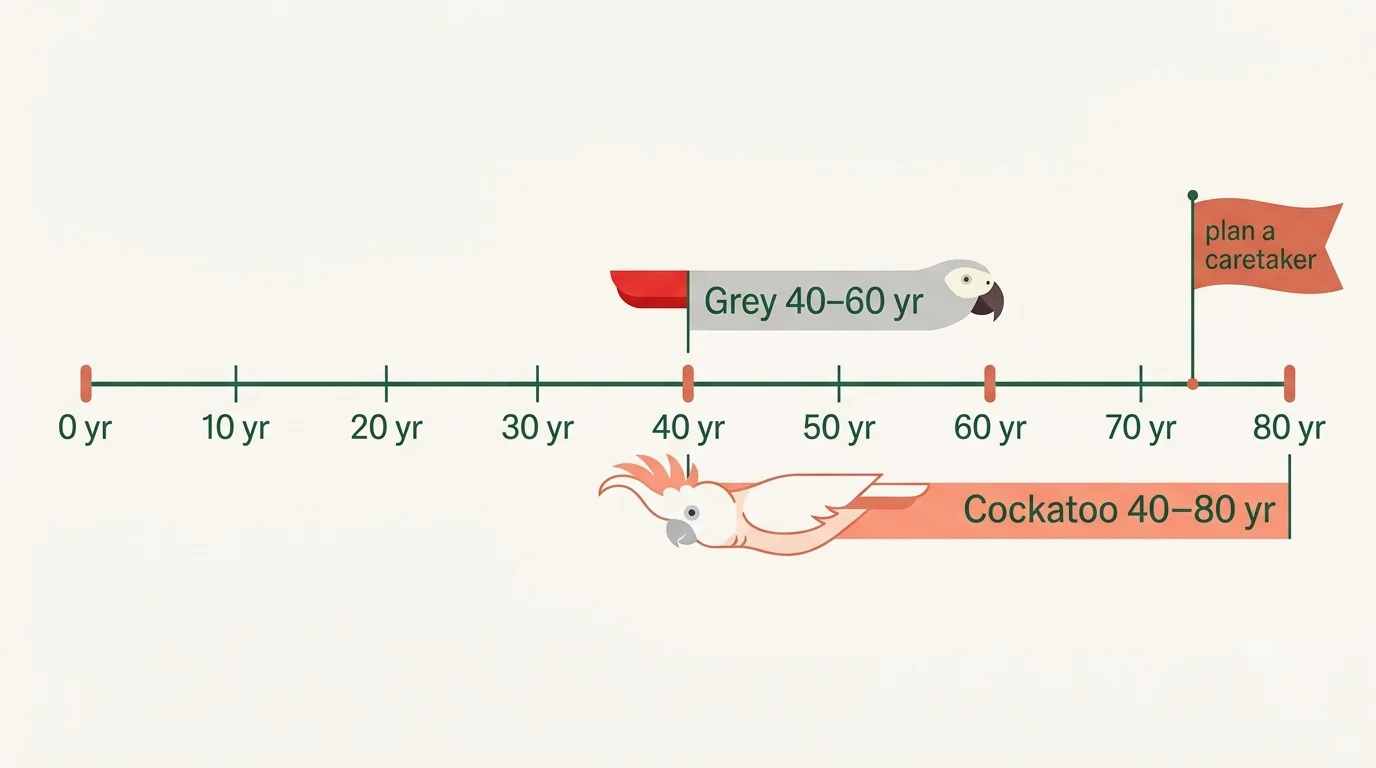
Here's the question almost no comparison page asks, and it outweighs talking or noise: both of these birds can outlive their owners. An African Grey lives 40–60 years; a large cockatoo can reach 80. A bird bought at 40 may still need care when you're pushing 100.
That long life is why rehoming is so common for both species — many large parrots pass through several homes in a lifetime, not from being bad birds but from outlasting jobs, marriages, moves and health. The responsible move either way is a written succession plan: name the person who inherits the bird, make sure they've actually met it, and set aside the paperwork and funds so the handoff isn't a crisis.
Inside a Working Parrot Succession Plan
Three things, in writing: a named caretaker who has agreed and spent real time with the bird; the bird's documents — CITES paperwork, health records, band number — in one folder; and a modest fund or instruction covering vet care and food during the transition. It's the same plan whether you choose a Grey or a cockatoo, and doing it is part of buying a decades-long bird responsibly.
CITES Rules and the Paperwork We Hand You
The African Grey holds the treaty's strictest rank, CITES Appendix I — a listing granted in 2017 once wild trapping had gutted native flocks, a backstory Encyclopaedia Britannica ↗ lays out well. Several cockatoos, the Moluccan and the Citron's parent species among them, carry Appendix-I or II status of their own. None of it outlaws ownership; what it does is make proof of captive-bred origin the entire game.
What Paperwork Comes With Every Grey?
Every Grey leaves with the complete folder: captive-bred CITES papers, a hatch record carrying the closed leg-band number, a DNA sexing certificate and an avian vet's health certificate. Should any seller of any parrot — Grey, cockatoo, whatever — stall when you ask for those four, the stall itself has told you what you need to know.
CITES Appendix I, Translated for Buyers
The Wild Bird Conservation Act, detailed by the U.S. Fish & Wildlife Service ↗, is the wall that keeps trapped Appendix-I parrots out of American homes. Home-bred birds with documentation move between owners legally. And your Grey's leg band was sealed on in the nest — it can't be forced onto a wild-caught adult later, which is why it outweighs any receipt in the box.
What IUCN Status Means for Greys and Cockatoos
In the wild the Congo Grey is rated Endangered and the Timneh Vulnerable; among the cockatoos here, the Moluccan is Vulnerable and the Citron's parent species Critically Endangered. Your captive-bred bird's legality is untouched by any of that — but it's why we treat documentation as ethics rather than marketing. Each papered, home-bred sale is one fewer market reason to pull a bird from the wild.
Citation: CITES appendices and IUCN Red List entries
Sources for the listings above: the CITES appendices database ↗ and the IUCN Red List ↗ entries covering Psittacus erithacus, Psittacus timneh and the cockatoos discussed here.
Every Grey we place ships with its full CITES and health paperwork. Join the list and we'll email you the moment the next documented, hand-raised chick is ready to reserve.
Shipping a Grey Home: the Process and the Guarantees
Tier 1Airport Pickup$185
IATA-compliant live-animal cargo on Delta, United or American to your closest major airport
Tier 2Home Delivery$350
A climate-controlled van brings your Grey to the door with the full document folder in hand
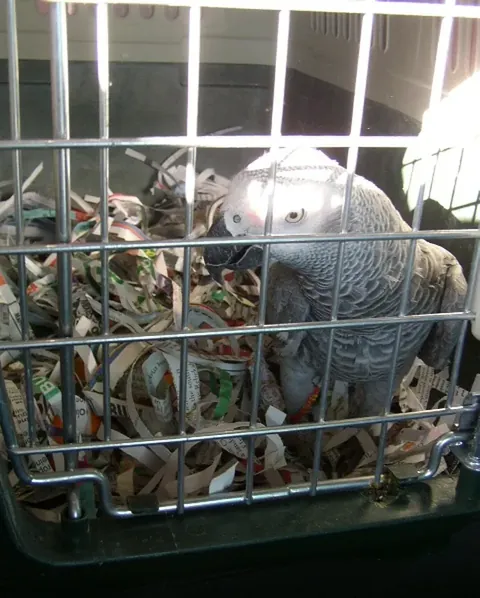
Two delivery tiers, nationwide, whichever Grey you reserve. Every shipment travels with the health certificate and the complete document folder — the same standard we'd want if we were the ones receiving the bird.
The States Our Greys Fly to Most
These seven regions account for a good share of the Greys that leave Midland each season; the complete African Grey shipping process lives on its own page. Every pill below opens that area's availability page:
Our written health guarantee protects your Grey from arrival onward — full terms sit on the health guarantee page. A $200 deposit holds the bird, and the remaining balance is settled before it travels.
Ships nationwide · $185 airport · $350 home
Today's Available Greys, Straight From Our Aviary
If this page has you leaning Grey over cockatoo, these are the chicks and young birds in our nursery today. Tap any card to open that bird's full profile — photos, parents and paperwork included.
Meet EvieShips nationwide · $185 airport · $350 home
Prefer a Bonded Pair or Fertile Eggs?
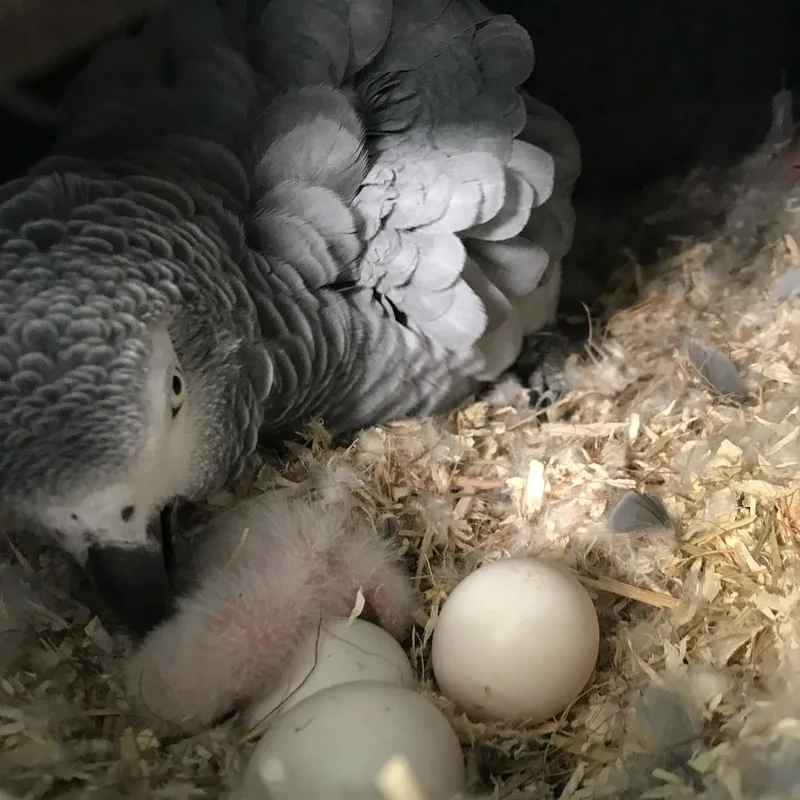
Some buyers arrive wanting more than a single companion chick. Seasoned aviaries ask after our bonded, proven-producing Grey pair, and experienced incubator keepers ask about candled fertile hatching eggs — each has its own page, and each ships with the same documentation stack our companion Greys do.
Bonded Proven-Producer PairFrom $3,000Closed-banded and actively producing — suited to established aviaries rather than first-time homesSee the pair pageShips nationwide · $185 airport · $350 home
Candled Fertile Hatching Eggs$95 eachCandled and incubator-ready before they ship — for seasoned hatchers only; buy five eggs and we cover US shippingView the hatching-eggs page
We've guided a decade of these Grey-or-cockatoo decisions, and the pattern is consistent enough that we'll put our own name to it. The verified buyer reviews — real names, real cities — live on our African Grey reviews page.
"Match the bird to the household — talker or cuddler — and 'I regret this' becomes a sentence our buyers simply never write."
Mark & Teri Benjamin · C.A.Gs, Midland, TX
The buyers who write us afterward were the ones who chose honestly — a Grey for a talker, a cockatoo for a cuddler — rather than by looks alone. Do that, and regret rarely gets a word in.
Your Grey-vs-Cockatoo Questions, Answered
Here are the follow-ups buyers send once the tables and scorecards have done their work — the real inbox questions from people torn between a talking Grey and a cuddling cockatoo. We keep the answers short and honest; the broader African Grey parrot FAQ handles the care, diet and day-to-day ownership topics beyond this matchup.
Do African Greys or cockatoos talk better?
African Greys talk far better. They are widely regarded as the best-talking parrots on earth, with vocabularies of 200 to 1,000-plus words and near-human clarity, and they use language in context — the trait that made Alex the Grey famous. Cockatoos can learn a handful of words and phrases but are prized for personality and cuddling, not speech. If a talking bird is the goal, the Grey wins this comparison outright.
Are cockatoos more affectionate than African Greys?
Cockatoos are more physically affectionate — they are 'velcro birds' that crave near-constant contact and will sit on you for hours. African Greys bond just as deeply but express it with proximity and interaction rather than cuddling; a Grey wants to be near you, not glued to you. Neither is more loving; they love differently. Choose a cockatoo for contact, a Grey for a more independent companion.
Which is louder, an African Grey or a cockatoo?
Cockatoos are dramatically louder. Large species like the Moluccan produce screams ranked among the loudest of any companion bird, easily carrying through apartment walls. African Greys are moderate — talkers, whistlers and appliance-mimics with predictable dawn and dusk vocal sessions. For thin walls or noise-sensitive households, the Grey is the far safer choice.
Can people with allergies own an African Grey or a cockatoo?
Both are 'powder-down' birds that produce fine feather dust, so neither is allergy-safe — a documented case of hypersensitivity pneumonitis in an owner was traced to an African Grey. Cockatoos produce even more dander than Greys. Anyone with asthma or bird allergies should spend time around adult birds and plan on an air purifier before buying either species.
Which is easier for a first-time owner, an African Grey or a cockatoo?
Neither is a true beginner's bird — both are intelligent, long-lived and demanding. Between the two, a Grey is generally more manageable than a large cockatoo, whose extreme emotional needs and volume overwhelm many owners (cockatoos are among the most-surrendered parrots). A well-researched first-timer can succeed with a Grey; a big cockatoo is better left to experienced keepers.
Which is smarter, an African Grey or a cockatoo?
There is no clean winner. African Greys are the benchmark for language and contextual reasoning, studied for decades by Dr. Irene Pepperberg. Cockatoos — especially Goffin's — are elite problem-solvers that spontaneously make and use tools. In Pepperberg's own contrafreeloading work, greys and cockatoos showed no significant overall difference. The Grey is the better talker; the cockatoo is the better tinkerer.
Which bites harder, an African Grey or a cockatoo?
Large cockatoos bite far harder. An African Grey's bite measures roughly 61 to 96 newtons — enough to snap a wooden popsicle stick and break skin, but manageable. Big cockatoos generate substantially more force and can cause serious injury, which is why they need close supervision around children. Neither should be provoked, but the Grey is the lower-risk bird by bite force.
Can an African Grey and a cockatoo live together?
Only with separate cages, careful supervision and never unsupervised free time together. The size, temperament and beak-strength mismatch makes cohabitation risky, and cockatoos can be pushy. Experienced multi-bird owners keep both successfully, but they manage introductions slowly and never leave them alone together. For most homes, one demanding parrot is already a full-time commitment.
Which lives longer, an African Grey or a cockatoo?
Both are lifetime commitments. African Greys typically live 40 to 60 years with proper diet, UV-B light and avian-vet care; large cockatoos can reach 40 to 80. Either bird may outlive its owner, so a written succession plan — naming who inherits and cares for the bird — is part of responsible ownership for both species.
Why do so many cockatoos end up rehomed?
Extreme emotional needs, high volume and feather-plucking drive it. A cockatoo denied constant attention can scream for hours and mutilate its own feathers, and owners describe the experience as years of intensity they weren't prepared for. African Greys are surrendered too — usually from boredom-driven plucking — but less often. Both species need a buyer who understands the decades-long reality before committing.
African Grey vs Umbrella Cockatoo — which is better?
It depends on the bond you want. The Umbrella is the archetypal velcro cockatoo: intensely affectionate, physically needy, loud, and large. The African Grey is the superior talker, more independent, quieter and more apartment-plausible. Choose the Umbrella for constant cuddling and accept the noise and neediness; choose the Grey for a talking, self-directed companion.
How much does an African Grey cost compared to a cockatoo?
Our documented African Greys run $1,700 to $3,500 (Congo) and $1,500 to $1,600 (Timneh). Cockatoos range roughly $1,000 to $4,000 depending on species, with Moluccans and Umbrellas at the top. On both sides, the price that matters is documentation — CITES paperwork, DNA sexing and disease screening — not the sticker. A cheap, undocumented bird of either species is a different, riskier product.
Is an African Grey or a cockatoo better for an apartment?
The African Grey, clearly. Greys keep to moderate, predictable noise, while large cockatoos produce sustained screams that carry through shared walls and end leases. Both need daily out-of-cage time and enrichment, but only the Grey is realistically apartment-compatible. Among cockatoos, a smaller Galah is the closest to apartment-workable — still louder than a Grey.
More Grey Reading Before You Commit
A parrot is a decades-long decision, so research like one. These three guides carry on past the comparison — how soon a Grey begins to talk, the true lifetime cost behind the sticker price, and whether a Grey belongs in a beginner's home.
Whether this page settled it on talking, noise or temperament, one step comes next either way: describe your household, and we'll tell you straight which Grey suits it — or say "a cockatoo may be your bird" if that's the honest call.