Not a generic checklist — the exact cage we send every C.A.Gs chick home to. Size, zone-by-zone layout, perch variety, toy rotation, food, sleep and the mistakes that quietly cause plucking.
Written by Mark & Teri Benjamin · C.A.Gs African Grey breeders, Midland TX · USDA-licensed since 2014
Building a cage and not sure it's right?
Send us a photo of your setup — we'll tell you what to fix before your Grey comes home.
✓ USDA AWA Licensed✓ CITES Appendix I✓ DNA Sexed✓ Avian Vet Certified✓ Ships Nationwide
On This Page
At a glance
What Does a Complete African Grey Cage Setup Include?
The seven numbers that decide whether a cage works for a Grey — straight from the setup we build for every C.A.Gs chick before it goes home.
Cage width (min → ideal)36" → 48"+ (Congo)
Bar spacing3/4"–1" (7/8"–1" for fledglings)
Perches4–7, varied diameter & texture
Toys6–8 in rotation, swap weekly
Daily out-of-cage4+ hours
Sleep10–12 hours, covered & quiet
Safest material304 stainless steel
Most cage problems trace back to one thing: a cage chosen for the owner's budget instead of the bird's biology. Get the blueprint below right — size, zones, perches, toys, materials and placement — and the cage stops being a trigger for feather plucking and screaming and starts being a home your Grey actually thrives in.
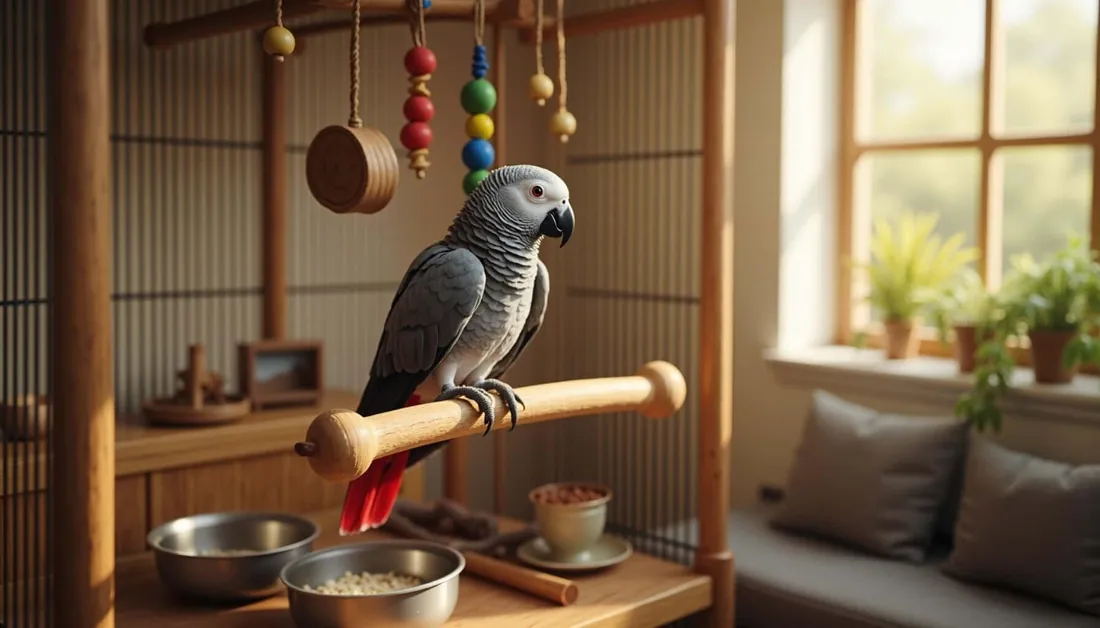
An African Grey relaxed beside a correctly set-up cage — see the size, zone and perch specs below.
What Size Cage Does an African Grey Need?
The short answer, snippet-ready: an African Grey needs a cage at least 36–48 inches wide, 24–36 inches deep, and 48–60 inches tall — and larger is strongly recommended. A Congo needs more room than a Timneh, and in both cases width matters more than height, because Greys move side-to-side far more than they climb.
Setup item
Minimum
Recommended
Ideal
Cage width
36"
48"
60"+
Perches
2
4
5–7
Toys
3
6
Rotation of 6–8
Daily out-of-cage time
2 hr
4 hr
5 hr+
Breeder verdict: Buy the widest cage your room allows — we have never once heard an owner say their Grey's cage was too big.
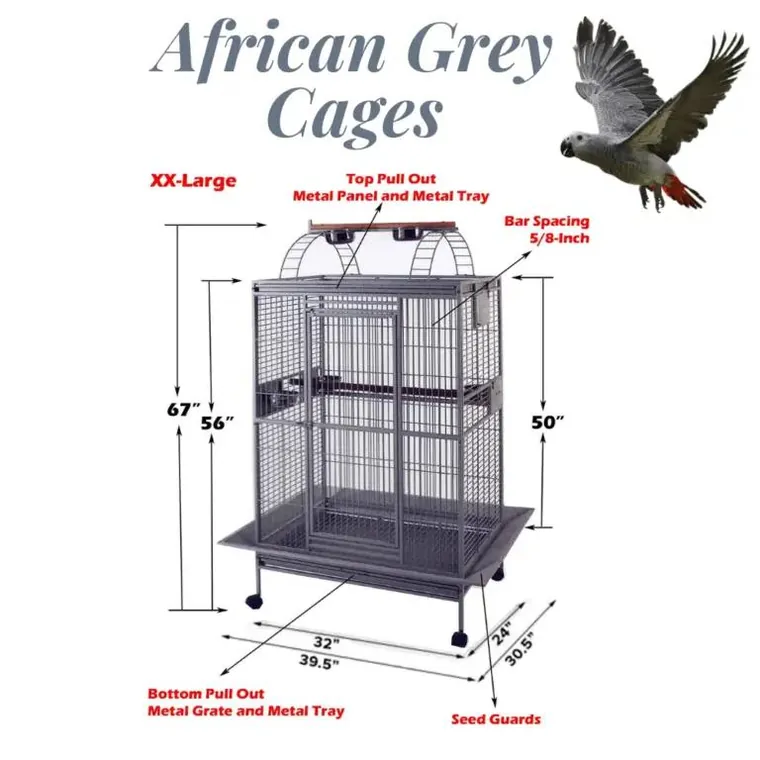
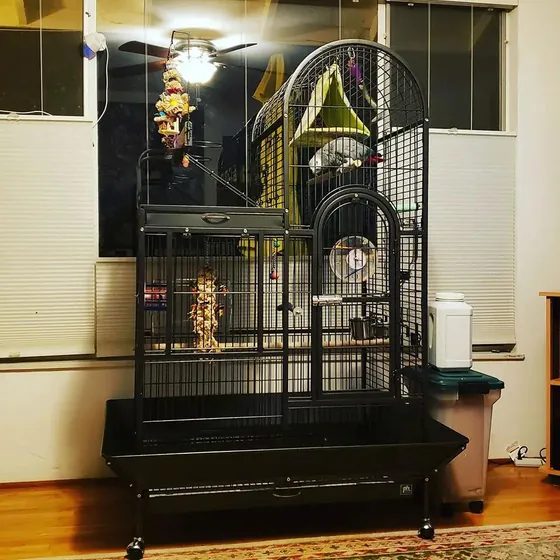
Typical extra-large play-top dimensions — use it as a floor, not a ceiling.
How Big Should a Congo African Grey Cage Be?
Minimum vs Ideal Dimensions
A Congo is a powerful, full-sized parrot. The 36"×24"×48" minimum just clears full wing extension; a 40"×30"×60" cage is the standard we build around in our own aviary.
Why a bigger cage prevents feather plucking
Confinement stress is real — a Grey with no room to flap or forage turns that energy inward, and the chest and leg feathers are the first to go. Space is the cheapest enrichment you will ever buy.
Our aviary flight-space benchmark
Every chick we raise grows up with daily out-of-cage flight time on top of a large enclosure. We tell families to treat the cage as a secure base camp — a few hours of supervised freedom daily does more for behaviour than any single accessory.
What Cage Size Does a Timneh African Grey Need?
How Timneh Sizing & Bar Spacing Differ
Timnehs run smaller, so 30"×20"×40" clears the minimum — though many owners happily size up. The bigger difference is bar spacing.
Subspecies
Minimum size
Bar spacing
Ideal size
Congo African Grey
36" × 24" × 48"
3/4" – 1"
40" × 30" × 60"
Timneh African Grey
30" × 20" × 40"
5/8" – 3/4"
36" × 24" × 48"
Breeder verdict: If your Grey can push its head between the bars, the spacing is unsafe — full stop.
Safe bar spacing, by age and subspecies
Congos: 3/4"–1". Timnehs: 5/8"–3/4". For a just-weaned fledgling we default to 7/8"–1" until it is fully sure-footed — a clumsy young bird is far more likely to catch a wing than a steady adult.
The head-entrapment test
Forget the cage's marketing size class. A "large bird" cage built for macaws often runs 1.25"–1.5" spacing — wide enough for a Grey to slip its head through. Always check the spacing number, never just the size label.
What Size Cage Do Two African Greys Need?
Two Greys don't need double the cage — they need more width and floor space, not a taller tower. For a bonded or companion pair, start around 48"×30"×60" and go wider if you can, and give each bird its own perches, bowls and toys so they never have to compete. Unbonded birds — like our Jins + Jeni pair — especially need room to retreat from each other.
A true breeding pair is a different job entirely: that is a dedicated breeding flight with a nest box and nesting privacy, not the companion play-top cage in this guide. If you are housing a bonded breeding pair, size up again and plan around the pair's flight space rather than a single-bird footprint.
How Should You Lay Out an African Grey Cage?
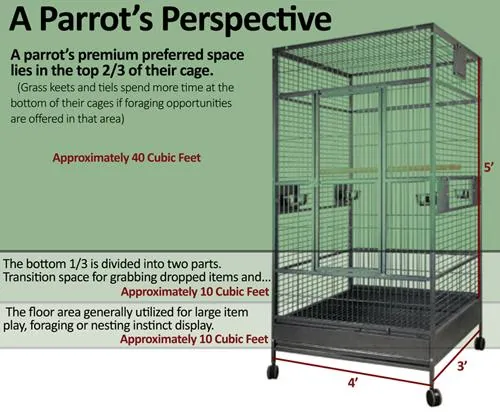
Here is the differentiator almost no competitor teaches: don't fill a cage evenly — zone it. A parrot reads its cage in three layers, and matching each zone to its natural behaviour is what turns a box of bars into a setup your Grey uses all day.
A Grey spends most of its day in the top two-thirds and forages in the bottom third.
What Goes in the Upper Zone — Security & Sleep?
The Sleeping Perch
Birds feel safest up high, so the top of the cage is for resting and sleep. Put the highest, most comfortable perch here — ideally a rope perch that is gentle on joints — and keep this zone calm.
How many hours of sleep an African Grey needs
Greys need 10–12 hours of quiet, dark sleep. Cover the cage or use a dedicated sleep cage in a separate quiet room; chronic sleep deprivation drives the same plucking and biting that owners blame on "attitude."
What Belongs in the Middle Zone — Eating & Interaction?
Food & Water Placement
The middle is the social, working zone — this is where food and water bowls, the main activity perch, and most toys belong, at the bird's eye level where it spends interactive time.
Never place a bowl under a perch
It sounds obvious, yet it is the most common contamination mistake: a bowl directly below a perch collects droppings. Offset bowls horizontally from perches, and use stainless rather than chewable plastic.
What Happens in the Lower Zone — Foraging & Climbing?
Ground-Level Foraging
The bottom third is for foraging and climbing. Scatter foraging toys and a low foraging tray here so your Grey works for treats the way it would in the wild — the single best boredom-buster you can build in.
Which Perches Does an African Grey Cage Need?
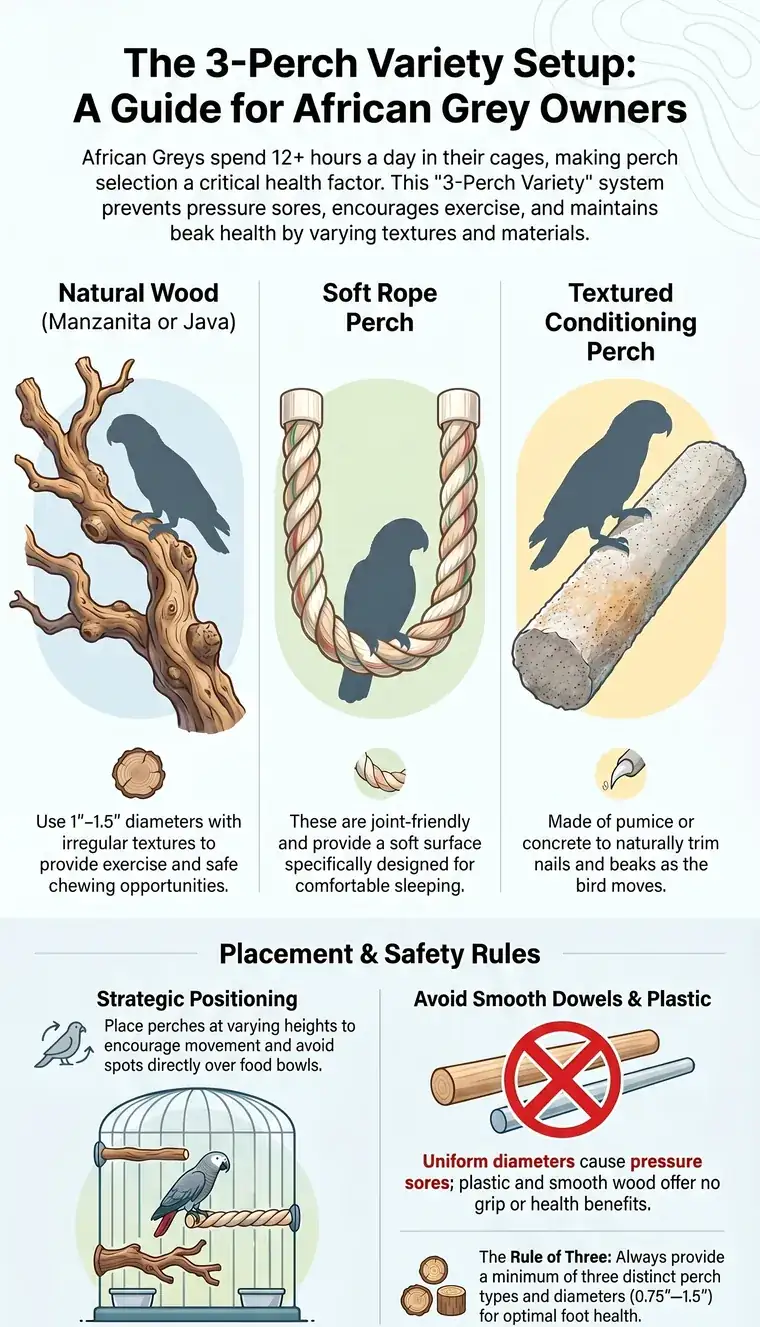
Perches are where your Grey stands every waking hour, so monotony here does real damage. Provide at least three — ideally four to seven across the zones — and deliberately vary diameter and texture.
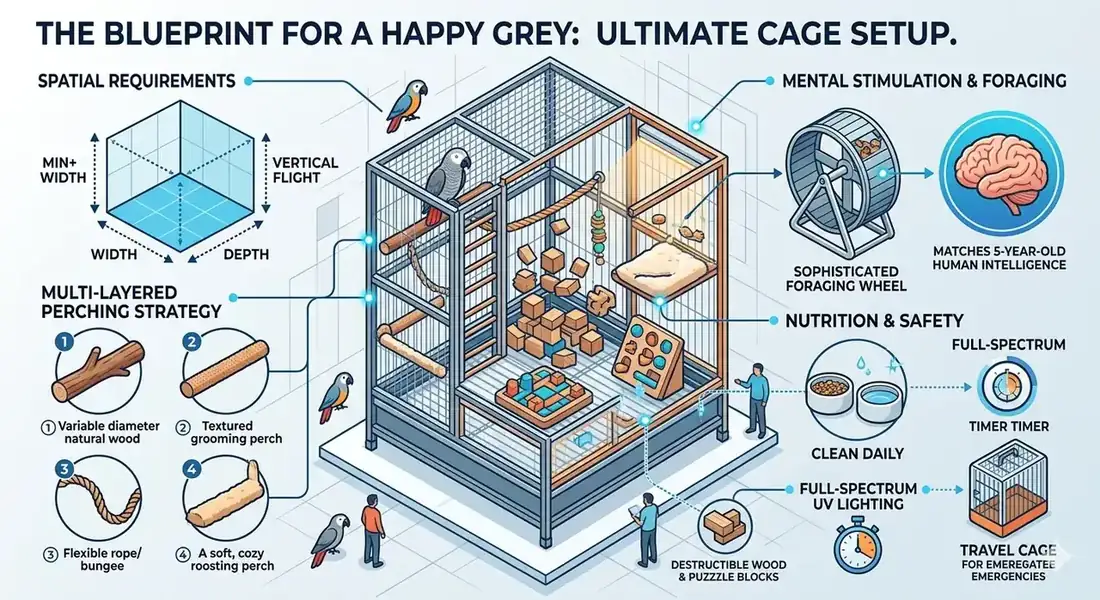
Our 3-perch variety rule at a glance — jump to the perch section below to build it.
Which Perch Types Does a Grey Need — Wood, Rope & Conditioning?
Diameter & Placement Variety
The working trio: a natural-wood perch (1"–1.5", for daytime), a rope perch (softer, for the sleep zone), and a pumice or concrete conditioning perch placed low for nails and beak. Mount them at different heights, and never directly above a bowl.
Why smooth dowels cause pressure sores
The round dowels that ship with most cages are a uniform diameter and slick — the foot grips identically all day, and within months that constant pressure point can ulcerate into bumblefoot. Treat the included dowel as packaging, not a perch.
Manzanita vs java wood — our pick
We favour manzanita for its rock-hard, irregular surface that resists chewing and conditions feet; java wood is a great second choice with more sculptural branching to climb. Both are non-toxic and built to last.
Which Perches Should You Avoid?
Sandpaper Covers & Plastic
Skip sandpaper perch covers entirely — they abrade the foot without ever conditioning nails, and they cause the very sores owners hope to prevent. Plastic perches are slick and offer no enrichment. Wood, rope and natural mineral surfaces only.
What Toys & Enrichment Does an African Grey Need?
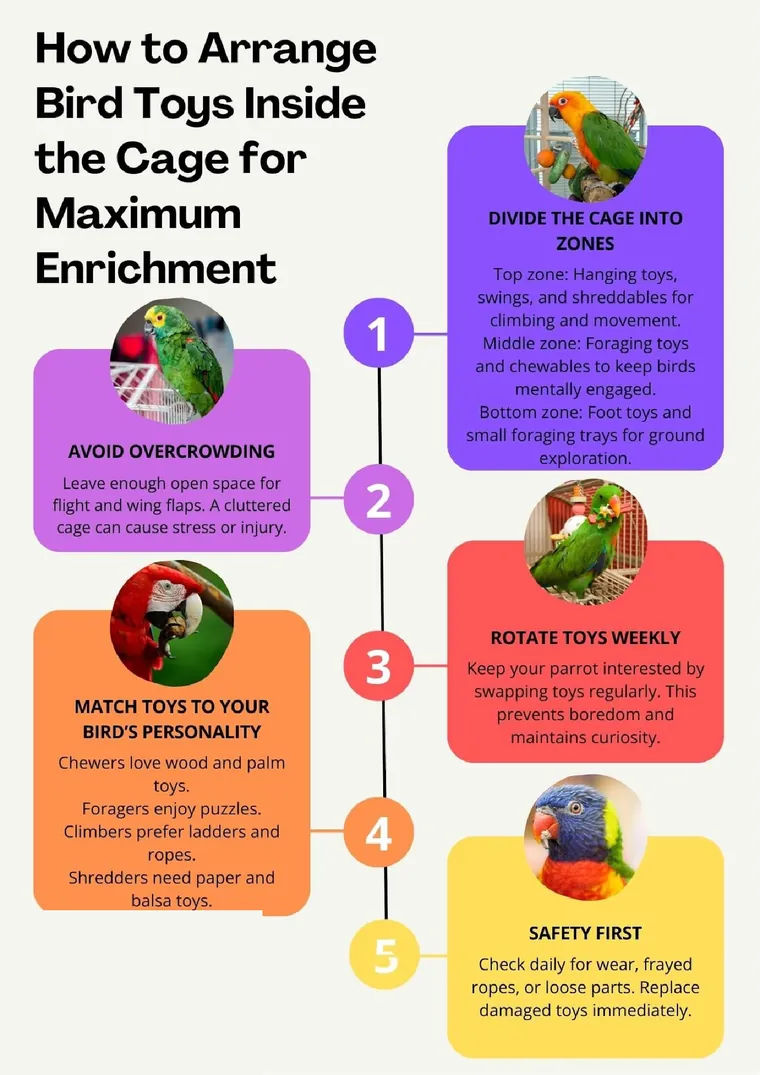
An African Grey has the cognition of a young child. A cage full of toys it has already solved is, to a Grey, an empty cage — and a bored Grey is a plucking, screaming Grey. The fix is not more toys; it is the right mix, zoned and rotated.
Zone, rotate and right-size the toys — the enrichment plan we send home with every C.A.Gs chick.
What Chew Toys Do African Greys Need?
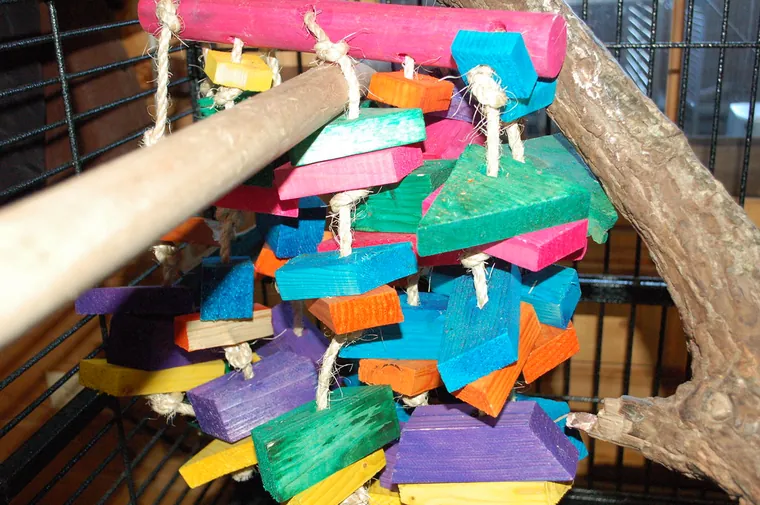
Greys are relentless chewers, so soft-wood blocks, palm and cork toys are non-negotiable — destruction is the point, and a shredded toy is a job well done. Refresh these as they are demolished.
Soft-wood and palm chew toys earn their keep — destruction is the point. More in our care guide.
Why Do Puzzle & Foraging Toys Matter?
Puzzle toys with latches, locks and stacking parts engage a Grey's problem-solving brain, while foraging toys that hide food make the bird work for every bite. As the World Parrot Trust's grey parrot profile ↗ documents, wild Greys spend much of the day foraging across the canopy — so foraging is the most mentally stimulating category of all, and the one that belongs in the lower zone.
How Does a Weekly Toy Rotation Work?
The 2–3 Swap Rule
Here is the tension: Greys are neophobic — they distrust brand-new objects — yet bored of familiar ones within a week. So keep a bin of 6–8 toys and every 5–7 days rotate out 2–3 while leaving 2 trusted toys as anchors.
Foraging, shreddable, puzzle & foot toys
Rotate across all four categories so the whole brain stays engaged: foraging (work for food), shreddable (chewing drive), puzzle (cognition), and small foot toys to manipulate.
Our weekly rotation schedule
In our aviary every bird gets fresh foraging daily and a 2–3 toy swap weekly, with shreddables refreshed as destroyed. New families get this exact schedule written down when a chick goes home.
Which Cage Materials Are Safe for an African Grey?
African Greys chew their bars constantly, so your bird effectively eats a little of the cage every day. As LafeberVet's clinical guide to heavy-metal poisoning in birds ↗ explains, that turns material choice into a toxicology question — and the answer is mostly stainless steel.
Is Stainless or Powder-Coated Steel Safer?
Verifying Lead-Free / Zinc-Free
304-grade stainless is the gold standard — inert, rust-proof, a once-in-a-bird's-life purchase across 40–60 years. Powder-coated steel is acceptable and cheaper, but only if the maker confirms, in writing, that the coating is lead-free and zinc-free.
Metals that can kill your Grey
Galvanized wire (common in hardware-store "flight cages") is zinc-coated — and as a peer-reviewed review of avian toxicoses ↗ documents, zinc and lead account for most companion-bird metal poisonings — while chrome plating flakes over time. Both are dangerous to a species that gnaws metal for fun — avoid them entirely.
Signs of heavy-metal toxicity — and when to call a vet
Sudden appetite loss, regurgitation, unusual thirst, weakness or seizures can all signal zinc or lead poisoning. It moves fast; any combination is an emergency. Contact a board-certified avian vet immediately — the Association of Avian Veterinarians directory ↗ can help you find one — because it is treatable when caught early.
Where Should You Place the Cage?
Placement is the most-ignored part of cage setup and one of the most important. Push the cage against at least one wall so your Grey isn't exposed on all sides, set the top near your eye level, and put it where the action is.
Wall-backed, in a busy room, at eye level — a setup a Grey feels secure in.
Should the Cage Be Near Family Activity?
Greys are intensely social and need to watch daily life. A cage marooned in a spare room breeds the isolation that drives screaming and plucking. The living room or a home office usually wins.
Why Keep the Cage Away From the Kitchen?
PTFE / Teflon Fumes
Never place a cage in or beside the kitchen. Overheated non-stick cookware releases PTFE (Teflon) fumes that the ASPCA's animal poison-control experts ↗ flag as odourless to us and lethal to birds within minutes.
Why Keep the Cage Away From Drafts & Windows?
Light, Sun & UVB
Keep the cage clear of drafty doors, AC and heating vents, and more than a few hours of direct sun (which can overheat a bird with no shade). Natural light is good; baking behind glass is not.
Bird-safe UVB lighting
As the avian team at Arizona Exotic Animal Hospital ↗ note, African Greys are especially prone to vitamin-D deficiency: because window glass filters out UVB, indoor Greys miss the wavelengths they need to make vitamin D3 and use calcium properly. A bird-safe UVB lamp on a timer for a few hours a day supplements that — it does not replace good diet or vet care, but it helps prevent the calcium issues Greys are prone to.
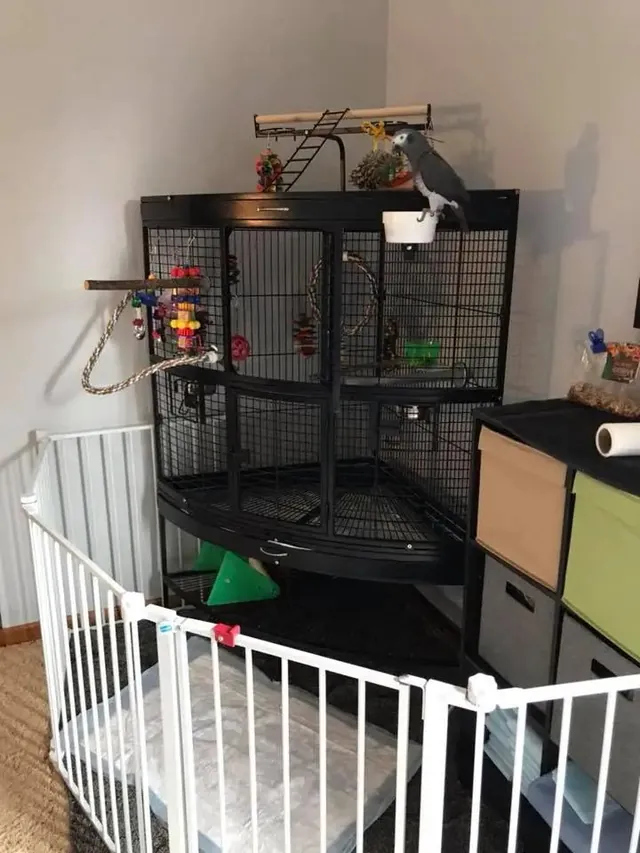
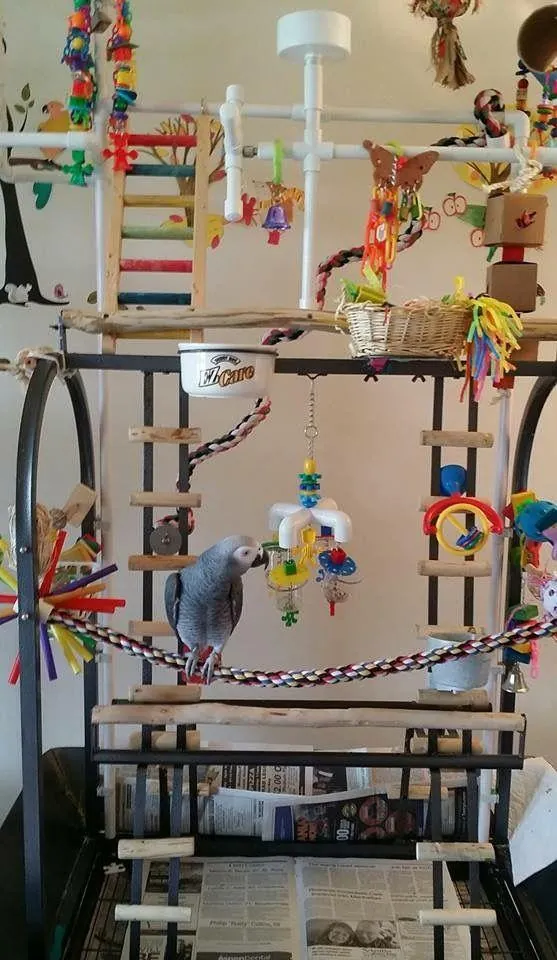
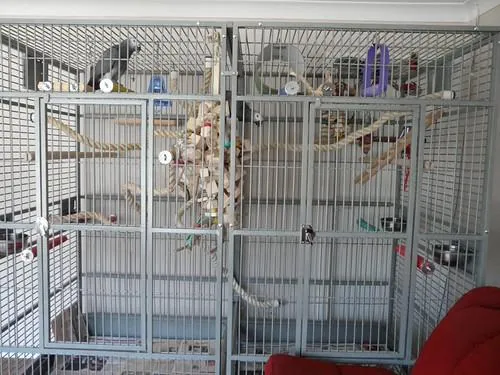
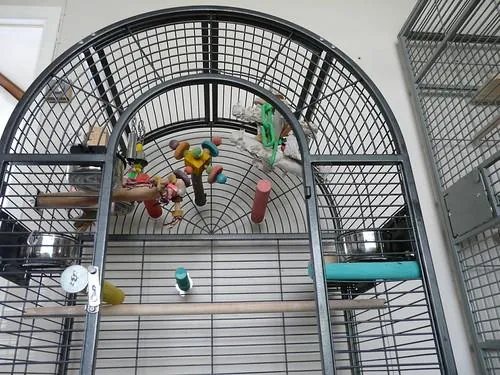
Real African Grey setups
What Are the Most Common African Grey Cage Mistakes?
Most setups fail the same handful of ways. If your build avoids these, you are already ahead of most owners — and most sellers.
Is the Cage Too Small or Round?
Round cages give a bird no corner to feel secure in and waste usable space; undersized cages are the root of confinement stress. Go rectangular, go wide.
Is the Cage Overcrowded With Toys?
A wall-to-wall toy jungle leaves no room to flap and can stress or even injure a bird. Leave open flight space — fewer toys, rotated, beats a crowded cage.
Is Perch Placement the Problem?
Bowls under perches, a single uniform dowel, or every perch crammed at one height — each undoes the zoning you just built. Spread perches across the zones and keep food clear of droppings.
Which cage setup fits your Grey?
Congo + room to spare
Go 40"×30"×60" at 7/8"–1" spacing — the build we send every Congo home to.
Congo + tight space/budget
A 36"×24"×48" play-top at 3/4"–1" is the safe floor — never smaller.
Timneh African Grey
Drop to 30"×20"×40" minimum at 5/8"–3/4" spacing — smaller head, tighter bars.
Just-weaned fledgling
Use 7/8"–1" spacing regardless of subspecies until they fledge fully.
How Do You Set Up an African Grey Cage Step by Step?
What Is Your Day-One Setup Blueprint?
Choose the right cage. Pick a 304-stainless or verified lead/zinc-free cage — Congo 36"×24"×48" minimum (48"+ wide ideal), correct bar spacing.
Add perches by zone. Mount 4–7 perches of varied diameter and material — a sleeping perch up high, activity perches in the middle, a foraging-friendly low perch.
Add toys and a rotation bin. Hang 6–8 toys across foraging, shreddable, puzzle and foot categories; keep spares in a bin and swap 2–3 weekly.
Set food and water stations. Place stainless bowls in the middle zone, never directly beneath a perch, with a separate foraging station lower down.
Place the cage. Against a wall at eye level in a busy family room, away from the kitchen, drafts and direct sun.
What Do You Get From a Real Breeder?
A safe, well-zoned cage is the easy part — the bird that lives in it is what matters. Here at C.A.Gs, every African Grey leaves fully weaned and socialised, with PCR DNA sexing, an avian-vet health certificate, and CITES Appendix I paperwork — all captive-bred in the USA and fully documented. We also walk every family through this exact cage blueprint before pickup.
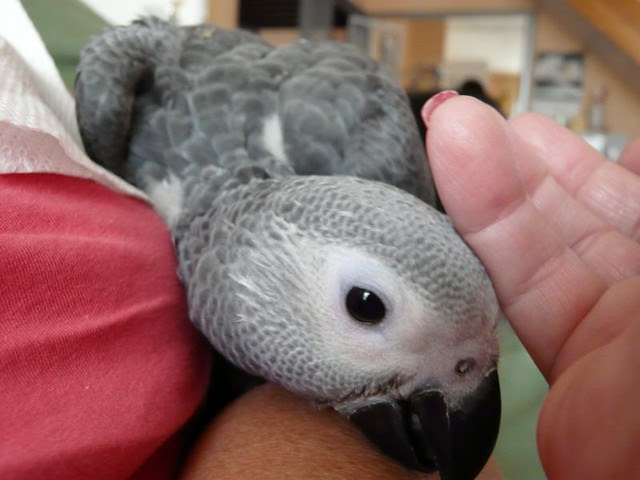
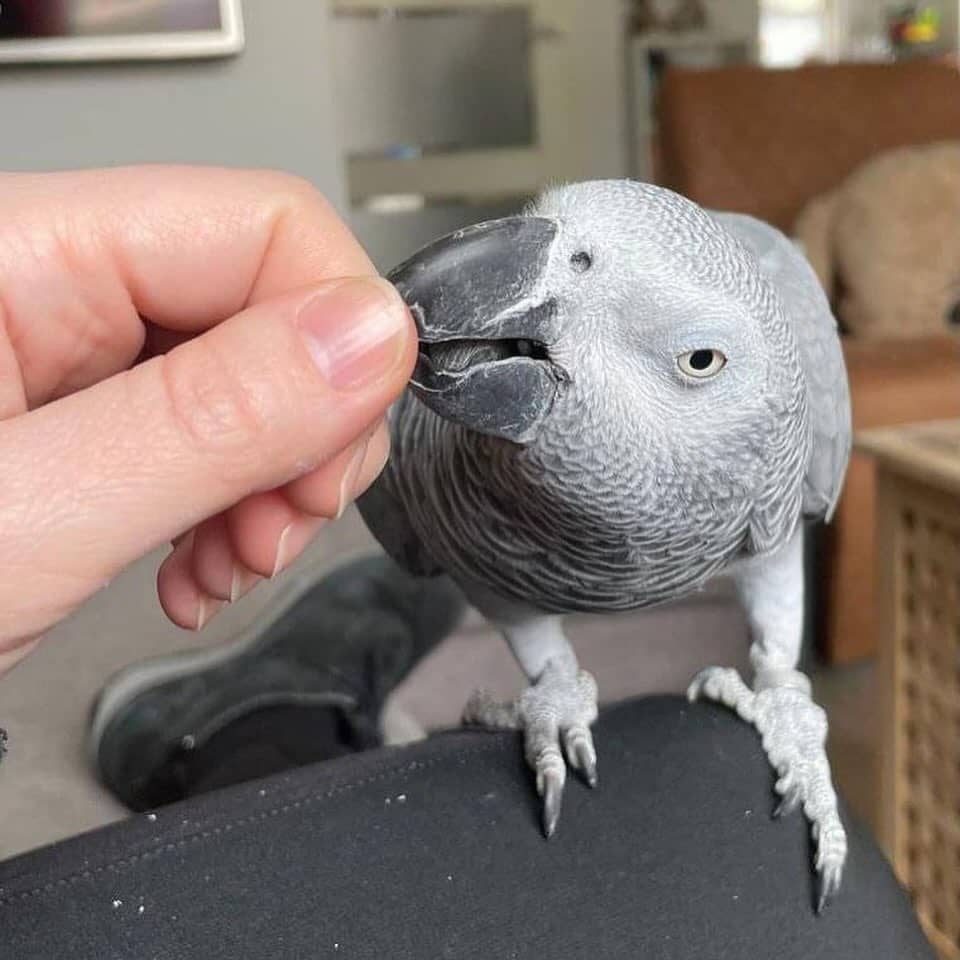
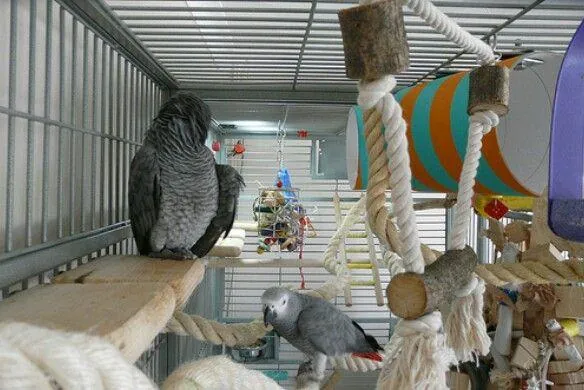
Two of our hand-raised Greys in a finished setup — meet the birds available just below.
Which Greys Are Ready for a Setup Like This?
Every bird below is hand-raised here in Midland and goes home cage-ready — fully weaned, PCR DNA-sexed, vet-checked and CITES-documented. Here's who we have available right now:
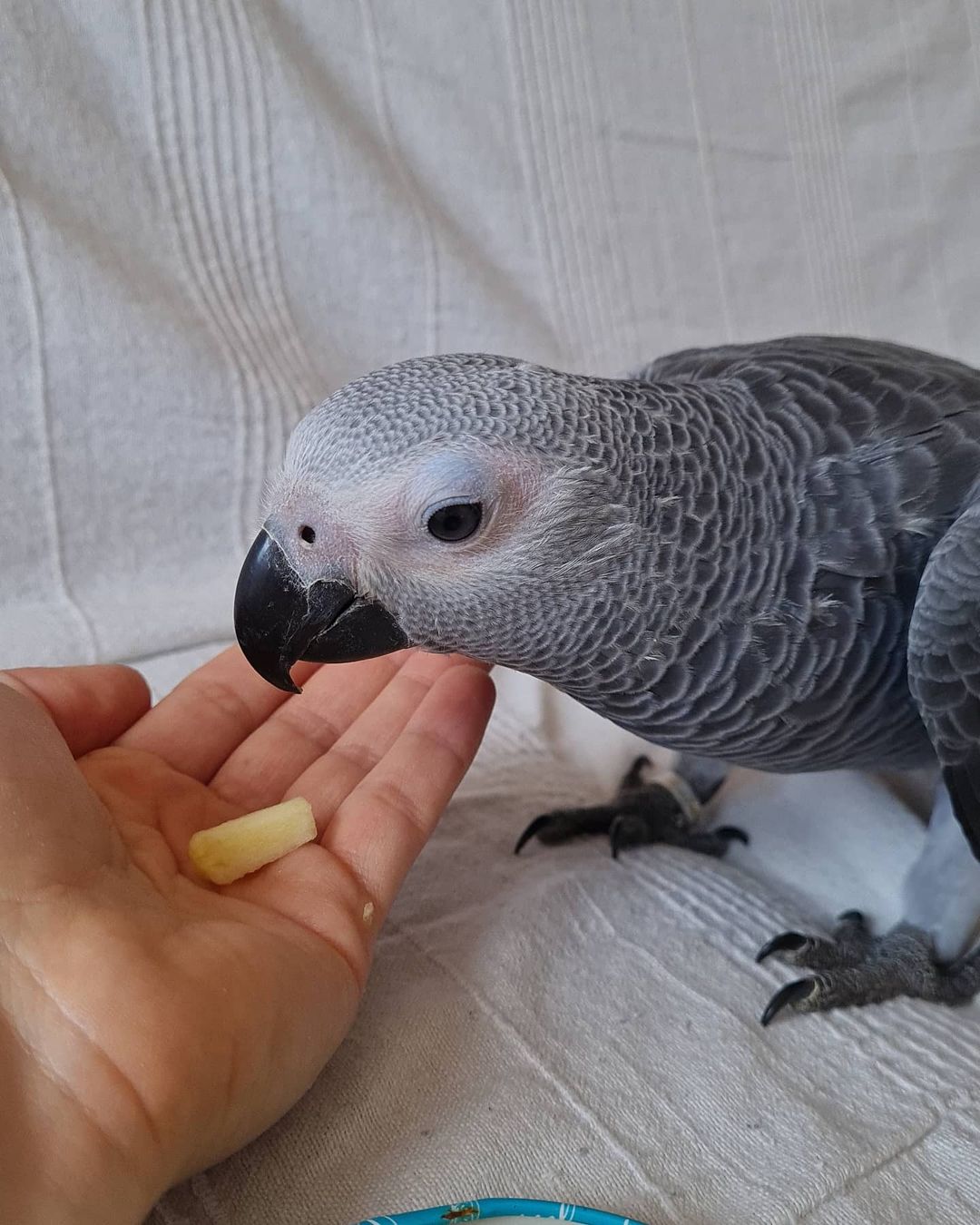
Baby Boy Midland, TX
Roys
Male · 4 mo · Congo African Grey
"Energetic, curious, and impossible to ignore."
Hand-raised male, 4 months old. Thrives in a lively home where there's always something to watch.
A Congo African Grey needs at least 36" wide × 24" deep × 48" tall, and a Timneh at least 30" × 20" × 40" — but wider is genuinely better, and 48"–60" of width is the sweet spot. Bar spacing should be 3/4"–1" for Congos and 5/8"–3/4" for Timnehs. Skip round cages; parrots need corners to feel secure.
Where should an African Grey's cage be placed?
Against a wall, at eye level, in a room the family actually uses — Greys are intensely social and need to watch daily life. Keep the cage well away from the kitchen (PTFE/Teflon fumes are lethal), away from drafts and vents, and out of more than a few hours of direct sun.
How many toys does an African Grey need in its cage?
Hang 4–7 toys at a time across four categories — foraging, shreddable, puzzle, and foot toys — and keep a bin of 6–8 so you can rotate. Swap 2–3 toys every 5–7 days while leaving 2 familiar ones in place, so the cage stays interesting without triggering neophobia.
Do African Greys need UV light?
They benefit from it. African Greys are prone to calcium and vitamin-D issues, and a bird-safe UVB lamp (run on a timer for a few hours daily, never through window glass) helps them synthesise vitamin D3 and use calcium properly. It supplements — it does not replace — a good pellet-based diet and vet care.
Can an African Grey stay in its cage all day?
No. A cage is a secure base, not a full-time home. Greys need at least 4 hours of supervised out-of-cage time daily plus 10–12 hours of quiet, covered sleep. Confining a Grey to its cage around the clock is one of the fastest routes to feather plucking and screaming.
What is the safest bar spacing for an African Grey?
3/4"–1" for adult Congos and 5/8"–3/4" for Timnehs. For just-weaned fledglings we run 7/8"–1": at 3/4" a clumsy young bird can wedge a wing or head. The rule is simple — your Grey should never be able to push its head through the gap.
How big should a cage be for two African Greys?
Two Greys need more width and floor space than one — not a taller cage. For a bonded or companion pair, start around 48" wide × 30" deep × 60" tall and go wider if you can, and give each bird its own perches, food and water bowls and toys so they never have to compete. Unbonded birds especially need the room to retreat from each other.
What size is a good African Grey breeding cage?
A companion cage and a breeding cage are different jobs. The play-top setup in this guide is for a pet Grey; a bonded breeding pair needs a larger flight-style enclosure with a nest box and nesting privacy, sized up beyond the companion minimums. If you are setting up to breed rather than to keep a companion, plan around the pair's flight space and the nest box, not a single-bird footprint.
Can an African Grey live in a 37" L × 22" W × 60" H cage if it's out most of the day?
It is right at the edge. That cage clears our 48" height minimum easily and 37" of length is fine, but 22" of depth is just under the 24" we want for a Congo to turn and stretch comfortably. Plenty of supervised out-of-cage time (4+ hours daily) genuinely helps, but the cage is still where your Grey sleeps and spends the day when you are not home — so we treat 24" depth as the floor, not 22". If you already own it, add that out-of-cage time and prioritise width on your next cage.
New African Grey clutches before they're listed — cage-ready families first.


 Baby Boy Midland, TX